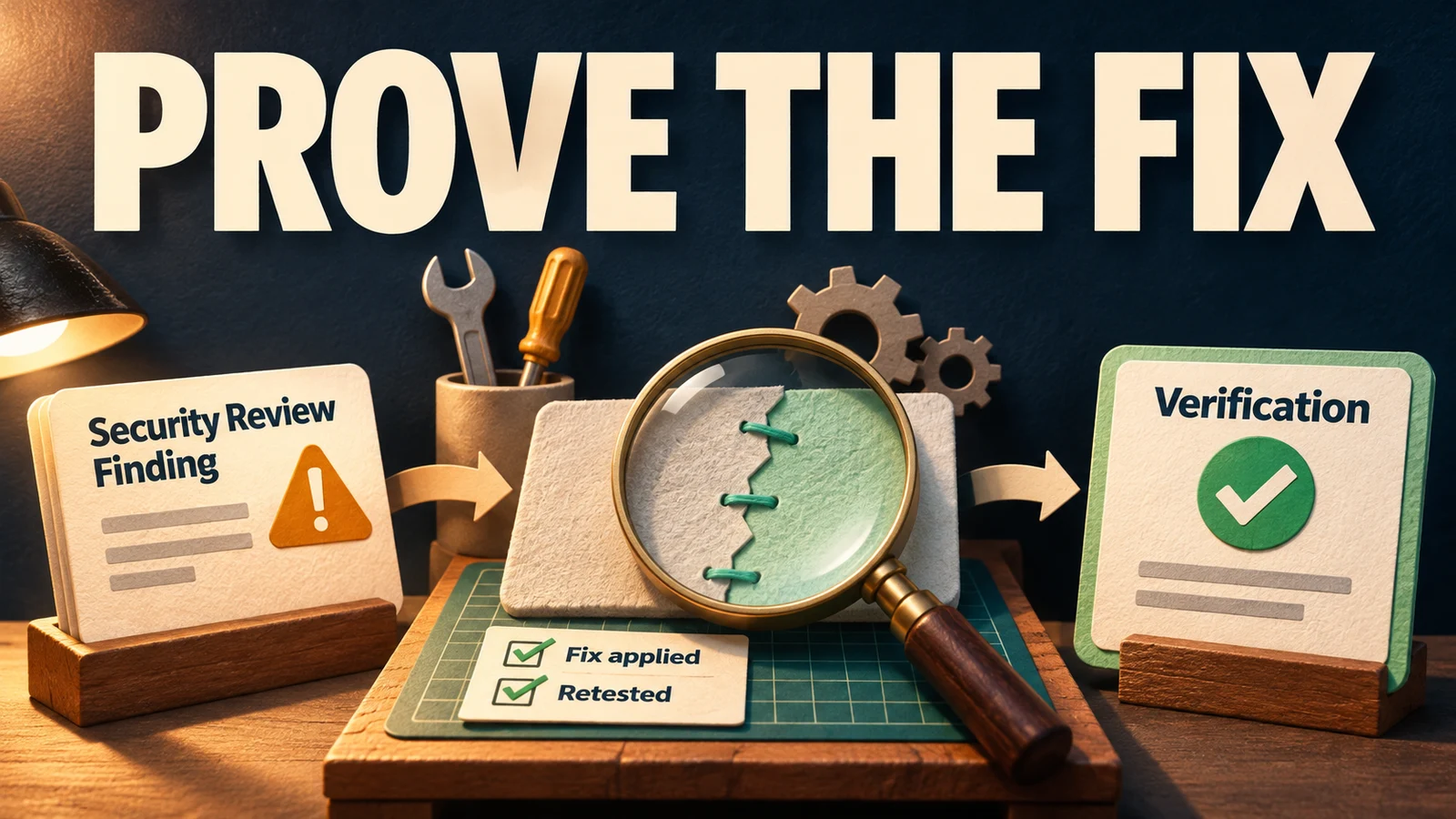
A useful web app security audit should leave you with a defined scope, evidence-backed findings, an ordered remediation plan and a way to verify the fixes. A long vulnerability list is incomplete if your team cannot tell what was tested, which risks matter or how to confirm that a repair reached the running application.
The report is a record of a review under stated conditions. It is not a guarantee that the application is free of vulnerabilities. Buy clarity about what was examined and what happens next, rather than a reassuring badge with an ambiguous meaning.
Agree what the review is meant to establish
A code-quality review, dependency scan, architecture review and application penetration test examine different things. They can complement one another, but the name “security audit” does not automatically include all of them.
Start with the application and business risks. What data does it hold? Who can use it? Which actions move money, change access or expose customer information? Which external services and administrative tools sit inside the proposed review?
Ask the reviewer to explain the intended methods and their limits. A scan of an unauthenticated website cannot establish that two paying customers are properly isolated. A source review without configuration access may leave important questions about the deployed system unresolved.
Write down the scope before testing
Identify the application version, environment, domains, APIs, roles and integrations to be examined. Record exclusions and access limitations. If production testing is included, agree the allowed activity, coordination contacts and steps for handling an unexpected effect.
Test accounts should represent meaningful access boundaries. A product with administrators, staff and customers needs more than one generic login. Include relevant customer or organization separation where the product relies on it.
For example, an illustrative document portal may allow a customer to view invoices while staff can upload files. The review should ask which operations each role can perform, which records belong to which customer, and where those rules are enforced.
Expect a repeatable account of each finding
A finding should identify the affected component, the conditions required, the observed behavior and the security consequence. The technical team needs enough information to reproduce and repair the issue within the authorized environment.
The business summary should translate that into a practical risk. An access-control failure might allow one customer to obtain another customer's document. An exposed credential might grant a defined service capability. The report should distinguish demonstrated behavior from a hypothetical extension of it.
Evidence must be handled responsibly. Use minimal test records, redact sensitive values and restrict the report itself. A review should not distribute real customer data merely to make the finding persuasive.
Use standards to make coverage understandable
OWASP's Application Security Verification Standard provides requirements for application security verification. Its Web Security Testing Guide describes testing approaches. A reviewer can use relevant standards to explain coverage and connect findings to recognized controls.
Ask for the version and scope being referenced. “OWASP tested” is too vague to establish which requirements were examined or how deeply. Some requirements may be outside the agreed assessment, and those omissions should be visible.
Automated tools are useful for repeatable checks, but they do not understand every custom business rule. A clean scan cannot establish that an approval flow, customer boundary or refund operation behaves safely. Those controls need review appropriate to the application.
Prioritize with the business consequence in view
A severity label is useful context, not the entire decision. Review what an attacker would need, what they could reach, whether the affected feature is exposed and what existing controls change the risk.
Keep uncertainty explicit. A reviewer may have demonstrated unauthorized access in a test environment while being unable to inspect the corresponding production configuration. That deserves an action to establish production exposure, not an unsupported claim that customers have already been compromised.
Give each accepted finding an owner, a proposed action and a target for review. Where a permanent fix takes time, describe any temporary mitigation and its limitations. Track residual risk deliberately rather than treating a workaround as silent closure.
Repair the control, then check related paths
Return to the document portal. Suppose the interface hides an invoice link, but the API does not adequately verify record ownership. Hiding another button would leave the underlying problem intact. The repair needs to enforce the intended access boundary where the operation is served.
OWASP's authorization guidance emphasizes permission checks throughout the application. For a finding involving a shared pattern, investigate other operations that use the same approach. One corrected endpoint does not prove that downloads, exports or background jobs are covered.
Add regression checks that would detect the demonstrated failure. Include the intended successful behavior too, so the repair does not simply deny every legitimate user. The objective is correct enforcement, not an application that appears secure because useful actions stopped working.
Make retesting a distinct deliverable
Agree whether the original engagement includes retesting, when it occurs and what evidence the reviewer needs. A development team's statement that a fix is complete is different from an assessment that the control now behaves as intended.
A retest record should identify the finding, repaired version, environment, date and observed result. Useful outcomes include verified fixed, partially fixed, still reproducible and unable to verify. Avoid forcing every issue into a misleading closed status.
When appropriate, verify the running deployment as well as the source change. A merged repair might not yet be released. A configuration fix might apply only to staging. If the reviewer cannot check production, document who will confirm that final step and what evidence they will retain.
Read the unresolved questions before accepting the report
A good review identifies limits honestly: unavailable roles, inaccessible integrations, areas not tested and assumptions that require confirmation. These details tell you what confidence the report can support.
Distinguish “not found” from “not tested.” Similarly, a vendor's existing assurance report does not automatically cover your application's use of that vendor. Your implementation, configuration and permissions still matter.
After remediation, keep the findings connected to future work. Material changes to authentication, permissions, payment flows or dependencies may justify another focused review. Security evidence has a scope and a date; it does not remain comprehensive while the application changes around it.
Ask for an example of the final handover
Before choosing a reviewer, request a sanitized example of their reporting format and ask how developers act on it. Look for clear evidence, explicit limitations and a workable remediation process. The report should be useful to both the owner deciding priorities and the engineer applying a fix.
The purchase is worthwhile when it reduces uncertainty and leads to verified improvements. Scope, evidence, ownership and retesting are the pieces that turn a review from an isolated document into an engineering outcome.
Frequently asked questions
Is a security audit the same as a penetration test?
The terms are used inconsistently. A particular engagement may include penetration testing, source review, configuration review or a combination. Ask for the actual methods, targets and deliverables.
Does a clean automated scan mean the app is secure?
No. Scanners cover particular classes of issues under particular conditions. Custom authorization and business-logic controls may require manual investigation and application-specific tests.
Should the developer who applies a fix verify it?
The developer should test the repair, and independent retesting can provide additional assurance. Agree the level of independence and evidence appropriate to the finding's consequence.
Can we close a finding once the code is merged?
A merge proves a change entered a branch. Confirm the intended repair, relevant deployment and retest result. If production behavior remains unverified, preserve that limitation in the finding's status.