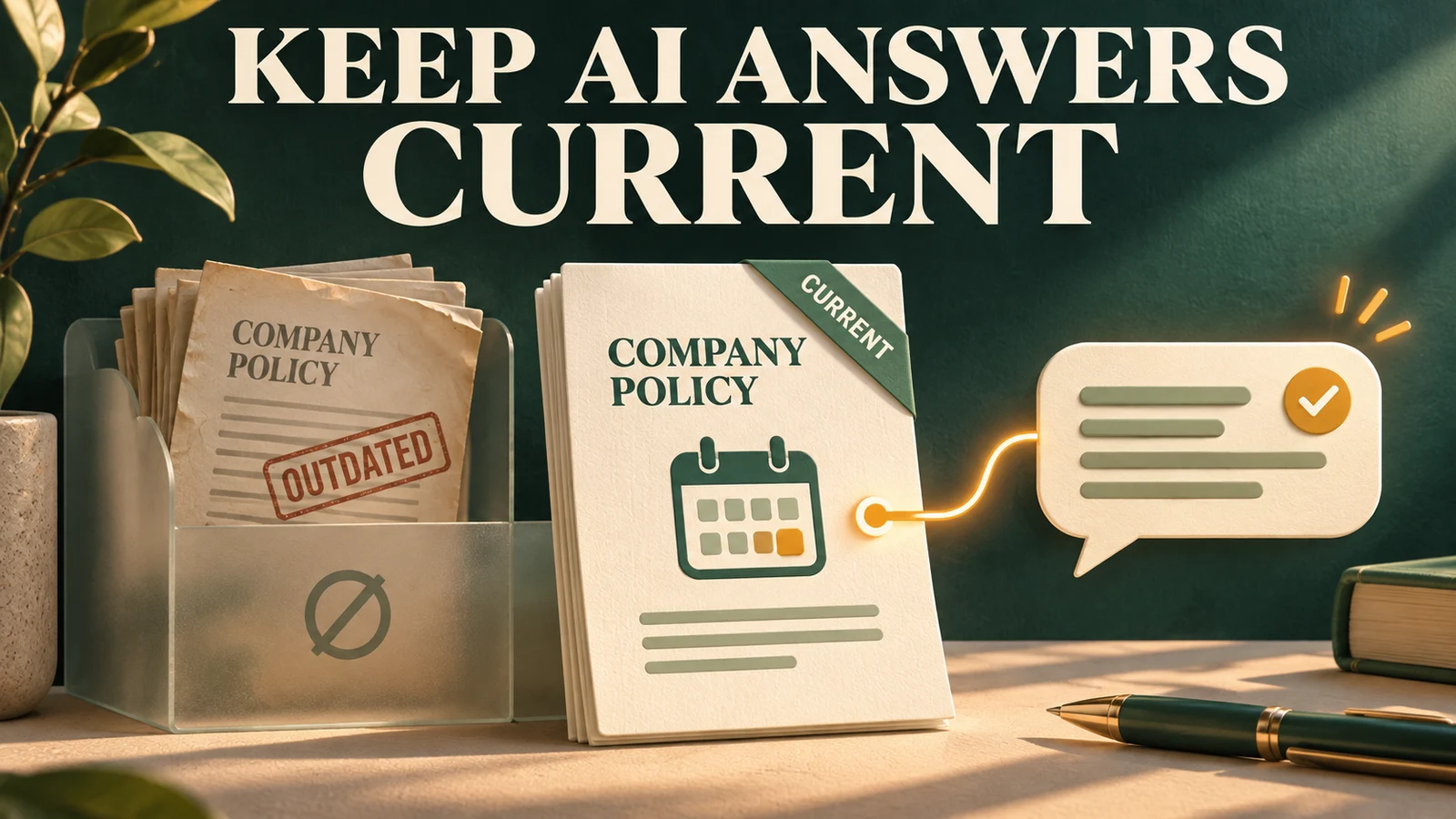
Keeping a company AI assistant current requires a process for publishing, updating and withdrawing the information it uses. Uploading the latest documents once is insufficient. The system must identify the authoritative source, replace superseded material, handle conflicting policies and recognize when it lacks enough evidence to answer.
These controls reduce stale answers; they cannot guarantee that a generative system will never make a mistake. The practical goal is to make incorrect answers less likely, easier to detect and less consequential. That begins with the company's information, before anyone chooses a model.
A correct quotation can still give the wrong answer
Imagine an illustrative company that changes its customer refund policy. The old handbook allows a longer return window. The new policy shortens that window for new purchases while preserving the old terms for existing orders.
An assistant can retrieve the old handbook, quote it accurately and attach a source reference. The answer is grounded in a document, yet wrong for a customer who bought yesterday. Alternatively, it can retrieve the new policy and apply it incorrectly to an earlier purchase.
Document freshness and policy applicability are different questions. A file's upload time does not establish when its contents take effect. Your assistant needs the context that determines which rule applies, including dates, customer groups and exceptions.
Define where an answer is allowed to come from
Make a source register before connecting every shared drive. For each source, record its owner, intended audience, subject, approval state and location. Distinguish a published policy from a draft, an archived policy and a colleague's working notes.
Agree which source wins when documents disagree. For example, an approved service policy may take precedence over an older training presentation. A customer-specific agreement may require a separate lookup rather than being treated as a general rule.
Where the hierarchy cannot resolve a conflict, route the question to a named owner. Asking a language model to improvise a compromise between contradictory policies creates an answer the business never approved.
Separate publication from indexing
Many company assistants use retrieval-augmented generation: they search selected information and provide relevant passages to a model that drafts an answer. This means the operational system includes both the original content and a searchable representation of that content.
A source can be current while the search index still contains an earlier version. A document can disappear from a drive while its extracted text remains searchable. The update process must account for these copies, including any answer caches.
Microsoft's Azure AI Search documentation gives a concrete example of why assumptions are dangerous: detecting changes and detecting deletions require distinct handling in its storage indexing workflows. Other systems have their own behavior. Verify the connector and indexing process actually used by your assistant.
Choose a freshness requirement by consequence
A company history page and an emergency operating procedure should not necessarily share the same update schedule. Define acceptable delay according to how quickly the information changes and what happens if the assistant uses an earlier version.
For ordinary reference material, a scheduled refresh may be adequate. For a policy change with immediate customer consequences, you may need a controlled publication process that confirms the searchable version before the assistant answers affected questions. Live quantities or account-specific facts may require an authorized system lookup instead of document retrieval.
State what should happen during a failed refresh. The assistant might temporarily stop answering a narrow class of questions and refer users to the source owner. Quietly retaining an old answer indefinitely is an operational decision, even if nobody intended to make it.
Carry the conditions with the policy
A policy passage is more useful when its effective date, scope and exceptions remain attached to it. If document extraction separates a rule from the heading that limits it to one region, retrieval can lose the very detail that makes the rule correct.
Review how the system divides documents into searchable passages. Test tables, footnotes, appendices and sections that refer to another policy. A confident answer based on half a table is still a failure.
Source references should help a person inspect the actual supporting material. Include a meaningful title and the relevant section where feasible. A link to a large folder proves little about whether the answer follows from the source.
Test a change from beginning to end
Build a small evaluation set from consequential questions employees already ask. Include questions whose correct answers depend on a date, role or customer category. Have the source owner review the expected answers and identify cases that should be escalated.
- Ask the questions against the initial approved information.
- Publish a controlled policy change and record when it becomes effective.
- Check that the changed material reaches the searchable index.
- Ask the affected questions again, including historical cases.
- Withdraw a test document and verify that it no longer supports new answers.
- Simulate a failed refresh and inspect the fallback behavior.
Inspect retrieval and answer generation separately. Did the assistant fail to find the right document, or did it misinterpret material it had? Microsoft's RAG evaluation guidance makes this distinction between retrieval quality and the generated answer's relationship to its evidence. A single overall score can hide the cause of a failure.
Give users a way to challenge the answer
A useful feedback action should capture the question, the response and the supporting source identifiers without collecting unnecessary private information. Assign someone to review reports and distinguish a content defect from a retrieval defect or a generation error.
Correcting the underlying document may fix one problem but leave previously cached responses intact. Closing the report should include checking the affected path again. Keep enough version information to understand what the assistant saw when it answered.
Feedback is a repair mechanism, not a substitute for preventive testing. Employees should not have to discover every stale policy through a customer complaint.
Make refusal specific and useful
An assistant should be able to explain that it found conflicting policies, cannot confirm which version applies or needs a detail the user has not supplied. It should then identify the next step, such as checking the purchase date or contacting the policy owner.
That behavior is more useful than an unsupported answer delivered fluently. The objective is dependable assistance within a known information boundary. A source owner, a tested update path and a workable escalation route do more for that objective than simply adding more documents.
Frequently asked questions
Will a newer AI model solve outdated answers?
It may interpret the supplied information differently, but it does not automatically repair stale indexes, conflicting policies or missing effective dates. Evaluate the information pipeline and the model separately.
How often should company documents refresh?
Set the interval from the rate of change and consequence of delay. Verify actual refresh completion, including deletion handling, instead of assuming a scheduled job always succeeds.
Does a cited source prove the answer is right?
No. The source may be obsolete, apply to another situation or fail to support the conclusion. Evaluate authority, applicability and whether the answer accurately reflects the relevant passage.
Should the assistant access every company document?
Start with a defined set of approved sources and preserve the user's access boundaries. Additional content is useful only if it improves the intended task without introducing unacceptable conflicts or exposure.