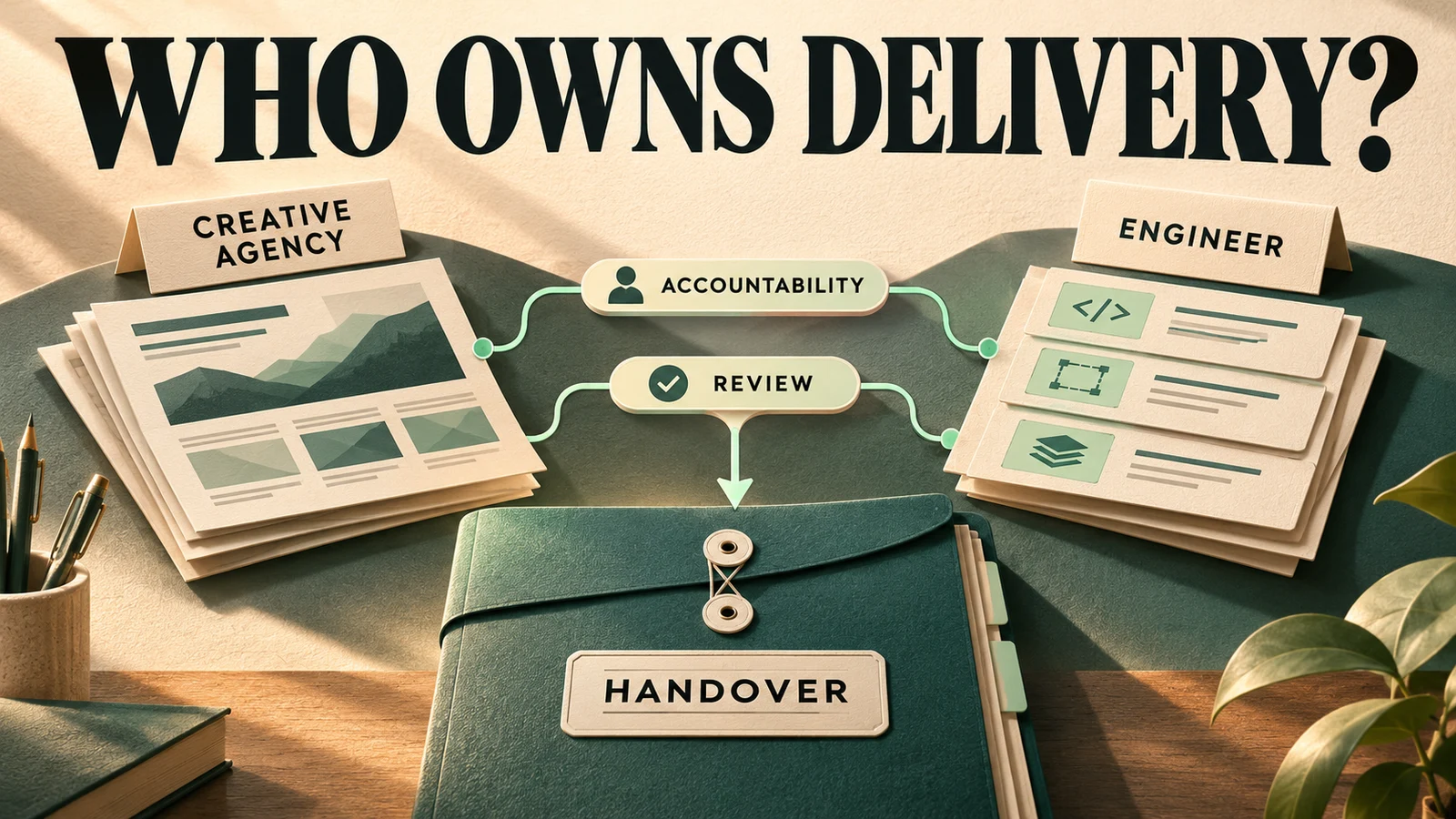
An agency development partnership works best when responsibility is explicit before the project starts. Agree who scopes the work, makes technical decisions, communicates with the client, accepts changes, controls production access and supports the result after delivery.
A capable engineer can still become a poor partner if the operating arrangement leaves these decisions unclear. Evaluate how the relationship handles ordinary work and awkward exceptions, then begin with a bounded assignment that demonstrates the process.
Define what you are buying from the partner
Extra development hours, ownership of a technical workstream and leadership of an entire delivery are different engagements. Describe the outcome and decision authority you expect, rather than relying on a label such as white-label development.
Consider an illustrative design agency building a customer portal for a client. The agency owns the visual design and commercial relationship. Its development partner owns implementation and technical recommendations. That arrangement still needs someone to resolve conflicts between the approved design, security requirements and the agreed budget.
Write down who makes that decision and who explains the consequence to the client. Without an agreed route, the engineer may wait for direction while the agency assumes technical ownership has already been delegated.
Build a responsibility map around decisions
A useful responsibility map names an accountable person for each consequential area. It should also identify who performs the work and who must review it. Keep it short enough that the team will actually use it.
- Scope and assumptions before a quote is presented.
- Architecture, integrations and technical trade-offs.
- Design approval and changes to approved designs.
- Client updates, feedback and acceptance.
- Code review, testing and release readiness.
- Production access, deployment and rollback.
- Defects, maintenance and incident communication.
One person may own several areas, particularly on a small project. The value is removing ambiguity, not adding management layers. Make sure the named person has enough information and authority to do the job.
Review the brief together before promising delivery
Bring the technical partner into scoping before the agency commits to a fixed interpretation of the work. Discuss integrations, data, permissions and existing systems. Identify assumptions that could change effort or timing.
For the portal example, a design might show a simple “approve” button. Implementation depends on who may approve, whether approval can be withdrawn, what changes afterward and which records the client may access. Those are product decisions with technical consequences.
Record open questions separately from confirmed scope. An estimate based on an unverified API capability should say so. Decide who obtains the answer and what happens if the assumption fails before the uncertainty becomes a missed milestone.
Agree how client communication works
Some agencies want all communication to pass through their project manager. Others benefit from technical participation in discovery or demonstrations. Either can work if the boundaries are clear and the client receives consistent information.
Define where questions are recorded, who can make commitments and how decisions return to the delivery team. A technical discussion should not quietly become an approved scope change. Equally, routing every detail through an intermediary can delay work if the intermediary cannot resolve it.
Set an escalation route for material risks. The partner should be able to raise a security concern, an impossible deadline or an unsupported client request without waiting for the next routine status meeting. Agree how the agency will respond and communicate the decision.
Make the work inspectable while it happens
Ask for demonstrations of working increments, relevant code access and a visible list of decisions and risks. A weekly message saying that development is on track provides little evidence if nobody can review the actual result.
Keep project repositories and service accounts under the agreed ownership from the beginning. GitHub, for example, supports repository roles that allow access to be assigned according to responsibilities. Use named accounts and grant the access needed for the work.
Review how changes enter important branches and how release approval operates. GitHub branch protections can require reviews or checks when configured and available for the account. Whatever tooling you use, verify the effective process rather than assuming a setting's name guarantees enforcement.
Separate acceptance from additional work
Agree how the agency and client will judge a milestone. Include the happy path, important exceptions and the environments where the work must function. Tie acceptance to observable behavior.
When feedback arrives, distinguish a defect against the agreed behavior from a new requirement. A missing permission check is different from a newly requested approval role. Both may deserve work, but they have different implications for scope and scheduling.
Use a simple change procedure: describe the request, explain the effect on cost and timing, identify who can approve it, and record the decision. This protects the agency's client relationship by making trade-offs visible before delivery is disrupted.
Treat access and production changes deliberately
Decide who can deploy, who authorizes a production change and who can reverse it. Include environment ownership, secrets, backups and monitoring. Avoid leaving the only recovery route in one person's personal account.
For routine releases, define the evidence required and the approval boundary. For incidents, agree a practical exception process with named contacts. A supplier should know whether they may disable a broken feature immediately or must first reach the agency's owner.
Test the handoff between people as well as systems. If the usual contact is unavailable, someone else should be able to locate the release information and understand the next action without reconstructing a private chat history.
Specify the handover before the final invoice
The handover should include the agreed source, build and deployment instructions, environment inventory, operating notes and known limitations. Clarify the rights and responsibilities for custom code and third-party components in the engagement terms.
Ask a person other than the original implementer to follow the instructions in a suitable environment. A successful demonstration by the author is useful, but it does not prove that another engineer can operate the project independently.
Separate the defect period from ongoing maintenance and new features. Agree response expectations, availability and costs. A project should not end with the agency assuming unlimited support while the partner assumes their responsibility stopped at launch.
Start with an assignment that tests the relationship
A bounded paid engagement can reveal whether the partner scopes carefully, asks useful questions, communicates problems early and delivers work others can review. Choose a task representative of the relationship you intend to build.
Review the operating experience alongside the technical result. Did the partner identify uncertainty? Were decisions recorded? Could the agency explain progress to the client? Could another engineer understand the handover?
A strong partnership gives the agency dependable technical capacity with a clear division of responsibility. The goal is a delivery process the agency can trust and explain, including when the project changes or something goes wrong.
Frequently asked questions
Should a development partner speak directly with our client?
Choose according to the project and relationship. Define who leads communication, who may make commitments and how technical decisions are documented. Direct participation can help when those boundaries are clear.
Who should own the repository and hosting accounts?
Agree ownership with the client and partner before work begins. Use named access, documented administration and a practical handover route. Avoid an arrangement where continuity depends on an individual's personal account.
Is a fixed monthly partnership better than project pricing?
It depends on the predictability and volume of work, required availability and scope. Compare what capacity and responsibilities are actually included, including how urgent work and changes are handled.
How can we evaluate a partner before a large engagement?
Use a bounded paid task with clear acceptance criteria. Assess scoping, communication, code quality, testing and handover, then decide whether the working relationship supports a larger commitment.