A Shopify store needs a custom product configurator when the rules of buying and producing the item cannot be handled well by the store's existing product setup or a suitable app. The strongest reason is a costly operational problem: customers submit combinations you cannot make, staff reconstruct orders manually or the price shown does not match the product being ordered.
A more elaborate product page is not automatically a better investment. First document the choices, constraints, pricing and production handoff. Then choose the simplest solution that supports that complete workflow.
Start with what the customer is actually ordering
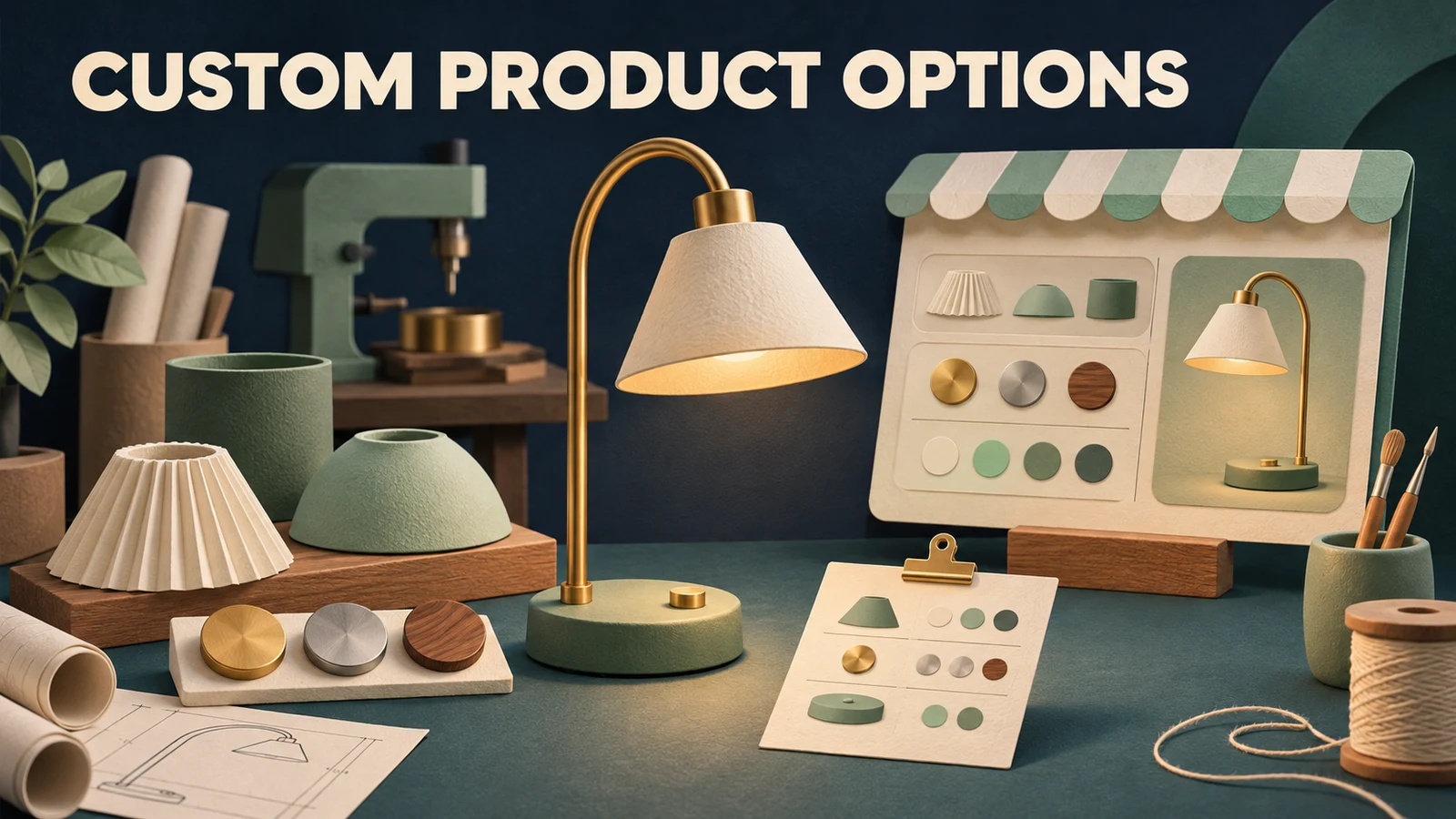
Consider a hypothetical made-to-order lighting business. Customers choose a shade, finish, cable length and mounting type. Some combinations are unavailable. A commercial order may also need a drawing or project reference.
The storefront must help a buyer make a valid choice, explain the resulting price and deliver a specification that production can use. A visually impressive preview solves only part of that problem.
Write down which choices affect the physical item, inventory, shipping, production time or price. Separate those from informational details such as an engraving message or a customer reference. This classification helps determine how the information should be represented in Shopify and any connected systems.
Use actual order examples during discovery. Ask the sales and production teams which missing details cause follow-up emails, delays or remakes. Those examples reveal the rules more reliably than a list of features copied from another storefront.
Compare three practical approaches
Ordinary product variants are a sensible starting point when the choices map cleanly to distinct sellable versions of an item. Keep the product setup understandable to the people who manage stock and orders.
A personalization or product-options app may fit when the store needs extra inputs, conditional fields or a richer selection interface. Evaluate the app against real orders and operational needs, including how it records the chosen configuration.
A custom solution becomes more compelling when the business has distinctive compatibility rules, a specialized pricing process, a production integration or a buying experience that available tools cannot support adequately.
These approaches can be combined. Custom development might extend an existing theme or app rather than replace the whole product system. The decision should follow the gap that remains after a practical trial.
Extra information is different from product pricing
Shopify supports line item properties for attaching custom information to a product in a cart or order. This can be useful for details such as a personalization message or a configuration reference.
Recording an extra field does not, by itself, establish a correct selling price, reserve a component or enforce a manufacturing constraint. Those responsibilities need their own implementation.
Ask a proposed developer to explain where the authoritative price comes from and how it reaches the checkout. A number changed visually by storefront JavaScript is not enough. The charged amount must come from a supported commerce mechanism that agrees with the selected configuration.
The exact implementation depends on the store's plan, APIs, apps and sales channels. Verify current platform capabilities before approving a quote. Avoid accepting a promise of arbitrary checkout behavior without a demonstration on the intended setup.
Represent the rules so someone can maintain them
A configurator often starts with a few simple dependencies. One material permits two finishes. One size requires a different fitting. A later product release can turn those relationships into a substantial rule set.
Decide who owns those rules and where they are maintained. If the operations team must ask a developer to change every available finish, ongoing maintenance may become expensive even when the initial interface is excellent.
Some rules belong in editable product data. Others are sufficiently complex to need application logic and a controlled release process. Make that distinction explicit. The people maintaining the catalog should know which changes are safe to make themselves.
Give configurations a stable reference and record the relevant version of the specification. An order placed last month should remain understandable after today's product rules change. Reconstructing an old order using only the latest live options can produce the wrong result.
Invalid combinations need a clear customer experience
Prevent incompatible choices early, but explain why a choice is unavailable where that explanation helps the customer. Silently resetting previous selections can make a buyer think the product is malfunctioning.
When a choice changes the price or lead time, show the consequence before the customer proceeds. Keep a readable summary of the complete specification, especially on mobile where earlier selections may be off screen.
Inputs need practical validation. A required measurement should have an agreed unit and an acceptable range. A file upload needs appropriate type and size handling. An incomplete input should lead to a useful correction message rather than a mysterious cart error.
For complex or uncertain requirements, a quote request may be the right outcome. Not every made-to-order product should be forced into instant checkout. The design can distinguish standard configurations that are safe to buy from exceptional work that needs a review.
The order must remain usable after checkout
Trace the specification through the cart, checkout, order confirmation, admin view and production handoff. Where another app or integration consumes the order, inspect the information it actually receives.
A screenshot of the product preview may help the customer, but production may need measurements, component identifiers, selected finishes and an approved drawing. Agree which record is authoritative and how staff retrieve it.
Think about access to uploaded files. A production partner may need the approved artwork without gaining access to unrelated customer documents. Keep sensitive files behind appropriate access controls and define retention according to the business need.
Also plan order changes. If a customer changes a measurement after payment, someone must decide whether the price, production instructions or delivery estimate changes. Preserve the original specification and an attributable record of the approved amendment.
Test the entire order lifecycle
Before launch, test beyond selecting options and clicking Add to cart. Use a small set of representative products and awkward combinations, then follow each order through the operations process.
- Two differently configured copies of the same product remain distinguishable.
- The final charged price matches the intended configuration.
- Cart edits and restored carts preserve valid choices.
- Unsupported combinations cannot be purchased through another entry point.
- Required files and measurements reach the people who need them.
- Discounts, quantity changes and shipping behave as agreed.
- Refunds, cancellations and order amendments have workable procedures.
- A normal catalog update does not silently change an existing order's specification.
Test the channels customers actually use. A configuration flow that works on one storefront does not prove equivalent behavior in another channel. Document supported routes and any intentional restrictions.
Make the business case before building custom
Estimate the current cost of the problem using your own records. Include staff time spent clarifying orders, the cost of avoidable remakes and the effort needed to reconcile specifications across systems.
Then compare the full cost of each option: configuration, custom development, app fees, catalog administration, support and future changes. A recurring app fee can be good value if the app does the job and remains easy to operate.
Do not assume a custom interface will increase conversion. More choices and more steps can also increase friction. Define the intended improvement and measure it, such as fewer incomplete orders or less time needed to prepare a production ticket.
For an early product line with limited order volume, a guided quote process may be sufficient. For a mature line with complex rules and repeatable demand, a custom configurator may remove substantial manual work. The point is to match the investment to the operating problem.
What a useful development brief contains
Give the developer a representative product, its valid and invalid configurations, pricing examples, required inputs and sample production instructions. Include the systems that must receive the order and who maintains the rules after launch.
Request a proof of the hardest requirement before committing to the full visual experience. That might be reliable pricing, an unusual compatibility rule or a clean production export. Solving it early reduces the chance of approving an attractive interface that cannot support the sale.
The right configurator connects a customer's choices to a product the business can confidently price, make and deliver. Judge the solution on that complete path.
Frequently asked questions
Do we need a custom app for basic personalization?
Not necessarily. Start by testing the theme's existing capabilities and suitable apps against the information and order workflow you need.
Can a custom field change the checkout price?
A stored field alone is not a pricing mechanism. The implementation must translate relevant choices into supported pricing behavior and verify the final charged amount.
Should every possible configuration be sold online immediately?
No. Configurations requiring engineering review or uncertain pricing can lead to a quote request, while standard combinations remain available for checkout.
What is the most important demonstration before approving development?
A complete representative order with correct pricing and usable production information. A visual preview by itself is insufficient evidence.
Who should maintain product rules after launch?
Name an owner in the business and agree which rules they can edit safely. Complex logic changes may still need developer review and release checks.