
Why Traditional CMSs Have Been Bad at SEO
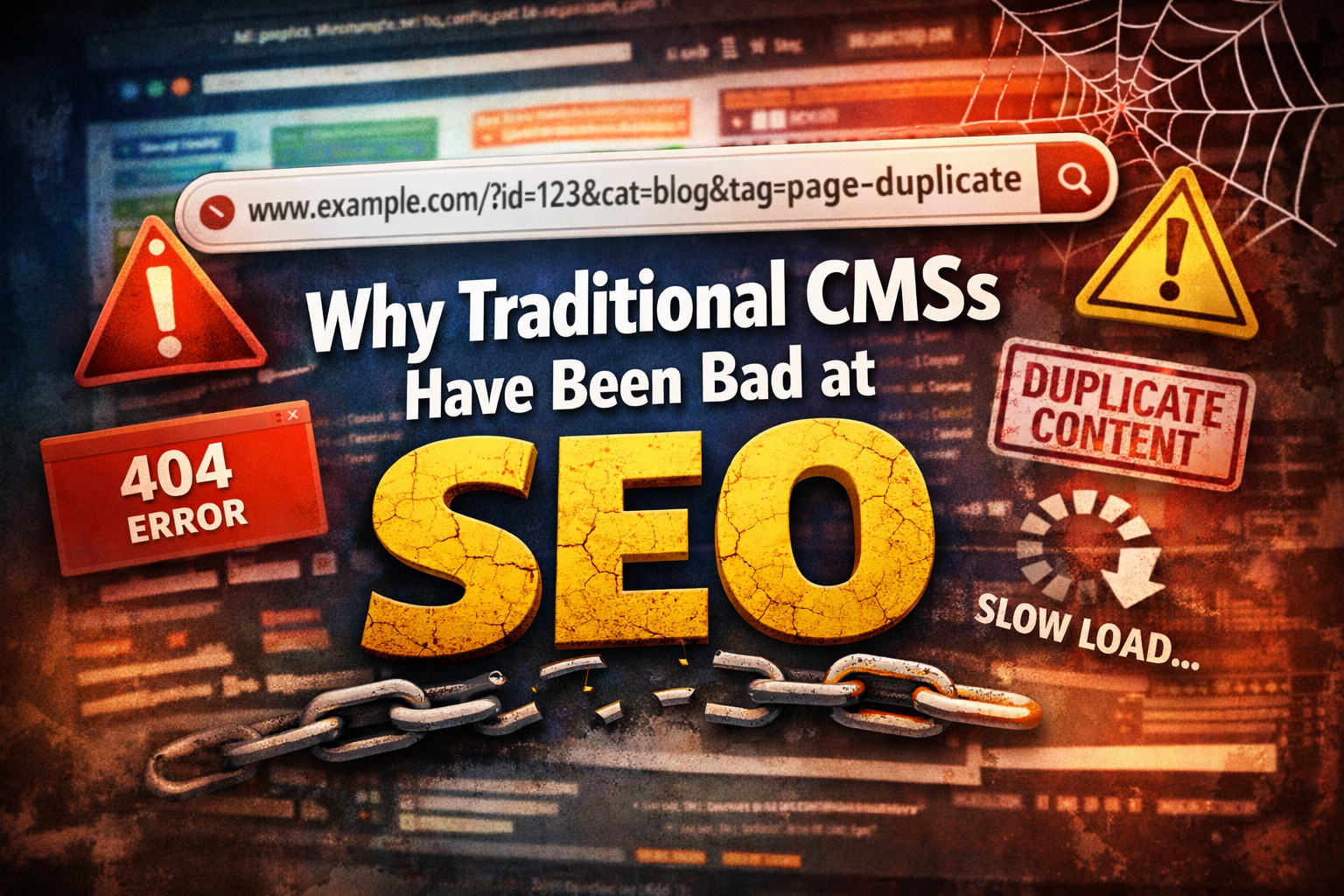
For years, a lot of businesses assumed that using a traditional CMS automatically meant they were “SEO-friendly.”
That idea was never fully true.
Traditional CMSs made publishing easier, but they often made technical SEO worse. In many cases, they helped people create pages fast while quietly introducing problems around crawlability, duplicate URLs, performance, bloated templates, weak internal structure, and poor control over metadata and canonicals. Google’s own documentation makes clear that search depends on successful crawling, indexing, and serving, and pages do not get guaranteed visibility just because they exist. (Google for Developers)
The issue was not that CMS platforms were useless.
The issue was that many traditional CMSs were built around content management first, while SEO was treated as an add-on, a plugin, or a patchwork of settings that site owners often did not fully understand. That created a generation of websites that looked manageable in the admin panel but were messy underneath.
1. They often generated too many URLs for the same content
One of the oldest SEO problems in traditional CMS environments was URL duplication.
The same article or product could appear through category archives, tag archives, filtered pages, author pages, dated archives, print pages, mobile versions, pagination layers, tracking parameters, and multiple navigation paths. Google explicitly documents that duplicate or similar pages require canonicalization decisions, and that canonical signals help consolidate ranking signals into one preferred URL. (Google for Developers)
That matters because search engines do not want to rank ten versions of the same page.
When a CMS creates many versions of similar content, the SEO value gets diluted. Internal links point to inconsistent URLs, backlinks may split across several versions, and Google has to decide which version is the representative one. In some cases, the wrong page becomes canonical. Google also warns that canonical mistakes are common, such as pointing canonicals at broken pages, placing them incorrectly, or canonicalizing important category pages to unrelated featured pages. (Google for Developers)
A lot of older CMS setups made this problem normal.
2. SEO was too dependent on plugins and manual fixes
Traditional CMSs often did not ship with strong technical SEO defaults.
Instead of giving site owners a clean base, they pushed them into a stack of plugins for titles, descriptions, sitemaps, redirects, schema, performance, canonical tags, image optimization, caching, and internal link management. That created a fragile environment where SEO depended on whether the right plugin was installed, configured correctly, updated on time, and still compatible with the rest of the site. WordPress plugin ecosystem materials themselves repeatedly emphasize optimization, cleanup, and consolidation because plugin sprawl adds overhead and maintenance risk. (WordPress.org)
This produced a common pattern:
The CMS itself was not “bad at SEO” in theory, but the real-world site ended up bloated, inconsistent, and hard to control.
That is one reason so many traditional CMS websites looked fine on the surface while underperforming in search.
3. Performance usually degraded as the site grew
A big SEO problem with traditional CMSs has been speed.
As themes became heavier and plugin stacks grew, pages often turned into a mix of oversized assets, extra scripts, multiple style sheets, third-party embeds, tracking tools, and inefficient templates. Over time, sites became slower to load and slower to render. Google’s crawl documentation notes that site availability and crawl efficiency matter, and Googlebot adapts crawling behavior partly based on how the site responds. (Google for Developers)
That does not mean every slow CMS page gets ignored.
But it does mean that slow, error-prone, or bloated pages make technical SEO harder than necessary. They also hurt user experience, which can reduce engagement and conversions even when rankings are acceptable.
Traditional CMSs often made this worse because performance was not part of the core content model. It was something site owners had to fix later.
4. They made site architecture messy
Good SEO usually benefits from a clear structure.
Important pages should be easy to discover, easy to link to, and easy for search engines to understand in context. Google explains that URL discovery often happens through links from known pages and through sitemaps. (Google for Developers)
Traditional CMSs often undermined this by creating too many low-value archive pages and too many layers between the homepage and the pages that actually mattered.
Instead of a clear path from homepage to category to important page, many CMS sites ended up with thin archives, weak tag pages, duplicate taxonomies, inconsistent breadcrumb systems, and navigation that was designed for admin convenience rather than search clarity.
So while the CMS helped you publish more pages, it often hurt your ability to signal which pages were actually important.
5. JavaScript and lazy-loading were often added badly
A lot of traditional CMS websites tried to modernize by adding more front-end effects, AJAX loading, visual builders, and lazy-loading systems.
That sounds fine until implementation gets sloppy.
Google’s documentation says lazy-loading is a common best practice, but if implemented incorrectly it can hide content from Google and interfere with crawling and indexing. (Google for Developers)
This became a real issue on many CMS-based sites where themes and builders layered on fancy behavior without enough attention to how content appeared in the HTML, whether important elements loaded reliably, or whether search engines could access the main content without needing perfect client-side execution.
In other words, traditional CMSs often combined old architecture with modern hacks.
That is not a great SEO recipe.
6. Canonical control was often weak or confusing
Canonicalization is one of those SEO concepts that sounds simple until a CMS gets involved.
Google says CMS users may not always be able to edit HTML directly and may have to rely on platform settings or other mechanisms to communicate canonical URLs. It also recommends being especially clear with canonicals when JavaScript is involved, and keeping canonical signals stable in the HTML source where possible. (Google for Developers)
That highlights one of the long-term problems with traditional CMSs:
They often hid important SEO controls behind themes, plugin settings, template logic, or page builders. Site owners could publish content, but they could not always clearly control how that content should be indexed, consolidated, or prioritized.
The result was often a site with technically “present” SEO settings but poor SEO outcomes.
7. Content publishing was easy, but content quality control was weak
Traditional CMSs were great at helping teams publish more.
They were not always great at helping teams publish better.
When your platform makes it easy to create pages without enforcing structure, quality, uniqueness, internal linking logic, or clear search intent, you end up with lots of pages that add little value. Search engines can crawl them, but that does not mean they help the site. Google states clearly that indexing and serving are not guaranteed just because a page exists. (Google for Developers)
This is one of the hidden SEO failures of older CMS thinking:
It encouraged volume before clarity.
That worked better in the earlier eras of search than it does now.
8. Many CMSs were built for editors, not for growth systems
Traditional CMSs solved an important problem: letting non-developers publish.
That was valuable.
But publishing is only one part of modern SEO.
Modern SEO also requires performance discipline, content strategy, entity clarity, consistent internal linking, good information architecture, technical cleanliness, mobile readiness, and the ability to evolve quickly without breaking indexation.
A lot of older CMS systems were not designed around that full growth stack. They were designed around pages, posts, categories, and admin usability. SEO became something you layered on top afterward.
That is why so many businesses using traditional CMSs felt stuck. They kept publishing, but traffic growth remained inconsistent.
What this means now
The lesson is not that every traditional CMS is unusable.
The lesson is that many traditional CMS implementations trained businesses to think SEO was mostly about adding blog posts, filling in meta tags, and installing a plugin.
That is not enough.
SEO works better when the site itself is structurally clean. Pages need clear canonicals, strong internal linking, stable rendering, fast delivery, low duplication, and a focused architecture that helps both users and search engines understand what matters most. Google’s current documentation still centers those fundamentals: crawlability, indexability, canonicals, rendering clarity, and site efficiency. (Google for Developers)
Why this matters for modern businesses
If your site still runs on a traditional CMS setup, the SEO problem may not be your content alone.
It may be the system underneath the content.
That is an important distinction.
Because once a CMS creates duplication, bloat, weak structure, and slow performance by default, your team spends more time fighting the platform than building visibility.
That is one reason many businesses are moving toward cleaner website architectures, leaner stacks, and more controlled front-end systems. The goal is not to be trendy. The goal is to remove technical friction between your content and search visibility.
Final thought
Traditional CMSs were not bad because they let people publish.
They were bad at SEO because they often let people publish into technical disorder.
And in search, technical disorder compounds.
A site can have good content and still underperform if its structure sends mixed signals, creates duplicate pages, slows down rendering, and makes discovery harder than it should be.
That is the real reason many traditional CMS sites have historically struggled with SEO.
Not because SEO was impossible on them.
But because too many of them made bad SEO the default