
Why Businesses Started Using AI Tools Like Claude and Lovable Instead of Traditional Drag-and-Drop Builders
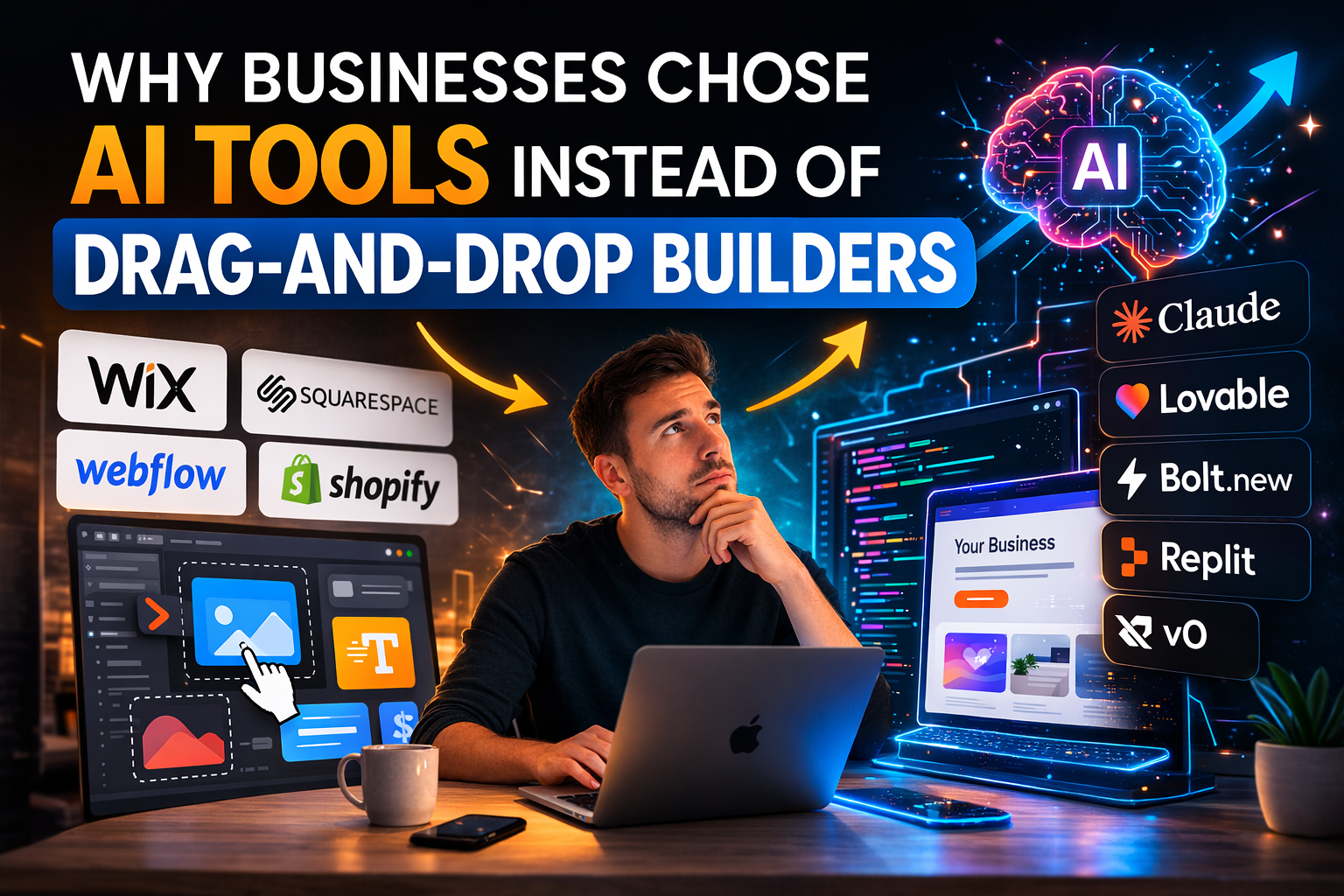
A big shift has happened over the last year: more businesses are starting website and app projects with AI tools instead of going straight to traditional drag-and-drop builders.
That does not mean builders are dead. Far from it.
Platforms like Wix, Squarespace, Webflow, and Shopify still have huge advantages in:
hosting
ease of editing
built-in business tools
low-risk maintenance
But a growing set of AI-first tools — including Claude Opus 4.6, Lovable, Bolt.new, Replit Agent, and v0 — are changing what businesses expect from the creation process itself.
Official product pages and 2026 comparison guides now frame these tools around building websites, apps, and full-stack products from prompts or conversational input rather than through manual block-by-block editing.
The key reason for the shift is simple:
AI tools increasingly feel faster, more flexible, and more custom than drag-and-drop builders.
That is the real starting point.
The old builder model solved simplicity. The new AI model solves speed.
Traditional drag-and-drop builders were built around a very clear promise:
Make websites accessible to non-technical people.
That still matters.
Squarespace explicitly markets its platform as an intuitive drag-and-drop website builder, while Wix continues to position itself as an easy-to-use all-in-one builder with templates, built-in AI tools, and business features. Webflow takes a more advanced visual-builder angle, while Shopify continues to emphasize visual editing and drag-and-drop customization for stores.
But what AI changed is the time-to-first-version.
Instead of:
choosing a template
dragging sections
adjusting blocks
manually rewriting every part of the page
businesses can now describe what they want and get a starting version much faster.
Lovable describes this directly as creating complete applications by chatting.
Bolt.new says users can build websites and apps using their words.
Replit describes vibe-coding tools as generating, testing, and deploying apps from prompts.
That is a major psychological shift.
A builder says:
“Here are the pieces, now assemble them.”
An AI builder increasingly says:
“Tell me what you want, and I will generate it.”
Businesses want more custom results without hiring a full agency
This is probably one of the biggest reasons AI tools are getting attention.
A lot of small and mid-sized businesses never actually wanted a generic site.
They accepted generic websites because that was the easiest affordable option.
Drag-and-drop builders made that tradeoff acceptable:
less originality
more control
lower cost
AI tools change that tradeoff.
Claude Opus 4.6 is being positioned by Anthropic as exceptionally strong at:
reasoning
planning
navigating large codebases
powering AI teammates
That matters because it means AI is no longer just good at writing copy snippets or suggesting design ideas.
It is getting strong enough to help generate real custom code and more original site structures much faster than older no-code workflows allowed.
So for many businesses, AI now looks like a middle path between two older choices:
cheap but generic builder
expensive but custom agency or developer work
That middle path is very attractive.
AI tools are appealing because they feel closer to “building what I actually mean”
One quiet frustration with drag-and-drop builders is that they still make the business owner translate their idea into blocks and layout decisions.
That is not always easy.
A founder may know they want:
a modern SaaS landing page
a cleaner booking site
a marketplace-style layout
a more premium-feeling service website
But turning that into builder actions still takes time and taste.
Templates help, but they also box people into patterns.
AI tools feel different because they let the user start from intent, not from the editor.
That is why products like Lovable, Bolt.new, Replit Agent, and v0 are resonating.
Their whole pitch is closer to:
“Describe the app or site you want.”
Instead of:
“Manually construct the page from controls.”
Even when the final result still needs editing, the creation flow feels more natural to many founders.
This matters because a lot of business owners are not trying to become designers.
They are trying to express an idea quickly and get something close to the right answer.
The rise of AI has also changed expectations around what a website builder should do
This is a bigger shift than it first appears.
Before, a website builder mainly had to help someone publish pages.
Now, more businesses expect the creation tool to also help with:
structure
copy
layout
visual hierarchy
sometimes even product thinking
In other words, they increasingly expect the tool not just to let them build, but to assist them intelligently while building.
That expectation naturally favors AI-first tools.
If a business owner sees Claude generate:
a better hero section
cleaner app structure
stronger CTA flow
more polished copy
in minutes, then a traditional drag-and-drop workflow can start to feel slow, manual, and outdated by comparison.
And this broader AI pressure is not limited to web creation. Reuters has reported that stronger AI agents are forcing software companies more broadly to defend why their older workflow model still matters.
That is important context.
The shift away from builders is not happening in isolation.
It is part of a larger shift in what users now expect from software.
Businesses are also choosing AI tools because they want more than just a website
Another reason AI tools are gaining ground is that many businesses no longer just want a brochure-style website.
They want:
landing pages
internal tools
customer portals
lightweight apps
dashboards
automations
onboarding flows
database-backed products
This is where AI builders are especially strong in perception.
Lovable, Bolt.new, and Replit are not selling only “make a homepage.”
They are selling the idea of building real products from conversation.
Replit’s own materials emphasize full-stack app generation and deployment.
Lovable explicitly frames the category around chatting your way to applications.
Bolt positions itself around building websites and apps in one flow.
Traditional builders can still win for simple marketing sites or stores.
But once the business idea starts drifting toward:
app behavior
custom logic
product workflows
AI tools begin to feel more aligned with the ambition.
Traditional builders still win in one important area: operating safety
This is the part many technical people ignore.
Even though businesses are shifting toward AI tools, drag-and-drop builders still solve something very important:
operational safety
Wix, Squarespace, Shopify, and Webflow are not just creation tools.
They are also platforms with:
hosting
updates
business tooling
publishing flows
support structures
bounded editing environments
That makes them safer for non-technical businesses that care more about managing the site later than about generating the first version faster.
Official platform materials keep emphasizing exactly those platform-level advantages.
So the shift is real, but it is not total.
Many businesses are using AI tools for:
ideation
first versions
faster custom builds
while still valuing traditional builders when they need:
stable editing
lower maintenance risk
a system non-technical staff can manage later
That is why this is better understood as a market rebalancing than a full replacement.
Why Claude matters in this shift even though it is not a classic website builder
Claude is important here because it represents something slightly different from tools like Lovable or Bolt.new.
Lovable and Bolt are productized around “build by chatting.”
Claude is broader, but that may actually make it more powerful for many businesses.
Anthropic positions Claude Opus 4.6 as especially strong in:
reasoning
planning
coding across larger codebases
That makes it useful not only for generating site sections, but for:
thinking through structure
refining UX flows
improving code
helping an actual developer or founder move much faster
So when businesses say they are using “AI instead of builders,” they often mean one of two things:
They are either using a purpose-built AI app builder like:
Lovable
Bolt
Replit Agent
v0
Or they are using a general AI model like Claude as the engine behind a more custom, faster build process.
Both paths reduce dependence on traditional drag-and-drop editors.
The deeper reason this shift is happening: businesses now value flexibility more than editor comfort
This is probably the strongest big-picture explanation.
Drag-and-drop builders became successful because they reduced friction for non-technical users.
AI tools are gaining because they reduce a different kind of friction:
the friction of being boxed into what the builder wants you to make
That is a very different problem.
As AI gets better, more businesses are deciding they would rather have:
faster custom generation
more original layouts
more flexible logic
quicker iteration
better starting points
less template sameness
Even if that means giving up some of the comfort and predictability of a classic builder.
In short, the market is shifting from ease of editing toward ease of creation.
That does not eliminate builders.
But it does explain why more businesses are trying AI first.
Final verdict
Businesses started using AI tools like Claude Opus 4.6, Lovable, Bolt.new, Replit Agent, and v0 instead of relying only on traditional drag-and-drop builders because AI now offers something many business owners want even more than a visual editor:
speed, flexibility, and a more custom result from plain-language intent.
Traditional builders like Wix, Squarespace, Webflow, and Shopify still matter because they are safer, easier to maintain, and better packaged for ongoing operations.
But AI tools are winning attention because they make the creation process feel less like assembling blocks and more like describing a business idea and getting something much closer to it immediately.
The simplest takeaway is this:
Businesses are moving toward AI tools because they want websites and products that feel more custom than builders, but much faster and cheaper than traditional development.