
How the Website Market Looks at the Start of Q2 2026 - Traditional CMS vs AI-Generated Websites
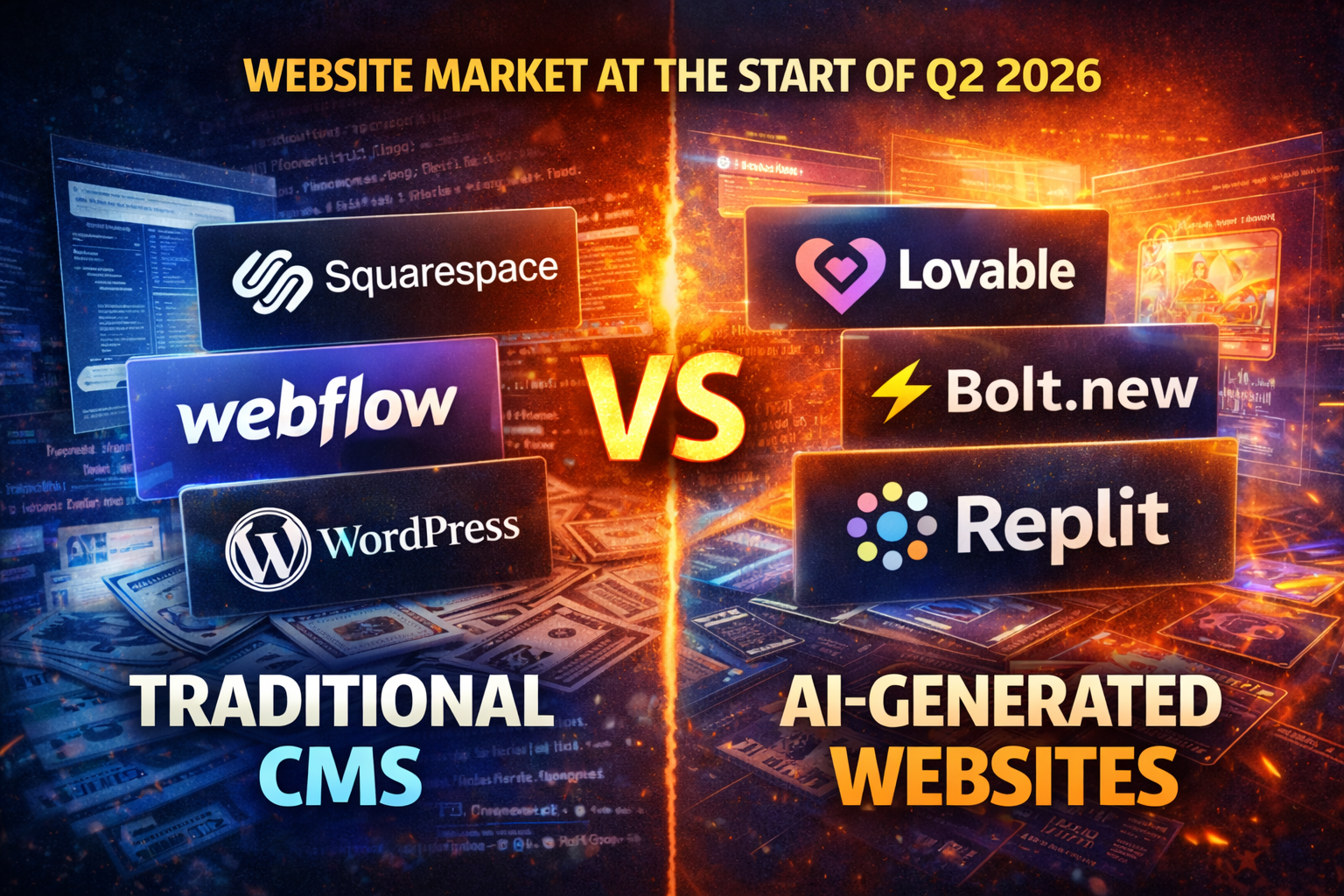
At the start of Q2 2026, the website market looks more interesting than a simple “old vs new” battle.
It is not really traditional CMS platforms on one side and AI-generated websites on the other.
The real shift is this:
Businesses are increasingly choosing between two very different ways of building online presence.
The first path is still the classic managed website stack - platforms like Squarespace, Webflow, and WordPress, where design structure, content control, and ongoing business operations matter a lot.
The second path is the prompt-first AI builder model - tools like Lovable, Replit, and Bolt.new, where speed, experimentation, and shipping something functional fast are the main attraction. Lovable positions itself as an AI app and website builder, Replit markets app and site building from natural language, and Bolt.new positions itself around building websites, apps, and prototypes from prompts.
That is why the market at the start of Q2 2026 does not look like a full replacement cycle yet.
It looks more like a split market.
Traditional CMS platforms are still the default for mainstream business websites
If you zoom out, the traditional CMS world is still much bigger.
W3Techs says WordPress is used by 42.5% of all websites, which corresponds to 59.8% market share among sites using a tracked CMS. Squarespace is at 2.5% of all websites and 3.5% CMS market share, while Webflow is at 0.9% of all websites and 1.2% CMS market share. W3Techs’ trend report also shows WordPress still dominant in early April 2026, even after a gradual share decline over the last year.
That matters because most real businesses are not choosing a website platform the way startup Twitter chooses tools.
They care about practical things:
Can the team update content?
Can marketing publish pages?
Can SEO teams manage structure?
Can the business trust the platform six months from now?
Can the site support forms, CMS content, landing pages, and basic operations without constant technical intervention?
That is where traditional CMS-style systems still feel safer.
Squarespace, Webflow, and WordPress are mature enough that businesses know what they are buying into. Squarespace continues to position itself around templates, commerce, domains, and AI website building. Webflow is still selling a flexible visual website builder with CMS capabilities and enterprise-friendly positioning. WordPress.com now offers both an AI website builder and an in-product AI Assistant, but inside a long-established publishing ecosystem rather than as a pure prompt-only tool.
So in the broader business market, traditional platforms are still the default answer.
But AI-generated website tools are not niche anymore
The other side of the market is growing much faster in energy, mindshare, and likely in new project creation.
Lovable, Replit, and Bolt are no longer “cute demo tools.” Their own positioning is clearly aimed at real websites and apps, not just toy prototypes. Lovable says it builds apps, websites, and digital products faster with AI. Replit says users can build apps and sites with natural language and deploy directly. Bolt says users can build and scale websites, apps, and prototypes using words.
And the money around these tools shows this is no side trend. TechCrunch reported in March 2026 that Lovable had crossed $400 million in ARR in February, and that Replit raised a $400 million Series D at a $9 billion valuation in March 2026.
That does not automatically prove long-term market dominance.
But it does prove that businesses, builders, and investors now take this category very seriously.
The biggest change is not that AI builders replaced CMSs
The biggest change is that traditional CMS platforms had to become more AI-native because prompt-based builders moved too fast.
That is a major signal.
Webflow now has an AI site builder and, as of February 2026, says it can create multi-page sites with structure, styles, and animations that users can continue editing in Webflow. Squarespace is actively promoting Blueprint AI as its proprietary AI website builder. WordPress.com supports AI website creation and has also introduced an AI Assistant directly into the site-building workflow.
So the market is no longer “CMS vs AI.”
It is “which platform combines structure and AI in the most useful way for a given business?”
That is a much more important distinction.
What businesses seem to want in Q2 2026
At the start of Q2 2026, businesses appear to want one of two things.
1. Reliability, control, and operational clarity
This is where Squarespace, Webflow, and WordPress still win a lot of deals.
These platforms are better suited to businesses that need predictable editing workflows, clear content structures, integrated CMS behavior, and less risk around handoff between founder, marketer, assistant, and contractor. Their value is not just site generation. Their value is site management over time.
2. Speed, iteration, and lower build friction
This is where Lovable, Replit, and Bolt are strongest.
If a founder wants a website, an internal tool, a client portal, or a product landing page fast, the prompt-first platforms are extremely attractive. Replit explicitly promotes backend features like database and auth alongside the generated UI. Bolt is pushing websites plus apps and prototypes. Lovable positions itself around full app and website generation, not just layout generation.
This makes AI-generated builders especially appealing for startups, solo founders, agencies trying to move faster, and businesses that care more about time-to-live than polished long-term content operations.
The market is splitting by use case
That is the clearest way to read Q2 2026.
Traditional CMS platforms still fit better when the website is primarily a business asset that needs consistent structure, ongoing editing, marketing workflows, and low operational chaos.
AI-generated website builders fit better when the website is closer to a fast-moving product surface, MVP, experiment, or launch asset.
In simple terms:
If the website is your long-term headquarters, traditional platforms still have the advantage.
If the website is part of fast iteration, AI builders have real momentum.
The weak point of AI-generated sites is still trust and maintainability
This is where the market is not fully settled.
AI tools can create a lot quickly, but businesses still have to trust what they are getting. Reuters reported in late 2025 that many companies still believed in AI’s long-term value while delaying some planned spending because adoption was not moving as smoothly as expected, and Reuters also reported in April 2026 on ongoing reliability limits in AI systems, especially hallucinations.
That matters for websites too.
A business can accept a rough first draft from AI.
What it struggles to accept is uncertainty around maintainability, hidden technical debt, inconsistent quality, or a workflow that becomes messy once the first version is live.
That is one reason mature site platforms still matter.
The weak point of traditional CMS platforms is speed
Traditional platforms still have one obvious disadvantage.
They often feel slower relative to what is now possible.
Even when they add AI, the experience is usually still more structured, more guided, and less radically fast than prompt-first builders. Webflow, Squarespace, and WordPress are all adding AI, but they are doing so inside broader platform logic. Lovable, Replit, and Bolt were built much more directly around “describe it and ship it.”
So businesses that used to wait days or weeks for a decent first version of a website now know they can get one in hours.
That changes buyer expectations across the whole market.
My read on the market at the start of Q2 2026
The website market is not watching traditional CMSs disappear.
It is watching the definition of a website platform change.
Traditional CMS platforms still dominate the mainstream business website world because they are more proven, more structured, and easier to manage over time.
AI-generated website builders are reshaping the edge of the market by making creation dramatically faster and by expanding who can build. Their growth, funding, and product momentum show that this is not a temporary curiosity.
So the market at the start of Q2 2026 looks like this:
Traditional CMS wins on structure, trust, and business continuity.
AI-generated builders win on speed, experimentation, and build friction.
And the most important trend of all is that the traditional platforms are being forced to become AI platforms too.
Final thought
If I had to summarize the market in one sentence, it would be this:
At the start of Q2 2026, businesses are not choosing between “old websites” and “AI websites.”
They are choosing between managed stability and prompt-driven speed.
And the winning platforms over the next 12 to 24 months will probably be the ones that combine both best.