
GitHub Copilot Is Getting More Expensive: What Developers Actually Get After the Pricing Change
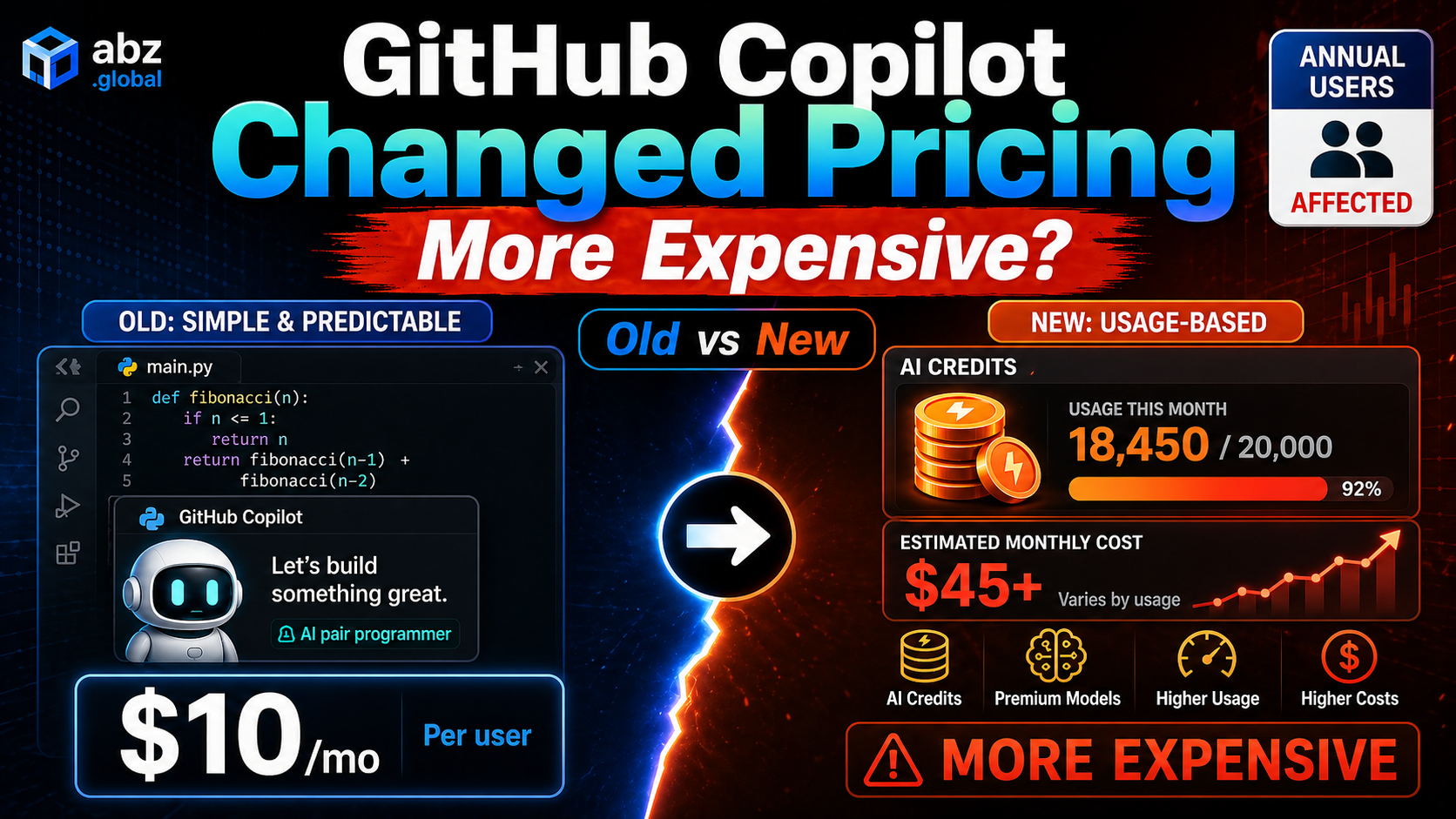
GitHub Copilot is changing the way it charges for AI coding.
The headline sounds harmless at first: the base price is not changing.
Copilot Pro is still $10/month. Copilot Pro+ is still $39/month. Copilot Business and Enterprise keep the same listed monthly seat prices too. GitHub says the change is not a direct plan price increase.
But for developers who use Copilot heavily, especially with agentic coding, large context, premium models, repository-wide tasks, or Copilot code review, the practical cost can still go up.
The important change is not the subscription price.
The important change is what that subscription price now buys.
GitHub Copilot is moving from premium requests to AI credits
Starting June 1, 2026, GitHub Copilot is moving away from premium request units and toward usage-based billing with GitHub AI Credits.
Under the old model, usage was easier to understand.
You had a Copilot plan. You got access to code completions, chat, premium requests, and model access depending on your plan. Once you paid the monthly fee, the mental model was simple: “I have Copilot.”
Under the new model, Copilot usage becomes closer to infrastructure billing.
Your usage consumes AI credits based on tokens. That includes input tokens, output tokens, and cached tokens. The model you choose also matters, because more powerful models cost more per token.
That means two developers paying the same $10/month can now get very different value from Copilot depending on how they use it.
One developer asking small questions with lightweight models may stay comfortably inside the included allowance.
Another developer using agent mode, large repository context, long conversations, premium frontier models, and code review automation may burn through the included allowance much faster.
The price did not change, but the product economics changed
This is the part many developers will feel.
GitHub is technically correct when it says the base plan pricing is not changing. Copilot Pro remains $10/month, and Copilot Pro+ remains $39/month.
But the old Copilot felt more like a fixed-price assistant.
The new Copilot feels more like a metered AI platform.
That is a major difference.
Before, the value of Copilot was easier to predict. You paid for the plan, used the tool, and did not think too much about how much every long prompt, code review, or agentic workflow cost in the background.
Now, the pricing is moving closer to how AI actually works behind the scenes: tokens, model costs, context size, and repeated model calls.
This is understandable from GitHub’s side. Copilot is no longer just autocomplete inside an editor. GitHub itself says Copilot has evolved into an agentic platform capable of long, multi-step coding sessions across repositories, and that this brings higher compute and inference costs.
But from the developer side, the conclusion is simple:
Copilot is becoming more expensive for people who use the most powerful parts of Copilot.
What you could do with the old price
With the old Copilot pricing model, a paid subscription mostly felt like a predictable monthly software cost.
For $10/month, Copilot Pro gave individual developers a low-friction way to add AI to their coding workflow. You could use autocomplete, ask coding questions, generate snippets, debug errors, get explanations, and use premium model access within the plan limits.
The exact limits still mattered, but the experience felt closer to a fixed subscription.
You were not thinking about every token.
You were not thinking about cached context.
You were not thinking about whether a long agent session across a large codebase was consuming $0.30, $2, $5, or more of usage value.
You were mostly thinking: “Does Copilot help me code faster?”
That simplicity was one of the reasons Copilot became so popular.
It turned AI coding into a normal developer utility.
What the same price buys now
Under the new usage-based model, Copilot Pro includes 1,000 AI credits per month, and Copilot Pro+ includes 3,900 AI credits per month. GitHub defines one AI credit as $0.01, meaning Copilot Pro includes $10 of monthly AI credits and Pro+ includes $39 of monthly AI credits.
That sounds fair at first, because the included credit amount matches the plan price.
But the problem is that not all usage is equal.
A simple chat question using a cheaper model may consume very little.
A long coding agent session working across multiple files can consume much more.
GitHub’s own documentation says usage is affected by conversation length, agentic features, model choice, and task complexity. Agent mode and Copilot cloud agent can involve multiple model calls inside one task.
So the new question is no longer only:
“Is Copilot worth $10/month?”
The new question becomes:
“How much real coding work do I get before I hit the included AI credits?”
That is a very different calculation.
Code completions are still included
There is one important positive detail.
GitHub says code completions and Next Edit suggestions are not billed in AI credits. They remain unlimited for paid Copilot plans.
That means Copilot is not becoming usage-based for every single thing.
If your main use case is still inline code completion, the change may not hurt much.
But modern AI coding has moved beyond autocomplete.
Developers now use AI tools for debugging, explaining unfamiliar code, generating tests, refactoring, reviewing pull requests, planning architecture, and sometimes letting agents work through multi-step tasks.
Those are exactly the workflows most likely to consume credits.
Copilot code review becomes more expensive in another way too
Copilot code review is also affected.
GitHub says Copilot code review will consume AI credits and also GitHub Actions minutes when it runs on GitHub-hosted runners.
That matters for teams.
A code review feature that looks like “part of Copilot” may now touch two billing areas:
AI usage and GitHub Actions usage.
For small teams, this may still be manageable.
For larger teams, it becomes another thing engineering managers need to monitor.
The cost of AI coding is moving from “developer tool subscription” toward “developer infrastructure.”
Annual subscribers are not completely protected
This is one of the most important parts of the change.
If you already paid annually for Copilot Pro or Copilot Pro+ before the change, you might expect the old value to stay untouched until renewal.
That is only partly true.
GitHub says annual Pro and Pro+ users will remain on their existing premium request-based pricing until their plan expires. But GitHub also says model multipliers for annual subscribers will increase on June 1, 2026.
That means annual users may still feel the change before their plan ends.
The subscription continues, but some premium models will consume more of the old request-based allowance than before.
For example, GitHub’s model multiplier table shows large increases for some models. Claude Opus 4.7 moves from a 7.5 multiplier to 27. Claude Sonnet 4.6 moves from 1 to 9. GPT-5.3-Codex moves from 1 to 6. Gemini 3.1 Pro moves from 1 to 6.
That is a meaningful change.
It means the same annual plan can effectively buy fewer premium model interactions after June 1, depending on which models you use.
Annual subscribers also should know that GitHub says annual plans will not auto-renew. Users will receive communication before renewal, and the options include canceling for a prorated refund or being downgraded to Copilot Free at renewal time.
So the annual plan situation is not simply:
“I paid for the year, nothing changes.”
It is closer to:
“You keep the old plan structure until expiration, but premium model usage gets more expensive through changed multipliers, and the annual plan will not continue automatically.”
Why GitHub is doing this
From GitHub’s perspective, this change makes sense.
AI coding tools are expensive to operate. The best models are not cheap. Long context is not cheap. Agentic workflows are not cheap. Running multi-step coding sessions across full repositories is much more expensive than serving autocomplete suggestions.
GitHub says the old premium request model is no longer sustainable because a quick chat question and a long autonomous coding session could cost the user the same amount.
That is the core issue.
Old software subscriptions worked well when the cost of serving one more user was relatively predictable.
AI does not work like that.
One user might ask 20 small questions per month.
Another user might run large coding agents all day.
Both users may pay the same subscription price, but they do not cost the provider the same amount.
Usage-based billing solves that business problem.
But it also makes the product feel less predictable for developers.
What developers should do now
The practical answer is not necessarily “cancel Copilot.”
Copilot is still useful. For many developers, it will still be worth the money.
But developers should stop treating AI coding tools as unlimited subscriptions.
They are becoming metered productivity infrastructure.
That means you should think differently about how you use them.
Use cheaper models for simple tasks.
Reserve premium models for architecture, complex debugging, large refactors, and tasks where the extra reasoning quality really matters.
Be careful with long conversations that keep pulling in more context.
Watch agentic workflows closely, because they can make multiple model calls under the surface.
Pay attention to code review billing if you use Copilot inside a team or company environment.
And if you are on an annual plan, check which models you use most, because the new multipliers may change the practical value of your remaining subscription.
The bigger AI coding lesson
The GitHub Copilot pricing change is not just about Copilot.
It is a signal about where AI coding tools are going.
The first wave of AI coding was sold as simple monthly access.
The next wave will look more like cloud infrastructure.
You will still have subscriptions, but the most powerful features will increasingly be tied to usage, credits, tokens, budgets, or rate limits.
That does not mean AI coding is becoming bad value.
A good AI coding tool can still save many hours. For a professional developer, even one or two saved hours can justify the monthly cost.
But the days of thinking “I pay $10 and use the most powerful AI features without thinking about cost” are ending.
Final thoughts
GitHub Copilot is not simply raising the sticker price.
It is changing the value structure of the product.
For light users, the change may not matter much.
For developers who mainly use inline autocomplete, Copilot may still feel similar because completions remain included.
But for heavy users, AI agents, premium models, long-context coding, and automated reviews, Copilot is becoming more expensive in practice.
The real question is no longer whether Copilot costs $10 or $39 per month.
The real question is how much serious AI-assisted development work those plans actually buy after usage-based billing begins.
That is the pricing shift developers should pay attention to.