
The State of Freelancing Platforms in Q2 2026: Upwork, Fiverr, AI, and the New Cost of Getting Clients
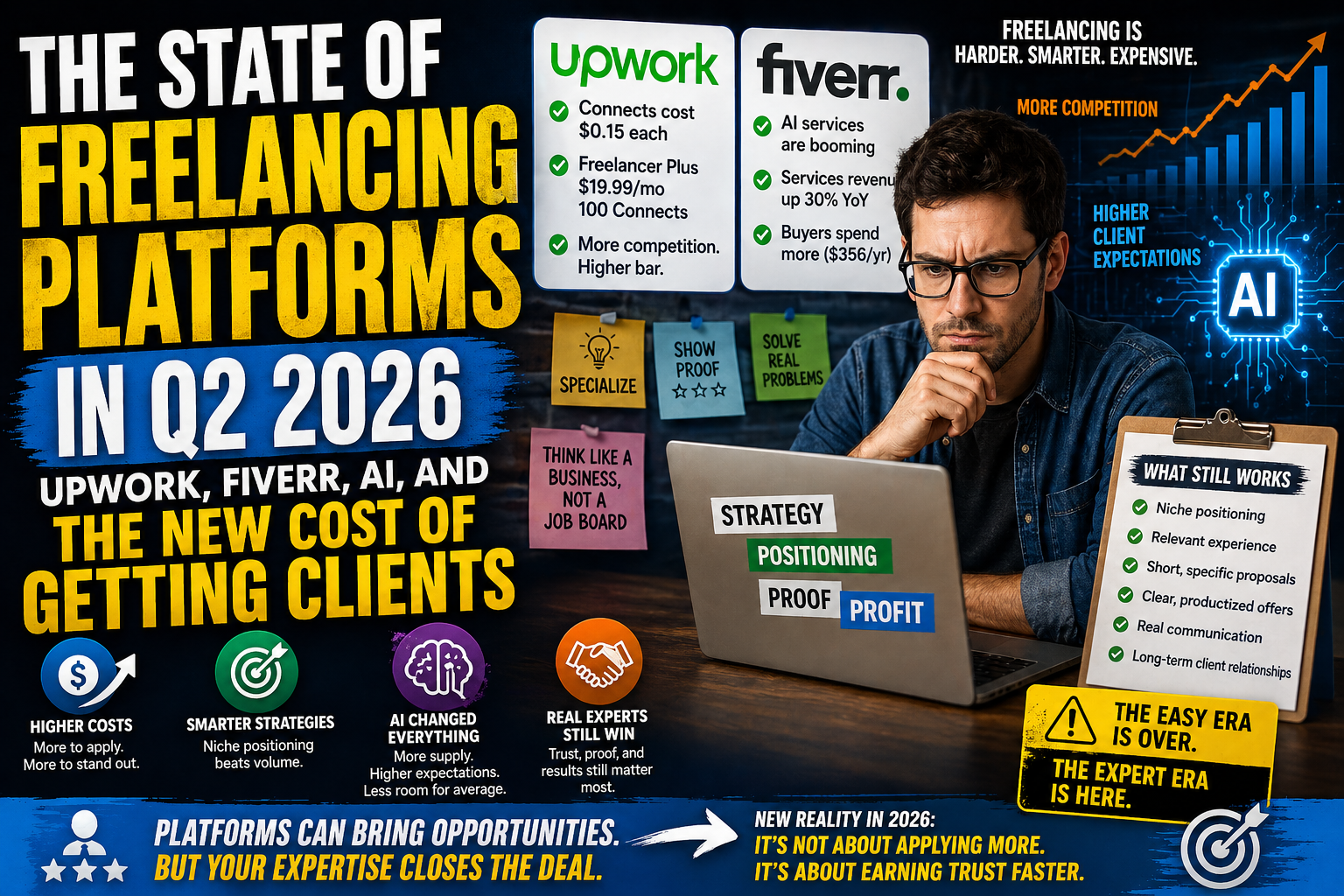
Freelancing platforms are not dead.
But the easy version of freelancing platforms is mostly gone.
In Q2 2026, Upwork and Fiverr still matter. They are still two of the biggest places where businesses go to find freelancers, agencies, consultants, developers, designers, marketers, writers, automation experts, and AI specialists.
But the platforms feel different now.
They are more competitive.
They are more expensive to use.
They are more influenced by AI.
And they reward a different type of freelancer than they did 5 or 10 years ago.
The better way to look at Upwork and Fiverr in 2026 is not as simple “freelancing websites.”
They are client acquisition channels.
And that is the biggest mindset shift freelancers need to make.
The old freelancing platform model is breaking
For a long time, the basic freelancing platform strategy was simple.
Create a profile.
List your skills.
Apply to jobs.
Get a few reviews.
Raise your rate slowly.
Repeat.
That model still exists, but it is much harder now.
The reason is simple: the platforms are no longer early-stage opportunity machines. They are mature marketplaces with huge freelancer supply, more paid features, more automation, more AI-generated proposals, and more buyers who expect faster delivery.
The platform is no longer the strategy.
The platform is only the distribution channel.
That means freelancers still need an actual business strategy behind it.
They need positioning.
They need proof.
They need a profitable offer.
They need to understand their numbers.
They need to know when applying is worth it and when it is just wasted money and time.
In 2026, freelancing platforms still work. But they work best for people who treat them seriously.
Upwork in Q2 2026: still strong, but more expensive to play
Upwork is still one of the strongest freelancing platforms for serious professional work.
It is especially relevant for software development, web development, design, marketing, automation, consulting, AI implementation, finance, admin, and long-term business support.
Upwork also clearly wants to position itself for the AI era. The company describes itself as a human and AI-powered work marketplace, and in April 2026 it announced that Upwork’s marketplace was coming to ChatGPT, allowing businesses to describe work needs, discover expert talent, and draft job posts inside ChatGPT.
That matters.
Upwork is not trying to be only a job board anymore.
It is trying to become part of the AI-assisted hiring workflow.
But for freelancers, the day-to-day reality is more complicated.
The cost of getting clients on Upwork has gone up.
Connects are the obvious example. Upwork’s own resource pages say Connects are used to submit proposals and that purchased Connects cost $0.15 each. Freelancer Plus costs $19.99/month and includes 100 Connects per month, compared with 10 for Basic.
That means applying is not free in any practical sense.
Every proposal has a cost.
Every boosted proposal has a cost.
Every weak application has a cost.
And when many freelancers are using AI to write faster proposals, clients receive more applications that sound polished but say very little.
So the Upwork problem in 2026 is not only competition.
It is noisy competition.
A client may receive dozens of proposals that look professional because AI helped write them. But many of them are generic, vague, and disconnected from the actual project.
That creates both a problem and an opportunity.
The problem is that it is harder to stand out with average writing.
The opportunity is that a freelancer who actually understands the project, asks better questions, shows relevant proof, and writes like a real expert can stand out even more.
Upwork is better for specialists than generalists
The most dangerous position on Upwork in 2026 is being generic.
“I am a web developer.”
“I am a graphic designer.”
“I am a virtual assistant.”
“I can do anything.”
That type of positioning is weak because it forces the client to figure out why they should choose one person over another.
Specialists have a much better chance.
For example, instead of saying:
“I build websites.”
A freelancer could position around:
Squarespace custom code for premium service businesses.
Shopify speed optimization for ecommerce brands.
Webflow landing pages for funded SaaS companies.
Angular and Firebase web apps for MVPs.
AI integrations for internal business workflows.
WordPress performance cleanup for established sites.
Those are not just skills.
They are buying contexts.
That is what clients understand.
In 2026, Upwork rewards freelancers who make the buying decision easier.
The client should land on a profile and immediately understand:
What this person does.
Who they help.
What problem they solve.
What proof they have.
Why they are safer than a cheaper alternative.
If a profile does not answer those questions quickly, the platform will feel much harder than it needs to be.
Fiverr in Q2 2026: no longer just the cheap gig marketplace
Fiverr’s original identity was simple.
Buy a service quickly.
The name itself came from the idea of simple gigs starting at $5.
That world is long gone.
In 2026, Fiverr is much more than a low-cost gig shelf. It is pushing AI services, Fiverr Pro, expert services, managed services, and more business-oriented categories.
Fiverr’s own site now highlights AI categories such as AI Video, AI Websites & Software, AI Mobile Apps, AI Agents, Data Model Training, AI Technology Consulting, and Generative Engine Optimization.
Its Q1 2026 results also show the shift clearly. Fiverr reported Q1 2026 revenue of $105.5 million, down 1.6% year over year, while services revenue grew 30% year over year to $38.4 million. Annual spend per buyer reached $356, up 15.4% year over year.
That tells an important story.
Fiverr is not only relying on the old marketplace model.
It is trying to move toward higher-value services, stronger buyer relationships, and AI-enabled business solutions.
For freelancers, that creates two very different realities.
Low-end generic gigs are brutal.
Premium productized services can still work.
If a freelancer is selling something basic that AI can generate or many people can imitate, Fiverr is extremely competitive.
But if the offer is a valuable business outcome, packaged clearly, backed by strong visuals, supported by proof, and delivered reliably, Fiverr can still be a serious acquisition channel.
Fiverr is better when the service is productized
Fiverr works best when the buyer can understand the offer quickly.
That is why productized services fit Fiverr better than vague consulting.
A strong Fiverr offer usually has:
A clear result.
A clear package.
A clear starting price.
A strong thumbnail.
A strong title.
Proof of previous work.
Simple scope boundaries.
Fast buyer understanding.
For example:
“I will design a modern Squarespace homepage.”
“I will fix Shopify speed issues.”
“I will create a Webflow landing page for your SaaS.”
“I will build an AI chatbot for your website.”
“I will audit your website UX and conversion flow.”
That type of offer is easier to buy than:
“I provide web development services.”
Fiverr is not always the best place for complex discovery-heavy projects, especially if the scope is uncertain. Upwork is usually better for custom projects that require conversation, calls, long-term collaboration, and flexible scope.
But Fiverr can be powerful when the service is packaged well.
That is especially true for Fiverr Pro, where the positioning is more premium and the buyer expects a higher level of experience.
AI changed both platforms
AI changed freelancing platforms in three major ways.
First, it increased supply.
More people can now offer services that previously required more time or skill to produce at a basic level. Writing, simple design, basic websites, social media content, automation drafts, research, data cleanup, and content repurposing are all easier to start with AI.
Second, it increased client expectations.
Clients now expect faster replies, faster drafts, better communication, more options, and more output.
Third, it made average work less safe.
Before AI, being average was not always fatal. Many clients still needed someone to do the work manually.
Now, if the work is only slightly better than what a client can generate with AI, the value becomes harder to defend.
That does not mean freelancers are finished.
It means freelancers need to move up the value chain.
AI did not remove the need for freelancers.
It removed the safety of being average.
The winning freelancer in 2026 is not the one who ignores AI.
The winning freelancer is the one who uses AI to move faster while still adding judgment, taste, technical ability, business understanding, and implementation quality.
AI can help write a proposal.
But it cannot replace years of knowing what usually goes wrong in a client project.
AI can generate a design direction.
But it does not automatically understand brand trust, conversion, hierarchy, or client politics.
AI can draft code.
But it does not take responsibility for production quality, edge cases, performance, maintenance, and real business outcomes.
That is where serious freelancers still have value.
The new cost of getting clients
The biggest change in freelancing platforms is not only AI.
It is the cost of getting clients.
On Upwork, proposals cost Connects.
On Fiverr, visibility is not guaranteed.
On both platforms, attention is harder to earn.
This means freelancers need to think more like business owners.
How much does it cost to get a client?
How many proposals does it take to close one project?
How many gig impressions turn into clicks?
How many clicks turn into messages?
How many messages turn into orders?
How much time is spent on unpaid discovery?
How much work is lost to revisions?
How much profit remains after fees, taxes, tools, and communication?
Many freelancers do not calculate this.
They just keep applying.
That is dangerous.
If a freelancer does not know their acquisition cost, they are not freelancing strategically.
They are gambling.
The platform may still bring work, but the freelancer needs to understand whether that work is actually profitable.
A $300 project that takes 20 hours, 15 messages, 3 calls, 2 revisions, and $20 in proposal costs is not the same as a $300 project that takes 3 hours and has a clear scope.
Revenue is not the same as profit.
Activity is not the same as progress.
What still works on Upwork in 2026
Upwork still works, but the strategy needs to be sharper.
What still works:
Specialized profile positioning.
A clear profile title.
Strong portfolio examples.
Case-study style project descriptions.
Short, specific proposals.
Applying only to high-fit jobs.
Showing that the project was actually read.
Mentioning relevant experience quickly.
Asking one or two intelligent questions.
Using Loom-style video explanations when appropriate.
Building long-term client relationships.
Turning small projects into repeat work.
Moving from task execution to consulting.
The biggest mistake is applying to too many jobs with weak fit.
That burns money, time, and energy.
A better approach is to apply to fewer jobs with much higher relevance.
The proposal should not sound like a generic cover letter.
It should sound like a specialist responding to a specific business problem.
For example, a bad proposal says:
“I have 10 years of experience and I can do this project. Please check my profile.”
A better proposal says:
“I looked at your Shopify store and the issue sounds like a combination of theme bloat, uncompressed media, and third-party app scripts. I have fixed similar performance problems before. The first thing I would check is the app loading order and the product page template. I can start with a quick audit and give you the top 5 fixes before touching the theme.”
That is much harder for a generic AI proposal to beat.
What still works on Fiverr in 2026
Fiverr still works when the offer is easy to understand and easy to buy.
What still works:
Specific productized services.
Strong gig thumbnails.
Clear package differences.
Simple pricing logic.
Premium positioning.
Fast but realistic delivery.
Strong social proof.
Before and after examples.
Niche-specific services.
Fiverr Pro credibility.
AI-assisted delivery with human review.
The mistake on Fiverr is trying to sell everything.
A gig should feel like a product.
The buyer should understand it in a few seconds.
What do I get?
Who is this for?
Why is this seller credible?
What is included?
What is not included?
Why should I pay more for this person?
If the gig does not answer those questions, the buyer will keep scrolling.
Fiverr is visual and transactional. Upwork is more conversational and project-based.
That difference matters.
Upwork vs Fiverr in 2026
The better platform depends on the type of work.
Choose Upwork if the goal is larger custom projects, long-term clients, discovery calls, ongoing retainers, technical work, consulting, or flexible project scopes.
Choose Fiverr if the service can be packaged clearly, priced clearly, explained quickly, and delivered in a repeatable way.
Use both if they are treated as different acquisition channels.
Do not copy the same offer from one platform to the other and expect it to work.
An Upwork profile should sell expertise and trust.
A Fiverr gig should sell a clear outcome.
The same freelancer can use both, but the strategy should be different.
What businesses should know when hiring freelancers in 2026
This shift is not only important for freelancers.
It also matters for businesses hiring freelancers.
AI has made it easier for weak freelancers to look stronger than they are.
A polished proposal does not always mean the person understands the work.
A beautiful gig image does not always mean the seller can handle complexity.
A low price does not always mean lower cost.
In fact, the cheapest option often becomes expensive later.
Businesses should pay more attention to:
Relevant portfolio examples.
Clear communication.
Real understanding of the problem.
Ability to explain tradeoffs.
Process.
Post-launch support.
Technical judgment.
Reviews from similar projects.
Responsiveness.
Scope clarity.
For simple tasks, Fiverr can be great.
For custom projects, Upwork can be great.
For serious websites, web apps, Shopify work, Squarespace customization, AI integrations, automation, or technical implementation, the cheapest freelancer is rarely the safest choice.
The real goal is not to hire the cheapest person.
The goal is to reduce risk and get the project done properly.
The middle of the market is under pressure
One of the biggest trends in freelancing is pressure on the middle.
At the low end, AI and global competition push prices down.
At the high end, clients still pay for trust, judgment, specialization, and execution.
The middle is where things get difficult.
A freelancer who is not cheap but also not clearly premium can struggle.
That is why positioning matters so much.
A freelancer does not want to be “another developer.”
They want to be the person known for a specific type of result.
A designer does not want to be “another designer.”
They want to be the designer who understands a specific business category.
An AI automation freelancer does not want to be “another AI automation freelancer.”
They want to be the person who can connect tools, understand workflows, protect the business from bad implementation, and make the automation actually useful.
The more specific the value, the easier it is to justify the price.
The best freelancers are becoming small businesses
Another important shift: the best freelancers no longer behave like isolated gig workers.
They behave like small businesses.
They have defined offers.
They have clear positioning.
They have systems.
They track acquisition.
They use AI tools.
They build content.
They have external websites.
They collect testimonials.
They create repeatable processes.
They understand client communication.
They know when to say no.
That is the future of freelancing platforms.
The platform can bring opportunities, but the freelancer still needs a real business behind the profile.
In 2026, relying only on the marketplace algorithm is risky.
Algorithms change.
Fees change.
Visibility changes.
Competition changes.
AI changes buyer behavior.
A serious freelancer should use platforms as one acquisition channel, not as the entire business.
Final thoughts
Upwork and Fiverr are not dead.
But the easy era is over.
In Q2 2026, freelancing platforms are more expensive, more competitive, more AI-influenced, and more demanding than before.
That hurts generic freelancers.
But it can help serious specialists.
If a freelancer has real expertise, clear positioning, strong proof, and a profitable offer, these platforms can still bring serious clients.
If a freelancer relies on volume, low prices, generic skills, and copy-paste proposals, the platforms will feel worse every year.
The future of freelancing platforms is not about who can apply the most.
It is about who can make the client trust them the fastest.
That is the new cost of getting clients.
Not only money.
Clarity.
Proof.
Positioning.
Specialization.
And the ability to show that behind the AI-generated noise, there is still a real expert who knows how to get the work done.