
Why Nuclear Fusion Has Been 10 Years Away for 50 Years
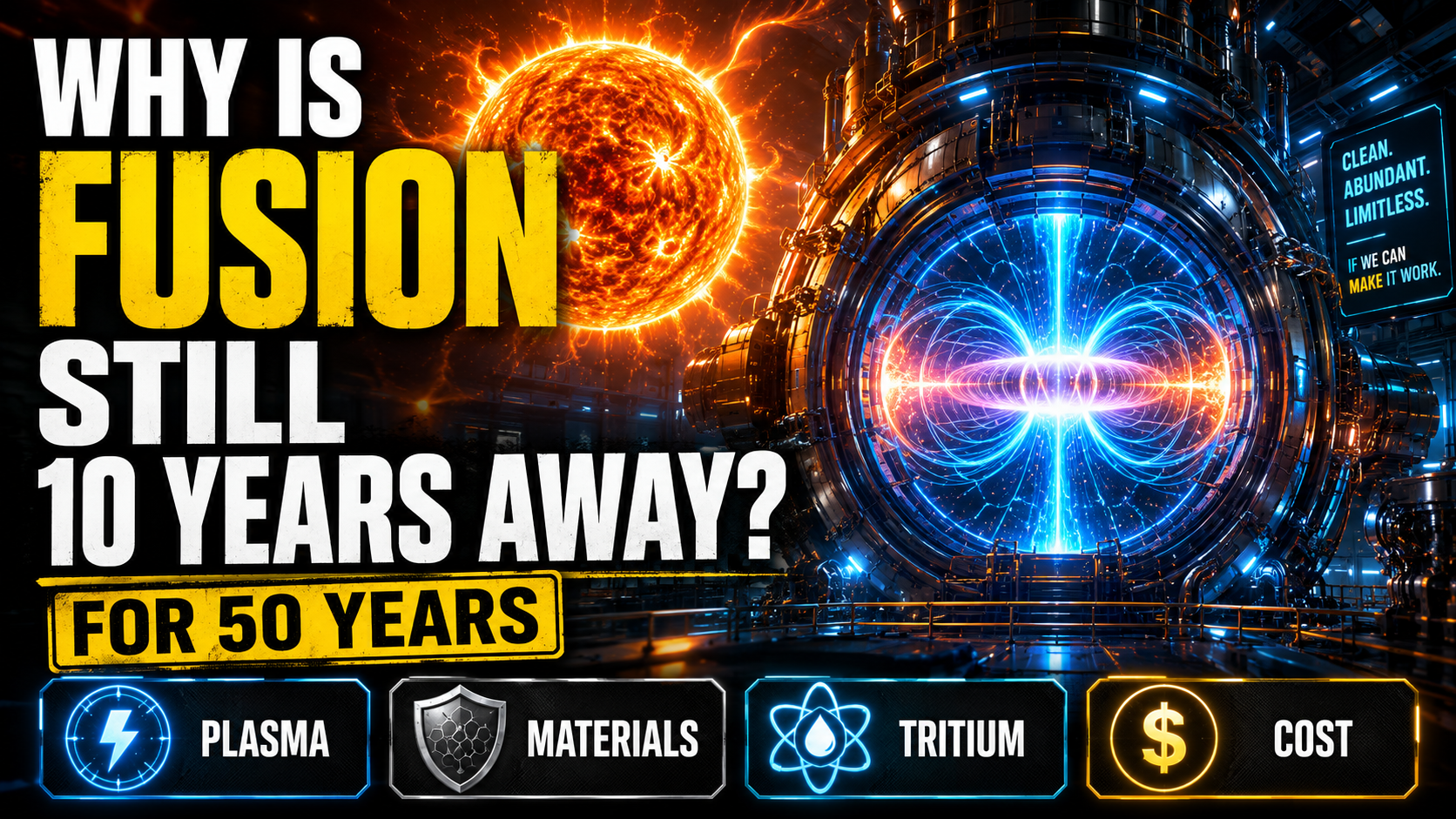
Nuclear fusion is one of the most famous promises in technology.
Clean energy.
Almost limitless fuel.
No carbon emissions during operation.
No nuclear meltdown in the traditional fission sense.
No long-lived radioactive waste on the scale people associate with conventional nuclear power.
A power source inspired by the same process that powers the Sun.
It sounds like the ultimate energy technology.
And yet, for decades, fusion has carried one of the best jokes in science and engineering: fusion is always 10 years away. Or 20 years away. Or 30 years away. The exact number changes, but the joke stays the same.
For the last 50 years, people have repeatedly heard that practical fusion power is just around the corner.
Then the corner moves.
This makes fusion easy to mock. It sounds like one of those futuristic technologies that is always promised, always funded, always announced, and never actually delivered.
But that cynical version is also too simple.
Fusion has made real progress. The science is not fake. The experiments are not meaningless. The recent breakthroughs are important. Private investment is much larger than it used to be. Startups are moving faster than older government megaprojects. AI and better simulation tools are helping researchers explore plasma control, materials, magnets, and reactor design in ways that were not possible decades ago.
At the same time, fusion is still not a commercial power source.
The reason is not one missing invention.
The reason is a full stack of scientific, engineering, economic, regulatory, and industrial problems.
Fusion is not just hard because we need to make atoms fuse. We already know how to make fusion happen.
Fusion is hard because we need to make it happen continuously, safely, reliably, affordably, and at power plant scale, while producing more usable electricity than the entire plant consumes.
That is a much higher bar.
Fusion is easy in the stars and hard on Earth
Fusion is the process of combining light atomic nuclei into heavier nuclei. When that happens, a small amount of mass becomes energy.
In the Sun, gravity does the hard work. The Sun is enormous. Its mass creates extreme pressure and temperature in the core. Hydrogen nuclei are forced close enough together that fusion can happen naturally.
On Earth, we do not have the Sun’s gravity.
So we have to replace gravity with technology.
That means extremely high temperatures, confinement systems, strong magnetic fields, lasers, compression, precision engineering, advanced materials, and control systems.
For the most common near-term fusion reaction, deuterium-tritium fusion, the plasma usually needs temperatures above 100 million degrees Celsius. EUROfusion explains that deuterium-tritium fusion reactions require temperatures in excess of 100 million degrees, while ITER materials also describe plasma temperatures around 100 million degrees and above.
This sounds impossible, but temperature alone is not the full problem.
A very hot plasma is not automatically a useful power plant.
The real challenge is getting three things right at the same time:
Temperature.
Density.
Confinement time.
This is often described through the Lawson criterion, which relates plasma density and confinement time at a given temperature to whether the fusion reaction can produce enough energy to sustain itself.
In simple language:
The fuel has to be hot enough.
Enough particles have to collide.
The plasma has to stay confined long enough.
If any of those are too low, the reaction loses energy faster than it produces useful energy.
That is why fusion is not just “make something very hot.”
It is “make something very hot, keep it stable, keep it clean, keep it confined, extract the energy, breed or supply the fuel, protect the machine, repeat the process, and sell electricity at a competitive price.”
That is the hard part.
We already have fusion. We do not yet have commercial fusion power.
This distinction matters.
Fusion already exists in laboratories.
Fusion also exists in hydrogen bombs, but that is uncontrolled fusion. Commercial energy requires controlled fusion.
The goal is not to create one short fusion event. The goal is to build a power plant that can produce electricity reliably.
That is why recent breakthroughs are both meaningful and often misunderstood.
The most famous recent breakthrough came from the National Ignition Facility, or NIF, in the United States. In December 2022, the US Department of Energy announced that Lawrence Livermore National Laboratory had achieved fusion ignition. The experiment delivered 2.05 megajoules of laser energy to a target and produced 3.15 megajoules of fusion energy output.
That was a major scientific milestone.
It showed that a fusion target could produce more energy than the laser energy delivered to it.
But it did not mean a fusion power plant had been solved.
Why?
Because the energy delivered to the target is not the same as the total electricity consumed by the facility. A commercial plant must produce net electricity after accounting for lasers or magnets, cooling, fuel handling, pumps, control systems, power conversion, maintenance, and all the other systems around the fusion reaction.
That is the difference between scientific gain and engineering gain.
Scientific gain asks:
Did the fusion reaction produce more energy than the energy delivered directly to the fuel target or plasma?
Commercial power asks:
Did the entire plant produce more electricity than it consumed, reliably and economically?
Those are very different milestones.
Still, NIF’s result was not a one-time accident. NIF has repeated and improved ignition results. In April 2025, NIF reported a fusion yield of 8.6 megajoules from 2.08 megajoules of laser energy delivered to the target, producing a target gain of 4.13.
That is real progress.
But it is still not a power plant.
Why the “10 years away” joke keeps happening
The joke exists because fusion has repeatedly made progress without becoming commercially useful.
That creates a pattern:
A scientific milestone happens.
The media says fusion is close.
Politicians and investors get excited.
Timelines become optimistic.
Then the next barrier appears.
The machine worked, but not long enough.
The plasma was hot, but not dense enough.
The energy gain was positive, but only at the target level.
The reaction worked, but the wall materials degraded.
The design looked promising, but tritium supply became a problem.
The prototype was impressive, but the economics were unclear.
The science advanced, but construction took longer than expected.
A paper discussing fusion ignition describes the old running joke as fusion being “twenty years away and always will be.”
That joke is funny because it reflects a real communication problem.
Fusion researchers often talk about the next scientific milestone.
The public hears “commercial energy is almost here.”
Those are not the same thing.
A lab experiment can be a breakthrough and still be decades away from cheap electricity.
This is not unique to fusion. It happens in batteries, aviation, quantum computing, robotics, medicine, AI hardware, and space technology. But fusion is especially vulnerable because the promise is so large.
When the prize is almost limitless clean energy, every milestone sounds like the finish line.
It usually is not.
The main fusion approaches
There is not one single fusion technology.
There are several approaches, and each one has different strengths and weaknesses.
Tokamaks
Tokamaks are the most famous magnetic confinement approach.
A tokamak uses a doughnut-shaped chamber and strong magnetic fields to confine plasma. The idea is to keep the hot plasma away from the walls while particles collide and fuse.
ITER, the huge international fusion experiment in France, is a tokamak. ITER is designed to produce a ten-fold return on heating power inside the plasma, or Q=10, meaning 500 megawatts of fusion power from 50 megawatts of input heating power. ITER itself will not convert that fusion heat into electricity.
That last detail is important.
ITER is not a commercial power plant. It is a massive scientific and engineering experiment.
ITER also shows why the joke exists. The project is enormous, international, expensive, and delayed. A new ITER schedule published in 2024 moved deuterium-tritium operation to 2039.
That does not mean ITER is useless. It means large government fusion programs move slowly because they are trying to prove extremely hard things at huge scale.
Stellarators
Stellarators are another magnetic confinement design.
Like tokamaks, they use magnetic fields to confine plasma, but the geometry is more complex. The advantage is that stellarators may be better suited to steady-state operation, which matters for a power plant.
The challenge is that stellarators are extremely difficult to design and build.
Modern computing has made stellarators more realistic because their twisted magnetic geometry can be optimized with advanced simulation. Germany’s Wendelstein 7-X is the best-known modern stellarator.
In May 2025, Wendelstein 7-X achieved a world record for long plasma discharges, sustaining a high fusion product for 43 seconds.
Again, this is meaningful.
But it is a plasma physics milestone, not commercial electricity.
Inertial confinement fusion
This is the approach used by NIF.
Instead of holding plasma in a magnetic field for a long time, inertial confinement compresses a tiny fuel pellet very quickly using lasers. The fuel becomes extremely hot and dense for a very short time.
The advantage is that it can create extreme fusion conditions.
The challenge is repetition, efficiency, target manufacturing, laser efficiency, heat capture, and power plant integration.
A commercial laser fusion power plant would need to fire repeatedly, produce targets at high volume, align them precisely, handle the energy output, protect the chamber, and convert heat into electricity.
NIF is a scientific facility, not a commercial power plant design.
That does not reduce its importance. It just explains why ignition did not instantly solve energy.
Magnetized target fusion
Magnetized target fusion tries to combine ideas from magnetic confinement and inertial confinement.
The plasma is magnetized, then compressed. Companies like General Fusion are working in this area. General Fusion says its LM26 machine is designed to validate fusion conditions at 50 percent power plant scale and demonstrate key commercial systems such as liquid-metal systems and heat-exchange components.
The appeal is that this approach may avoid some extremes of pure laser fusion or huge tokamaks.
The challenge is still proving that it can reach the right conditions repeatedly and economically.
Field-reversed configurations, Z-pinches, and other startup designs
Some private companies are trying to move beyond traditional tokamaks.
TAE Technologies is pursuing a field-reversed configuration approach and has raised major private funding, including participation from Google and Chevron.
Zap Energy is working on a sheared-flow-stabilized Z-pinch concept, which aims to use plasma current and self-compression rather than massive external magnets in the traditional tokamak sense.
Tokamak Energy is developing high-temperature superconducting magnet systems, and STEP Fusion recently named Tokamak Energy as a magnet systems partner, citing 11.8 tesla performance in a complete tokamak-configured high-temperature superconducting system.
These approaches are exciting because they may be smaller, faster, cheaper, or more manufacturable than traditional designs.
But they also have to prove themselves.
Fusion has many clever concepts.
Commercial fusion will reward the concept that works as a power plant.
Recent breakthroughs are meaningful, but not final
Fusion progress is not imaginary.
Several recent milestones show that the field is advancing.
NIF achieved ignition in 2022 and later improved target gain.
JET, the Joint European Torus in the UK, produced a record 69 megajoules of fusion energy over five seconds in its final deuterium-tritium experiments.
Wendelstein 7-X advanced long-duration stellarator performance.
ITER, despite delays, remains a massive global effort to study burning plasmas and fusion technologies at scale.
Private companies have raised billions and are building machines faster than older fusion programs.
The Fusion Industry Association reported that the industry raised $2.64 billion in the 12 months leading to July 2025, while Reuters reported total private funding across surveyed fusion companies at nearly $9.77 billion since 2021.
This is a different fusion industry from the one that existed 30 years ago.
It is no longer only universities and government laboratories.
It now includes startups, energy companies, sovereign interests, large technology companies, industrial partners, and public-private programs.
That matters.
But none of this means commercial fusion is guaranteed.
The industry has moved from “can we make fusion conditions?” toward “can we engineer a plant?”
That is progress, but the engineering phase may be just as hard as the physics phase.
The materials problem may be one of the biggest barriers
A fusion power plant is not just plasma in a bottle.
It is a machine that must survive intense radiation, heat, stress, and particle bombardment.
For the most likely near-term reaction, deuterium-tritium fusion, much of the energy comes out as high-energy neutrons. Neutrons are useful because they can carry energy into a blanket where heat can be extracted. But they are also destructive.
They slam into materials.
They damage crystal structures.
They cause swelling and embrittlement.
They activate materials, making some components radioactive.
They degrade the inner wall, divertor, blanket, and structural components.
This creates a power plant availability problem.
A plant that works for a few pulses is not enough.
A commercial plant must operate for long periods, shut down predictably, replace components efficiently, and return to service quickly.
Downtime is economics.
If a fusion plant produces beautiful plasma but needs constant expensive maintenance, it may lose to solar, wind, batteries, natural gas, fission, geothermal, or other technologies.
That is why the US Department of Energy’s fusion roadmap focuses not only on plasma physics, but also on structural materials, plasma-facing components, confinement systems, the fuel cycle, blankets, and plant engineering.
That list tells the real story.
Fusion is no longer only a physics problem.
It is a full industrial engineering problem.
The tritium problem is real
The most practical near-term fusion fuel is deuterium-tritium.
Deuterium is relatively easy. It can be extracted from water.
Tritium is not easy.
Tritium is radioactive and rare. It has to be produced, handled, stored, recovered, and recycled carefully.
A commercial fusion plant cannot simply depend forever on existing tritium supplies. It likely needs to breed tritium inside the power plant using lithium blankets. The idea is that neutrons from the fusion reaction hit lithium and produce more tritium.
That sounds elegant.
But breeding tritium reliably inside a real power plant is another hard engineering challenge.
The International Atomic Energy Agency describes tritium self-sufficiency as one of the key challenges that commercial fusion power plants must overcome.
This is one of the least glamorous but most important parts of fusion.
A power plant needs fuel.
A fleet of fusion power plants needs a fuel supply chain.
If tritium breeding does not work at scale, deuterium-tritium fusion economics become much harder.
This is also why some companies are interested in alternative fuels, such as proton-boron fusion. The appeal is lower neutron production in theory, but these fuels are even harder to fuse because they require more extreme conditions.
Again, fusion is a trade-off machine.
Easier fuel physics can create harder materials problems.
Cleaner reaction products can require much higher temperatures.
Smaller machines can create harder confinement challenges.
There is no free path.
The commercial power plant is harder than the reactor
The public usually imagines the fusion reactor as the hard part.
But the power plant around the reactor may be just as important.
A commercial fusion plant needs:
A working reactor core.
Fuel handling.
Tritium breeding and recovery.
Radiation shielding.
Heat extraction.
Steam turbines or another power conversion system.
Power electronics.
Cooling systems.
Remote maintenance.
Robotics.
Vacuum systems.
Cryogenic systems for superconducting magnets.
Control systems.
Safety systems.
Grid connection.
Regulatory licensing.
A supply chain.
Skilled workers.
Reliable uptime.
Competitive cost.
That is why commercial fusion is not just a science race.
It is an infrastructure race.
A machine can produce fusion energy and still fail as a business if the plant is too expensive, too complex, too maintenance-heavy, or too slow to build.
This is where fusion faces tough competition.
Solar power is cheap.
Wind power is mature.
Batteries are improving.
Geothermal is advancing.
Conventional nuclear fission is available now, even if it has its own economic and political problems.
Natural gas is cheap in many markets.
Fusion has to arrive not only as a miracle, but as a power source that can compete.
If the first fusion plants cost too much, utilities may treat them like science projects rather than energy infrastructure.
Why startups may move faster than government labs
Fusion startups have several advantages.
They can make faster decisions.
They can focus on one design.
They can hire aggressively.
They can use modern software tools.
They can build smaller prototypes.
They can take technical risks that government labs may avoid.
They can use private funding instead of waiting for annual political budgets.
They can benefit from better magnets, better materials, better sensors, better simulation, better manufacturing, and better AI.
Commonwealth Fusion Systems is one of the most visible examples. Google signed a power purchase agreement for 200 megawatts of electricity from CFS’s planned ARC power plant, which CFS expects to put power on the grid in the early 2030s in Virginia.
Helion is another high-profile example. Helion announced a power purchase agreement with Microsoft for electricity from its first fusion power plant, scheduled for deployment in 2028.
These agreements are important because they show that major technology companies are willing to bet on fusion as a future energy source.
But they should not be confused with proof.
A power purchase agreement is not the same as a working power plant.
A timeline is not the same as grid delivery.
A startup can move faster than a government lab, but it cannot skip physics.
It cannot skip materials.
It cannot skip safety.
It cannot skip tritium supply.
It cannot skip grid integration.
It cannot skip power plant economics.
So yes, startups can accelerate fusion.
But they cannot magically remove the hard parts.
Why government labs still matter
It is tempting to say startups will solve fusion and government labs are too slow.
That is also too simple.
Government labs and public projects created much of the scientific foundation that startups now use.
Plasma physics.
Superconducting magnet research.
Materials testing.
Diagnostics.
Neutron science.
Tritium handling.
Safety frameworks.
High-performance computing.
Tokamak and stellarator data.
Laser fusion science.
Large-scale experimental infrastructure.
These are not things most startups can fund alone.
ITER may be slow, but it is studying problems that are directly relevant to future power plants. JET produced important deuterium-tritium data. Wendelstein 7-X is advancing stellarator knowledge. NIF proved ignition in a laboratory target.
The best future is probably not startups versus government.
It is startups plus government.
Public labs can build shared infrastructure, produce open science, test materials, develop regulatory knowledge, and reduce risk.
Private companies can iterate faster, focus designs, attract capital, and push toward commercialization.
Fusion probably needs both.
Regulation is becoming clearer
Fusion is nuclear, but it is not nuclear fission.
That matters for regulation.
Fusion does not involve a chain reaction in the same way fission reactors do. If the conditions are not maintained, the plasma cools and the reaction stops. That makes fusion fundamentally different from conventional nuclear reactors.
In the United States, the Nuclear Regulatory Commission has been working on a fusion regulatory framework. A 2026 Federal Register notice discusses regulation of fusion machines under byproduct material rules, and the Fusion Industry Association notes that NRC commissioners voted in 2023 to regulate fusion under 10 CFR Part 30, the same broad framework used for particle accelerators, separating fusion from fission regulation.
This is good for the industry.
A clear regulatory path reduces uncertainty.
But regulation is still not the main bottleneck.
The main bottleneck is proving that fusion machines can operate safely, reliably, and economically.
A friendlier regulatory category helps only after the machine works.
AI can help, but it cannot repeal plasma physics
AI is one of the reasons fusion feels more credible today than it did decades ago.
Fusion is a data-heavy, simulation-heavy, control-heavy problem. That makes it a good match for modern AI and high-performance computing.
AI can help with:
Plasma control.
Instability prediction.
Reactor optimization.
Magnet design.
Materials discovery.
Digital twins.
Fault detection.
Robotic maintenance.
Simulation acceleration.
Experiment planning.
Manufacturing quality.
Control systems.
One famous example is DeepMind’s work with the Swiss Plasma Center. A Nature paper showed deep reinforcement learning used for magnetic control of tokamak plasmas, with the system learning to command control coils while satisfying physical and operational constraints.
That is not commercial fusion by itself.
But it shows why AI matters.
Fusion machines are complex dynamic systems. If AI can help control plasma shapes, predict disruptions, optimize experiments, and reduce design iteration time, it can shorten development cycles.
The DOE’s fusion roadmap also explicitly includes advanced research, high-performance computing, and AI as part of the strategy to close fusion science and technology gaps.
But AI has limits.
AI cannot make tritium appear.
AI cannot stop neutron damage by itself.
AI cannot turn a lab shot into a 40-year power plant.
AI cannot make a billion-dollar reactor cheap overnight.
AI cannot replace physical testing.
AI can accelerate fusion development.
It cannot make fusion easy.
The grid reality: fusion must compete in the real world
Fusion’s biggest competitor may not be science.
It may be time.
The world needs clean energy now.
Solar, wind, batteries, geothermal, fission, hydro, efficiency, grid upgrades, and demand management are all moving while fusion is still maturing.
By the time fusion is ready, the energy market may be very different.
That does not mean fusion will be useless.
The world will likely need far more electricity because of AI data centers, electrified transport, heating, cooling, desalination, industrial processes, and economic growth.
Fusion could become extremely valuable if it provides reliable, dispatchable, low-carbon power.
It could complement solar and wind.
It could power industrial hubs.
It could serve data center regions.
It could replace coal plants.
It could help countries with limited renewable resources.
But the economics must work.
A fusion plant cannot simply be cleaner. It has to be financeable, buildable, insurable, maintainable, and attractive to utilities or industrial buyers.
That is why the first commercial fusion plants will matter so much.
If they work but cost too much, fusion may remain niche.
If they work and show a path to lower cost, the industry could accelerate dramatically.
So what is actually holding fusion back?
The short answer is:
Everything has to work at once.
The longer answer is more useful.
Fusion is held back by plasma confinement, because hot plasma does not want to behave.
It is held back by instabilities, because tiny disruptions can ruin performance.
It is held back by materials, because reactor walls must survive neutron bombardment and heat.
It is held back by tritium, because the most practical fuel cycle needs reliable breeding and recovery.
It is held back by power conversion, because heat must become electricity efficiently.
It is held back by maintenance, because commercial plants need uptime.
It is held back by manufacturing, because advanced magnets, lasers, targets, and reactor components must be produced reliably.
It is held back by cost, because energy markets are competitive.
It is held back by scale, because a successful experiment is not the same as a power plant.
It is held back by timelines, because first-of-a-kind infrastructure is slow.
It is held back by communication, because scientific milestones are often oversold as commercial milestones.
That is why fusion has remained “10 years away.”
Not because no progress happened.
Because each solved problem reveals the next harder layer.
Conclusion: fusion is no longer science fiction, but it is not solved yet
The fair view of fusion is neither hype nor cynicism.
Fusion is not fake.
The recent breakthroughs are real.
NIF ignition was real.
JET’s record was real.
Wendelstein 7-X progress is real.
ITER’s delays are real.
Private investment is real.
Power purchase agreements from Google and Microsoft are real.
AI-assisted plasma control is real.
The startup ecosystem is real.
But commercial fusion power is still not here.
The old joke exists because fusion has often been presented as closer than it really was. But the joke can also hide the progress that has been made. Fusion has moved from a purely scientific dream toward an engineering and commercialization race.
That is a major shift.
The next question is not only:
Can we produce fusion energy?
We can.
The real questions are:
Can we produce net electricity?
Can we do it continuously?
Can we do it safely?
Can we do it cheaply?
Can we build the plants fast enough?
Can we maintain them?
Can we breed enough tritium?
Can we compete with other energy sources?
Can startups turn prototypes into infrastructure?
Can AI and simulation shorten the path?
That is why fusion is still hard.
But it is also why fusion is more interesting now than it has been in decades.
The realistic conclusion is optimistic, but balanced.
Fusion may not solve the energy crisis next year.
It may not arrive on the optimistic timelines some startups are promising.
It may not be cheap at first.
But the field is advancing faster than before, with better tools, better magnets, better computing, more private capital, more public-private coordination, and stronger demand for clean, reliable electricity.
Fusion has been 10 years away for 50 years.
This time, it may still not be exactly 10 years away.
But it is closer to becoming an engineering reality than it has ever been.