
What Is Holding Back Nuclear and Electric Aviation?
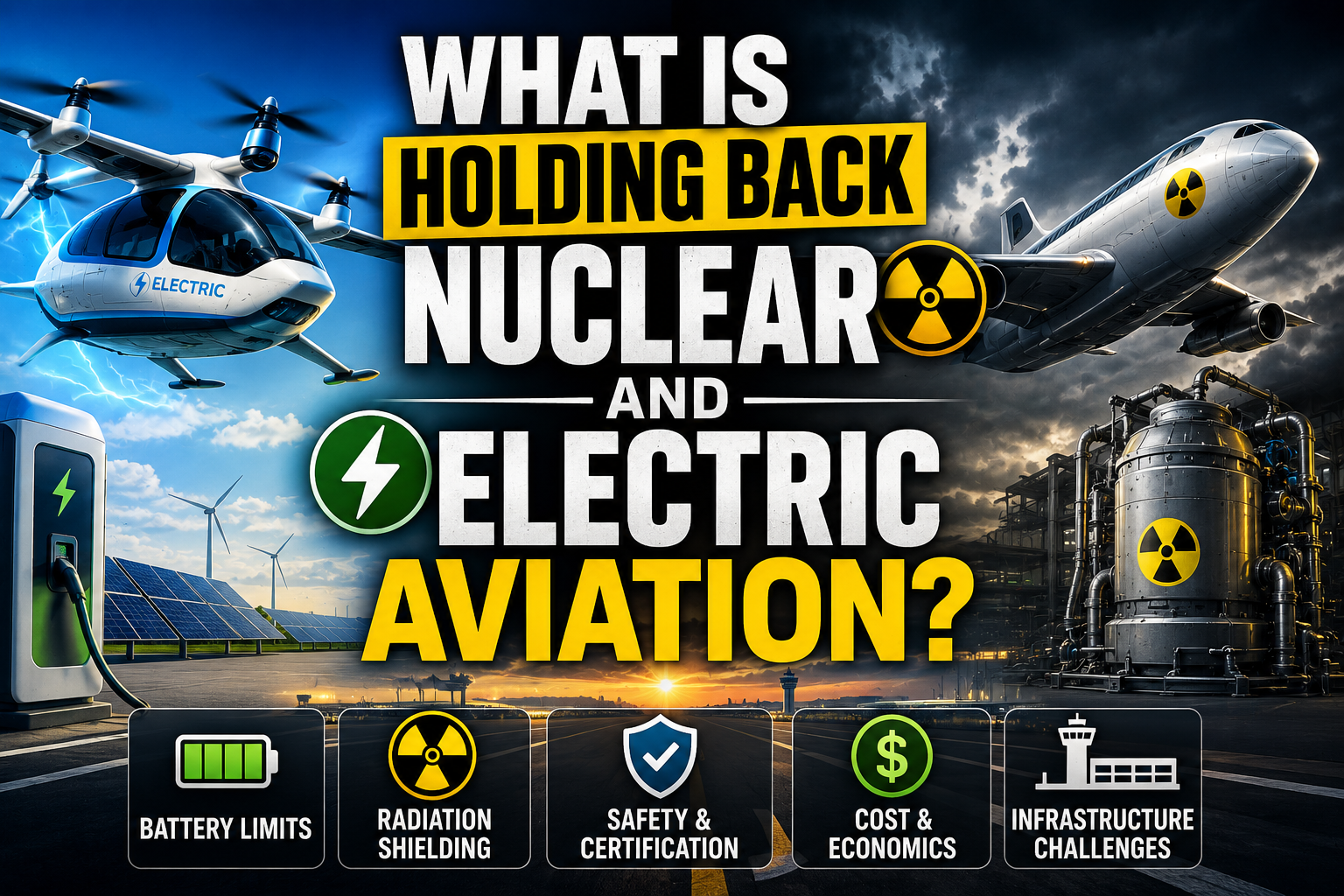
Aviation has an energy problem.
That is the simple reason we still fly around the world mostly by burning jet fuel.
Electric cars are now normal. Solar and wind power are no longer exotic. AI is accelerating software development. Batteries power phones, laptops, cars, buses, scooters, drones, and even some boats. Nuclear power can keep submarines and aircraft carriers running for years. Rockets are becoming reusable. Satellites are launched regularly. Supersonic flight is being reconsidered. Hypersonic flight is being tested.
And yet, commercial aircraft are still mostly powered by kerosene-based jet fuel.
That feels strange at first.
If we can electrify cars, why not airplanes?
If nuclear reactors can power submarines, why not airplanes?
If aviation is one of the hardest sectors to decarbonize, why have we not already replaced jet fuel with something cleaner, more advanced, and more futuristic?
The answer is that aircraft are extremely sensitive to weight, safety, certification, energy density, infrastructure, and economics. A car can carry a heavy battery and still work. A ship can carry a nuclear reactor and heavy shielding. A train can get electricity from overhead wires. But an airplane has to lift everything it uses into the sky.
That changes the entire equation.
Electric aviation is real and already progressing in small aircraft, experimental aircraft, air taxis, and short regional concepts. Nuclear aviation is also technically possible in theory, and it was seriously explored during the Cold War. But the two technologies sit on very different timelines.
Electric aviation is the more achievable near-term path.
Nuclear aviation is the more extreme long-term idea.
Both are held back by the same basic truth:
Flying is not just about having enough energy. It is about having enough energy at the lowest possible weight, with extreme safety, predictable reliability, public trust, and a business model that works every day.
Jet fuel is hard to beat
To understand why aviation has not changed faster, we need to start with jet fuel.
Jet fuel is not used because the aviation industry lacks imagination. It is used because it is extremely energy dense, easy to store, globally available, relatively cheap, and compatible with decades of aircraft, airport, maintenance, and safety infrastructure.
That last part matters.
A modern airliner is not just a machine. It is part of a global operating system. Airports, fuel suppliers, maintenance crews, engines, regulators, pilots, airlines, insurers, and manufacturers are all built around the current aviation fuel system.
Jet fuel has another advantage: as the aircraft burns it, the aircraft gets lighter.
That is a huge benefit.
A long-haul aircraft takes off heavy, burns fuel during the flight, and lands much lighter. Batteries do not work that way. A battery weighs the same when full and when empty. That means an electric aircraft must carry the full battery weight for the entire flight, even after much of the energy has been used.
This is one of the central problems of electric aviation.
The issue is not that electric motors are inefficient. Electric motors can be extremely efficient. The issue is the energy storage system. NASA research has described the energy storage requirement for electric aircraft as an extraordinary challenge, noting that Boeing and NASA studies identified around 400 Wh/kg as a threshold for general aviation and 750 Wh/kg for commercial regional air service, while state-of-the-art lithium-ion battery technology was around 200 Wh/kg and expected to plateau near 300 Wh/kg because of chemistry limits.
That gap explains almost everything.
Electric aircraft can work where the mission is short, light, and predictable.
They struggle when the mission is long, heavy, and commercial.
Electric aviation is already here, but not in the way people imagine
When people imagine electric airplanes, they often imagine a battery-powered version of a Boeing 737 or Airbus A320.
That is not the realistic near-term future.
The realistic near-term future is smaller.
Electric trainers.
Short-hop aircraft.
Electric air taxis.
Cargo drones.
Airport shuttle aircraft.
Hybrid-electric regional aircraft.
Specialized aircraft where quiet operation, low maintenance, and short range matter more than high speed or long range.
NASA’s electrified aircraft propulsion work is focused on improving efficiency and reducing energy consumption in aviation. NASA describes electrified aircraft propulsion as a path that includes different airframe designs, propulsion configurations, hybrid-electric systems, turboelectric concepts, lightweight materials, superconducting technologies, and ground testbeds. NASA also lists an integration timeframe around the mid-2030s for some of this research.
That is an important detail.
Even NASA is not presenting large electric airliners as a simple near-term replacement for conventional aircraft. The path is staged.
First, prove components.
Then prove powertrains.
Then prove aircraft-level integration.
Then prove certification.
Then prove economics.
Then scale.
That is how aviation works.
The battery problem in simple terms
Aviation is brutally sensitive to weight.
A car can become heavier and still drive.
An airplane becomes heavier and must pay for it every second it is in the air.
More weight means more lift required.
More lift usually means more drag.
More drag means more power required.
More power means more energy storage required.
More energy storage means more weight.
That loop is the enemy of electric aircraft.
This is why battery energy density matters so much. It is not only about how much energy a battery stores. It is about how much energy it stores per kilogram.
If the battery is too heavy, the aircraft needs more wing, more structure, more power, and more battery just to carry the battery.
This does not mean electric aircraft are impossible. It means they have to be designed around missions where batteries make sense.
Short flights are possible.
Small aircraft are possible.
Urban air mobility may be possible.
Training aircraft are possible.
Regional aircraft may become possible with better batteries and hybrid systems.
Large long-haul electric aircraft are much harder.
The key mistake is assuming aviation will electrify like cars did. Cars and airplanes are different machines with different physics. A car pushes itself along the ground. An airplane must lift itself into the air.
That is why battery progress that looks impressive for cars may still be insufficient for large aircraft.
NASA’s X-57 shows both the promise and difficulty
NASA’s X-57 Maxwell was one of the most visible all-electric aircraft research programs.
It did not end with a triumphant first flight. NASA announced in 2023 that the X-57 would conclude aircraft operational activities without first flight. The program faced challenges to safe flight, including mechanical issues and lack of availability of critical components, but NASA emphasized that the project produced important lessons in battery technology, electromagnetic interference, motor controller design, electric propulsion design, and certification approaches.
This is a useful example because it shows how aviation research works.
A program can be valuable even if it does not produce a commercial aircraft.
The X-57 helped regulators, researchers, and companies understand what electric aircraft integration actually requires. It also showed that electrifying an aircraft is not as simple as replacing a combustion engine with an electric motor.
You need batteries.
You need thermal management.
You need high-voltage systems.
You need safe fault handling.
You need electromagnetic compatibility.
You need certification logic.
You need redundant systems.
You need reliable components.
You need testing.
You need maintenance procedures.
You need safe failure modes.
Electric aircraft are software, power electronics, batteries, motors, cooling systems, structures, sensors, and flight controls all working together. That makes them exciting. It also makes them hard.
Electric air taxis may arrive before electric airliners
Electric aviation is most advanced in the eVTOL and advanced air mobility sector.
These aircraft are not traditional airliners. They are usually small aircraft designed for short urban or regional trips. They take off and land vertically like helicopters, then transition into forward flight like airplanes.
This matters because the mission is short. A 10-minute to 30-minute flight is much easier to electrify than a three-hour airline route.
Regulators are also moving. The FAA issued its final rule for powered-lift operations in October 2024, covering pilot and instructor certification as well as operational rules for aircraft that can take off like helicopters and fly like airplanes. The FAA says it now has regulations in place to certificate powered-lift aircraft and operators for commercial flights.
Companies like Joby and Archer are now deep into certification and flight testing.
Joby announced in March 2026 that its first FAA-conforming aircraft for Type Inspection Authorization had flown, calling it a major step in the final stage of FAA type certification. Joby said FAA pilots were expected to begin for-credit TIA flight testing later in 2026.
Archer announced in May 2026 that it had closed Phase 3 of the FAA’s four-phase type certification process for its Midnight eVTOL and had already been progressing into Phase 4, where compliance is demonstrated through formal testing and analysis.
That does not mean electric air taxis are already proven as large businesses.
They still need certification, production, maintenance, pilot training, infrastructure, public acceptance, noise management, battery lifecycle economics, and profitable operations.
But they are much closer to reality than electric long-haul airliners.
This is likely where electric aviation becomes normal first.
Not by replacing a 737.
By replacing some helicopter flights, airport transfers, short premium hops, cargo routes, and specialized urban mobility missions.
Regional electric aircraft are the next major test
Beyond air taxis, the next big market is regional aviation.
This is where companies like Heart Aerospace matter.
Heart Aerospace’s ES-30 is a 30-passenger hybrid-electric regional aircraft concept. Heart says it targets 200 km all-electric range, 800 km hybrid range with 25 passengers, a 30-minute charge time, and type certification in 2029.
That design choice is important.
The ES-30 is not presented as a pure battery-electric aircraft for long-haul missions. It uses a hybrid approach because the battery problem is still real.
Hybrid-electric aviation may be the bridge between today’s jet fuel aircraft and future zero-emission aircraft.
A hybrid aircraft can use electric propulsion where it makes sense and fuel-based systems where batteries are not enough. This can reduce emissions, noise, and operating cost on some routes without forcing the entire mission onto batteries.
NASA’s Electrified Powertrain Flight Demonstration project also focuses on hybrid-electric aircraft propulsion technologies, with ground and flight tests intended to enable a new generation of hybrid electric-powered aircraft.
This is probably the most realistic aviation electrification path for the 2030s:
Small aircraft go electric.
Air taxis go electric.
Some regional aircraft become hybrid-electric.
Large commercial aircraft become more electric internally, but still use fuel for propulsion.
That may sound less dramatic than “fully electric airliners,” but it is how real transitions happen.
The startup reality is harsher than the hype
Electric aviation has produced impressive prototypes, but it has also produced painful setbacks.
Eviation’s Alice is a good example. It became one of the most famous fixed-wing electric commuter aircraft concepts and completed a first flight in 2022. But in 2025, Eviation paused development and laid off most employees while seeking long-term partnerships and funding.
Lilium is another warning sign. The German electric aircraft developer entered self-administration proceedings in October 2024 and transitioned to regular insolvency proceedings in March 2025. In 2026, the company’s patents and registered intellectual property rights were sold to Archer Aviation.
These failures do not mean electric aviation is dead.
They mean electric aviation is expensive, capital-intensive, and unforgiving.
Building an aircraft company is not like building a mobile app. You cannot launch a minimum viable aircraft with paying passengers and fix critical bugs later. Aircraft require certification, manufacturing quality, safety culture, long test programs, deep supplier networks, and large amounts of capital.
This is why many electric aviation companies may fail even if the technology category eventually succeeds.
The industry can be right while many startups are wrong.
Why large electric airliners are still far away
The dream version of electric aviation is a large battery-powered airliner carrying 150 passengers over hundreds or thousands of kilometers.
That is where the physics becomes brutal.
A large airliner needs huge amounts of energy, especially for takeoff, climb, cruise, reserves, diversions, weather margins, and safety requirements.
Airlines do not plan flights based only on the ideal route. They need reserve energy. They need the ability to divert to another airport. They need safe margins. They need performance in hot weather, cold weather, rain, icing, turbulence, and high-altitude airports.
A battery-electric aircraft has to carry all of that energy as battery mass.
It also needs thermal management. Batteries get hot during charging and discharging. High-power aviation batteries would need serious cooling systems, fire protection, monitoring, isolation, and emergency procedures.
Charging is another issue.
A large electric aircraft would require enormous airport charging capacity. Airports would need grid upgrades, high-power chargers, safety zones, new procedures, maintenance training, and coordination with electricity providers.
Turnaround time also matters.
Airlines make money when aircraft fly. If charging takes too long, utilization drops. If battery swapping is used, the airport needs a large battery logistics operation. If fast charging is used, the battery may degrade faster and require more cooling.
Battery degradation is not a small issue. Airlines care about asset life. If a battery pack loses capacity after repeated cycles, the economics change. A battery that works for a car may not be acceptable for an aircraft that needs strict performance reserves.
This is why the large electric airliner is not just waiting for one breakthrough battery.
It needs an entire system breakthrough.
Hydrogen is part of the conversation, but it is not easy either
Hydrogen often appears in the same conversation as electric aviation because hydrogen fuel cells create electricity. A hydrogen aircraft can use electric motors without carrying heavy batteries as the main energy store.
That sounds promising.
Airbus has been exploring hydrogen through its ZEROe program. Airbus says ZEROe was launched in 2020 to explore hydrogen combustion and hydrogen fuel cells, and in 2025 it selected hydrogen fuel cell technology as the propulsion method for the future aircraft concept. Airbus describes the concept as fully electric, with propellers powered by hydrogen fuel cells and water as the only byproduct of the fuel cell reaction if the hydrogen is made using renewable energy.
But hydrogen has its own problems.
It is difficult to store.
It needs large tanks.
Liquid hydrogen requires cryogenic temperatures.
Airports need new infrastructure.
Green hydrogen supply is limited.
Certification is complex.
The aircraft design changes because hydrogen takes more volume than jet fuel.
The industry also needs production, distribution, safety, fueling, maintenance, and emergency procedures.
This is why hydrogen timelines have already become more cautious. Reuters reported in 2025 that Airbus was delaying plans to develop a hydrogen-powered commercial aircraft by the middle of the next decade, citing slower-than-expected technology development, with the project expected to lag by an additional 5 to 10 years.
Hydrogen may still become important.
But like electric aviation, it is not magic.
It replaces one set of problems with another.
Nuclear aviation sounds powerful because nuclear energy density is enormous
Nuclear aviation is attractive for one obvious reason:
Nuclear fuel contains a huge amount of energy.
A nuclear-powered aircraft could theoretically fly for extremely long periods without refueling. That made it interesting during the Cold War, when military planners imagined bombers that could stay airborne for long durations.
The United States seriously explored nuclear aircraft propulsion. The Air Force Materiel Command history notes that the Aircraft Nuclear Propulsion program expanded to include a demonstration of nuclear-powered flight, and that the program was halted in March 1961.
The most famous aircraft in this story was the Convair NB-36H. It carried an operating nuclear reactor, but the reactor did not power the aircraft’s engines. It was mainly used to test whether a reactor could be carried in flight and whether the crew could be shielded.
That distinction matters.
We did not have a practical nuclear airliner in the 1950s.
We had an experimental aircraft carrying a reactor to study shielding and safety.
The Smithsonian National Air and Space Museum notes that the NB-36H flew its final test flight in 1957, and that the Air Force demonstrated a nuclear reactor could be operated aboard an aircraft, but only barely. The same source explains that the heavy shielding required to protect the crew made the future of crewed nuclear aircraft doubtful.
That sentence captures the core problem:
Nuclear energy is light at the fuel level, but the reactor system is not light.
A nuclear aircraft needs a reactor.
It needs shielding.
It needs containment.
It needs cooling.
It needs emergency systems.
It needs crash protection.
It needs maintenance protocols.
It needs security.
It needs public acceptance.
It needs certification.
Once you include the whole system, the “nuclear fuel is energy dense” argument becomes much less simple.
The shielding problem killed much of the dream
A nuclear reactor emits radiation. Passengers and crew must be protected from that radiation.
Protection means shielding.
Shielding means weight.
Weight is the enemy of flight.
This is the same loop we see with batteries, but for a different reason. Batteries are heavy because of chemistry. Nuclear aircraft become heavy because the reactor system must be safe.
There is a brutal trade-off:
If you add enough shielding, the aircraft may become too heavy.
If you reduce shielding, the aircraft may become unsafe.
That is not a good trade-off for commercial aviation.
The military can sometimes accept unusual risks for strategic reasons. Commercial aviation cannot. Airlines cannot operate aircraft that create fear of radiation exposure. Regulators cannot certify passenger aircraft where crash scenarios include radioactive contamination. Airports cannot easily handle nuclear aircraft accidents. Insurers would have serious concerns. The public would likely reject it.
The Smithsonian article on the NB-36H describes how the reactor was activated only at cruising altitude because of concern about accidents during takeoff and landing. Flights were conducted over remote areas, and emergency teams were prepared for possible radiation-contaminated crash sites.
That is acceptable for a Cold War experiment.
It is not acceptable for a normal airline flight from London to New York or Bucharest to Paris.
Crash risk is the political nightmare
Commercial aviation is safe, but crashes can happen.
With a normal aircraft crash, the risks are already severe: fire, fuel spill, debris, loss of life, and infrastructure damage.
With a nuclear aircraft crash, the public would worry about radioactive contamination.
Even if engineers designed a reactor that could survive most crashes, regulators would ask about the worst cases.
What happens if the aircraft crashes during takeoff?
What happens if it hits water?
What happens if it crashes near a city?
What happens if there is an onboard fire?
What happens if maintenance is mishandled?
What happens if terrorists target it?
What happens if the reactor has to be removed from service?
What happens to the aircraft at end of life?
What happens to airports that receive nuclear aircraft?
What happens to first responders?
Commercial aviation does not only require engineering safety. It requires public trust.
Nuclear aircraft would face a public trust problem from day one.
Nuclear power already struggles with public acceptance on the ground. Putting reactors in aircraft flying over cities would be much harder.
Nuclear aircraft also lost their military reason
The Cold War nuclear aircraft idea was partly driven by the desire for extremely long-range bombers.
But military technology moved.
Intercontinental ballistic missiles became more important.
Submarines became powerful nuclear deterrent platforms.
Aerial refueling improved the range of conventional bombers.
Jet engines improved.
Missile technology changed the strategic equation.
That weakened the case for nuclear-powered aircraft.
If a conventional bomber can be refueled in the air, and missiles can deliver strategic weapons without a pilot, why build an enormously complex nuclear aircraft?
That is part of why the old nuclear aircraft dream faded.
It was not only a technical failure. It was also a strategic and economic failure.
Could modern nuclear technology change the answer?
Modern nuclear technology is better than it was in the 1950s.
Small modular reactor concepts are advancing.
Materials are better.
Simulation is better.
Sensors are better.
AI-assisted engineering is better.
Autonomous safety systems are better.
Digital twins are better.
Manufacturing is more advanced.
So could nuclear aviation come back?
Possibly in niche military or special-purpose contexts.
But commercial nuclear passenger aviation remains unlikely.
The barriers are not just reactor design. The barriers are certification, crash safety, airport acceptance, insurance, terrorism risk, radiation regulation, maintenance, waste handling, public fear, and international overflight rules.
A nuclear-powered cargo drone for remote military endurance is one thing.
A nuclear-powered passenger airliner landing at major airports is another.
Even if the engineering improved, the public and regulatory burden would be enormous.
This is why nuclear is much less likely than electric aviation for commercial passenger aircraft.
Electric aircraft have a difficult path.
Nuclear passenger aircraft have a nearly impossible social and regulatory path.
Nuclear may help aviation indirectly
There is one area where nuclear power could matter for aviation: not inside the airplane, but behind the energy system.
Nuclear power could help produce low-carbon electricity.
That electricity could charge electric aircraft.
It could produce green hydrogen.
It could help synthesize e-fuels.
It could power airport infrastructure.
It could support heavy industry and manufacturing.
This indirect role is much more plausible than nuclear reactors inside passenger aircraft.
In other words, nuclear may help decarbonize aviation from the ground, not from the aircraft cabin.
That distinction is important.
The future may include nuclear-powered grids producing energy for cleaner aviation fuels, but not nuclear-powered airliners carrying passengers over cities.
Certification is the hidden wall for everything
Whether we talk about electric, hydrogen, hybrid, or nuclear aviation, certification is the hidden wall.
Aircraft certification is slow because aircraft safety matters.
A new propulsion system must be proven across many conditions:
Normal operation.
Abnormal operation.
Battery failure.
Thermal runaway.
Electrical faults.
Motor failure.
Controller failure.
Cooling system failure.
Lightning strikes.
Icing.
Crashworthiness.
Emergency landing.
Fire containment.
Maintenance error.
Pilot workload.
Software failure.
Cybersecurity.
Passenger evacuation.
Airport operations.
This is already difficult for battery-electric and hydrogen aircraft.
For nuclear aircraft, the certification challenge would be far beyond anything in normal commercial aviation.
This is why new aviation technologies take longer than software.
A software company can ship a beta version.
A passenger aircraft cannot be a beta product.
That is the core reason aviation looks slow compared with digital technology.
The economics must work, not just the prototype
A prototype can fly once.
A business must fly every day.
That is the difference many futuristic aviation concepts fail to respect.
For electric aviation, the economic questions include:
How much does the aircraft cost?
How long do batteries last?
How expensive is replacement?
How fast can it recharge?
How much airport infrastructure is required?
How many passengers can it carry?
How far can it fly with reserves?
Can it operate in bad weather?
Can it fly enough hours per day?
Can airlines or operators make money?
Can maintenance be standardized?
Can pilots be trained affordably?
Can insurance be priced reasonably?
For nuclear aviation, the economic questions are even harder:
Who builds the reactor?
Who certifies it?
Who maintains it?
Who insures it?
Where can it land?
Which countries allow overflight?
How are accidents handled?
How is waste handled?
How is public trust created?
How are security risks controlled?
These are not small details. They determine whether the technology leaves the presentation deck and becomes a real transportation system.
AI and software can speed up progress, but not delete physics
This is where the modern era is different from the first aviation experiments.
AI and software can accelerate aviation development in meaningful ways.
Engineers can run more simulations.
Design teams can explore more aircraft shapes.
Battery systems can be modeled more deeply.
Thermal behavior can be analyzed faster.
Digital twins can track aircraft systems across test cycles.
Manufacturing defects can be detected earlier.
AI can help analyze flight test data.
Software tools can speed up certification documentation.
Autonomous systems can improve flight control.
Predictive maintenance can reduce operating cost.
Battery management systems can become smarter.
This matters because aircraft development is slow and expensive. Anything that reduces iteration time is valuable.
But AI does not remove the need for real-world testing.
It does not make batteries lighter by itself.
It does not eliminate radiation shielding.
It does not certify an aircraft.
It does not make airports upgrade their grids.
It does not make passengers trust nuclear aircraft.
It does not make regulators ignore crash scenarios.
AI can help engineers move faster.
It cannot repeal the laws of physics.
That is the balanced view.
Software and AI will absolutely improve the odds for electric and hybrid aviation. They may also help hydrogen aircraft and advanced propulsion systems. But the energy problem remains physical.
What will probably happen first?
The future of aviation will not be one technology replacing everything overnight.
It will be layered.
The first layer is more efficient conventional aircraft.
Airlines will keep improving engines, aerodynamics, materials, operations, and fuel efficiency.
The second layer is sustainable aviation fuel.
SAF is attractive because it can work with existing aircraft and airport infrastructure, although cost and supply remain major issues.
The third layer is more-electric aircraft.
Even if propulsion stays fuel-based, more aircraft systems can become electric, reducing complexity and improving efficiency.
The fourth layer is electric small aircraft.
Training, short hops, private aviation, and specialized missions are realistic early markets.
The fifth layer is eVTOL and advanced air mobility.
This could become real for short urban trips, airport transfers, and specialized premium services if certification and economics work.
The sixth layer is hybrid-electric regional aircraft.
This may become one of the most important practical bridges, especially for routes under a few hundred kilometers.
The seventh layer is hydrogen regional aircraft.
This may become important later if infrastructure, storage, and fuel cell technology mature.
The eighth layer is large zero-emission aircraft.
This is the hardest commercial target and probably the slowest to arrive.
Nuclear passenger aircraft are not on the near-term commercial path.
They are more likely to remain a historical lesson, a theoretical concept, or a niche military research topic.
Electric aviation is closer than nuclear aviation
If we compare electric and nuclear aviation directly, the answer is clear.
Electric aviation is already being tested, certified, and commercialized in limited forms.
Nuclear aviation is not close to commercial passenger use.
Electric aircraft have hard problems, but they are normal engineering and certification problems: battery weight, power systems, cooling, charging, reserves, maintenance, and economics.
Nuclear aircraft have engineering problems plus social, political, security, and regulatory problems that are far harder to solve.
That is why the future is likely electric first, hybrid second, hydrogen later, and nuclear mostly indirect.
Nuclear power may help produce the electricity or hydrogen that supports cleaner aviation.
But nuclear reactors inside passenger aircraft are very unlikely in the foreseeable future.
Conclusion: aviation will change, but slower than cars
The reason we do not have nuclear and electric airliners everywhere is not lack of ambition.
It is energy density.
It is weight.
It is safety.
It is certification.
It is infrastructure.
It is public trust.
It is economics.
Electric aviation is real, but it will arrive first in smaller aircraft, air taxis, training aircraft, short regional routes, and hybrid systems. Large battery-electric airliners remain difficult because batteries are still far heavier than jet fuel for the same usable mission energy.
Hydrogen may help, especially for regional aircraft, but it requires new aircraft designs, new airport infrastructure, new supply chains, and major certification work.
Nuclear aviation is technically fascinating, but commercially unlikely. The Cold War experiments showed the promise and the danger. The reactor may provide enormous energy, but shielding, crash risk, radiation safety, public acceptance, airport access, and certification make nuclear passenger aviation far harder than it sounds.
Still, the future is not pessimistic.
Aviation is changing.
Electric motors are improving.
Battery technology is improving.
Fuel cells are improving.
AI and simulation are accelerating aircraft design.
Certification frameworks for new aircraft categories are forming.
Companies like Joby, Archer, Heart Aerospace, Beta Technologies, and others are pushing real hardware into testing.
NASA and other research organizations continue to build the technical foundation for electrified flight.
The most realistic future is not one magical replacement for jet fuel.
It is a gradual transition:
More efficient aircraft.
Cleaner fuels.
Electric short flights.
Hybrid regional aircraft.
Hydrogen experiments.
Better software.
Better batteries.
Better infrastructure.
More automation.
More AI-assisted engineering.
Aviation will not electrify as quickly as cars because the sky is less forgiving than the road.
But it will electrify where the mission makes sense first.
And from there, the future will expand step by step.