
What Is Holding Back Supersonic and Hypersonic Passenger Flights?
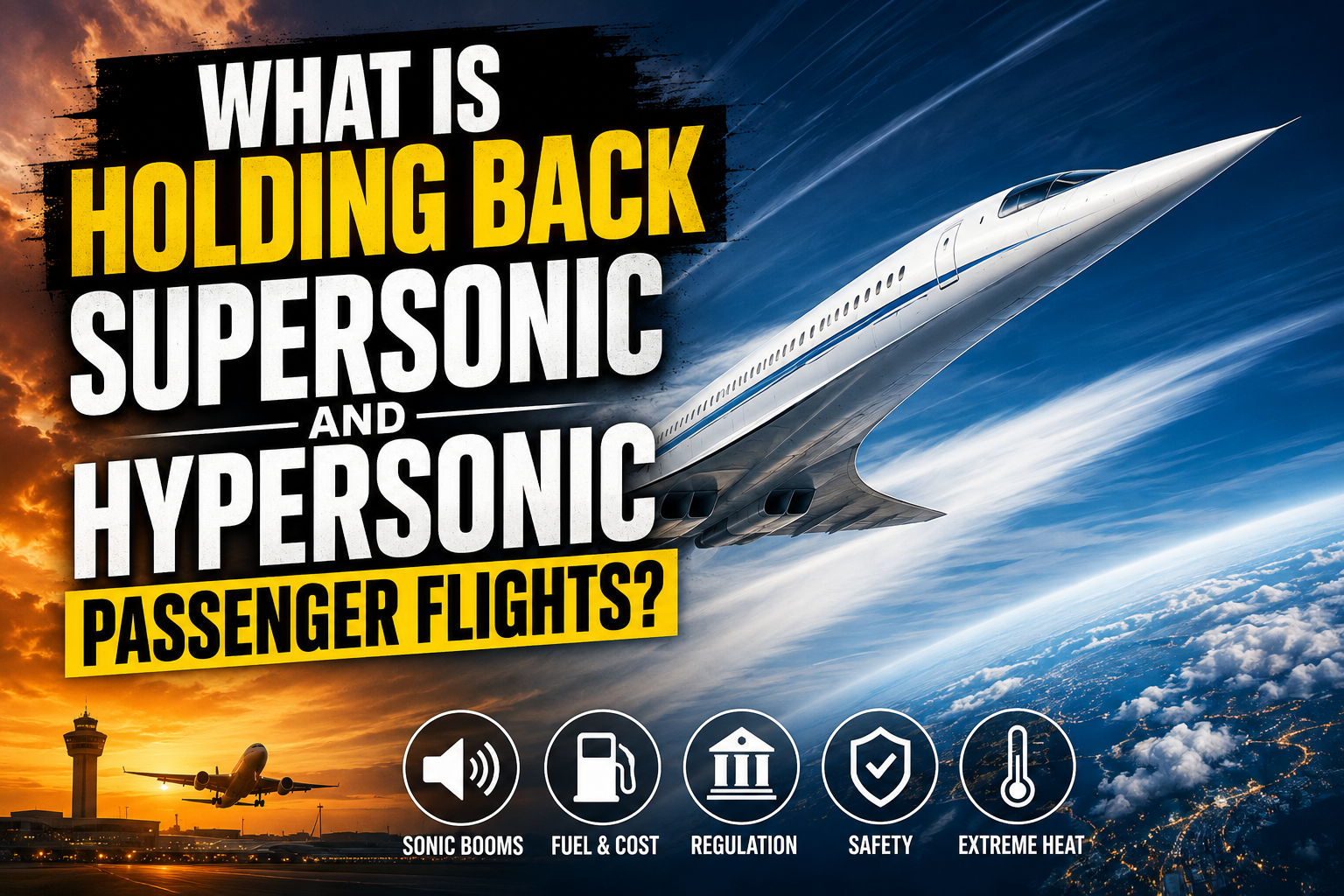
Commercial aviation has a strange problem.
In many areas of technology, the future keeps getting faster. Chips get faster. Software ships faster. AI models improve faster. Data moves around the world almost instantly. A founder can build and launch a web app in weeks. A video call can connect people across continents in seconds.
But when we talk about air travel, the story is different.
A commercial flight from New York to London today is not dramatically faster than it was decades ago. A flight from Europe to the United States still takes hours. Long-haul travel still consumes a full day when you include airport time, security, delays, boarding, taxiing, and transfers.
This is especially strange because we already had supersonic passenger travel.
Concorde entered scheduled commercial service in 1976 and was retired in 2003. British Airways describes its withdrawal of Concorde on October 24, 2003 as the end of the world’s only supersonic passenger service.
So the question is obvious:
If we could fly passengers faster than the speed of sound decades ago, why are we still flying mostly the same way today?
The simple answer is this: speed is not the hard part by itself.
The hard part is making speed work as a business, as a safe transportation system, as an environmental product, as a regulated aircraft, and as something airlines can operate every day without losing money.
Supersonic flight is possible. Hypersonic flight is possible in limited military, research, and experimental contexts. But commercial passenger aviation is not just about proving something can fly fast once. It is about proving it can fly safely thousands of times, carry paying passengers, fit into airports, pass noise rules, meet emissions expectations, survive maintenance cycles, and generate profit.
That is where the real challenge begins.
Supersonic and hypersonic do not mean the same thing
Before looking at the business and engineering problems, it helps to define the terms.
Subsonic flight means flying below the speed of sound. Most commercial airliners cruise around Mach 0.8 to Mach 0.85.
Supersonic flight means flying faster than the speed of sound, usually above Mach 1. Concorde cruised at around Mach 2, meaning roughly twice the speed of sound.
Hypersonic flight usually means Mach 5 or higher, or at least five times the speed of sound. NASA describes hypersonic speeds as greater than Mach 5.
That difference matters.
A Mach 1.7 or Mach 2 airliner is difficult.
A Mach 5 passenger aircraft is in a different engineering universe.
Supersonic aircraft face sonic booms, high drag, engine complexity, fuel burn, airport noise, regulatory barriers, and economics.
Hypersonic aircraft face all of that, plus extreme aerodynamic heating, thermal protection, exotic propulsion, structural stress, high-altitude operations, emergency safety questions, and a much harder certification path.
In other words, supersonic commercial flight is difficult to bring back.
Hypersonic commercial flight is much harder.
Concorde did not fail because it was unimpressive
The wrong lesson from Concorde is that supersonic passenger travel failed because the technology was bad.
Concorde was one of the most impressive commercial aircraft ever built. It could cross the Atlantic in a fraction of the time required by conventional airliners. It became a symbol of engineering ambition, national pride, luxury travel, and aviation progress.
But Concorde also showed the central problem of high-speed passenger flight:
A spectacular aircraft is not automatically a scalable business.
Concorde had several commercial limitations.
First, it was expensive to operate. Supersonic flight burns more fuel, requires specialized maintenance, and leaves less room for the cost efficiencies that airlines normally depend on. The Smithsonian National Air and Space Museum notes that unprofitable operation and restrictions on supersonic travel contributed to Concorde’s downfall.
Second, its route network was limited. Concorde’s sonic boom meant it could not simply fly supersonically over populated land areas. This pushed the aircraft toward oceanic routes, especially transatlantic routes.
Third, it served a small premium market. Concorde was not a mass-market product. It was closer to a flying luxury service for executives, celebrities, diplomats, and wealthy travelers.
Fourth, the aircraft became harder to justify after the Air France crash in 2000, rising maintenance costs, and the air travel downturn after September 11, 2001. Concorde eventually became a symbol of a future that was technically possible but commercially fragile.
That is the key lesson.
Concorde proved that passengers could fly faster than sound.
It did not prove that supersonic passenger travel could become a large, durable, profitable, environmentally acceptable commercial market.
Commercial aviation optimized for efficiency, not speed
Modern aviation did not stop improving after Concorde.
It improved in a different direction.
Airlines, manufacturers, regulators, airports, and passengers mostly optimized for lower cost, better fuel efficiency, higher safety, longer range, lower noise, better reliability, and more seats per aircraft.
That is why modern airliners are not dramatically faster than older jets. They are more efficient, more comfortable, safer, more digitally managed, and more economically optimized.
This is important because airlines do not buy aircraft only because they are exciting. Airlines buy aircraft because the numbers work.
For a normal airliner, the core business equation includes:
Fuel cost.
Maintenance cost.
Crew cost.
Airport fees.
Financing cost.
Passenger capacity.
Load factor.
Range.
Reliability.
Turnaround time.
Regulatory compliance.
Residual value.
A supersonic airliner makes one part of the equation better: time.
But it makes many other parts harder.
It usually carries fewer passengers. It burns more fuel per seat. It needs more advanced engines and structures. It faces more noise restrictions. It may have fewer routes where it can use its full speed. It may be more expensive to maintain. It may require premium fares.
So the business question is not simply:
Would people like to fly faster?
Of course they would.
The real question is:
Can enough people pay enough money, often enough, on enough routes, to support an aircraft that is more expensive to build, certify, operate, fuel, maintain, and insure?
That is much harder.
Physics is the first wall
A commercial airplane is not moving through empty space. It is pushing through air.
At subsonic speeds, aircraft designers already fight drag constantly. Drag is one of the main reasons aircraft burn fuel. The more drag, the more thrust is needed. More thrust usually means more fuel burn.
At supersonic speeds, the physics changes. Shock waves form. Wave drag becomes a central design problem. Embry-Riddle’s aerospace materials explain that supersonic wings and airfoils face different flow physics because shock waves and expansion waves significantly affect performance.
This is why supersonic aircraft tend to look different. They often have slender fuselages, sharp noses, swept or delta wings, and highly optimized shapes.
The aircraft must be efficient at very high speed, but it must also take off, land, climb, descend, and operate safely at lower speeds.
That creates design compromises.
A wing shape that is good for supersonic cruise may not be ideal for low-speed takeoff and landing.
An engine optimized for high-speed cruise may be less efficient at subsonic speeds.
A shape designed to reduce wave drag may create cabin, cargo, and structural constraints.
A design that reduces sonic boom may affect payload, range, or aerodynamics.
This is why supersonic aircraft are not just faster versions of normal airliners. They are different machines.
And different machines mean different economics.
The sonic boom problem is not just noise
The sonic boom is one of the biggest reasons commercial supersonic flight disappeared from everyday life.
When an aircraft flies faster than sound, it creates shock waves. Those shock waves can reach the ground as a boom. For people below, that can sound like an explosion or a sharp thunderclap.
This is not just annoying. It becomes a regulatory, political, and social acceptance problem.
The FAA still states that civil aircraft flights are prohibited from operating above Mach 1 over land in the United States unless they receive special authorization. Cornell’s version of 14 CFR § 91.817 also says no person may operate a civil aircraft in the United States above Mach 1 except under authorization conditions.
That rule exists because the public does not want constant sonic booms over cities, suburbs, farms, schools, hospitals, and homes.
This is one of the major differences between oceanic supersonic flight and overland supersonic flight.
Flying fast over the Atlantic is one thing.
Flying fast over New York, Chicago, Los Angeles, Dallas, Paris, Berlin, Madrid, Bucharest, or London is another.
If the aircraft can only go supersonic over water, then the route map becomes limited. That weakens the business case.
This is why NASA’s X-59 program matters. NASA’s Quesst mission is designed to demonstrate quieter supersonic flight and collect public response data so regulators can create better noise thresholds for commercial supersonic flight over land. The X-59 is designed to reduce the traditional sonic boom into a quieter sonic thump. NASA lists the X-59’s design research speed as Mach 1.4 at 55,000 feet.
If low-boom aircraft can prove that overland supersonic flight is acceptable, the market changes.
If they cannot, supersonic airliners may remain mostly ocean-crossing aircraft.
Regulation is moving, but slowly
There is real movement in regulation.
In June 2025, President Donald Trump signed an executive order directing the FAA to pursue changes related to the longstanding overland supersonic flight restrictions, as long as aircraft do not create an audible sonic boom on the ground. Reuters reported that the order directed the FAA to lift the 1973 ban under those conditions.
In March 2026, the US House passed the Supersonic Aviation Modernization Act, which would require the FAA to revise regulations to allow civil supersonic operation when no sonic boom reaches the ground.
That sounds like a breakthrough.
But for aircraft manufacturers, the important detail is that policy direction is not the same as aircraft certification.
A law or executive order can open the door.
It cannot make a new aircraft safe.
It cannot prove community noise acceptance.
It cannot certify a new engine.
It cannot prove economics.
It cannot create a global regulatory framework overnight.
It cannot make airports accept louder aircraft.
It cannot make airlines take delivery.
It cannot make passengers pay premium fares.
Aviation regulation moves slowly because commercial aviation is safety-critical. That is frustrating for innovation, but it is also why flying is so safe.
Supersonic aircraft need not only permission to fly. They need standards for takeoff noise, landing noise, cruise boom, emissions, airport operations, certification, maintenance, training, and international routes.
ICAO is also preparing for possible new supersonic aircraft by addressing noise standards. ICAO says it continues work on supersonic aircraft noise standards and sonic boom measurement procedures. ICAO has also said future supersonic aircraft will need to comply with noise limits that apply to today’s subsonic aircraft from 2029.
So the regulatory path is improving.
But it is still a path.
It is not a finished highway.
Airport noise is a separate problem
Even if a company solves the sonic boom problem during cruise, it still has to solve airport noise.
This is often missed in public discussions.
People think the main problem is the boom. But aircraft also need to take off and land.
Supersonic aircraft often need powerful engines. Powerful engines can create more takeoff noise. If an aircraft is too loud near airports, it faces operational restrictions, political pushback, curfews, or expensive mitigation requirements.
This matters because major airports are already noise-sensitive.
Communities near airports care about noise.
Regulators care about noise.
Airlines care because airport access is valuable.
An aircraft that can fly from New York to London in 3.5 hours is not useful if it cannot operate freely at major airports.
That is why modern supersonic developers emphasize quiet takeoff and landing as much as high-speed cruise.
The future of supersonic aviation depends not only on speed, but on whether these aircraft can behave like acceptable neighbors around airports.
Fuel burn and emissions are central
Speed costs energy.
That is one of the biggest problems.
A supersonic aircraft must overcome more drag. It needs more thrust. It often carries fewer passengers. That can increase fuel burn per passenger.
The National Academies notes that supersonic flight increases specific fuel consumption and requires a more robust airframe design, which creates higher fuel weight fraction and shorter range or higher maximum takeoff weight for comparable payload.
This creates a difficult commercial and environmental equation.
Passengers want faster flights.
Airlines want profitable flights.
Governments want lower emissions.
Airports want lower noise.
The public wants cheaper travel.
Investors want returns.
A supersonic aircraft must satisfy enough of these groups to survive.
This is why sustainable aviation fuel, or SAF, is often mentioned in modern supersonic plans. Boom says Overture is designed around modern standards and promotes sustainability as part of its positioning. Its Overture page presents the aircraft as a premium cabin product with fares similar to today’s business class.
But SAF is not magic.
It can reduce lifecycle carbon emissions depending on feedstock, production method, and supply chain. But it does not automatically solve fuel quantity, cost, availability, non-CO2 effects, or high-altitude emissions concerns.
If supersonic aircraft burn more fuel per passenger and depend on expensive SAF that is not available at scale, the economics become harder.
The aircraft has to be fast, but it also has to be efficient enough to exist in a world that is increasingly climate-conscious.
Safety and certification may be the biggest hidden barrier
The public often talks about the glamorous part: speed.
Aircraft manufacturers and regulators care about the less glamorous part: certification.
Commercial aircraft certification is brutal because it has to be.
A new passenger aircraft must prove that it can handle normal operations and abnormal operations. It must handle engine failures, system failures, lightning strikes, bird strikes, rejected takeoffs, emergency descents, avionics issues, software failures, structural fatigue, maintenance errors, pilot workload, evacuation requirements, and thousands of other scenarios.
A supersonic aircraft adds more complexity.
Higher speeds.
Higher temperatures.
More specialized structures.
Different engine behavior.
Different flight envelopes.
Different control laws.
Different emergency scenarios.
Different noise requirements.
Different training requirements.
Different maintenance inspections.
For a hypersonic passenger aircraft, the certification challenge becomes even more extreme.
What happens if a Mach 5 passenger aircraft needs to divert?
What happens if a thermal protection system is damaged?
What happens if an engine fails during acceleration?
What happens if the vehicle is at extremely high altitude and passengers need emergency descent?
What happens if communication or navigation is affected?
What happens if the aircraft needs to transition between propulsion modes?
What happens if a sensor system fails while the vehicle is operating near the edge of its thermal and aerodynamic envelope?
These are not impossible questions.
But they are expensive questions.
And every expensive question slows the timeline.
Boom Supersonic is the most visible modern attempt
Boom Supersonic is the company most associated with bringing back commercial supersonic passenger flight.
Boom’s XB-1 demonstrator broke the sound barrier in January 2025. Boom says XB-1’s flights helped build the foundation for Overture, its planned commercial airliner. Boom’s 2025 year review says XB-1 made its second and final supersonic flight in February and was then retired to Boom’s Denver headquarters.
Overture is the real product.
Boom says Overture has orders and pre-orders from United Airlines, American Airlines, and Japan Airlines. American Airlines announced an agreement in 2022 to purchase up to 20 Overture aircraft with an option for 40 more, and said it paid a non-refundable deposit on the initial 20 aircraft. United’s Boom page says United will purchase 15 Overture airliners once Overture meets United’s safety, operating, and sustainability requirements.
That last phrase matters: once it meets requirements.
Airline interest is not the same as certified aircraft delivery.
Boom still has to prove the aircraft, the engine, the manufacturing system, the operating economics, and the certification case.
One of the most important parts is the engine. Boom is developing Symphony for Overture, and says an ignition test proved flame stability ahead of a fully operational engine core prototype test planned for 2026.
That is exciting, but it also shows the challenge.
A supersonic airliner is not just a shape. It is a complete commercial aviation ecosystem. The engine alone is a massive program.
Boom may succeed. But it has to do what even giant aerospace companies find difficult: develop and certify a new aircraft and a new propulsion system for a market that has not existed commercially since Concorde.
Other companies show the wider race
Boom is not alone.
Spike Aerospace has promoted the S-512 Diplomat as a next-generation supersonic business jet. Its public positioning emphasizes quieter, cleaner, safer, and more efficient supersonic flight.
Hermeus is working on high-speed aircraft, but its current public focus is mostly unmanned and national security-oriented. Hermeus says its Quarterhorse Mk 2.1 aircraft received a Special Airworthiness Certificate - Experimental Category from the FAA.
Venus Aerospace is pursuing advanced propulsion, including rotating detonation rocket engine technology, and frames its work around space, defense, and commercial high-speed flight.
Stratolaunch has become an important player in hypersonic testing infrastructure, with its public positioning focused on advancing hypersonic technologies.
This wider ecosystem matters.
The return of high-speed aviation will probably not come from one company alone. It will require progress in engines, materials, simulation, sensors, software, flight testing, manufacturing, regulation, and airline operations.
That is why the hypersonic world is currently more defense and test-infrastructure-heavy than passenger-airline-heavy.
The technology has to mature before it can become a normal airline product.
Hypersonic passenger aircraft are much harder than supersonic aircraft
Supersonic aircraft are hard because they fly faster than sound.
Hypersonic aircraft are hard because the atmosphere starts behaving like an enemy.
At Mach 5 and above, aerodynamic heating becomes one of the defining problems. NASA’s hypersonic research materials describe hypersonic speeds as greater than Mach 5, and NASA has developed systems to measure temperature and strain on high-speed vehicles at those speeds.
NASA’s X-43A program also showed how difficult and experimental hypersonic air-breathing propulsion remains. NASA says the X-43A made aviation history with successful scramjet-powered flights at hypersonic speeds above Mach 5.
That is not the same as operating a passenger airline.
A passenger aircraft must not only reach hypersonic speed. It must do it repeatedly, safely, affordably, and comfortably.
Hypersonic flight introduces major problems:
Thermal protection.
Airframe expansion and contraction.
Material fatigue.
Engine inlet stability.
Propulsion transitions.
High-altitude cabin safety.
Emergency abort modes.
Runway and airport compatibility.
Maintenance after thermal cycling.
Passenger comfort during climb and acceleration.
Certification of software and autonomous systems.
Noise during takeoff, acceleration, and reentry-like phases.
Even the shape of the aircraft becomes harder. At hypersonic speeds, sharp leading edges can improve aerodynamic efficiency, but they also face extreme heating. Blunt shapes can reduce heating in some contexts, but increase drag. Engines and airframe become deeply integrated. The aircraft is less like a normal plane and more like a complete thermal, propulsion, guidance, and materials system.
This is why hypersonic passenger travel is not simply “Concorde but faster.”
It is closer to building a reusable, airline-safe, atmosphere-flying spacecraft that can operate from airports.
That is a much bigger leap.
The passenger experience also matters
Even if the engineering works, the passenger experience has to make sense.
For supersonic travel, the value proposition is easy to understand.
New York to London in around three and a half hours.
Tokyo to Seattle faster.
Long business trips compressed.
A transatlantic meeting and return in the same day.
Less time in the air.
For some passengers, that is valuable enough to pay more.
But hypersonic passenger flight creates new questions.
Would passengers accept a steeper climb profile?
Would the cabin have small windows because of structural and thermal constraints?
Would the flight feel more like aviation or more like spaceflight?
Would ticket prices be business-class expensive, private-jet expensive, or something beyond that?
Would airport procedures become more complex?
Would medical restrictions apply?
Would insurers and regulators treat it like normal aviation?
For high-speed passenger travel to become mainstream, the experience cannot feel experimental. It has to feel boring.
That is what commercial aviation ultimately demands.
Aviation succeeds when extraordinary engineering becomes ordinary to the passenger.
The business case for faster flight is real
Despite all the problems, the business case is not imaginary.
Time is valuable.
A three-hour time saving can matter a lot to business travelers. A faster route can increase productivity, reduce hotel nights, improve scheduling, and make long-distance travel less exhausting.
Supersonic aircraft do not need to replace all airliners to be successful.
They only need to succeed on the right routes, at the right price, with the right customers.
The likely early market is not mass economy travel.
It is premium long-haul travel.
Business class.
Corporate travel.
High-income leisure travel.
Government and diplomatic travel.
Possibly premium airline routes over oceans.
That is why Boom’s positioning around business-class-like fares is important. The company is not trying to build a 300-seat low-cost supersonic aircraft. It is trying to build a smaller premium aircraft where time savings can justify higher fares.
This makes sense.
If supersonic travel returns, it will probably return first as a premium service.
Then, if manufacturing scales, fuel efficiency improves, regulations open, and airline networks adapt, prices may fall.
That is how many technologies mature.
First, expensive and limited.
Then, cheaper and broader.
But the first version still has to work financially.
Why AI and software may change the timeline
This is where the modern era is different from the Concorde era.
Concorde was designed in a world without modern AI, cloud computing, digital twins, advanced simulation pipelines, modern composite materials, modern sensors, and today’s software development tools.
That does not remove the laws of physics.
But it can change the speed of iteration.
AI and software can help in several ways.
First, aerodynamic design can be simulated and optimized faster. NASA has described aerodynamic shape optimization as a key method for reducing drag while maintaining safe flight characteristics.
Second, digital twins can help engineers understand how aircraft structures, engines, and systems behave across thousands of operating scenarios.
Third, AI-assisted engineering can help search through design trade-offs faster. Engineers can test more shapes, materials, flight profiles, control strategies, and maintenance scenarios before building physical prototypes.
Fourth, software development is much faster than it was decades ago. Teams can build simulation tools, telemetry dashboards, control systems, test analysis pipelines, and internal engineering platforms at a speed that was not possible in the Concorde era.
Fifth, machine learning can help analyze flight test data. Supersonic and hypersonic programs generate enormous amounts of sensor data. Finding patterns faster can reduce development cycles.
Sixth, AI can help with manufacturing quality control, predictive maintenance, and anomaly detection.
But there is an important limitation.
AI can accelerate engineering work.
It cannot certify an aircraft by itself.
It cannot make a loud aircraft quiet by wishful thinking.
It cannot make fuel burn disappear.
It cannot remove the need for real flight testing.
It cannot negotiate away safety.
It cannot make regulators ignore risk.
So AI is not a magic solution.
It is an accelerator.
For high-speed aviation, acceleration matters because aerospace development cycles are long and expensive. If AI and modern software can reduce iteration time, improve simulation accuracy, and catch design problems earlier, they can improve the odds.
The future of supersonic and hypersonic aviation may depend as much on software velocity as on engine thrust.
What has to happen for supersonic passenger flight to return
For supersonic passenger flights to return in a serious commercial way, several things must happen at the same time.
A company must certify a safe aircraft.
The aircraft must meet takeoff and landing noise standards.
It must either avoid unacceptable sonic booms or operate mostly where sonic booms are allowed.
It must have engines that are efficient enough and maintainable enough.
It must use fuels that fit airline economics and climate expectations.
It must offer enough range for valuable routes.
It must carry enough passengers to make revenue work.
Airlines must believe they can fill seats at premium fares.
Airports must accept it.
Regulators must approve it.
Passengers must trust it.
Manufacturers must produce it at scale.
Maintenance networks must support it.
Insurance markets must price it.
That is a long list.
But it is not impossible.
The likely first successful version of next-generation commercial supersonic flight will probably be smaller, premium, ocean-route-focused, and highly optimized around specific profitable routes.
It may not look like mass-market aviation at first.
It may look more like the return of a premium speed layer on top of the existing airline network.
That is still meaningful.
Aviation does not need every flight to become supersonic for supersonic aviation to matter.
What has to happen for hypersonic passenger flight to become real
Hypersonic passenger flight needs everything supersonic flight needs, plus much more.
It needs reusable thermal protection.
It needs reliable high-speed propulsion.
It needs aircraft structures that survive repeated heating and cooling cycles.
It needs safe abort modes.
It needs passenger-friendly acceleration and cabin systems.
It needs airport integration.
It needs a certification framework that may not fully exist yet.
It needs a business model that can justify enormous development and operating costs.
It needs public trust.
It needs insurance.
It needs government support or deep private capital.
It needs years of test data.
Hypersonic passenger flight may happen one day.
But the first large-scale markets for hypersonic technology are more likely to be defense, research, space access, and specialized cargo before everyday passenger flights.
Passenger aviation is the hardest version because the tolerance for failure is extremely low.
A hypersonic drone can fail during testing.
A passenger aircraft cannot.
That difference changes everything.
The real bottleneck is not imagination
We are not missing imagination.
Engineers can imagine faster aircraft.
Founders can imagine new routes.
Passengers can imagine two-hour global travel.
Governments can imagine national aerospace leadership.
Investors can imagine a huge new market.
The bottleneck is not imagination.
The bottleneck is integration.
Physics has to work with economics.
Economics has to work with regulation.
Regulation has to work with safety.
Safety has to work with engineering.
Engineering has to work with manufacturing.
Manufacturing has to work with airlines.
Airlines have to work with passengers.
Passengers have to work with price.
Price has to work with fuel.
Fuel has to work with climate expectations.
Climate expectations have to work with politics.
This is why aviation moves more slowly than software.
A software product can launch, fail, patch, update, and relaunch.
A passenger aircraft cannot use paying passengers as beta testers.
That is the central difference.
Conclusion: faster flight is coming, but not evenly
The future of supersonic and hypersonic passenger flight should be viewed with optimism, but not hype.
Supersonic passenger travel is realistic. It has happened before. The technology is improving. Regulations are moving. NASA is testing quiet supersonic concepts. Boom has already flown a supersonic demonstrator and is pushing toward Overture. Other companies are working on related pieces of the puzzle.
But the return of supersonic travel will not be easy.
The aircraft must be quiet enough, efficient enough, safe enough, certifiable enough, and profitable enough.
That is a much harder standard than “can it break the sound barrier?”
Hypersonic passenger travel is even more difficult. It is not just faster air travel. It is a new class of vehicle with extreme heating, propulsion, materials, safety, and certification challenges.
Still, the direction is clear.
The aviation industry is entering a new high-speed research era. AI, simulation, software, digital engineering, advanced materials, and better testing infrastructure may shorten development cycles. The world has more computational power, more data, better sensors, and faster engineering workflows than it had during Concorde’s era.
That does not guarantee success.
But it makes the next attempt more credible.
The most likely future is not that every passenger flies hypersonic across the world by 2030.
The more realistic future is this:
Supersonic flight returns first for premium long-haul routes.
Overland supersonic flight becomes possible only if low-boom aircraft prove acceptable.
Hypersonic flight matures first through defense, testing, space, and specialized missions.
Commercial hypersonic passenger travel remains a longer-term ambition.
In the end, what is holding us back is not one thing.
It is the full stack of aviation reality: physics, heat, drag, engines, fuel, noise, regulation, certification, safety, manufacturing, economics, and public acceptance.
The exciting part is that all of these areas are now moving again.
The sky may not become hypersonic overnight.
But after two decades without Concorde, the race for faster passenger flight is clearly alive again.