
What Is Holding Back Commercial Drone Transportation?
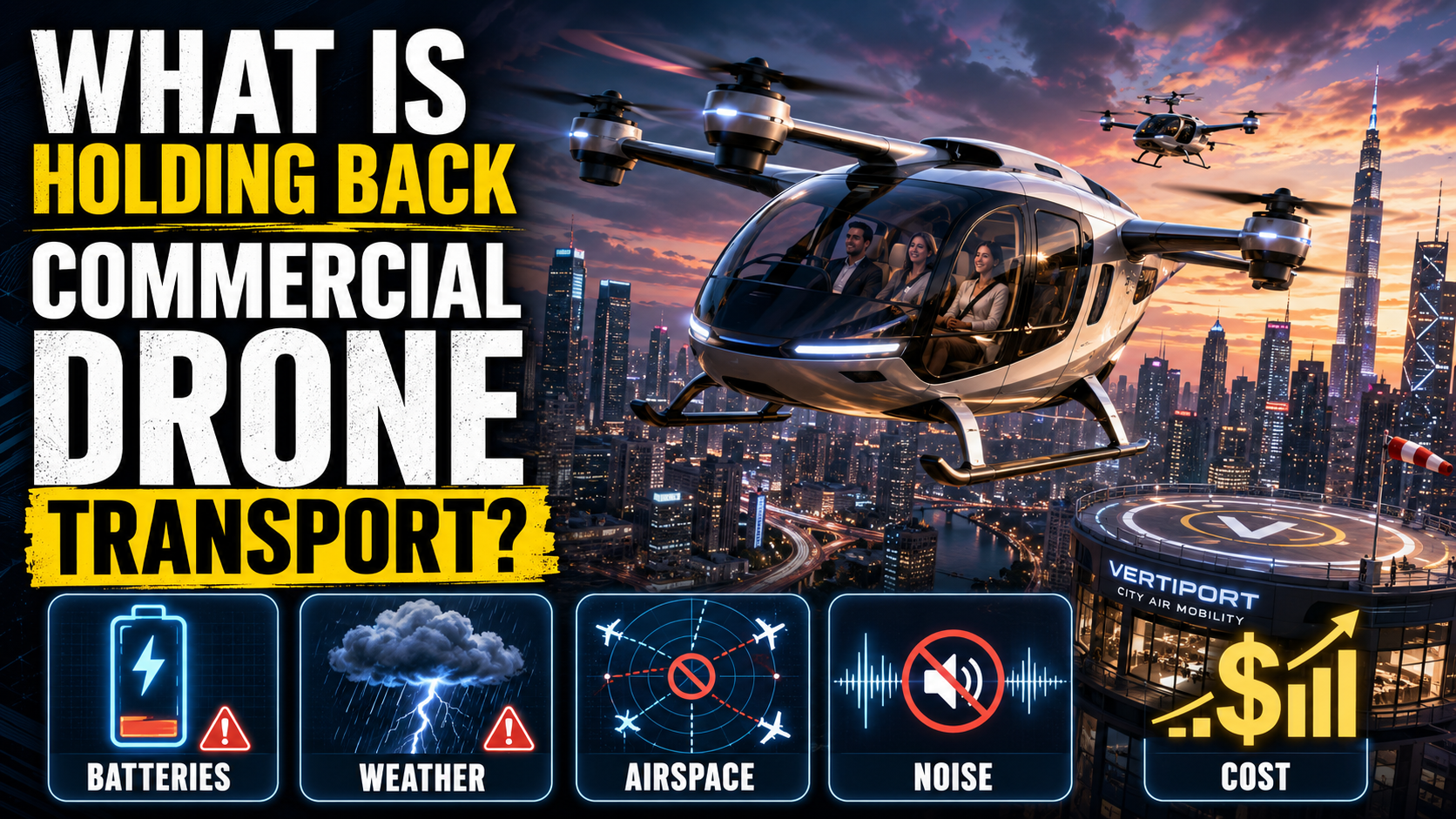
Commercial drone transportation sounds like one of the most obvious next steps in mobility.
Cities are congested.
Roads are crowded.
Airport transfers are slow.
Short city-to-city trips often take longer than they should.
A 30-minute trip by air can easily become a two-hour trip by car because of traffic, parking, bridges, tunnels, road design, or poor public transport connections.
So the idea is simple:
Why not go above the traffic?
Instead of sitting in a car, take a small electric aircraft from one part of the city to another. Instead of driving from an airport to downtown for 90 minutes, fly there in 10. Instead of taking a slow regional trip between two nearby cities, use a small electric air taxi that takes off vertically, flies like a plane, and lands close to the destination.
This is the promise of commercial drone transportation.
But the reality is more complicated.
The technology exists in prototype form. Companies are flying real aircraft. Regulators are building new rules. Some cities and countries are preparing early routes. Major companies like Joby Aviation, Archer Aviation, Wisk, EHang, BETA Technologies, Vertical Aerospace, and others are trying to make short-range electric aviation practical.
The FAA already describes Advanced Air Mobility as a new aviation era involving aircraft that are often highly automated, electrically powered, and capable of vertical takeoff and landing. Many of these aircraft fall into the powered-lift category and are commonly called air taxis.
So why are they not everywhere?
Why do we not yet have drone taxis operating like public transportation?
Why do we not have city-to-city drone shuttles between nearby urban areas?
Why are these vehicles still mostly in testing, certification, pilot programs, demos, and carefully controlled early operations?
The short answer is that flying over a city is not like launching an app.
Commercial drone transportation is not just a vehicle problem.
It is an aviation safety problem, a battery problem, a weather problem, an airspace problem, an infrastructure problem, a noise problem, a regulatory problem, an insurance problem, and an economics problem.
The longer answer is more interesting.
First, “drone transportation” is not just one thing
When people say “drone transportation,” they usually mix several different ideas together.
There are small delivery drones that carry packages.
There are larger cargo drones that carry medical supplies, logistics items, or military payloads.
There are autonomous passenger drones, like EHang’s EH216-S in China.
There are piloted electric vertical takeoff and landing aircraft, usually called eVTOLs.
There are electric aircraft that take off from runways, sometimes called eCTOL aircraft.
There are hybrid aircraft that use electric propulsion with a fuel-based generator.
And there are future concepts that may eventually fly without onboard pilots.
For this article, the focus is passenger drone transportation and air taxis inside cities or between nearby cities.
That mostly means eVTOL aircraft.
An eVTOL aircraft is not just a big quadcopter. Most serious air taxi designs are closer to a new category of aircraft. They take off vertically like a helicopter, transition to wing-borne flight like an airplane, and land vertically near the destination.
This is important because vertical takeoff is convenient, but wing-borne flight is much more efficient.
A pure multicopter has to fight gravity with rotor thrust during the entire flight. That consumes a lot of energy. A winged eVTOL can use rotors for takeoff and landing, then rely on wings during cruise. That is why many leading companies are building aircraft that combine helicopter-like vertical lift with airplane-like forward flight.
This is also why regulators call many of these aircraft “powered-lift.”
The FAA issued a final rule in 2024 for powered-lift operations, covering pilot and instructor certification as well as operational requirements. The FAA described this as the final piece needed to safely introduce these aircraft in the near term.
That does not mean mass adoption is ready.
It means the rulebook is starting to exist.
Demonstration flights are not public transportation
One of the biggest mistakes in this industry is confusing a successful flight with a successful transportation system.
A prototype flying is impressive.
A demo flight over a city is impressive.
A test aircraft landing at an airport is impressive.
But public transportation requires something very different.
It requires reliability.
It requires high utilization.
It requires predictable schedules.
It requires affordable pricing.
It requires maintenance at scale.
It requires passenger trust.
It requires weather tolerance.
It requires insurance.
It requires trained operators.
It requires charging infrastructure.
It requires airspace integration.
It requires landing sites near where people actually want to go.
It requires cities to approve the physical footprint and tolerate the noise.
A vehicle can fly perfectly in a test environment and still fail as a public transport system.
This is why air taxis are more likely to arrive first as premium airport transfers, limited city routes, event transport, medical flights, cargo routes, and high-value regional connections.
That is very different from replacing buses, metros, trams, or trains.
A city bus can carry 50 to 100 people. A metro train can carry hundreds or more. Most early eVTOL air taxis carry one pilot and four passengers, or sometimes fewer. Archer’s Midnight, for example, is designed for four passengers plus a pilot, with a range of up to 100 miles, speeds up to 150 mph, and short back-to-back trips around 20 miles.
That is useful.
But it is not mass transit.
It is a premium, low-capacity, high-speed transport layer.
The technology is real, but still early
It is fair to say that commercial drone transportation is no longer science fiction.
Joby Aviation began flight testing its first FAA-conforming aircraft in 2026, describing it as a major step toward FAA type certification and Type Inspection Authorization flight testing. Reuters reported that the aircraft seats a pilot plus four passengers and that Joby had logged more than 50,000 miles in developmental aircraft.
Archer Aviation said in May 2026 that its Midnight aircraft had closed Phase 3 of the FAA’s four-phase type certification process, while continuing work toward type certification and initial U.S. operations.
Wisk, backed by Boeing, is taking a different approach. It is developing an autonomous all-electric air taxi and says it has flown more than 1,750 test flights across earlier generations of aircraft.
EHang is even further ahead in one specific category. Its EH216-S has received type certificate, production certificate, standard airworthiness certificate, and air operator certificate approvals for pilotless human-carrying eVTOL aircraft from China’s Civil Aviation Administration. The EH216-S is a short-range autonomous passenger aircraft with a listed range of 30 km and maximum design speed of 130 km/h.
BETA Technologies is building electric aircraft and charging infrastructure, with both vertical takeoff and conventional takeoff variants. Its ALIA CTOL aircraft lists 5-passenger capacity and one-hour charging, and the company has been selected for the FAA’s eVTOL Integration Pilot Program.
Vertical Aerospace is developing its Valo aircraft to meet UK CAA and EASA SC-VTOL Enhanced category standards, with a four-passenger, one-pilot design, 150 mph cruise speed, and 100-mile range target.
So the industry is real.
But “real” does not mean “ready for mass public transportation.”
The aircraft exist.
The infrastructure does not yet exist at scale.
The regulations are improving.
The full certification path is still hard.
The economics are still unproven.
The public has not yet experienced these aircraft daily above cities.
And many companies still need a lot of capital before they reach mature commercial service.
The cautionary story: not every air taxi company will survive
A serious transportation article should not only mention the successful demos.
It should also mention the failures.
Air taxis are capital-intensive. Aviation is expensive. Certification is slow. Manufacturing is hard. Safety margins are unforgiving. A company can raise hundreds of millions or even billions and still fail before commercial launch.
Lilium, once one of Europe’s most visible eVTOL startups, moved into insolvency after failing to secure funding, with Reuters reporting that the company struggled with battery technology, regulatory hurdles, and high capital needs.
Volocopter also filed for insolvency in late 2024 and was later taken over by Diamond Aircraft in 2025.
These failures do not mean the entire industry is doomed.
But they are a reminder that air mobility is not software.
You cannot simply ship a minimum viable aircraft to the public and patch it later.
Aviation companies need working hardware, certified systems, manufacturing quality, maintenance operations, regulatory approval, pilots or autonomy frameworks, insurance, city partnerships, passenger demand, and enough cash to survive years of testing.
That is a brutal business model.
Battery physics is one of the biggest barriers
Electric aviation has a simple problem:
Batteries are heavy.
Jet fuel is energy-dense. Batteries are clean at the point of use and efficient through electric motors, but they store far less energy per kilogram than liquid fuels.
For cars, this is manageable because the road supports the vehicle’s weight.
For aircraft, every kilogram matters.
The aircraft must lift its own batteries. It must also lift passengers, luggage, structure, motors, rotors, wings, avionics, cooling systems, safety systems, and reserve energy.
Vertical takeoff makes this even harder.
A vertical takeoff uses a lot of power because the aircraft must generate enough thrust to lift itself straight up. This is why eVTOL aircraft are usually optimized for short flights rather than long routes.
Current battery energy density limits range, payload, and reserves, especially for passenger eVTOLs that need enough power for takeoff, cruise, landing, emergency diversion, and safe reserve margins. A 2026 aviation whitepaper on eVTOL challenges describes onboard energy capacity as the primary technological constraint for manned passenger eVTOL aircraft.
This is why early air taxi routes are usually short.
Airport to downtown.
Downtown to event venue.
One side of a bay to another.
City center to nearby business district.
A nearby city connection where ground transport is inefficient.
These routes can make sense if the time savings are large enough.
But they do not create a universal public transportation system.
If a vehicle has limited range, limited passenger capacity, and high operating cost, it must be used where speed is valuable enough to justify the price.
That is why the first realistic use case is not “everyone takes a drone to work.”
It is “some people pay for fast trips where the ground route is painful.”
Weather is a bigger problem than people think
Cars can drive in rain.
Buses can operate in wind.
Trains can usually run in fog.
Aircraft are different.
Small aircraft operating at low altitude inside cities are especially exposed to weather problems.
Urban air mobility must deal with wind, gusts, building wake turbulence, rain, lightning, fog, icing, heat, low visibility, and micro-weather patterns created by buildings and terrain.
A 2026 scientific assessment of urban air mobility explains that low-altitude urban operations will face dynamic micro-weather, including strong wind-speed gradients, updrafts, downdrafts, building wake shear, small-scale turbulence, urban vortex shedding, and localized icing in cold climates.
This matters because public transportation needs reliability.
A service that works only on perfect weather days is not public transportation.
It is a novelty.
If air taxis are delayed or canceled whenever wind, fog, heavy rain, or low visibility hits, passengers will still need backup transport. That makes the service less useful, especially for airport transfers and business travel.
Weather also affects economics.
If aircraft cannot fly enough hours per day, revenue drops.
If they need larger reserve margins, range drops.
If they need stronger systems to handle bad weather, weight and cost rise.
If operations require constant weather monitoring and conservative dispatching, complexity rises.
NASA-linked research has identified weather as a major barrier for urban air mobility, noting that safety and operational impacts from adverse weather will be key to community acceptance.
This is one of the least glamorous problems in air taxis.
The aircraft may work.
The weather may not cooperate.
Noise and public acceptance can make or break the industry
Air taxis are often described as quieter than helicopters.
That is probably true for many electric designs.
But “quieter than a helicopter” is not the same as “acceptable above a city all day.”
Noise is not only about decibels.
It is also about frequency, repetition, location, time of day, and whether people feel they benefit from the service.
A helicopter passing once may be annoying.
Hundreds of air taxi flights per day over residential neighborhoods could become politically impossible.
EASA’s study on the societal acceptance of Urban Air Mobility found that stronger focus on reducing noise footprint increased public acceptance for drone delivery and air taxi use cases by 11 percent, showing that noise is not a small issue.
Public acceptance also includes safety fears, privacy concerns, visual pollution, inequality concerns, and distrust of autonomous systems.
People may ask:
Will these vehicles fly over my house?
Will they be noisy at night?
Who benefits from them?
Are they just toys for rich people?
What happens if one crashes?
Can they be hacked?
Will they disturb parks, schools, hospitals, or historic districts?
Will they create another layer of transport inequality?
These questions matter because cities are political systems.
Even if regulators approve the aircraft, local governments still control zoning, vertiports, noise rules, community engagement, land use, and many practical deployment decisions.
A technically successful aircraft can still fail if the public does not want it.
Vertiports are harder than landing pads
A drone taxi needs somewhere to land.
That sounds simple until you think about scale.
A real vertiport is not just a painted circle on a roof.
It needs passenger waiting areas.
Security or identity checks, depending on the route.
Fire safety.
Emergency access.
Battery charging.
Grid connection.
Aircraft parking.
Maintenance access.
Weather monitoring.
Noise management.
Lighting.
Passenger boarding systems.
Accessibility.
Luggage handling.
Integration with taxis, buses, trains, walking routes, or parking.
Rooftop structural capacity.
Emergency landing procedures.
Local zoning approval.
Insurance.
A clear safety buffer around takeoff and landing.
And if the aircraft are electric, it also needs high-power charging infrastructure.
This is one of the biggest differences between a demo and a network.
A demo needs one aircraft and one landing site.
A transportation system needs many aircraft and many landing sites in useful places.
If vertiports are far from where people actually start and end their trips, much of the time saving disappears.
Imagine this:
You take a car to a vertiport.
Wait to board.
Fly for 8 minutes.
Land at another vertiport.
Take another car to your final destination.
The flight may be fast, but the full door-to-door trip may not be as magical as the marketing suggests.
This is why early routes will likely focus on places where the start and end points are obvious, such as airports, business districts, resorts, islands, waterfronts, hospitals, or event venues.
NASA’s Urban Air Mobility market study found that airport shuttle and air taxi markets could be viable under unconstrained assumptions, but it also highlighted constraints such as weather, infrastructure, and traffic volume.
That is the key word: constraints.
The air taxi dream looks best when constraints are removed.
Real cities are full of constraints.
Airspace is already busy
Cities are not empty above the roads.
There are helicopters.
Police aircraft.
Medical helicopters.
News helicopters.
Commercial airplanes near airports.
Private aircraft.
Military restrictions.
Temporary flight restrictions.
Drones.
Emergency operations.
No-fly zones.
Tall buildings.
Cranes.
Stadiums.
Weather balloons.
Birds.
And controlled airspace around major airports.
Adding thousands of air taxi flights per day is not just a scheduling problem. It is a safety-critical air traffic management problem.
Traditional air traffic control is not designed for dense, automated, low-altitude, high-frequency, on-demand aircraft operations inside cities.
The system has to know who is flying, where they are going, what altitude they use, what routes they follow, how they avoid each other, what happens in emergencies, and how they coordinate with existing aviation.
A 2025 study on urban air mobility implementation found that in the United States, top barriers include airspace utilization, remote or autonomous operations, and system safety and cybersecurity.
That makes sense.
A public drone transportation network cannot depend on every vehicle improvising.
It needs rules, corridors, separation systems, communication systems, backup systems, and emergency procedures.
This is especially important if the industry moves toward autonomy.
A piloted aircraft can talk to air traffic control.
An autonomous aircraft needs certified systems that can detect, decide, communicate, and recover safely.
That is much harder than building a flight demo.
Certification is slow because aviation is unforgiving
People often complain that regulation slows innovation.
Sometimes that is true.
But aviation regulation exists because aircraft failures can be catastrophic.
A car can usually pull over.
A train runs on tracks.
A bus can stop.
An aircraft has fewer options.
If something fails in the air, the system must remain safe.
This is why aviation requires redundancy.
Multiple motors.
Backup power.
Fault-tolerant controls.
Strong structures.
Certified software.
Battery safety.
Fire containment.
Reliable sensors.
Maintenance procedures.
Pilot training.
Emergency landing capability.
Safe operating envelopes.
Quality-controlled manufacturing.
And proof that the aircraft behaves safely across many scenarios.
The FAA’s powered-lift rule created a framework for pilots and operations, including visibility and minimum safe altitude requirements.
In Europe, EASA has its own VTOL certification framework, and it has received type certification requests for aircraft referred to as air taxis.
This is progress.
But every aircraft still has to earn certification.
That means testing hardware, software, batteries, controls, failure modes, maintenance procedures, manufacturing processes, and operational rules.
This is why the timeline is long.
It is not enough for the aircraft to fly.
It must be proven safe enough for paying passengers.
Pilots solve one problem and create another
Many early air taxi services will likely be piloted.
That makes sense.
Pilots help with certification, passenger trust, abnormal situations, and integration into today’s aviation system.
But pilots also create problems.
A pilot takes one seat.
A pilot adds cost.
A pilot requires training.
A pilot limits scalability.
A pilot may make labor a bottleneck.
For a four-passenger aircraft, adding a pilot means 20 percent of the seats are not revenue seats.
That matters.
If the long-term dream is affordable public transportation, autonomy is important.
But autonomous passenger flight over cities is one of the hardest possible versions of autonomy.
It requires aircraft-level safety, perception, communication, cybersecurity, weather decision-making, emergency planning, remote supervision, and public trust.
Wisk is one of the companies pursuing autonomous air taxis, but that path adds regulatory complexity because it removes the onboard pilot from the aircraft. Wisk says its aircraft are autonomous and all-electric, backed by Boeing, and based on six generations of aircraft development.
Autonomy may be the key to long-term economics.
But it is not the shortcut to early deployment.
In the near term, pilots may be necessary.
In the long term, pilots may be too expensive.
That is a difficult transition.
The economics are not yet public transportation economics
This is probably the biggest issue.
A public transportation vehicle has to move many people at low cost.
Air taxis move few people at high speed.
That can be valuable, but it is not the same business.
The cost stack includes:
Aircraft purchase or lease cost.
Battery replacement.
Maintenance.
Pilots or remote supervisors.
Insurance.
Vertiport fees.
Charging infrastructure.
Electricity.
Ground staff.
Software.
Air traffic coordination.
Regulatory compliance.
Depreciation.
Downtime.
Customer support.
Cleaning.
Security.
Weather cancellations.
If the aircraft carries only four passengers and needs expensive infrastructure, the fare has to be high unless utilization is extremely high.
This is why early routes will probably compete with premium taxis, helicopters, black car services, airport transfers, and business travel.
They will not compete directly with buses or metros.
A UK government evidence review cited market analysis suggesting that air taxis were unlikely to be ubiquitous and profitable in 2030, partly because of the capital cost required for large-scale urban operations.
McKinsey’s Advanced Air Mobility report also described the market opportunity as large but uncertain, with challenges including technology, regulation, public acceptance, air traffic management, and physical infrastructure.
That is the difference between a large future market and a guaranteed public transport revolution.
Air taxis can become a real market without becoming mass transit.
City-to-city routes may be more realistic than dense city routes
Inside cities, air taxis face noise, zoning, dense airspace, rooftop constraints, public acceptance, and limited landing sites.
Short city-to-city routes may sometimes be easier.
For example:
A route across water.
A route between two nearby cities with bad road connections.
A route between an airport and a business district.
A route connecting islands.
A route connecting rural areas to medical centers.
A route where existing public transport is weak.
A route where road congestion is severe and predictable.
A route between two controlled aviation sites.
This is why “regional air mobility” may become more practical than the fantasy of thousands of aircraft buzzing through every downtown.
Electric aircraft may work well where they connect existing airports, small airfields, heliports, or purpose-built vertiports.
The U.S. Advanced Air Mobility National Strategy says that by 2030 there could be new air operations in multiple urban and rural areas, including powered-lift and short-takeoff-and-landing flights, using vertiport infrastructure mostly funded by private sources.
That sounds realistic.
Not flying cars everywhere.
Not drones replacing metros.
But new aviation routes that fill gaps in the transportation network.
AI and software can help, but they cannot remove the hard parts
AI can make commercial drone transportation more realistic.
This is one of the most interesting parts of the industry.
AI and advanced software can help with:
Flight planning.
Route optimization.
Weather prediction.
Airspace coordination.
Obstacle detection.
Autonomous navigation.
Fleet scheduling.
Predictive maintenance.
Battery health monitoring.
Simulation.
Digital twins.
Pilot assistance.
Remote supervision.
Certification documentation.
Passenger operations.
Vertiport flow management.
AI can also speed up engineering.
Better simulation tools can help teams test more scenarios before physical flight. AI-assisted software development can help companies build control systems, operational platforms, testing tools, and fleet management systems faster. Data from test flights can be analyzed more quickly. Maintenance issues can be detected earlier.
For a company building an eVTOL, software is not secondary.
Software controls the vehicle.
Software manages the fleet.
Software connects passengers.
Software monitors batteries.
Software supports safety.
Software helps operations scale.
But AI does not cancel aviation reality.
AI cannot make batteries weightless.
AI cannot make bad weather disappear.
AI cannot make the public accept constant noise.
AI cannot certify an aircraft by itself.
AI cannot replace physical testing.
AI cannot remove the need for emergency procedures.
AI cannot make a four-seat aircraft behave like a metro train.
AI can accelerate progress.
It cannot make aviation easy.
Why commercial drone transportation is taking longer than expected
The reason this industry is taking so long is not that everyone is incompetent.
It is because the full system is hard.
The vehicle has to work.
The batteries have to be safe.
The aircraft has to be certified.
The manufacturing process has to be certified.
The pilots have to be trained.
The operators have to be approved.
The routes have to be planned.
The vertiports have to be built.
The grid connection has to support charging.
The airspace has to be managed.
The weather systems have to be reliable.
The insurance market has to understand the risk.
The public has to accept the service.
The business model has to make sense.
The fares have to be attractive.
The service has to be available when people need it.
The aircraft has to fly often enough to pay for itself.
Every one of those layers can delay deployment.
This is why commercial drone transportation often feels “almost here” but keeps taking longer.
The prototype is not the product.
The product is not the service.
The service is not the network.
And the network is not public transportation until it is safe, affordable, reliable, and useful at scale.
What will probably happen first
The most realistic future is phased.
First, we will see more demonstrations, pilot programs, and limited commercial services.
Then we will see airport transfer routes in cities where regulators, operators, and infrastructure partners are aligned.
Then we will see premium urban routes and event routes.
Then medical, emergency, cargo, island, and regional routes may expand.
Then autonomous operations may slowly appear in controlled conditions.
Then costs may decline as aircraft, batteries, maintenance, software, and operations improve.
Only after that could air taxis become a broader transportation layer.
The FAA’s eVTOL Integration Pilot Program is a sign that the industry is moving from pure theory into operational testing. The FAA says the program includes selected partners and is intended to help innovation and safety move together.
This is the right direction.
But it is not yet mass adoption.
The most likely near-term model is not a drone taxi on every street corner.
It is a small number of high-value routes.
Think airport to downtown.
Downtown to major business district.
City to nearby city.
Mainland to island.
Hospital to regional medical site.
Stadium to airport.
Luxury resort to airport.
That is still meaningful.
It just is not the Jetsons version.
Conclusion: commercial drone transportation is coming, but not as mass public transport yet
Commercial drone transportation is real.
The aircraft are flying.
The rules are being written.
Some companies are making serious certification progress.
China has approved EHang’s pilotless human-carrying eVTOL for commercial operations.
The United States has created powered-lift rules and launched pilot programs.
Europe has certification frameworks for VTOL aircraft.
Major companies are investing.
Cities are exploring vertiports.
AI and better software are accelerating testing, simulation, fleet management, and operations.
This is no longer pure science fiction.
But it is also not ready to replace public transportation.
The reason is simple:
Flying is hard.
Flying safely over cities is harder.
Flying safely, quietly, affordably, and repeatedly over cities as a public transportation service is much harder.
The biggest barriers are not only technical. They are systemic.
Battery limitations restrict range and payload.
Weather can disrupt schedules.
Noise can trigger public opposition.
Vertiports are expensive and politically difficult.
Airspace integration is complex.
Certification takes time.
Pilots raise costs.
Autonomy is harder than marketing suggests.
Insurance and maintenance are expensive.
Four-passenger aircraft cannot move people like buses, metros, or trains.
The likely future is not that drone taxis replace public transport.
The likely future is that they become a new premium layer above existing transport.
They may be useful for airport transfers, medical routes, emergency response, high-value business travel, island connections, regional mobility, and specific city-to-city corridors where ground travel is inefficient.
Over time, better batteries, better manufacturing, better software, AI-assisted operations, improved air traffic systems, and stronger infrastructure could bring costs down.
But the path will be gradual.
Commercial drone transportation will probably arrive first as a useful niche, then expand into a wider mobility category.
The optimistic view is that air taxis are coming.
The realistic view is that they will not become normal public transportation overnight.
The sky may become part of the urban transportation network.
But it will happen route by route, aircraft by aircraft, certification by certification, and city by city.