
Why Anthropic’s New Product Announcements Are Triggering Billions in Stock Market Losses
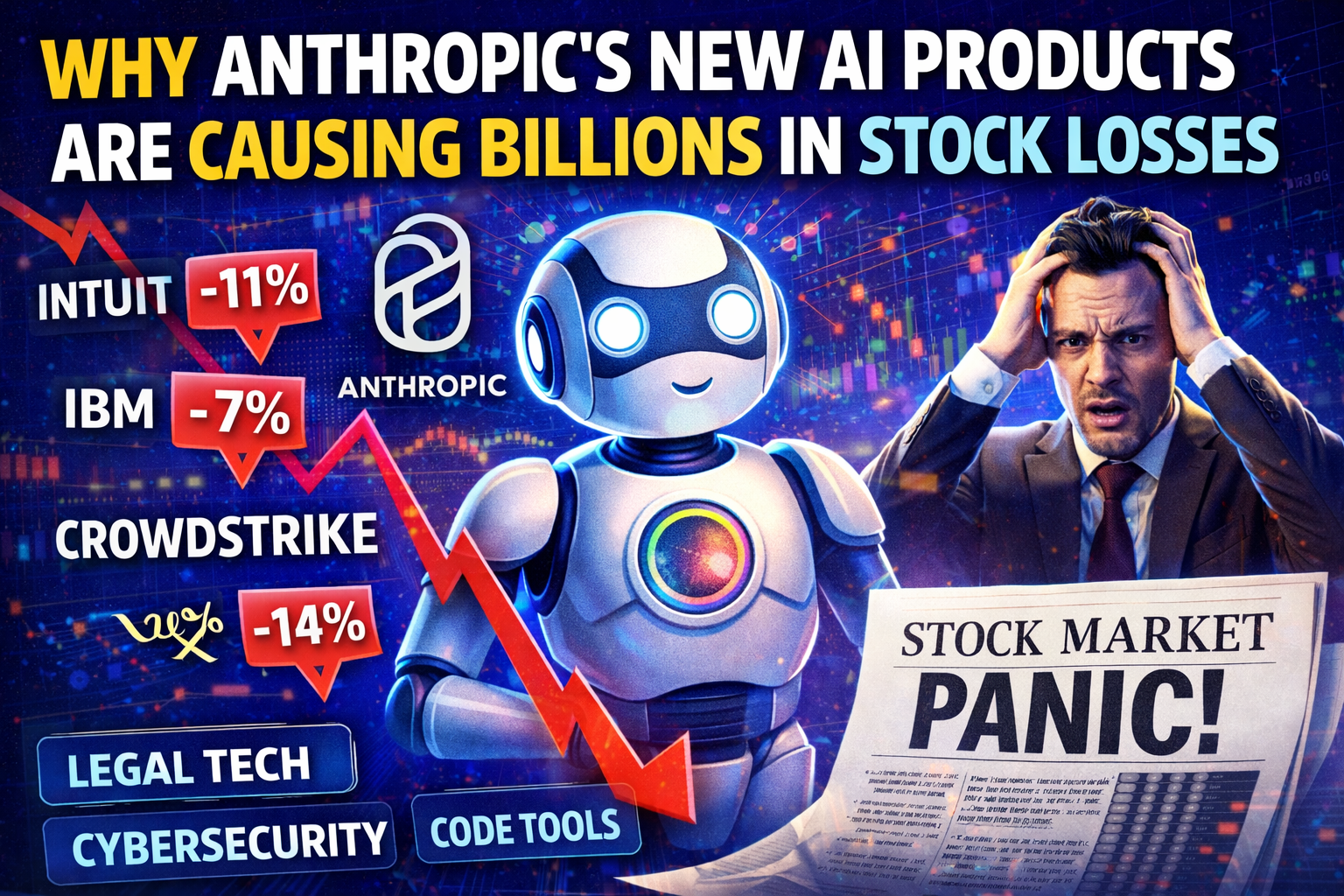
The short answer: Anthropic is forcing investors to reprice entire business models
What’s happening is not just “AI hype.”
Anthropic keeps announcing products that move Claude up the stack — from a chatbot to a system that can do real work in legal, sales, finance, data analysis, coding, security, and now even legacy modernization workflows. That makes investors ask a much more painful question:
“If Claude can do more of the actual work, what’s left for the software layer we used to pay for?”
That question is what wipes out market cap.
What actually triggered the selloffs
1) Claude Cowork plugins (legal / sales / finance / data)
Reuters directly tied the early-February software selloff to Anthropic’s Cowork plugin launch, which introduced automation across legal, sales, marketing, and data analysis. Anthropic’s own Cowork post confirms this positioning and says it open-sourced 11 plugins, including Legal, Finance, Data, and Sales.
This hit a nerve because it looked like Claude was no longer “just a model” — it was becoming an application-layer competitor to tools that charge premium subscriptions for exactly those workflows. Reuters explicitly described investor fears that LLMs are pushing into that lucrative enterprise layer.
2) Claude Code Security (cybersecurity stocks)
Reuters also reported a fresh selloff in cybersecurity names after Anthropic launched Claude Code Security, a feature that scans codebases for vulnerabilities and suggests patches. Anthropic’s announcement says it’s in limited research preview and is aimed at finding high-severity issues and proposing fixes for human review.
That was enough for investors to start pricing in a threat — even though analysts quoted by Reuters said the reaction was likely overdone and noted Claude Code Security does not replace core real-time security functions like live intrusion detection.
3) Claude Code messaging for COBOL modernization (legacy consulting fear)
Anthropic also published new messaging around COBOL modernization, arguing AI can automate analysis work that used to require “armies of consultants” and can compress projects from years to quarters. That’s exactly the kind of statement that makes investors panic about legacy modernization and services revenue.
Bloomberg’s headline reflects how seriously markets took it, reporting that IBM shares plunged as Anthropic highlighted COBOL modernization efforts.
Why the market reaction is so violent
1) Anthropic is attacking the “workflow,” not just the feature
Investors used to treat AI labs as infrastructure or copilots.
But Anthropic’s product direction (Cowork plugins, Claude Code Security, Claude Code enterprise workflows) tells the market something different:
Anthropic wants to own the workflow itself.
That means AI is no longer just helping existing software vendors — it may replace part of what they sell. Reuters even described this as LLMs “muscling into” the application layer.
2) AI compresses labor — and many software valuations were built on labor-heavy economics
A lot of legacy software and services businesses still depend on one or more of these:
charging per user seat
charging for analyst-heavy workflows
charging for expert review time
charging for “complexity management”
Reuters quoted analysts saying investors are repricing because AI lets companies do more with fewer staff, which threatens the traditional per-user model and the old “visibility premium” these businesses enjoyed.
That is a valuation shock, not just a product update.
3) Markets hate uncertainty more than bad news
The biggest issue is not that investors know exactly who loses.
It’s that they don’t know.
Reuters repeatedly framed the environment as one where AI is muddying valuations and business prospects, and that uncertainty is causing a broad “sell-everything” mindset in software. The result was a brutal drawdown in the S&P 500 software & services index.
When investors can’t model the impact cleanly, they de-risk first and analyze later.
4) Anthropic is credible enough now that the market takes its announcements seriously
This matters.
If a small startup makes bold claims, investors ignore it.
If Anthropic makes them, they react.
Reuters reported Anthropic at a $380 billion valuation, with a claimed $14 billion run-rate revenue, and said Claude Code alone was at over $2.5 billion run-rate, more than doubling since the start of 2026. Reuters also said business subscriptions to Claude Code had quadrupled, with enterprise now over half of Claude Code revenue.
That scale makes Anthropic’s product announcements feel like imminent competitive pressure, not distant experimentation.
5) The announcements keep stacking (plugins, model upgrades, security, code workflows)
Markets also react because Anthropic is shipping fast.
Reuters noted that Anthropic’s improved Claude model launch (Opus 4.6) came just days after the earlier selloff, with messaging around stronger reliability, coding/finance gains, larger prompts, and multi-agent Claude Code workflows. That reinforces the narrative that capability gains are compounding faster than incumbents can adapt.
In other words: every new release becomes “proof” for the bearish thesis.
Is the market overreacting?
In some cases, yes.
Reuters quoted cybersecurity analysts saying the selloff there was “panic-driven” and narrative-led, and emphasized that Anthropic’s security tool doesn’t replace major categories of security software. Reuters also reported analysts saying some software selloffs looked overdone.
So the better framing is:
Anthropic is not instantly killing these companies.
It is forcing the market to price in a future where their margins, pricing power, or growth may be lower.
That repricing alone can erase billions.
What founders and builders should learn from this
If you build software, this is the real lesson:
1) “Feature moats” are collapsing
If your product is mostly a workflow wrapper around knowledge work, investors (and soon customers) will ask why an AI-native workflow can’t do it cheaper.
2) The moat moves to data, distribution, trust, and integration
The tools that survive are the ones with:
proprietary data
system-of-record status
deep workflow integration
compliance / audit trust
strong UX around human review
(Which is exactly why Anthropic keeps stressing human approval in security and structured workflows in Cowork.)
3) Investors are repricing “who owns the user”
The market is no longer just valuing model makers vs SaaS companies.
It’s valuing who controls the actual work loop:
task comes in
AI reasons
AI executes
human approves
system logs it
Anthropic’s recent launches are all moving in that direction.
Final framing for your abZ.Global article
Anthropic’s announcements are causing billions in stock losses not because a press release instantly replaces an industry, but because they keep showing the same pattern:
Claude is moving from assistant → operator.
And when investors believe an AI company can start doing the core work of legal tools, security tooling, or legacy modernization, they reprice the incumbents immediately — often too aggressively, but not irrationally.