
What the Internet Is Saying About Gemini 3.1 Pro So Far (2026)
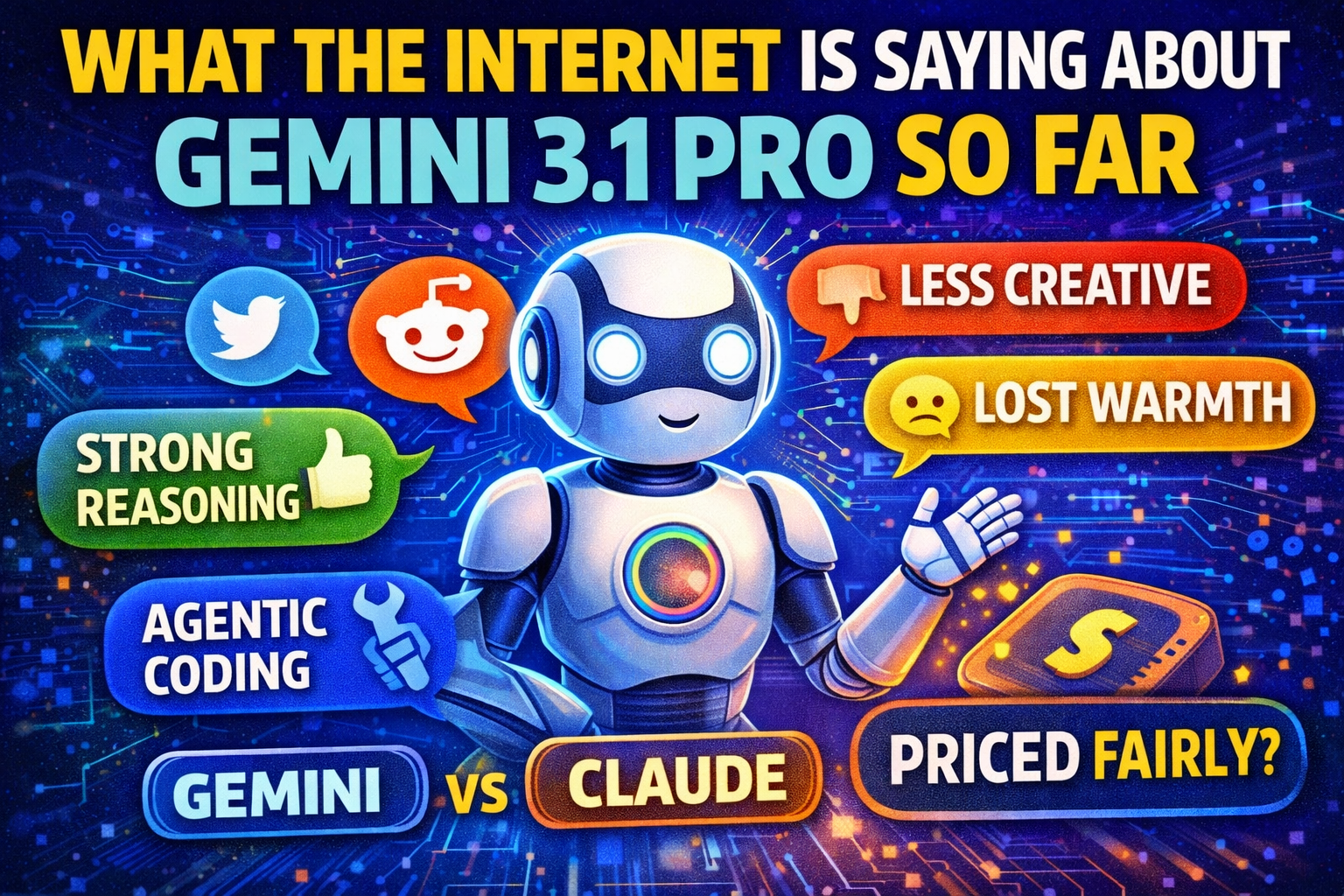
1) The core narrative: “bigger reasoning jump” + “better baseline”
Google is positioning Gemini 3.1 Pro as an upgraded “core intelligence” model meant for complex, multi-step tasks, rolling out across consumer + developer surfaces (Gemini app, NotebookLM, Gemini API, Vertex AI).
In plain terms: Google wants 3.1 Pro to feel like a stronger default for serious work, not just a marginal refresh.
2) Benchmarks are a big part of the hype (and they’re strong)
The most cited number online is ARC-AGI-2: 77.1% (and the comparison vs Gemini 3 Pro is dramatic).
The official model card also highlights strong results on:
GPQA Diamond (science knowledge)
Terminal-Bench 2.0 (agentic terminal coding)
SWE-Bench Verified (agentic coding)
Internet takeaway: “This is a real step up on paper,” especially for reasoning + tool-using workflows.
3) Developers are talking about reliability, tool use, and “less nonsense”
Google’s developer docs explicitly frame 3.1 Pro Preview as:
“better thinking”
“improved token efficiency”
“more grounded, factually consistent”
optimized for software engineering and agentic workflows
Also notable for builders:
multimodal inputs (text/image/video/audio/PDF)
large context (up to ~1M input tokens)
Internet takeaway: devs are paying attention because it’s being pitched as a model you can actually ship with fewer weird failures in multi-step tasks.
4) Distribution matters: it’s showing up in more places fast
One reason it’s being discussed a lot: it’s not “locked in a lab.” It’s appearing across mainstream tooling.
Examples people mention:
availability across Google surfaces and plans (Gemini app / NotebookLM in preview)
GitHub Copilot model picker (public preview rollout)
developer access via AI Studio / CLI / Antigravity / Android Studio (reported in early impressions)
Internet takeaway: “If it’s in Copilot and the Gemini ecosystem, we’ll test it.”
5) The biggest criticism: “did it lose the soul?”
A repeated theme in early reaction posts and coverage:
Some users like the more analytical, grounded style — others complain it feels less creative / less emotionally warm than before.
This pattern is common whenever a model gets tuned harder for “reliability,” so the internet is basically debating the tradeoff:
more precise + more consistent
vsmore human + more playful
6) Head-to-head comparisons: “Claude feels safer; Gemini feels more technical”
Early “battle test” style articles tend to land on a nuanced conclusion:
Gemini 3.1 Pro shines when the task is technical, structured, or multimodal/knowledge-heavy
Claude (in those tests) often wins for judgment, nuance, “real-world constraints,” and emotionally sensitive writing
Internet takeaway: people aren’t saying “Gemini wins everything.” They’re saying it’s now firmly in the top tier, but preference depends on the job.
7) Pricing chatter: “same ballpark, watch long prompts”
Builders are also discussing cost, and Google’s pricing page is now frequently referenced:
Gemini 3.1 Pro Preview (paid):
$2.00 / 1M input tokens (≤200k prompt) and $12.00 / 1M output tokens (≤200k prompt)
higher rates for prompts >200k tokens
Batch is cheaper (roughly half)
Internet takeaway: price is reasonable for the capability, but long-context prompts can get expensive fast if you’re not careful.
What builders should do with this information
If you’re deciding whether to try Gemini 3.1 Pro this week:
Use it for
multi-step reasoning work
agentic coding / tool-using workflows
long-context synthesis
multimodal analysis (docs + images + video inputs)
Be cautious if your app depends on
“warm” personality, emotional support tone, creative writing vibe (based on early feedback)