
Top Things Discussed at the India AI Impact Summit 2026 (Delhi) - and What It Means for Builders
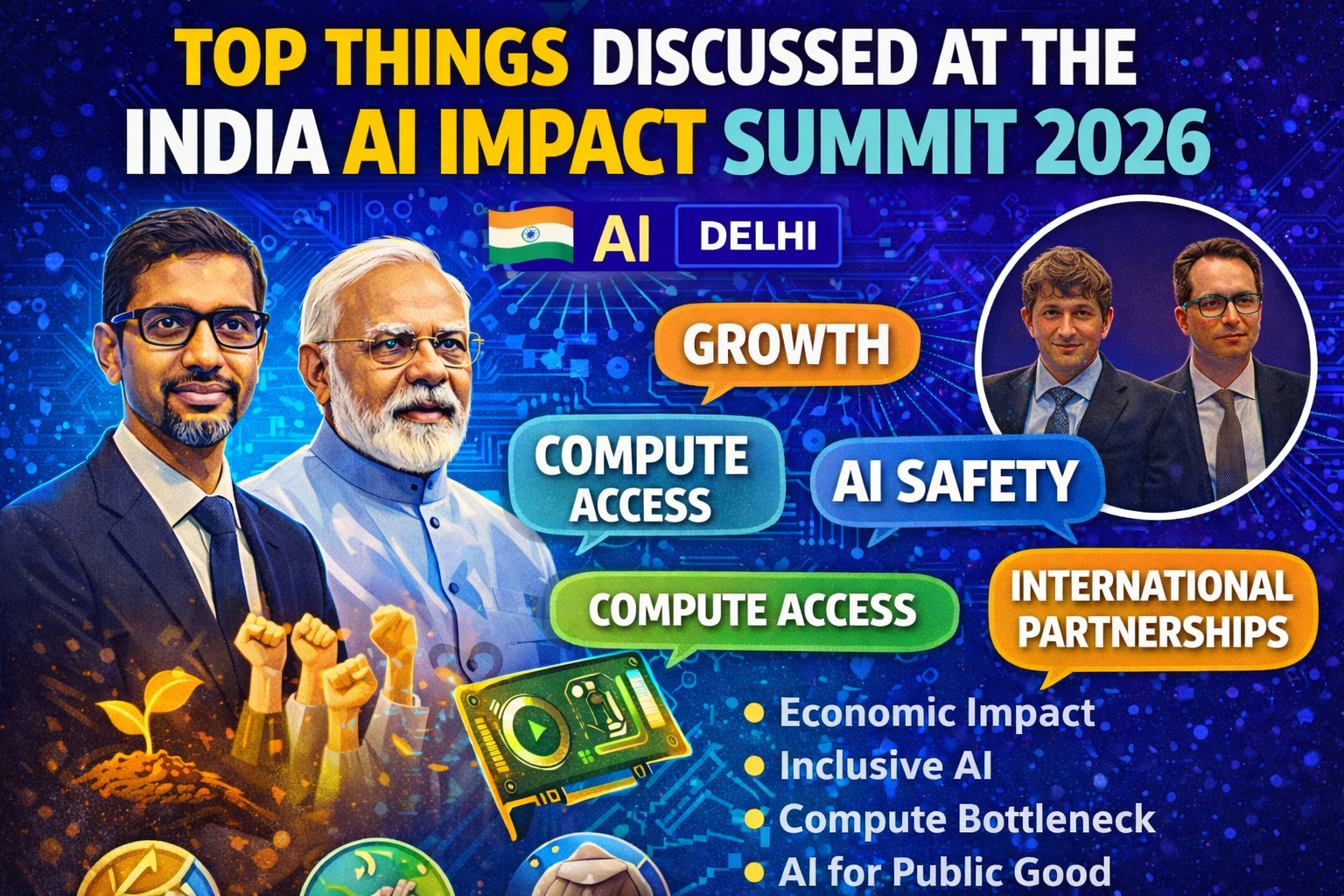
The India AI Impact Summit 2026 positioned itself as a Global South-led AI gathering focused on measurable outcomes: public services, infrastructure, jobs, and governance. The Government of India framed the summit around three pillars - People, Planet, Progress - with seven working-group themes spanning growth, compute access, inclusion, safety, human capital, science, and resilience/efficiency.
1) AI for economic growth and real-world outcomes (not demos)
A repeated thread across sessions was using AI to push productivity and growth through practical deployments - not just research or flashy prototypes. The World Bank’s programming emphasized “small AI” and practical pathways that link AI to productivity, jobs, and measurable development impact.
Builder takeaway: If you are shipping AI features, the winning story is not “we added AI,” it is “we reduced cost, time, errors, or improved conversion and service delivery.”
2) Democratizing compute + data infrastructure (the bottleneck everyone admits)
Compute access was treated as a core constraint - who gets GPUs, at what price, on what terms, and with what data-localization rules. The World Bank explicitly highlighted “access to compute and data infrastructure” as a central focus.
At the policy level, the summit’s working themes included “Democratizing AI Resources.”
You also saw this in “infrastructure-first” announcements:
A large AI-ready data center campus MoU in Gujarat (250MW, green / AI-ready positioning).
Builder takeaway: In 2026, “AI strategy” becomes “infrastructure strategy” faster than most teams expect (latency, cost, region, compliance, and vendor dependency).
3) Sovereign AI, localization, and “Bharat-first” models
A major theme was reducing dependence and building India-hosted and India-trained capabilities, especially for multilingual and regional use cases.
Example: Andhra Pradesh announced a partnership aimed at building a “Swadeshi AI stack,” including multilingual foundation models (with regional language support) and India-hosted cloud/GPU infrastructure.
Builder takeaway: If your customers are in India (or any multilingual market), “English-first” UX is a conversion tax. Multilingual flows, localized examples, and culturally-aware copy become product features, not marketing polish.
4) AI for public services: health, education, agriculture
This summit leaned hard into “AI that improves outcomes at scale.”
The World Bank highlighted examples of small AI already delivering results in:
agriculture (pest diagnosis from basic smartphone photos),
health (TB screening support),
education (lightweight AI tutors).
Builder takeaway: The most defensible AI products in the next wave are often boring on the surface: triage, routing, document workflows, screening, fraud, support ops, and training. They compound.
5) Safety, trust, and governance (plus the tension around enforcement)
“Safe and Trusted AI” was one of the seven summit themes.
Day 5 coverage emphasized multilateral governance and a Leaders’ Declaration roadmap.
But there was also pushback from civil society: Amnesty argued that human-rights concerns (surveillance, discrimination, privacy risks) were papered over, calling for binding guardrails and meaningful public participation.
Builder takeaway: Expect more procurement questions, more compliance language, and more “prove you are safe” requirements. Teams that can document data handling, model behavior, and human-in-the-loop processes will close deals faster.
6) Human capital: skilling, reskilling, and the jobs question
The summit’s official themes included Human Capital.
In parallel, political leaders pushed proposals like national AI coordination bodies and major reskilling initiatives to offset disruption.
Builder takeaway: Businesses will increasingly judge AI vendors by how well they fit into real teams: onboarding, workflows, training materials, audit trails, and “how does this change my staff’s day?”
7) International partnerships and alignment (cooperation + dependency debate)
A big storyline was India working with global AI leaders and institutions while navigating dependency risks.
The Guardian described intense interest in US AI capabilities and framed the geopolitical question of sovereignty versus reliance, including references to a US-India tech alignment push.
Economic Times reported a trilateral partnership (India, Kenya, Italy, supported by UNDP) focused on sovereign AI adoption across Africa.
Builder takeaway: If you sell AI products internationally, “where your model runs” and “whose infrastructure you depend on” is becoming part of the sales conversation.
8) The viral moment: Sam Altman + Dario Amodei didn’t do the “hand-holding” photo op
Yes, that happened, and it went viral. During a staged on-stage moment prompting leaders to hold hands, reporting described OpenAI’s Sam Altman and Anthropic’s Dario Amodei keeping their hands apart, highlighting the competitive tension between major AI labs.
Why it matters (briefly): It became a meme, but it also reflects the real dynamic underneath the summit - cooperation in public, competition in private, and a race for distribution, compute, and influence.
What this means for product teams (practical checklist)
If you are building products (or choosing vendors) after this summit, here’s the most useful mental model:
Start with the impact metric (time saved, cost reduced, conversion increased).
Plan for compute constraints (cost ceilings, region, latency, vendor lock-in).
Localize early (language, examples, UI copy, support).
Treat governance as a feature (logs, controls, approvals, policy, auditability).
Build human workflows (training, handoffs, escalation paths).
Design for public trust (privacy, data minimization, transparency).