
Dubai’s Luxury Has a Strategic Flaw: Safe Streets, Exposed Skies
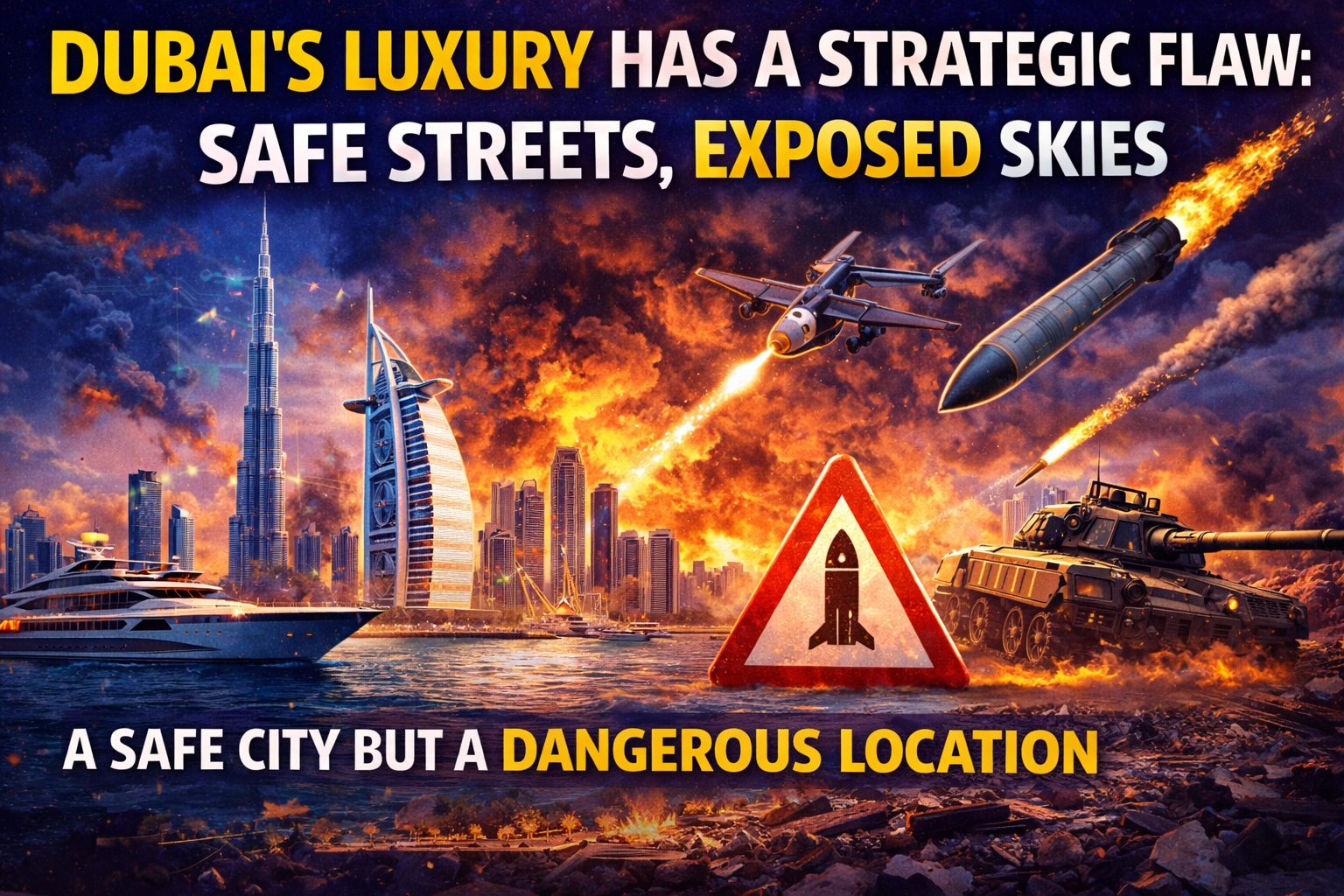
Dubai is safe - until the threat is not human-to-human
One of Dubai’s greatest strengths is real: daily life there feels orderly, modern, and physically safe compared with many global cities. But the recent Iran-related attacks exposed a different category of vulnerability entirely.
The issue is not street crime.
The issue is geopolitics, geography, and airspace.
After the U.S. and Israel launched strikes on Iran, Iran retaliated across the region. Reuters reported missile and drone attacks across Gulf states, with blasts heard in Dubai, damage to infrastructure in the UAE, and Dubai’s “safe-haven” image suddenly put under pressure.
The uncomfortable truth: luxury does not equal strategic security
Dubai has built one of the most impressive urban brands in the world:
luxury real estate
tourism
aviation
trade
finance
global talent inflow
But all of that sits in a region where a large-scale war can reach the city fast.
Reuters reported damage in and around Dubai including the airport area, the Burj Al Arab zone, Palm Jumeirah, homes hit by shrapnel, and a fire at Jebel Ali Port caused by debris from an aerial interception. Even where casualties were limited, the symbolism was huge: one of the world’s premier “safe lifestyle” cities was no longer psychologically insulated from war.
The flaw is geographic before it is military
The deeper problem is location.
Dubai is in a region dense with strategic infrastructure, energy routes, U.S.-aligned states, and military assets. Reuters noted that several Gulf states hit or threatened in the recent escalation - including the UAE, Qatar, Kuwait, and Bahrain - host U.S. military presence, making them part of the retaliation map when conflict with Iran expands. Analysts quoted by Reuters said Iran’s message was that no U.S. ally in the region is beyond reach.
That means even if Dubai itself is not the central belligerent, it can still be exposed because of:
proximity
alliance structures
shared airspace risk
nearby military targets
dependence on regional calm
Important nuance: the UAE is not undefended
It would be inaccurate to say Dubai or the UAE has no military defense.
In fact, the UAE and other Gulf states intercepted many incoming projectiles during the recent attacks. Reuters reported repeated interceptions across Gulf states, and UAE authorities said much of the incoming fire was dealt with before direct impact. But that still did not prevent disruption, debris, infrastructure damage, airspace shock, panic buying, and psychological damage to Dubai’s core promise of stability.
So the real argument is not:
“Dubai has no defense.”
It is:
“Even with defense, Dubai cannot fully escape the risks created by its geography.”
A city built on confidence is unusually sensitive to regional war
This matters because Dubai’s economy is not based mainly on oil. Reuters noted that its model depends heavily on trade, tourism, aviation, property, and financial services. That makes perception incredibly important.
If missiles, drones, or even interception debris disrupt airports, ports, hotels, or the city’s psychological image, the damage is larger than the physical blast radius. A city like Dubai runs on confidence:
confidence that flights keep moving
confidence that expats feel secure
confidence that wealthy buyers keep buying
confidence that companies keep relocating staff there
Reuters reported that UAE markets were disrupted, air traffic was affected, and financial firms began discussing contingencies after the strikes. That is exactly what a strategic flaw looks like in practice: not instant collapse, but sudden doubt in a model built on predictability.
The biggest weakness is that Dubai cannot relocate its risk
Dubai can build more towers.
It can build better hotels.
It can market itself brilliantly.
It can even strengthen defenses.
But it cannot move itself out of the Gulf.
And that is the key point.
When a regional war breaks out, geography overrides branding. The city’s polished surface cannot fully protect it from:
missile range
drone swarms
airspace closures
maritime disruption
investor fear
That is why Reuters framed the recent attacks as a test of Dubai’s “safe-haven” status, not just a temporary security incident.
What the recent Iran war showed
The U.S.-Israeli strikes on Iran, followed by Iranian retaliation across the Gulf, demonstrated something many investors and residents may have underweighted:
Dubai is safe in peacetime, but highly exposed in a major regional war.
Reuters reported that Iran’s strikes widened across Gulf states, hit infrastructure, shook the UAE’s stability narrative, and raised fears that the region’s business hubs could be drawn deeper into conflict. Analysts warned this could harden Gulf alignment with Washington while simultaneously showing how exposed these states are when war with Iran expands.
That is the contradiction at the center of Dubai:
extraordinary urban success
paired with unavoidable strategic exposure
Dubai’s luxury has a big flaw - not because the city is unsafe person-to-person, but because its prosperity depends on regional calm that it cannot fully control.
Recent strikes did not prove Dubai is weak.
They proved something subtler and more important:
A city can be extremely safe socially, highly advanced economically, and still be strategically vulnerable in war.
In other words:
Dubai has mastered lifestyle security.
It has not escaped geopolitical security.