
Was the UAE Prepared for Iran’s Missile and Drone Attacks? A Technology-Focused Look at Dubai’s Air Defense
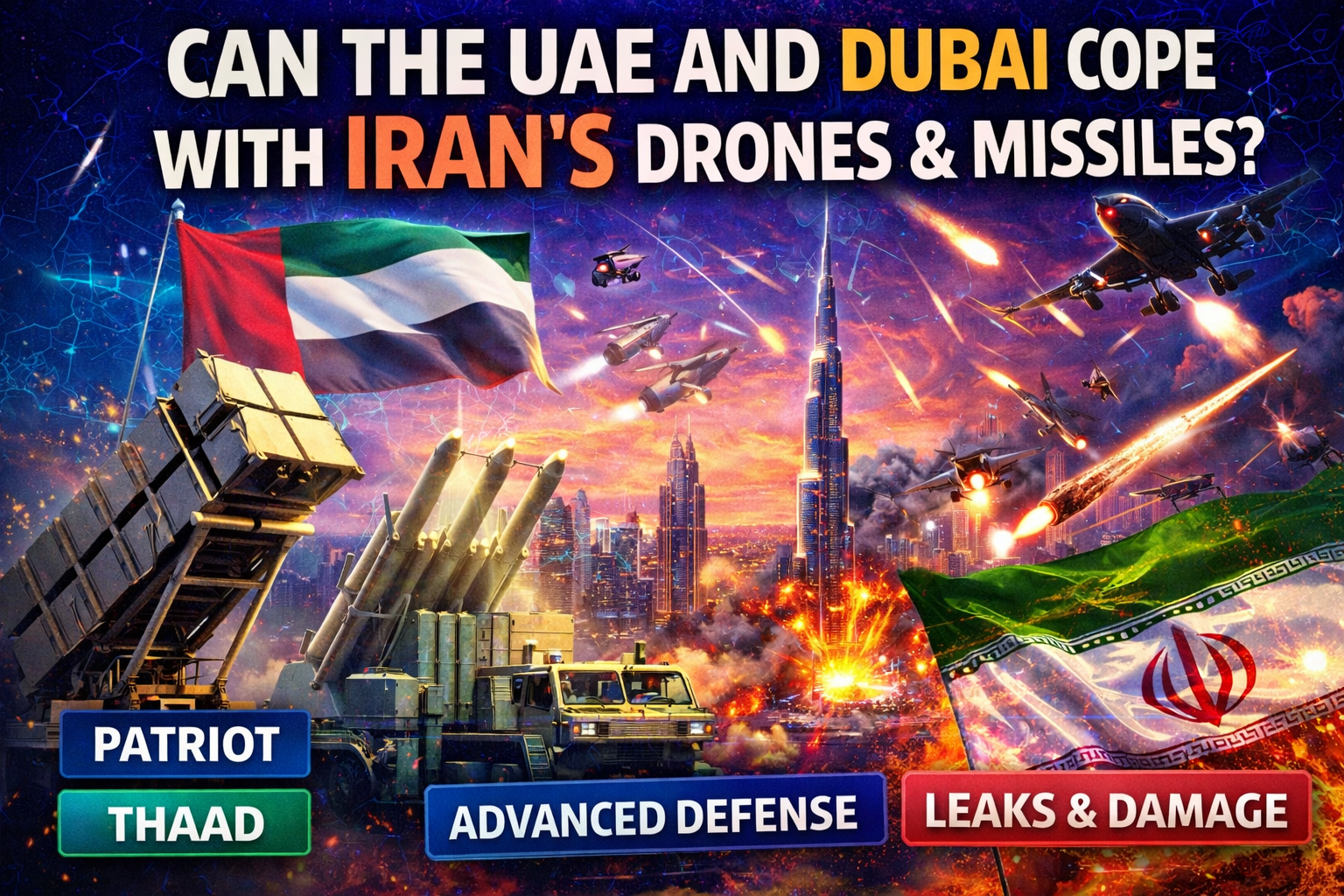
The short answer
Yes — the UAE was preparing for this kind of scenario. But no — that does not mean it can make Dubai or the UAE fully untouchable in a major war.
That is the fairest conclusion.
The UAE has spent years building a serious air-and-missile defense architecture, and recent official statements show it intercepted large numbers of incoming Iranian ballistic missiles, cruise missiles, and drones. But the same recent attacks also showed the limits: debris still fell, people were still killed and injured, and high-value civilian and economic sites were still disrupted.
First: Dubai does not have its own separate shield
When people ask whether Dubai can defend itself, the real subject is the UAE’s national integrated air-defense network.
Publicly documented elements of that network include:
THAAD for terminal ballistic missile defense,
Patriot / PAC-3-related systems for lower-tier missile defense and homeland defense,
fighters and air-defense forces operating as part of the national response,
and regional coordination with other Gulf states.
So the real question is not “Does Dubai have its own dome?”
It is: How strong is the UAE’s national shield, and how much stress can it handle?
Was the UAE actually prepared for this scenario?
To a meaningful extent, yes.
This was not a threat that appeared out of nowhere. The UAE had already experienced mixed attacks involving drones, cruise missiles, and ballistic missiles during the 2022 Houthi strikes. Reuters reported at the time that the UAE said such weapons were used together in the assault, and that some were intercepted. After those attacks, Reuters also reported that the UAE sought replenishment for THAAD and Patriot interceptors, while the United States moved to assist its defenses.
That matters because it shows the UAE had already learned a hard lesson years earlier: the danger was no longer just classic aircraft or isolated rockets. The danger was the mixed salvo — drones, cruise missiles, and ballistic missiles used together.
On top of that, U.S. defense notifications show the UAE continued to buy and expand both THAAD and Patriot-related capabilities in later years, which strongly suggests long-term planning for repeated or larger attacks rather than an assumption of permanent calm.
So the right framing is:
The UAE was not asleep.
It had been preparing for years.
But preparation is not the same thing as invulnerability.
What the recent attacks showed
The most important evidence comes from the attacks themselves.
The UAE’s state news agency, citing the Ministry of Defence, said that by March 1 the country had dealt with 165 ballistic missiles, 2 cruise missiles, and 541 drones since the Iranian attack began, with most destroyed and some debris causing property damage. The same official statement said there were three fatalities and dozens of injuries.
At the same time, Reuters reported damage in Dubai to the international airport area, the Burj Al Arab, Palm Jumeirah, and the Jebel Ali port area, where debris from an intercepted missile caused a berth fire and DP World temporarily paused operations at Jebel Ali Port. Reuters also reported injuries from falling shrapnel and damage from debris in Abu Dhabi.
That tells you two things at once:
The UAE’s defense system is real and capable.
It still cannot promise a clean, consequence-free shield in a dense urban and economic environment.
Why the UAE’s system is technologically serious
A lot of commentary swings between two extremes:
“The UAE is helpless,” or
“The UAE is fully protected.”
Neither is accurate.
1) THAAD gives the UAE a serious ballistic-missile layer
THAAD is designed to intercept ballistic missiles in their terminal phase of flight, using an X-band radar and hit-to-kill interceptors. CSIS describes it as a transportable system that can defeat short-, medium-, and intermediate-range ballistic missiles inside or outside the atmosphere.
That is a major capability, especially in a region where ballistic missiles are a real threat.
2) Patriot adds a lower-tier layer
The UAE also has Patriot / PAC-3-related capability, and U.S. defense documentation describes those systems as part of homeland defense and deterrence for regional threats. Raytheon says Patriot can counter tactical ballistic missiles, cruise missiles, drones, and advanced aircraft.
That matters because not every threat comes in at the same altitude, speed, or radar profile.
3) The UAE is not operating blind
Reuters reported that Gulf states activated joint air-defense systems and reconnaissance flights as the crisis widened. That means warning, tracking, and response are not just local battery-level issues — they are tied into broader regional coordination.
But here is the hard truth: “coping” is not the same as “being safe”
This is where the technology story gets more realistic.
Even a strong layered defense still leaves three major risks:
1) Leakage
Some threats may get through, especially in a prolonged or highly mixed attack.
2) Debris
Even successful interceptions can still send burning fragments and shrapnel into civilian areas. The recent attacks demonstrated exactly that in both Dubai and Abu Dhabi.
3) Disruption
A missile does not need to destroy a city to damage the system around it. If ports pause, airport areas are hit, roads go quiet, panic buying starts, and businesses shut temporarily, the attack is already achieving part of its effect. Reuters described panic buying, unusually subdued streets, quiet neighborhoods, remote-work guidance, and shaken confidence in Dubai’s image as a safe haven.
So even when the defense “works,” the country can still take a serious hit economically and psychologically.
The hardest challenge is the mixed attack
From a technology perspective, the most dangerous Iranian profile is not one missile type by itself.
It is a mixed campaign:
ballistic missiles to force high-end interceptor use,
cruise missiles to exploit lower-altitude detection challenges,
drones to stretch radars, fighters, operators, and interceptor inventories.
The UAE had already seen this kind of mix in 2022, and the recent war reinforced that it remains the core problem.
That is why the right question is not “Can the UAE shoot down missiles?”
It clearly can.
The harder question is: Can it keep doing that repeatedly, at scale, across days or weeks, without major leakage, disruption, or depletion?
That answer is less comfortable.
The economics are a hidden weakness
There is also a cost problem.
Advanced missile defense is expensive. Reuters reported in 2024 that missile-defense systems such as THAAD and Patriot are extremely costly, and that high-powered radars, computers, and interceptor missiles run into the billions. Reuters also noted that even wealthy countries are being pushed to invest more heavily in missile defense because of growing missile threats.
That means the UAE can absolutely build a formidable shield — but sustaining it against repeated, mixed attacks is not cheap. Over time, long wars become not only a military problem, but also an inventory and economics problem.
So can the UAE cope with Iran’s air attacks?
The best grounded answer is:
Against limited or medium-size bursts: yes, probably better than most regional states.
Against a prolonged, repeated, mixed saturation campaign: only partially, and not without damage and disruption.
That conclusion fits the available evidence:
the UAE has real layered defenses, not symbolic ones;
it had clearly been preparing for this type of threat for years;
it intercepted a large share of recent incoming threats;
but recent attacks still caused casualties, damage, fires, and pauses to critical commercial infrastructure;
and Reuters reported that the wider Gulf states themselves are now treating these attacks as severe enough to justify joint air-defense activation and collective self-defense messaging.
The UAE was prepared in the sense that it invested, learned, upgraded, and built a layered defense for years.
But the recent attacks showed the limit of that preparation:
The UAE can blunt Iran’s air attacks.
It cannot erase them.
That is the real technology verdict.
Dubai and the wider UAE are not undefended. They are among the better-defended states in the region. But when a wealthy, visible, trade-dependent country sits inside missile and drone range, even strong defense becomes a game of damage reduction, not perfect immunity.