
SpaceX just bought its way into the AI coding race with a $60B option on Cursor
What actually happened
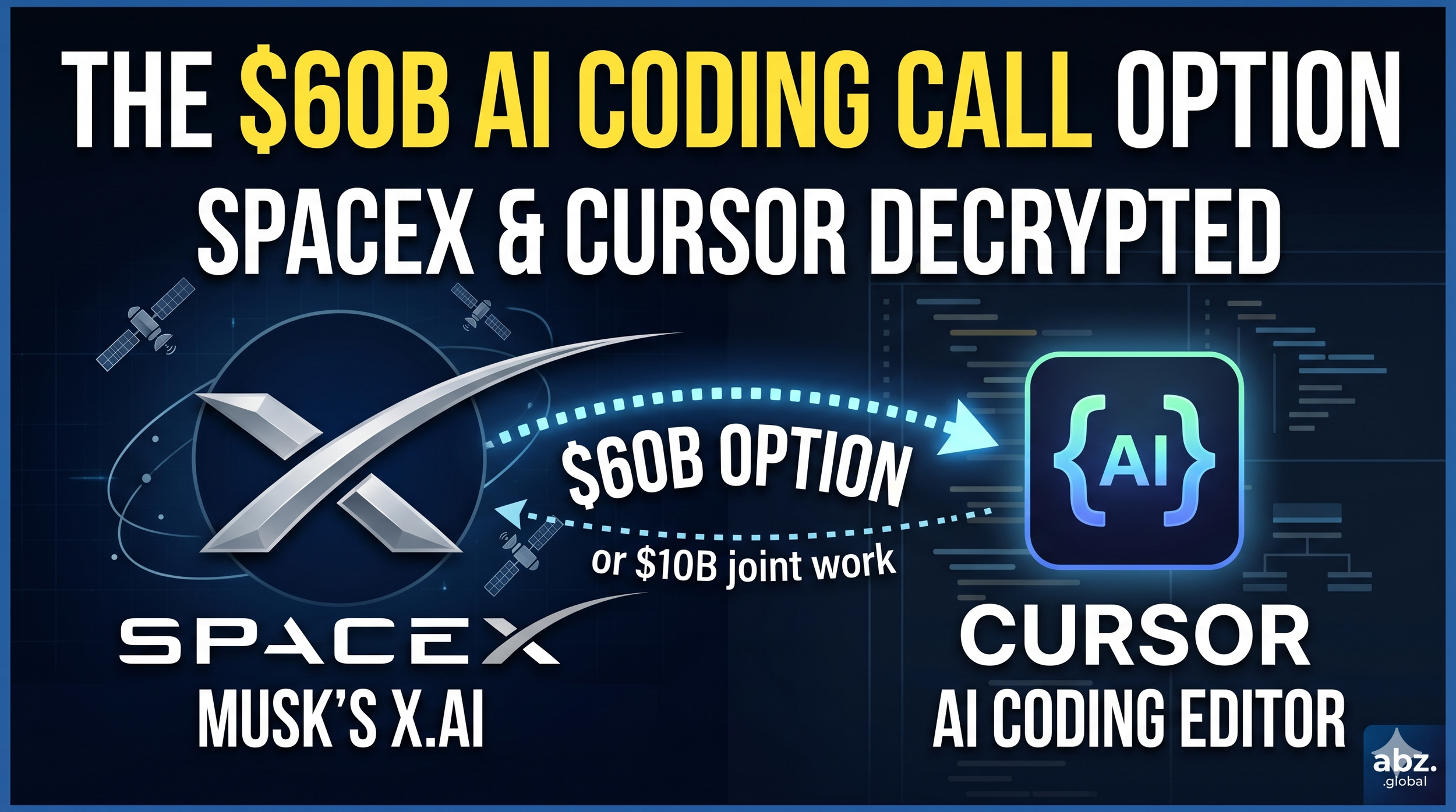
On April 21, SpaceX posted on X that it has an agreement with Cursor, with two possible outcomes later this year.
SpaceX said it has struck a deal with Cursor to develop a next-generation "coding and knowledge work AI," which includes a surprising provision - an option to buy the popular software development platform for $60 billion later this year.
The alternative path is paying Cursor $10 billion for joint work instead of acquiring it outright.
This is not a normal acquisition announcement. It is basically a call option on one of the fastest growing companies in software, signed by the same group that now owns xAI after the February merger with SpaceX.
Why this is a strange deal
Most acquisitions are binary. You buy the company or you do not.
This one gives SpaceX optionality. It can watch how the partnership plays out, then decide between a $10B bill and a $60B takeover. It also quietly removes Cursor from the table for any competitor that might have wanted to buy it first.
That is the real trick here. Even if SpaceX never exercises the option, it has already reshaped the market.
The Cursor valuation story is wild
A quick look at how fast this company moved:
January 2025: valued around $2.5 billion
May 2025: around $9 billion
November 2025: $29.3 billion post-money on a $2.3B Series D
April 2026: a $60B option and a fundraise targeting over $50B
Cursor was valued at just $2.5 billion in January of last year, climbed to $9 billion by last May, and was assigned a $29.3 billion post-money valuation when it closed on $2.3 billion in Series D funding in November.
That is roughly a 20x move in about eighteen months. Not for a social app. For a code editor.
Why SpaceX wants it
The honest answer is that xAI has a coding problem.
After the xAI merger, Musk went through heavy layoffs and the company lost most of its original co-founders. Cursor brings three things xAI cannot easily build in house right now.
A proven product. Cursor 3 is already the default AI-first editor for a huge share of professional developers.
Codebase intelligence. Cursor has spent years getting good at indexing and reasoning over large monolithic repos, which is exactly the kind of work Tesla, SpaceX, and X internally need.
Talent. Two of Cursor's senior engineers, Andrew Milich and Jason Ginsberg, already left to join xAI reporting directly to Musk.
Buying Cursor is faster than rebuilding it.
The awkward part for Anthropic and OpenAI
Here is the detail that gets less attention but matters a lot.
Cursor still uses and sells access to Claude and GPT models even as both firms roll out their own coding tools, an awkward arrangement that this new SpaceX partnership may be designed to eventually escape.
Cursor today is a major distribution channel for Claude and GPT in the coding workflow. If xAI successfully trains a Cursor-native model on the Colossus supercomputer, that distribution can be quietly rerouted.
This is not just SpaceX buying a developer tool. It is SpaceX trying to own the surface where professional developers actually spend their hours.
What this means if you build software for a living
For individual developers
Short term, nothing changes. Cursor still works, still talks to Claude and GPT, still ships updates. Long term, expect pressure to try an xAI-trained model inside Cursor. Keep an eye on pricing and default model settings, because that is where these shifts usually show up first.
For agencies and freelancers
The AI coding category is consolidating around a few very well funded players. If your client work involves AI-assisted development, your stack is about to have fewer real choices. It is worth being model-agnostic at the architecture level, so switching between Claude, GPT, and whatever xAI ships next is a config change and not a rewrite.
For SaaS founders
This deal confirms something that has been true for a while. AI-native workflow tools are being priced like platforms, not like software. A code editor at $60B is not an editor anymore, it is infrastructure. If you are building in a workflow category, your moat is not the features, it is the habit your users form and the data you accumulate from that habit.
The bigger picture
SpaceX is heading into what might be the largest IPO ever. Wrapping a high-margin, high-growth AI coding business into that story makes the pitch a lot more interesting than rockets and Starlink alone.
Musk is also building a closed loop. Compute from Colossus, models from xAI, distribution through X, and now potentially the IDE where developers actually write code. Every layer of that stack points back to one owner.
Whether that is good for developers depends entirely on how open the Cursor experience stays once the ink is dry.
Takeaways
The deal is structured as an option, not a purchase, which gives SpaceX cheap optionality and locks Cursor out of the market.
Cursor went from $2.5B to a $60B option price in fifteen months, which resets expectations for every late-stage AI company in the pipeline.
The real target is not the editor, it is the default surface for professional coding work and the models running inside it.
If you ship software for clients or for yourself, keep your stack portable. The next twelve months in AI coding are going to be loud.