
Google's new TPU 8t and TPU 8i signal the real AI race is about inference, not training
What Google announced
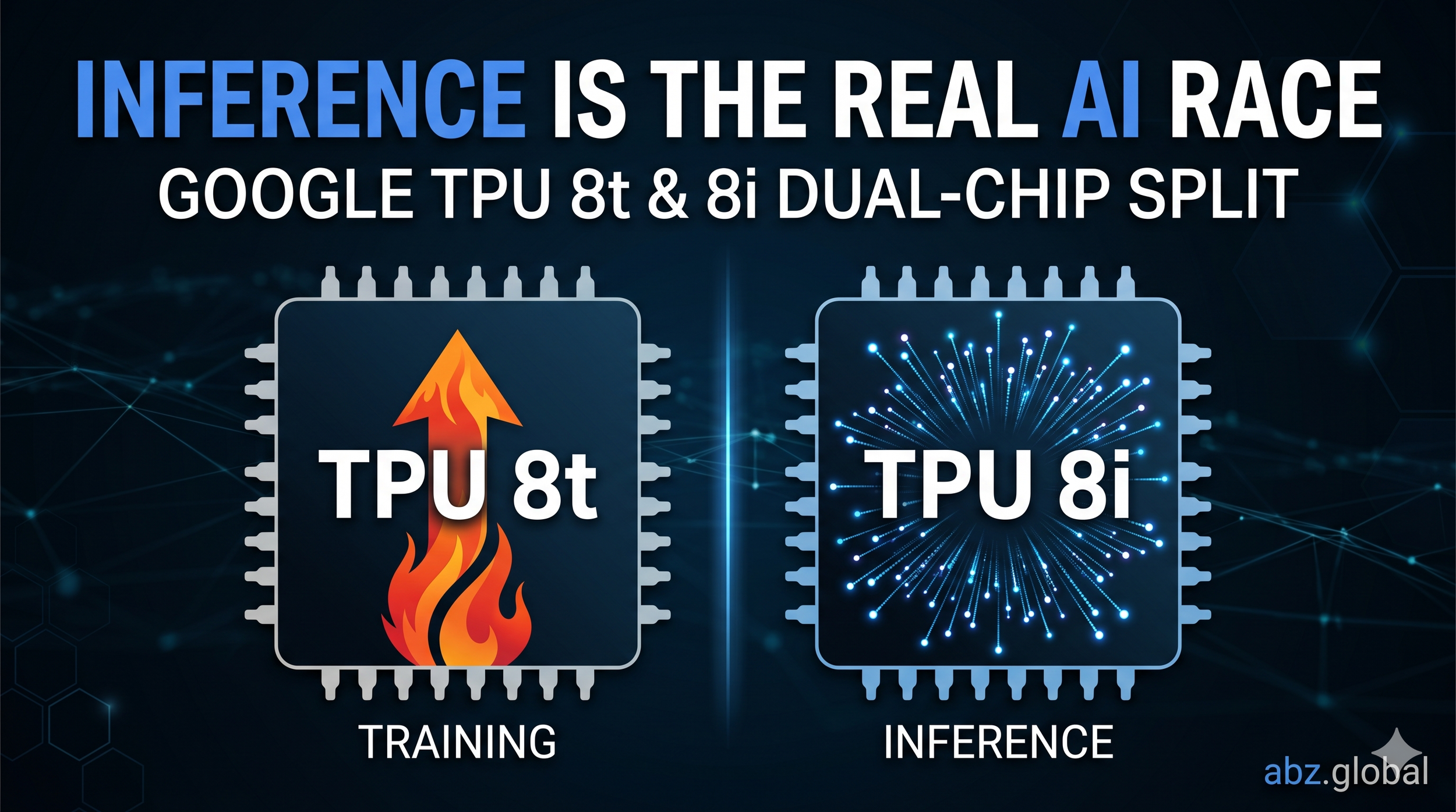
At Google Cloud Next 2026, Google introduced the eighth generation of its TPUs and did something it has never done before. It split the lineup into two chips instead of one.
TPU 8t is built for training. TPU 8i is built for inference.
According to Google's own post, TPU 8t delivers nearly three times the compute performance per pod compared to the previous Ironwood generation. TPU 8i connects 1,152 TPUs in a single pod, designed specifically to run millions of agents concurrently at low latency and low cost.
That second sentence is the interesting one.
Why the split matters
For years, the AI conversation has been dominated by training. Bigger models, more parameters, more FLOPs, more benchmarks.
Google is signaling a shift. The hardware is now being specialized around the assumption that the real workload in 2026 and beyond is not training frontier models, it is running agents in production.
Training is a cost you pay once. Inference is a cost you pay every single time a user or agent does something. As soon as you scale to millions of concurrent agents, inference economics stop being a footnote and start being the entire business model.
TPU 8i is basically Google saying the quiet part out loud. The money is in the inference layer.
The timing is not random
This announcement landed on day one of Google Cloud Next 2026, where the opening keynote theme was "the agentic cloud."
Put the pieces together.
Google is positioning Gemini Enterprise as an orchestration layer for agents. It is pushing Agentspace, Vertex AI Agent Builder, and a growing catalog of pre-built agents. And now it has a chip designed specifically to run those agents cheaply at massive concurrency.
This is a full stack play. Models, tools, runtime, and silicon, all aimed at one thing, which is owning the place where agents actually do work.
The competitive picture
AWS has Bedrock and Trainium. Microsoft has Azure, Copilot, and a deep Nvidia dependency. Anthropic reportedly has a deal to use up to a million Google TPUs in 2026, which already gives Google a real footprint outside its own first-party models.
The thing none of the others have is in-house silicon co-designed with their own frontier model team. Nvidia builds the best general-purpose AI chips in the world, but it does not own a model lab. Google does.
If TPU 8i really does what Google claims, the cost per agent call on Google Cloud could become hard to match. That is a quieter, more durable advantage than whichever model tops the benchmark leaderboard this quarter.
What this means if you build software for a living
For agencies and freelancers
Expect a wave of client conversations about "can we run this agent on Google Cloud for cheaper." If your stack is already portable across providers, you win. If you hardcoded to one API or one provider, now is a good time to add an abstraction layer, because pricing pressure across clouds is about to get serious.
For SaaS founders
Inference cost is going to become a first-class product metric, right next to CAC and churn. If your product uses AI at any meaningful volume, your gross margin depends on which inference chip you end up running on. Watch for Vertex AI pricing updates in the next few weeks, because TPU 8i availability will almost certainly reshape the cost curve for agentic features.
If you are building an agent-heavy product, this is also a signal about where the category is going. Single-call AI features are table stakes. The next twelve months are about systems that run many agents in parallel, persistently, across a user's actual data.
For individual developers
Two things are worth paying attention to. First, model choice is becoming less of a religion and more of a routing decision, because the same underlying hardware can run multiple frontier models. Second, the tooling around multi-agent systems is going to get a lot better, a lot faster, now that the infra economics are starting to make sense.
The bigger picture
For a long time, the interesting questions in AI were about the models. Who has the biggest context window, who scores highest on reasoning, who can do code.
Those questions are not going away, but they are sharing the stage now with a different set of questions. Who can run this thing cheaply. Who can run it with low enough latency that an agent feels instant. Who can run a million of them at once without the unit economics collapsing.
Google just planted a flag on that second set of questions with dedicated inference silicon. That is a more pragmatic announcement than a new frontier model, and probably a more important one for anyone actually trying to ship AI products.
Takeaways
Google split its TPU line into TPU 8t for training and TPU 8i for inference, with TPU 8i designed around running millions of agents concurrently.
The announcement reframes the AI arms race around inference economics, not training records.
The full Google stack, from Ironwood's successor all the way up to Gemini Enterprise and Agentspace, is aimed at owning the runtime where agents do real work.
For builders, the practical takeaway is to keep your stack portable, treat inference cost as a core product metric, and start designing for multi-agent workflows, because the infrastructure is finally getting built for them.