
OpenAI Introduces Workspace Agents in ChatGPT for Teams
OpenAI just announced something that pushes ChatGPT further into real team operations.
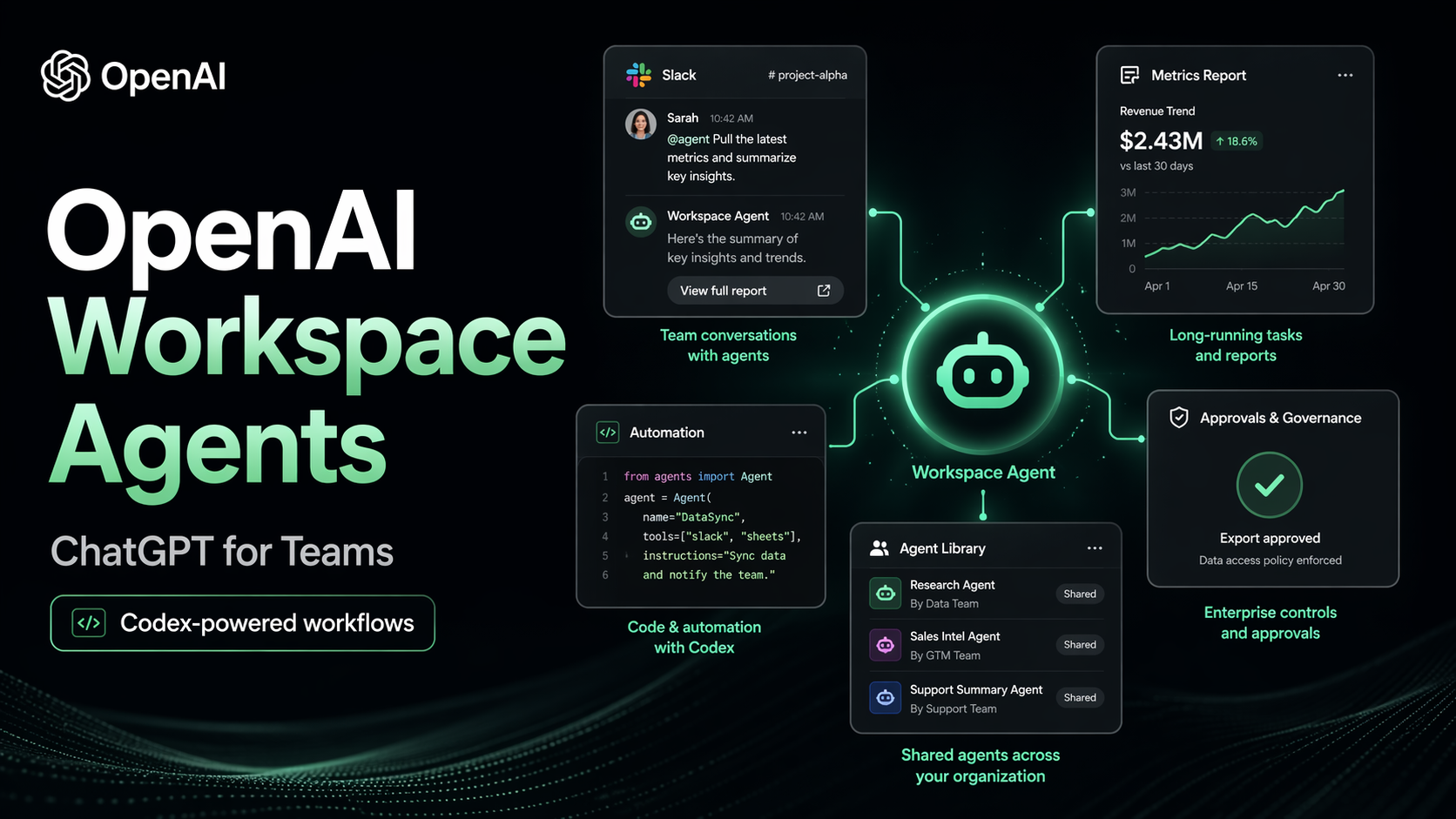
The company introduced workspace agents in ChatGPT, a new system designed for organizations that want AI to do more than answer prompts. According to OpenAI, these agents are built for shared workflows, long-running tasks, and work that needs to move across tools, approvals, and teams. They are powered by Codex and can keep running in the cloud even when the user is away.
That matters because this is not just another chatbot feature.
OpenAI describes workspace agents as an evolution of GPTs. The positioning is important. GPTs were already useful for creating tailored assistants, but workspace agents move closer to something operational. They are built to gather context from connected systems, follow a team’s process, take action across tools, and ask for approval when needed. OpenAI says teams can build them once, use them inside ChatGPT or Slack, and keep improving them over time.
The examples OpenAI gives make the direction very clear.
These agents can be used for software review, product feedback routing, weekly metrics reporting, lead outreach, and third-party risk checks. In other words, OpenAI is aiming at the repetitive but important work that usually sits between departments and requires people to stitch together information manually. OpenAI also says its own sales team is already using an agent to combine call notes and account research, qualify leads, and draft follow-up emails directly in inbox workflows.
This is where the product becomes more interesting from a business perspective.
A lot of AI tools still depend on a person sitting there and prompting the model step by step. Workspace agents are meant to reduce that manual coordination. OpenAI says they can write or run code, use connected apps, remember what they have learned, and continue work over multiple steps. Teams can also schedule them to run automatically or deploy them in Slack so they can respond where work is already happening.
The collaboration angle is probably the biggest upgrade.
OpenAI says workspace agents can be shared inside an organization through an Agents tab in the ChatGPT sidebar. That means team knowledge, process logic, and working patterns can be turned into reusable agents instead of living only in documentation or in the heads of a few employees. OpenAI frames this as a way to build a workflow once, improve it through use, then reuse or duplicate it across the company.
There is also a clear governance story here.
For sensitive actions such as editing spreadsheets, sending emails, or creating calendar events, OpenAI says organizations can require approval before the agent proceeds. The company also says Enterprise and Edu admins can control which tools and actions user groups can access, manage who can build and share agents, and use the Compliance API to inspect configuration changes and agent runs. OpenAI adds that built-in safeguards are designed to help defend against issues such as prompt injection from misleading external content.
That enterprise framing is not accidental.
Workspace agents are launching in research preview for ChatGPT Business, Enterprise, Edu, and Teachers plans. OpenAI says the feature will be free until May 6, 2026, and will then move to credit-based pricing. For Enterprise and Edu customers, admins can enable agents with role-based controls.
My view is that this announcement is one of the clearest signs yet of where ChatGPT is heading.
OpenAI is not just trying to make ChatGPT better at conversation. It is trying to make it useful as a shared work layer inside organizations. The real opportunity here is not “AI that answers better.” It is AI that can sit inside recurring business processes, use company context, follow rules, and keep work moving without constant human hand-holding.
If OpenAI executes well, workspace agents could become one of the strongest arguments for ChatGPT inside teams. Not because they sound futuristic, but because they go after something practical: the messy operational work that slows companies down every week.
Workspace agents are still in research preview, but the direction is obvious: OpenAI wants ChatGPT to become less of a prompt box and more of a real operational layer for teams.