
OpenAI Just Launched Daybreak. Cybersecurity Is Becoming Part of the Development Workflow
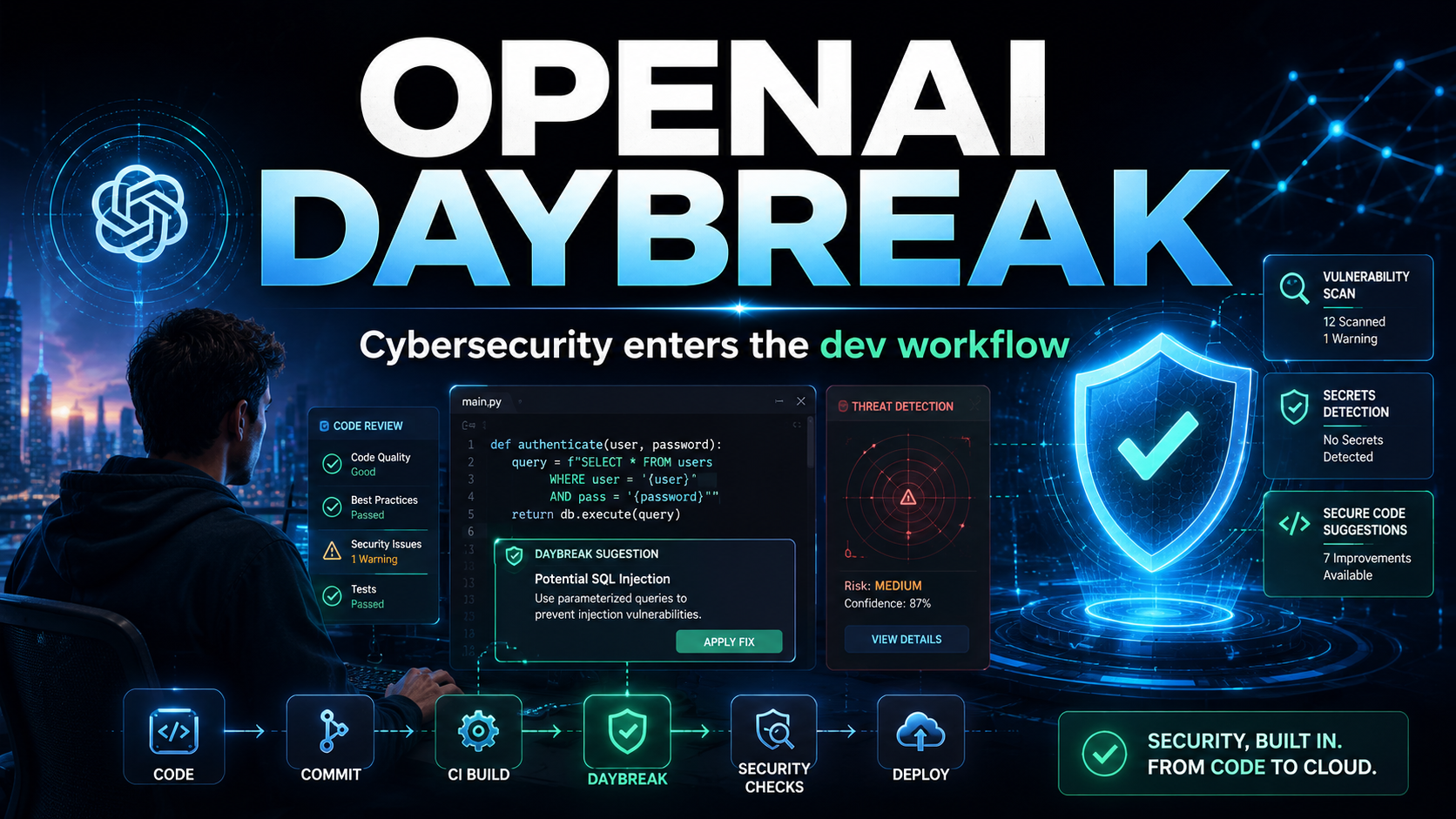
For years, cybersecurity has mostly lived after the software is already built.
A company builds a website, app, platform, API, internal tool, or SaaS product.
Then security comes later.
Scan it.
Audit it.
Patch it.
Monitor it.
Hope nothing important was missed.
That model is starting to break.
Software moves too fast now. Dependencies change too quickly. AI-generated code is becoming more common. Small teams are shipping more code with fewer people. Businesses are connecting more tools, more APIs, more payment systems, more customer data, and more automation workflows.
Security cannot stay as a separate phase at the end.
That is why OpenAI’s new Daybreak initiative is interesting.
Not because it means AI will magically solve cybersecurity.
It will not.
But because it points to a much bigger shift:
Cybersecurity is moving directly into the development workflow.
What OpenAI Daybreak actually is
OpenAI describes Daybreak as its vision for changing how software is built and defended.
The idea is simple.
Instead of only finding and patching vulnerabilities after software exists, AI should help developers and security teams build software that is more resilient from the beginning.
That means using frontier AI models to help with secure code review, threat modeling, patch validation, dependency risk analysis, detection, and remediation guidance inside normal development workflows.
In plain English:
AI is moving from “help me write code” to “help me understand whether this code is safe.”
That is a big difference.
The first wave of AI coding tools helped developers move faster.
The next wave will need to help developers move faster without creating hidden security problems.
Why this matters now
The timing matters.
AI has already changed software development.
Developers are using AI to generate components, refactor code, write tests, build prototypes, migrate APIs, debug errors, and ship faster.
That speed is useful.
But faster development also creates a new problem.
If teams generate and ship more code, they also create more surface area for bugs, misconfigurations, dependency issues, and security mistakes.
This is especially important for small businesses and startups.
A large enterprise might have a security team, compliance process, dedicated DevOps people, and internal review standards.
A small company often does not.
A founder might use AI to build an MVP.
A freelancer might ship a custom integration.
An agency might maintain websites across WordPress, Shopify, Webflow, Squarespace, Firebase, and custom JavaScript apps.
In all those cases, the same question becomes more important:
Who is checking the security impact of all this new code?
Daybreak is OpenAI’s answer to that larger direction.
AI should not only help produce software.
It should also help defend it.
The real shift is earlier security
The most important idea behind Daybreak is not “AI for cybersecurity.”
That phrase is too broad.
The more useful framing is earlier security.
Security should happen while the software is being designed.
Security should happen while the code is being written.
Security should happen when dependencies are added.
Security should happen before a patch is merged.
Security should happen before a vulnerability becomes an emergency.
This is where AI can be genuinely useful.
A model can help reason across a codebase.
It can explain unfamiliar systems.
It can identify risky patterns.
It can help validate whether a fix actually addresses the problem.
It can summarize the likely impact of a vulnerability.
It can help developers understand which dependency updates matter.
It can assist with remediation steps.
None of that removes the need for human review.
But it can reduce the time between discovery and action.
And in cybersecurity, time matters.
Why secure code review is becoming more important
Secure code review used to feel like something only mature engineering teams did seriously.
That will probably change.
AI makes code easier to create.
But easy code creation does not automatically mean good code creation.
A generated function might work.
A generated API endpoint might return the right data.
A generated form might submit correctly.
A generated admin tool might save time.
But security is often about the cases that are not obvious.
What happens with malformed input?
What happens when a user changes an ID in the URL?
What happens when a token expires?
What happens when a permission check is missing?
What happens when a file upload accepts the wrong type?
What happens when a dependency has a known vulnerability?
What happens when the AI-generated code looks correct but skips an edge case?
This is why secure code review will become part of normal development, not just enterprise security.
The more AI helps us write code, the more we need AI and humans to help inspect the code.
Patch validation may become one of the biggest use cases
One of the underrated parts of cybersecurity is not finding a problem.
It is proving that the fix works.
A vulnerability is reported.
A developer patches the code.
Everyone wants to move on.
But did the patch actually close the issue?
Did it introduce another bug?
Did it only fix one path while leaving another path open?
Did the dependency update break something else?
This is where AI-assisted patch validation could become very useful.
A good security workflow should not stop at “we changed the code.”
It should ask:
What was the original risk?
What changed?
How can we reproduce the issue safely?
How do we confirm it is fixed?
What evidence can we keep for later review?
That last part matters for businesses too.
Security is not only technical.
It is also operational.
Clients, partners, enterprise buyers, and regulators increasingly want to know that software companies have a process for handling risk.
AI can help create that process faster, especially for smaller teams.
Dependency risk is no longer a small detail
Modern software is built on dependencies.
A website might use a CMS, plugins, analytics scripts, payment tools, authentication providers, JavaScript packages, image libraries, automation tools, and third-party APIs.
A web app might depend on hundreds or thousands of packages.
That creates leverage.
It also creates risk.
One vulnerable dependency can affect thousands of companies.
One compromised package can spread quickly.
One outdated plugin can become the weakest point in an otherwise solid website.
For agencies and developers, dependency risk is becoming a normal part of the job.
It is not enough to build the feature.
You also need to know what the feature depends on.
You need to know what packages were added.
You need to know whether a plugin is still maintained.
You need to know whether an update is safe.
You need to know whether a vulnerability actually affects your project.
This is exactly the type of work where AI can help reduce analysis time.
Not by blindly saying “update everything.”
But by helping teams understand risk in context.
Why this matters for agencies
For web development agencies, Daybreak is a signal.
Clients will increasingly expect security-aware development.
Not necessarily full enterprise security.
But more awareness.
More checks.
More responsible maintenance.
More careful dependency choices.
More thoughtful integrations.
More review before shipping.
This applies to simple websites too.
A business website today is rarely “just a website.”
It might include contact forms, newsletter integrations, analytics, CRM connections, payment flows, booking systems, customer accounts, tracking pixels, automation tools, embedded scripts, and admin permissions.
Every connection adds convenience.
Every connection also adds potential risk.
For agencies, this creates an opportunity.
The value is no longer only design and development.
The value is building digital products that are clean, functional, maintainable, and safer by design.
That is a better pitch than “we use AI.”
The real pitch is:
We use modern tools to build faster, but we also understand quality, structure, security, and long-term maintainability.
Why business owners should care
Most business owners do not care about cybersecurity terminology.
They care about practical outcomes.
Can my website be trusted?
Can customers submit information safely?
Can my store run without avoidable issues?
Can my app scale without becoming fragile?
Can my business avoid embarrassing security mistakes?
Can my team move fast without creating hidden risk?
That is where this conversation becomes important.
AI-assisted development can help businesses build faster.
But speed without review is not enough.
A cheap website built quickly can become expensive later if it has poor structure, weak security, outdated plugins, messy integrations, or no maintenance process.
A custom app built with AI can still fail if no one understands the architecture.
A generated feature can still create problems if no one checks permissions, data handling, or edge cases.
The business lesson is simple:
AI can accelerate development, but it does not remove the need for professional judgment.
The developer role is changing again
Developers are not just writing code anymore.
They are becoming system reviewers.
They are becoming AI supervisors.
They are becoming security-aware product builders.
They need to understand what to delegate to AI and what not to delegate.
They need to know how to review generated code.
They need to know how to test.
They need to know how to reason about architecture.
They need to know when a dependency is acceptable and when it is risky.
They need to know when a fix is real and when it only looks real.
Daybreak fits into this broader shift.
The best developers will not be the ones who write every line manually.
They will be the ones who can use AI to move faster while still protecting the quality of the system.
That is a much harder skill than prompting.
This is not about replacing cybersecurity teams
It is important not to overhype this.
Cybersecurity is complex.
AI will not replace experienced security professionals.
It will not magically secure every codebase.
It will not remove the need for audits, monitoring, access control, infrastructure security, incident response, or human expertise.
But it can help bring more security thinking into places where it was missing before.
That is the meaningful part.
Most small and mid-sized businesses will never have a full internal security team.
Most startups do not have perfect security processes.
Most agencies are not cybersecurity firms.
But all of them build and maintain software.
If AI can help those teams catch more issues earlier, understand risk faster, and validate fixes better, that is a real improvement.
The future is security inside the workflow
The future of software development is not just AI writing code.
It is AI inside the entire workflow.
Planning.
Building.
Testing.
Reviewing.
Documenting.
Securing.
Maintaining.
Daybreak is one more signal that the AI race is moving from simple productivity to deeper operational work.
Not just “write this function.”
But “help me understand this system.”
Not just “generate this feature.”
But “check whether this feature is safe.”
Not just “fix this bug.”
But “prove the fix actually works.”
That is where AI becomes more valuable for serious businesses.
The companies that benefit most will not be the ones that use AI randomly.
They will be the ones that build better workflows around it.
The takeaway
OpenAI Daybreak is not just a cybersecurity announcement.
It is a sign of where software development is going.
Security is moving earlier.
AI is becoming part of defensive workflows.
Developers are becoming reviewers and orchestrators.
Agencies will need to show not only that they can build fast, but that they can build responsibly.
Business owners will need to understand that AI-generated software still needs structure, testing, maintenance, and security review.
That is the real lesson.
The next phase of AI in software is not only about creating more code.
It is about creating better systems around the code.
And for businesses, that matters much more.
https://openai.com/daybreak