
OpenAI Just Launched a Deployment Company. This Is the Next Phase of AI in Business.
For the last few years, most businesses have treated AI like a tool.
Open ChatGPT. Ask a question. Generate copy. Summarize a document. Build a quick prototype. Maybe connect an API. Maybe test an internal chatbot.
That was the first phase.
The next phase is very different.
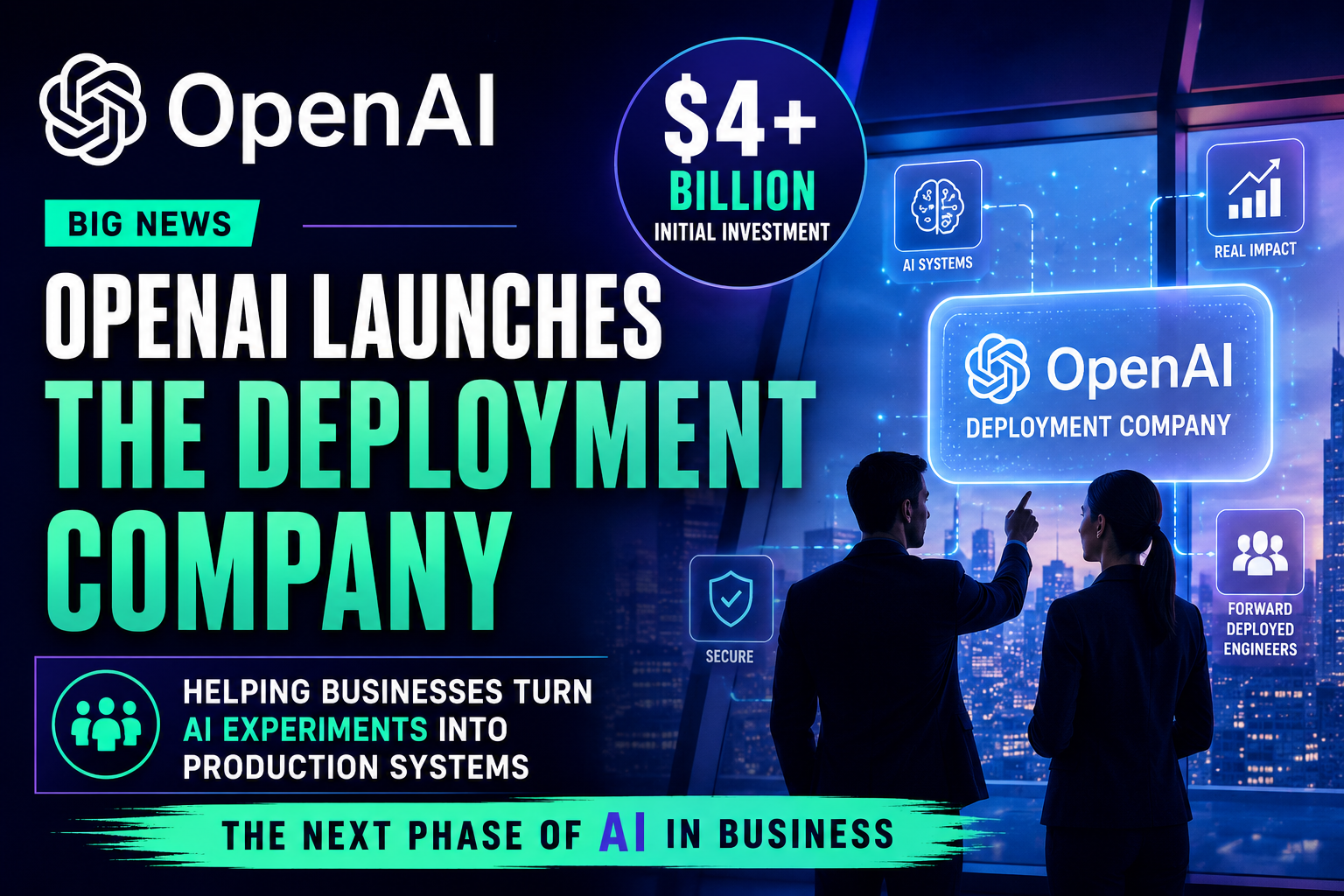
On May 11, 2026, OpenAI announced the launch of the OpenAI Deployment Company, a new company created to help organizations build and deploy AI systems inside real business operations. Not just demos. Not just prompts. Not just “AI features” added to existing software. Actual production systems built around how companies work every day.
That sounds like a corporate announcement, but it is more important than it looks.
This is OpenAI admitting something every serious business is starting to realize:
The hard part is no longer getting access to AI.
The hard part is deploying it properly.
AI adoption is moving from tools to systems
In 2023 and 2024, most companies were still asking simple questions.
Should we use ChatGPT?
Can AI help our marketing team?
Can developers use Copilot?
Can we automate support?
Can we generate internal documentation faster?
Those were useful questions, but they were mostly tool-level questions.
Now the question is bigger:
How do we redesign actual workflows around AI?
That is a completely different problem.
A business does not become AI-native because employees have access to a chatbot. A business becomes AI-native when AI is connected to the real data, real tools, real permissions, real processes, and real decisions that move the company forward.
That is why OpenAI’s Deployment Company matters.
It is not just another product launch. It is a sign that enterprise AI is moving from software subscriptions to operational transformation.
What OpenAI is actually building
OpenAI says the new Deployment Company will help organizations build and deploy AI systems they can rely on across important work.
The important term here is Forward Deployed Engineers.
This concept is not new in technology. Palantir made the forward-deployed engineering model famous years ago. The idea is simple: instead of selling software from far away and hoping the customer figures it out, engineers go close to the customer, understand the messy real-world problem, and build inside that environment.
That approach makes even more sense for AI.
Why?
Because AI is not only a software layer. It changes how work gets done.
A traditional software project usually starts with requirements, features, tickets, permissions, integrations, testing, and deployment.
An AI deployment adds more complexity.
You need to understand which tasks should be automated, which should be assisted, which still need human approval, which data the AI can access, how errors are handled, how outputs are evaluated, how the system improves, and how people actually adopt it.
That is not something most businesses can solve by buying a subscription.
OpenAI is going after the messy middle
The biggest AI opportunity is not the demo.
The demo is easy.
A support bot that answers five sample questions looks impressive.
An AI assistant that summarizes a PDF looks useful.
An agent that can generate a report from a prompt looks exciting.
But then reality arrives.
The support bot needs access to the right customer data. The PDF summary has to respect privacy rules. The report generator needs to pull from live systems, handle missing data, ask follow-up questions, and produce something a manager can trust.
This is where many AI projects get stuck.
They work in controlled examples, but they fail inside the business.
That messy middle is exactly what OpenAI appears to be targeting with the Deployment Company.
It is the gap between:
“We tested AI.”
And:
“This workflow now runs better because of AI.”
That gap is where the money is.
Why OpenAI acquired Tomoro
As part of the announcement, OpenAI said it agreed to acquire Tomoro, an applied AI consulting and engineering firm.
This is another important signal.
OpenAI is not only hiring AI researchers and building models. It is buying deployment expertise.
That means OpenAI knows that the enterprise market will not be won only by having the best model. It will also be won by helping companies actually use those models in reliable, measurable, practical ways.
For business owners, this is the part to pay attention to.
The AI market is no longer only about model quality.
It is about implementation quality.
The best model in the world does not help if it is not connected to the right workflow.
A powerful AI assistant does not create business value if employees do not trust it.
A custom AI tool does not matter if it saves five minutes in one department but never becomes part of the company’s operating system.
Deployment is where AI becomes real.
The $4 billion signal
OpenAI said the Deployment Company will launch with more than $4 billion of initial investment.
That number matters because it shows how serious the deployment layer has become.
For a long time, many people assumed AI companies would mostly sell access to models. You pay for ChatGPT. You pay for API usage. You pay for enterprise seats. You build on top.
That model still exists, but it is not enough for large organizations.
Big companies do not just want access to AI.
They want help figuring out where AI creates value, how to integrate it, how to control it, how to measure it, and how to scale it across departments.
That creates a massive market around implementation.
In other words, AI is becoming less like a tool you install and more like infrastructure you reorganize around.
What this means for normal businesses
Most companies are not going to work directly with the OpenAI Deployment Company.
This will likely start with large enterprises, complex organizations, and companies with serious budgets.
But the lesson applies to every business.
The question is not:
“Are we using AI?”
The better question is:
“Where is AI actually changing the way work gets done?”
A small business does not need a $4 billion deployment company to apply this thinking.
It can start much smaller.
For example:
A service business can use AI to turn client calls into project briefs, estimates, timelines, and internal tasks.
An ecommerce business can use AI to analyze product reviews, support tickets, and customer behavior to improve product pages.
A real estate company can use AI to generate listing descriptions, qualify leads, and summarize client communication.
A web agency can use AI to speed up planning, content structure, QA, client communication, and technical implementation.
The principle is the same:
Do not start with the tool.
Start with the workflow.
The mistake many companies will make
A lot of businesses will still approach AI backwards.
They will ask:
“What AI tool should we buy?”
Instead of:
“What important process in our business is slow, repetitive, expensive, or inconsistent?”
That second question is much better.
AI works best when it is attached to a real operational bottleneck.
Not every workflow needs AI. Not every business process should be automated. Not every task is worth redesigning.
But when you find a workflow that is repeated often, uses lots of information, requires decisions, and creates measurable business value, AI can become very powerful.
That is why the OpenAI Deployment Company is interesting.
It is not selling AI as magic.
It is positioning AI as something that has to be deployed into the company’s real environment.
That is the mature version of AI adoption.
This is also a signal for agencies and developers
For web agencies, software developers, automation specialists, and consultants, this announcement is a clear signal.
The market is moving toward implementation.
Businesses will not only need websites, apps, automations, and integrations. They will need help understanding how AI fits into their existing operations.
That creates a new type of opportunity.
The most valuable agencies will not be the ones that simply say, “We can add AI to your website.”
The valuable agencies will say:
“We can understand your workflow, identify where AI can create value, connect it to your existing tools, build the system, test it, and make it usable by your team.”
That is a very different positioning.
It is not AI hype.
It is AI deployment.
And for many businesses, that is exactly what they need.
The future of AI is less flashy than people think
The next phase of AI will not always look like a science fiction interface.
In many companies, AI will be invisible.
It will summarize information before meetings.
It will prepare draft replies.
It will check data quality.
It will route support tickets.
It will generate reports.
It will review contracts.
It will turn scattered conversations into structured tasks.
It will help teams understand what happened last week, what needs attention today, and what is likely to become a problem next month.
That is not as flashy as a viral AI demo.
But it is much more useful.
The companies that win with AI will not be the ones that try the most tools.
They will be the ones that quietly rebuild the right workflows around intelligence.
AI is becoming part of business infrastructure
This is the deeper meaning of OpenAI’s announcement.
AI is moving from the experimental layer to the infrastructure layer.
At first, AI was something people used on the side.
Then it became something companies added to products.
Now it is becoming something companies organize work around.
That is a big shift.
It means AI strategy can no longer sit only with marketing, IT, or innovation teams. It has to involve leadership, operations, legal, security, product, customer support, and the people doing the actual work every day.
Because the real question is not whether AI can generate an answer.
The real question is whether AI can improve how the company operates.
What businesses should do now
Most businesses do not need to copy what large enterprises are doing.
They need to apply the same thinking at their own scale.
Start by mapping the workflows that create the most friction.
Where does information get lost?
Where do people repeat the same manual work every week?
Where do clients wait too long?
Where does the team make decisions with incomplete context?
Where does reporting take too much time?
Where do projects slow down because knowledge is spread across emails, documents, spreadsheets, chats, and tools?
Those are the places to look first.
Then ask a practical question:
Could AI help this workflow become faster, clearer, more consistent, or easier to manage?
If yes, the next step is not to buy ten AI tools.
The next step is to design the workflow.
What data does the system need?
Who uses it?
What should AI generate?
What should humans approve?
Where should the output go?
How do we measure whether it works?
That is how AI becomes useful.
The real takeaway
OpenAI launching a Deployment Company is not just another AI headline.
It is a sign that the market is growing up.
The first wave of AI was about access.
The second wave was about experimentation.
The next wave is about deployment.
For businesses, that means the advantage will not come from saying “we use AI.”
Everyone will use AI.
The advantage will come from knowing where to use it, how to integrate it, and how to turn it into measurable operational improvement.
That is the difference between AI as a toy and AI as infrastructure.
And that is where the next few years of business transformation will happen.