
Is SaaS Dead in Q2 2026?
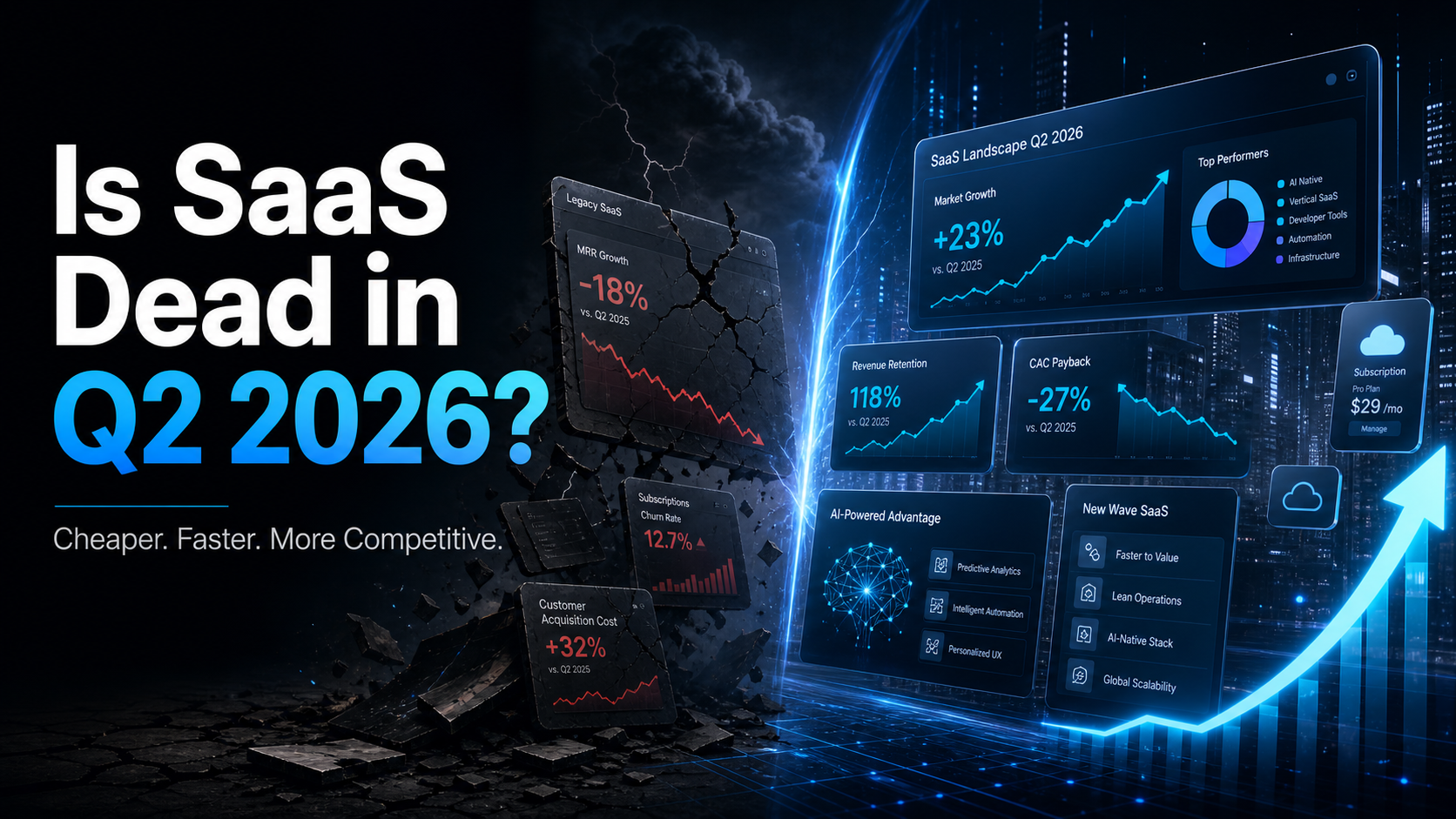
Every few months, the internet declares SaaS dead.
Sometimes the reason is AI.
Sometimes it is subscription fatigue.
Sometimes it is because another startup built a feature that used to require an entire platform.
Sometimes it is because customers are tired of paying $49, $99, or $299 per month for tools that feel almost identical to five other tools.
So, is SaaS dead in Q2 2026?
No.
But lazy SaaS is dying.
That is the more useful answer.
SaaS is not disappearing. Businesses are still spending heavily on software. Gartner expects worldwide IT spending to reach $6.31 trillion in 2026, up 13.5% from 2025, and software remains one of the strongest parts of that growth. At the same time, AI spending is accelerating fast, with worldwide AI spending forecast to reach $2.52 trillion in 2026. (Gartner)
So the market is not saying, “We do not need software anymore.”
The market is saying something different:
We need better software.
We need cheaper software.
We need faster software.
We need software that actually understands the workflow.
And we are no longer willing to pay premium prices for generic dashboards, shallow automation, and products that feel like database templates with a login screen.
That is the real state of SaaS in Q2 2026.
SaaS is not dead. The old SaaS comfort zone is dead.
For more than a decade, SaaS companies had a very attractive business model.
Build a cloud product once.
Charge every month.
Add a few features every quarter.
Grow with subscriptions.
Improve margins as the customer base expands.
That model created huge companies. It also created a lot of lazy products.
Many SaaS tools became too comfortable. They charged more every year, added complexity instead of clarity, and relied on switching costs instead of customer love.
For a while, that worked.
In 2026, it is harder.
AI has changed the cost of building software. Small teams can now build faster. Solo founders can launch products that previously required full engineering teams. Agencies can build internal tools, automations, dashboards, and custom workflows much faster than before.
That does not kill SaaS.
It kills the excuse that every simple workflow needs an expensive subscription.
If a product is only a form, a database, a few filters, a notification system, and a dashboard, customers are asking a fair question:
Why is this still expensive?
That is where lazy SaaS starts to lose.
SaaS consumers now have more leverage
The biggest change in Q2 2026 is not just that SaaS companies have more competition.
It is that SaaS consumers have more options.
A few years ago, if a business needed software, the default answer was simple: subscribe to an existing SaaS product.
Now the decision is more complicated.
A company can subscribe to a SaaS product.
It can connect existing tools with automation.
It can use AI inside its current workflow.
It can build a lightweight internal tool.
It can hire a developer or agency to create a custom solution.
It can use no-code or low-code tools.
It can use an AI coding tool to help produce a first version much faster.
For SaaS consumers, this is good news.
It means the old rule of “just pay for the market leader” is weaker than before.
The better question in 2026 is:
Does this tool deserve to become part of our workflow?
That is a higher bar.
A SaaS product has to justify its place. Not with a long feature list, but with real usefulness.
Does it save time?
Does it reduce mistakes?
Does it help the team make better decisions?
Does it replace messy manual work?
Does it integrate with the systems people already use?
Does it become more valuable over time?
If the answer is no, the subscription is vulnerable.
AI is not killing SaaS. AI is exposing weak SaaS.
AI is often presented as the thing that will kill SaaS.
That is too simplistic.
AI will not eliminate software. People and businesses still need interfaces, workflows, permissions, billing, collaboration, history, compliance, storage, reporting, and structure.
A chatbot alone is not enough for most business operations.
But AI is exposing products that were not very deep to begin with.
If a SaaS product’s main value is generating text, summarizing information, creating basic reports, or moving data between simple steps, AI can threaten it quickly.
If a SaaS product is deeply embedded into a company’s workflow, connected to important data, trusted by teams, and difficult to replace, AI is more likely to strengthen it.
This is why the future of SaaS is not “AI wrapper versus traditional SaaS.”
The real split is:
Shallow SaaS versus workflow SaaS.
Shallow SaaS gives users a feature.
Workflow SaaS becomes part of how the work gets done.
That difference matters more than ever.
SEG’s 2026 SaaS report points in the same direction: buyers are rewarding durable growth, retention, deep workflow integration, data depth, and companies that can use AI without becoming replaceable by it. (Software Equity Group)
That is the new SaaS test.
Not “do you have AI?”
But:
Does AI make your product more useful, or does it make your product easier to replace?
SaaS is becoming cheaper to build
One reason SaaS feels more competitive in 2026 is simple: building software is cheaper and faster than it used to be.
AI coding tools, better frameworks, cloud platforms, templates, APIs, and automation have reduced the time needed to get from idea to working product.
This does not mean building great software is easy.
It means building average software is easier.
That distinction is important.
The internet will be flooded with more SaaS products, micro-SaaS tools, internal apps, AI dashboards, productivity tools, marketing tools, sales tools, and automation platforms.
Most of them will not matter.
But enough of them will be good enough to pressure existing products.
This creates a strange market.
Software is easier to create, but harder to sell.
That is one of the defining SaaS realities of Q2 2026.
The building barrier is lower.
The distribution barrier is higher.
Customers have more choices. They are more skeptical. They have seen too many tools overpromise. They know that “AI-powered” does not automatically mean useful.
For SaaS consumers, this means more power.
For SaaS companies, it means the product must be sharper.
SaaS is becoming more competitive because features are easier to copy
In older SaaS markets, a feature could be a moat for a while.
In 2026, that window is much shorter.
If one product adds AI summaries, competitors can add AI summaries.
If one product adds a calendar view, competitors can add a calendar view.
If one product adds chat with your data, competitors can add chat with your data.
If one product adds auto-generated reports, competitors can add auto-generated reports.
The feature gap closes faster.
This creates a problem for SaaS companies that rely only on features.
A feature is not enough anymore.
The product needs a stronger reason to exist.
That reason can be data.
It can be workflow depth.
It can be trust.
It can be simplicity.
It can be a better user experience.
It can be a niche focus.
It can be a strong ecosystem.
It can be a better business model.
It can be customer service.
It can be a product philosophy that actually matches how users think.
But it cannot just be “we also have AI.”
By Q2 2026, that is no longer enough.
SaaS consumers are tired of bloated subscriptions
One of the biggest risks for SaaS companies is not AI.
It is customer fatigue.
Many businesses are tired of paying for too many tools.
The problem is not one subscription. The problem is the stack.
A company starts with a project management tool.
Then it adds a CRM.
Then a help desk.
Then an email platform.
Then analytics.
Then a reporting tool.
Then an automation tool.
Then an AI tool.
Then a calendar scheduling tool.
Then a knowledge base.
Then a document tool.
Then a customer feedback tool.
Then a team communication tool.
Individually, each product may make sense.
Together, the stack becomes expensive, fragmented, and difficult to manage.
This is why SaaS consumers are becoming more selective.
They are asking:
Can we consolidate?
Can we remove this?
Can we replace three tools with one?
Can we use a simpler product?
Can we build a small internal tool?
Can we automate this without another subscription?
Can AI handle part of this workflow inside tools we already use?
This is not anti-SaaS.
It is anti-bloat.
The SaaS companies that survive this shift will not necessarily be the ones with the most features.
They will be the ones that are easiest to justify.
The best SaaS products in 2026 will feel less like software and more like leverage
The next generation of SaaS winners will not just store information.
They will help users move.
They will help users decide.
They will reduce repetitive work.
They will connect context.
They will turn messy workflows into clearer systems.
They will become leverage.
That matters because SaaS consumers do not want more apps for the sake of more apps.
They want outcomes.
A business does not buy a CRM because it wants a CRM.
It buys a CRM because it wants to manage leads, close deals, understand customers, and avoid losing revenue.
A team does not buy project management software because it wants boards and lists.
It buys project management software because it wants clarity, accountability, delivery, and less chaos.
A company does not buy analytics software because it wants charts.
It buys analytics software because it wants better decisions.
In 2026, SaaS products that forget this will struggle.
The market is moving away from software as a place where users manually manage everything.
It is moving toward software as a system that helps users act faster and think better.
That is a major shift.
The “AI wrapper” problem is real
A lot of new SaaS products in 2026 are basically AI wrappers.
Some are useful.
Many are not.
An AI wrapper is not automatically bad. A good wrapper can turn a powerful model into a practical workflow. That can be valuable.
The problem is when the product has no real depth beyond the model.
If the product has no unique data, no workflow ownership, no user experience advantage, no distribution, no trust, and no strong niche, it is fragile.
SaaS consumers should be careful here.
A product that looks impressive in a demo may not be useful in daily work.
The real test is not whether it can generate something once.
The real test is whether it makes a repeated workflow better.
Can you use it every day?
Does it remember the right context?
Does it fit your process?
Does it reduce work, or does it create another place to manage work?
Does it produce reliable results?
Does it still make sense after the first week?
That is where many AI-first SaaS tools fail.
They are exciting at first contact and weak in long-term use.
Enterprise SaaS is not dead either
Some people confuse “SaaS is changing” with “enterprise SaaS is dead.”
That is also wrong.
Large companies still need serious software. They need security, compliance, permissions, admin controls, integrations, audit logs, procurement processes, support, and reliability.
A random AI agent will not replace that overnight.
But enterprise SaaS is under pressure too.
Large SaaS companies can no longer rely only on seat-based pricing and incremental product updates. Customers want to see real AI value, real workflow improvement, and better cost justification.
Reuters recently described the pressure on major SaaS companies like SAP and Salesforce, noting that AI creates both risk and opportunity for legacy SaaS vendors. The advantage of these companies is that they already sit close to enterprise data and workflows. The challenge is proving that their AI features create meaningful revenue and profit impact, not just marketing noise. (Reuters)
That is the enterprise version of the same story.
SaaS is not dead.
But the margin for vague value is smaller.
What SaaS consumers should do in Q2 2026
For SaaS consumers, the current market is an opportunity.
You do not need to accept every subscription as permanent.
You do not need to keep paying for software just because it has always been there.
You do not need to buy every new AI tool.
You do not need to replace everything either.
The smarter move is to review your software stack with a simple framework.
First, identify the tools that are clearly essential.
These are the products your team uses constantly, where the value is obvious, and where replacing them would create real friction.
Second, identify the tools that are useful but overlapping.
These are the tools that may still be valuable, but duplicate features from other products.
Third, identify the tools that are barely used.
These are the easiest subscriptions to cancel.
Fourth, identify workflows that are still manual even though you pay for software.
This is where automation, AI, or a custom internal tool may create more value than another SaaS subscription.
Finally, ask which tools are becoming more valuable over time.
The best software compounds.
It stores useful history.
It improves collaboration.
It creates better data.
It becomes part of the operating system of the business.
The weakest software does the opposite.
It adds another login, another dashboard, another bill, and another place where work gets lost.
The future of SaaS is not fewer tools. It is better tools.
It is tempting to say the future will have fewer SaaS products.
Maybe.
But the more likely answer is that the future will have better filtering.
There will still be many tools.
There will still be many niches.
There will still be many SaaS companies.
But customers will be more selective.
They will not reward every product just because it exists.
They will reward software that is specific, useful, fast, integrated, and worth the monthly cost.
That is a healthy correction.
The SaaS market became too comfortable with the idea that every workflow deserves a subscription and every subscription deserves annual price increases.
Q2 2026 feels different.
Customers have more leverage.
Builders have better tools.
AI has raised expectations.
Competition is everywhere.
The result is not the death of SaaS.
It is the death of lazy SaaS.
Conclusion: SaaS is not dead. Generic SaaS is.
So, is SaaS dead in Q2 2026?
No.
The market data does not support that. Software spending is still growing. AI spending is exploding. Businesses still need digital tools, cloud platforms, automation, collaboration, reporting, and workflow systems. (Gartner)
But the easy version of SaaS is under pressure.
The version where a company builds a generic dashboard, adds a few integrations, charges a monthly fee, and expects customers to stay forever is becoming weaker.
SaaS consumers are more careful now.
They are asking harder questions.
They want proof.
They want value.
They want fewer empty features and more real outcomes.
That is good.
SaaS is not dead.
Lazy SaaS is dead.
And in Q2 2026, that may be exactly what the software market needed.