
How Large Is the Global Software Industry in 2026?
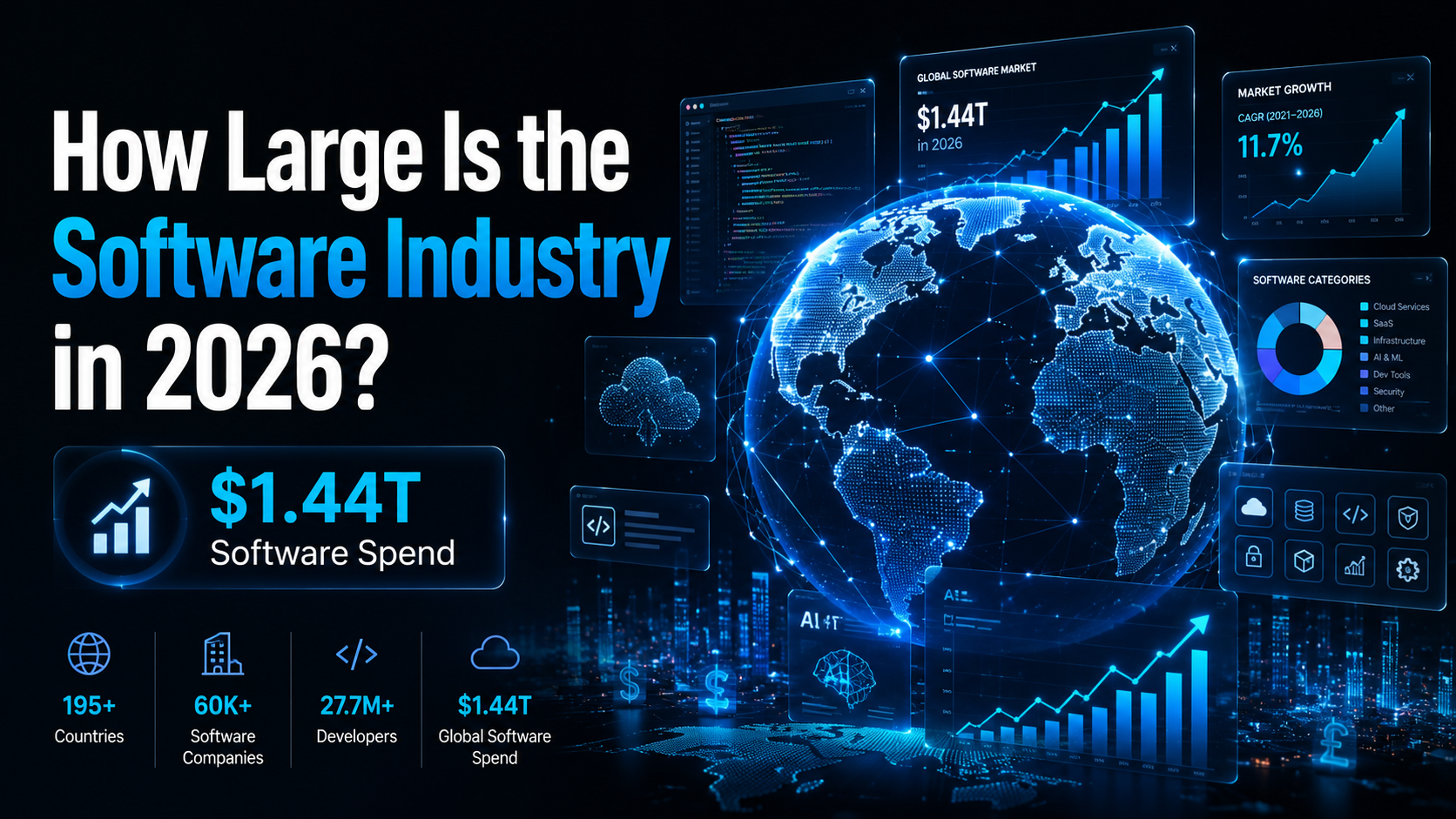
Software is one of the largest industries in the world.
But the size of the software industry is not easy to measure with one clean number.
That is because “software” is not just apps.
It includes SaaS subscriptions, enterprise platforms, cloud software, developer tools, cybersecurity, databases, AI software, custom development, internal business systems, IT services, application implementation, managed services, cloud infrastructure, and the engineering teams inside companies that build software for their own operations.
So when someone asks, “How large is the global software industry in 2026?” the honest answer is:
It depends what you include.
But even using conservative numbers, the answer is clear.
The global software economy is already worth well over $1 trillion per year. If you include software-related IT services, custom development, cloud infrastructure, AI platforms, and internal development budgets, the broader software-driven economy moves into the multi-trillion-dollar range.
That is the real scale of software in 2026.
It is not a niche industry.
It is one of the main operating layers of the global economy.
The simplest number: software spending is around $1.44 trillion in 2026
The best starting point is Gartner’s global IT spending forecast.
In April 2026, Gartner forecast worldwide IT spending to reach $6.316 trillion in 2026, up 13.5% from 2025. Inside that number, software spending alone is forecast at $1.443 trillion, growing 15.1% year over year.
That is the cleanest headline number:
The world is expected to spend about $1.44 trillion on software in 2026.
That includes major categories such as enterprise software, infrastructure software, SaaS products, business applications, security software, productivity tools, cloud software platforms, and many other commercial software products.
For context, that means software spending is larger than the GDP of many countries.
And it is still growing quickly.
A 15.1% growth rate on a $1.44 trillion base is enormous. It means the world is adding hundreds of billions of dollars in annual software spending, not because software is new, but because more of the economy now runs through software.
But software development is larger than software spending
There is an important distinction:
Software spending is not the same as software development spending.
Software spending usually means money spent on software products and platforms.
Software development spending is broader. It includes the money companies spend to create, customize, implement, integrate, maintain, and operate software.
That includes internal developers.
External agencies.
IT consultants.
Custom software firms.
Cloud engineers.
DevOps teams.
Application implementation partners.
AI integration teams.
Product teams.
Maintenance teams.
Support teams.
Security teams.
Data teams.
This is why the true software development economy is bigger than the software market alone.
Gartner’s same 2026 forecast expects IT services to reach $1.870 trillion in 2026, making it the largest overall IT spending category. Gartner defines this area as including application implementation and managed services, infrastructure implementation and managed services, and infrastructure-as-a-service.
A large part of that is software-related work.
Not all of it is pure software development, of course. Some of it is infrastructure, consulting, managed IT, cloud operations, and support. But in the real world, these categories overlap heavily with software implementation and software operations.
So if we look only at software products, we see a $1.44 trillion market.
If we include software-related services, implementation, maintenance, cloud operations, and custom development, the practical software economy becomes much larger.
The commercial software market is still growing fast
Different research firms define the “software market” differently, so their numbers vary.
Fortune Business Insights estimates the global software market at $830.83 billion in 2025 and projects it to grow to $926.34 billion in 2026, reaching $2.212 trillion by 2034.
Grand View Research estimated the global software market at $730.70 billion in 2024 and projected it to reach $1.397 trillion by 2030.
These numbers are lower than Gartner’s $1.443 trillion software spending forecast because each firm uses different definitions and category boundaries.
That matters.
One report may count only certain software revenue categories.
Another may include broader enterprise and infrastructure software.
Another may include cloud software in a different way.
But the direction is consistent.
The software market is large.
It is growing.
And it is becoming more important, not less.
Custom software development is smaller, but growing faster
Custom software development is a different part of the market.
This is the money companies spend on software built specifically for their needs, rather than buying an existing SaaS or enterprise platform.
This includes internal tools, custom dashboards, workflow systems, mobile apps, portals, automations, enterprise integrations, industry-specific software, and private business platforms.
Grand View Research estimated the global custom software development market at $43.16 billion in 2024 and projected it to reach $146.18 billion by 2030, growing at a 22.6% CAGR.
Global Market Insights estimated the custom software development market at $44.2 billion in 2025 and projected it to grow from $50.6 billion in 2026 to $213.4 billion by 2035.
So custom software is much smaller than the total software market, but it is growing faster.
That makes sense.
Many businesses now realize that not every workflow fits perfectly inside generic SaaS tools. Sometimes a company needs something specific. Sometimes it needs to connect multiple systems. Sometimes it needs an internal platform. Sometimes it wants to reduce subscription bloat by building a focused tool that does exactly what the business needs.
AI is also changing this category.
Custom software used to be expensive and slow. It still requires skill, but AI-assisted development is reducing the time needed to prototype, build, test, and maintain software. That makes custom development more accessible to smaller companies.
The result is simple:
More companies can now afford software that is built around their own workflow.
Application development software is also becoming a huge category
Another important category is application development software.
This includes tools used to build software: development platforms, low-code tools, testing tools, app development environments, deployment systems, and related platforms.
Fortune Business Insights projects the global application development software market to grow from $172.94 billion in 2026 to $826.48 billion by 2034.
This is important because it shows that software development itself has become a software market.
Companies are not only buying software.
They are buying tools to create more software.
That is one of the strongest signs that software development is becoming more distributed. More teams, more departments, more agencies, and more founders are building software, not just traditional software companies.
AI is expanding the software economy, not shrinking it
One of the biggest questions in 2026 is whether AI will reduce software development spending.
The logic sounds simple:
If AI helps developers build faster, maybe companies will need fewer developers.
If companies need fewer developers, maybe total spending on software development goes down.
That may happen in some narrow areas.
But at the market level, the opposite may also happen.
AI can reduce the cost of building individual features while increasing the total amount of software the world creates.
This is a common pattern in technology.
When something becomes cheaper, people often consume more of it.
If software becomes cheaper to build, more businesses will build software.
Small companies that could not afford custom systems may start building them.
Departments that waited months for internal IT may create their own tools.
Founders may launch products faster.
Agencies may deliver more complex projects with smaller teams.
Large companies may automate more workflows.
This is why AI is unlikely to make software less important.
It may make software more everywhere.
Gartner forecasts worldwide AI spending at $2.52 trillion in 2026, up 44% year over year.
A lot of that spending is infrastructure, chips, cloud, data centers, platforms, and AI systems. But the practical outcome is software: AI features inside products, AI copilots, AI agents, AI workflows, AI analytics, AI automation, and AI-powered business systems.
AI is not replacing the software industry.
AI is becoming part of the software industry.
Cloud infrastructure is part of the software development budget now
Software development in 2026 does not stop when the code is written.
Modern software needs hosting, databases, storage, APIs, authentication, monitoring, security, deployment pipelines, backups, analytics, AI model access, and cloud infrastructure.
This means cloud spending is now deeply connected to software spending.
A company may not think of its cloud bill as a “software development” cost, but functionally it often is. The cloud is where modern software runs.
Omdia reported that global cloud spending reached $399.6 billion in 2025, up 24% year over year, and projected cloud infrastructure investment could pass $500 billion in 2026.
That matters because the software economy is no longer just licenses and subscriptions.
It is also the infrastructure needed to run digital products at scale.
Every SaaS company, AI platform, mobile app, e-commerce system, internal dashboard, and business automation needs infrastructure behind it.
The more software the world builds, the more infrastructure it needs.
For software consumers, the market size matters
This may sound like a business or investor topic, but it matters for software consumers too.
When an industry becomes this large, consumers get more choice.
More SaaS tools.
More AI tools.
More automation platforms.
More custom development options.
More low-code builders.
More internal tool platforms.
More developer tools.
More competition.
That can be good.
It can also be confusing.
A larger software market means consumers need to be more careful. There are more products than ever, but not all of them are useful. There are more AI features than ever, but not all of them are valuable. There are more subscription tools than ever, but not all of them deserve to stay in the budget.
The question for consumers is no longer:
Is there software for this?
There probably is.
The better question is:
Which software is actually worth paying for?
That is a very different buying environment.
The software industry is becoming harder to define
In the past, software was easier to separate from the rest of technology.
There was hardware.
There was software.
There were IT services.
There was telecom.
Now the boundaries are blurry.
A SaaS product may include AI models, cloud infrastructure, third-party APIs, custom workflows, mobile apps, browser extensions, analytics, and automation.
A custom software project may include cloud architecture, AI integration, security, data pipelines, frontend development, backend development, and ongoing maintenance.
A business may pay for a software subscription, then pay consultants to implement it, then pay developers to integrate it, then pay cloud providers to run connected systems, then pay AI providers to automate workflows around it.
Where does “software” end?
In 2026, that is harder to answer.
This is why the global software industry is best understood in layers:
Commercial software products.
SaaS subscriptions.
Enterprise platforms.
Custom software development.
Application development tools.
Cloud infrastructure.
IT services and implementation.
AI platforms and AI-enabled software.
Internal software engineering teams.
Together, these layers form the real software economy.
A practical estimate: the software economy is already multi-trillion-dollar
So how large is the global software industry in 2026?
A practical way to frame it is this:
The direct global software spending market is around $1.44 trillion in 2026, according to Gartner.
The broader software market, depending on definition, is often estimated in the high hundreds of billions to above $1 trillion, with strong growth toward the 2030s.
Custom software development is smaller, likely in the tens of billions annually, but growing much faster than the broader market.
IT services, much of which supports software implementation, application management, cloud operations, and digital transformation, is projected at $1.87 trillion in 2026.
AI spending is forecast at $2.52 trillion in 2026, and much of that will flow into software, platforms, infrastructure, and AI-enabled workflows.
Cloud infrastructure spending is also moving toward the $500 billion range in 2026.
So if we are talking only about software products, the answer is roughly a trillion-dollar-plus industry.
If we are talking about the full software development and software operations economy, the number is much larger.
It is not unreasonable to think of software as a multi-trillion-dollar global economic layer.
The most important point: software demand is not slowing down
The biggest mistake is assuming that because AI can write code, the world will need less software.
The opposite may be true.
AI can make software easier to create.
But businesses still need strategy, design, architecture, security, integrations, maintenance, product thinking, user experience, data quality, reliability, and ongoing improvement.
Code is only one part of software.
A working business system is much more than code.
That is why software development spending does not disappear just because coding becomes faster.
Instead, the work shifts.
Less time may be spent writing boilerplate.
More time may be spent deciding what to build.
More time may be spent connecting systems.
More time may be spent improving workflows.
More time may be spent making software useful, secure, reliable, and adopted by real users.
AI changes the software development process.
It does not remove the need for software.
Conclusion: software is one of the world’s largest economic engines
The global software industry in 2026 is massive.
Direct software spending is projected at about $1.44 trillion.
Software-related IT services are even larger.
Custom development is growing quickly.
Application development platforms are expanding.
Cloud infrastructure continues to rise.
AI is injecting trillions of dollars into the broader technology stack.
For consumers, this means more choice, more competition, and more pressure to make better software decisions.
For businesses, it means software is no longer optional. It is how companies sell, operate, communicate, automate, analyze, and compete.
The important shift is this:
Software is no longer just an industry.
Software is becoming the operating layer of every industry.
That is why the global software industry is so large in 2026.
And it is why the world is still allocating more money to software development, not less.