
Big Tech Went to China With Trump. The Real Story Is AI, Chips, and Market Access
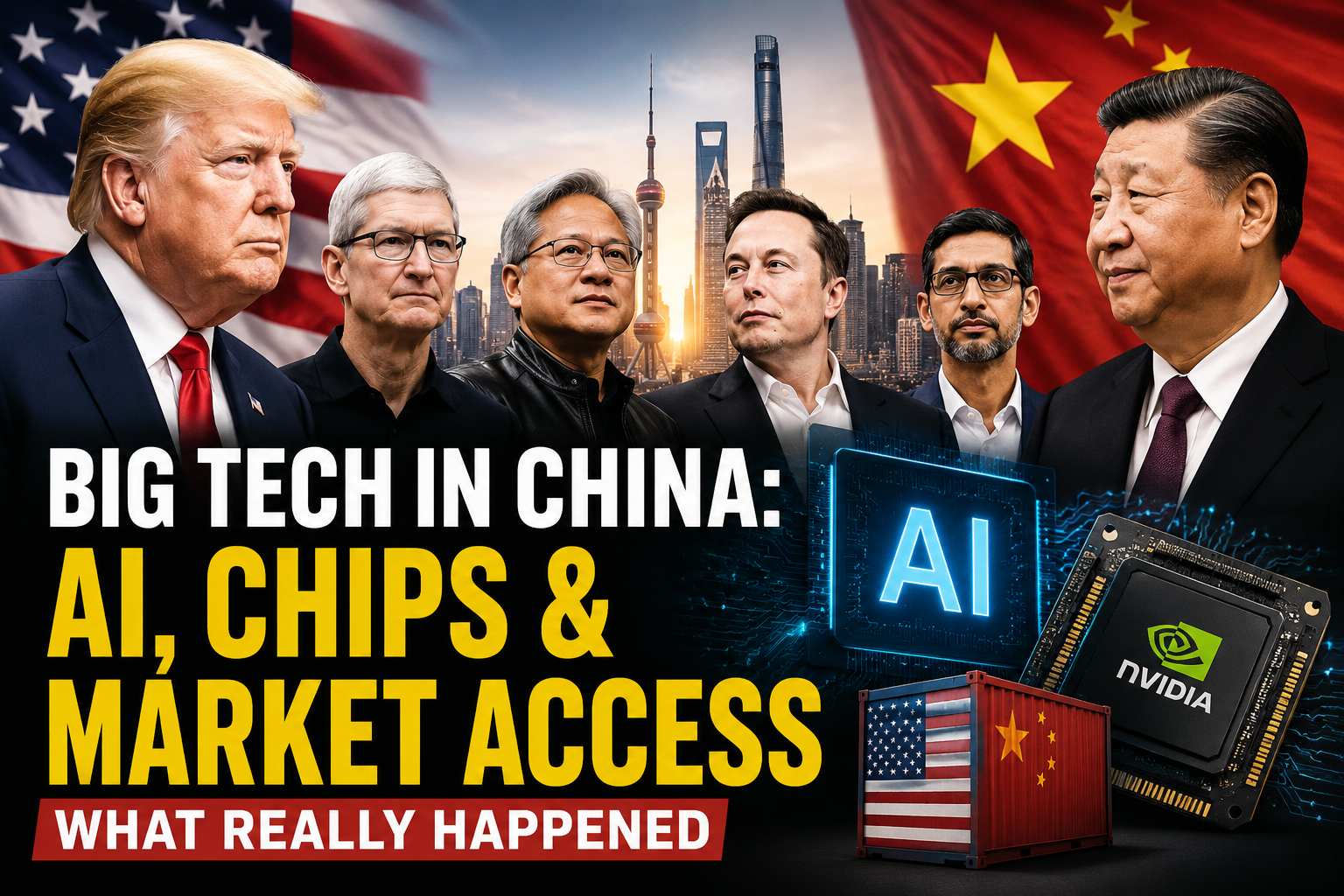
Trump’s visit to China was not just a political event.
It was also a technology event.
When U.S. presidents travel with business leaders, the guest list usually tells you what matters. This time, the guest list told a very clear story: artificial intelligence, semiconductors, smartphones, electric vehicles, aviation, finance, and access to the Chinese market are all becoming part of the same conversation.
This is the new shape of global technology.
It is not only about which company builds the best product. It is about which country controls the chips, which market allows access, which government approves exports, and which side can move faster in AI.
For developers, agencies, startups, and technology companies, that matters more than it may seem at first.
The biggest tech story was what did not happen
Before the visit, a lot of attention was on semiconductors.
Nvidia CEO Jensen Huang joined the trip, and that immediately raised expectations. Nvidia is at the center of the AI infrastructure boom. Its GPUs are not just another hardware product. They are the foundation that powers large AI models, cloud AI workloads, research labs, startups, and enterprise AI systems.
So naturally, many people were watching for a major U.S.-China chip breakthrough.
But that breakthrough did not really arrive.
Reports after the summit said chip stocks fell because the meeting ended without a major technology agreement. There was no clear breakthrough around Nvidia’s H200 chips, even though the U.S. had approved exports. China had still not formally cleared the path in the way markets hoped.
That tells us something important.
AI chips are no longer normal products. They are strategic assets.
A normal product can be sold if the buyer wants it and the seller can deliver it. AI chips are different. They sit at the intersection of business, national security, military capability, cloud infrastructure, and economic power.
That is why every chip decision now becomes political.
China wants access, but not dependency
China still wants access to global technology markets. U.S. companies still want access to Chinese consumers, manufacturers, suppliers, and business opportunities.
But China does not want to depend forever on U.S. semiconductors, U.S. operating systems, U.S. cloud platforms, or U.S. AI infrastructure.
That is the deeper story.
Even when American CEOs travel to Beijing, China’s long-term strategy remains clear: reduce dependence on foreign technology where it matters most.
That does not mean American companies are shut out. Apple still cares deeply about China. Tesla still cares about China. Qualcomm still cares about China. Nvidia would obviously like more access to China.
But every one of these companies now operates in a more complicated world.
The old version of globalization was simple: build anywhere, sell everywhere.
The new version is different: build where governments allow it, sell where regulators approve it, and compete in markets where technology is increasingly treated as national infrastructure.
Boeing got the clearest win, not Big Tech
One interesting part of the visit is that the clearest reported business win was not actually from Big Tech.
It was Boeing.
Trump and Boeing said China agreed to buy 200 aircraft, with Trump suggesting the order could eventually become much larger. That is a major development for Boeing because China had been a difficult market for years.
This matters because it shows something about the summit.
The trip created movement in traditional industrial trade. Planes, engines, aerospace, finance, agriculture, and payments all appeared to get attention.
But the most sensitive technology topics, especially advanced chips, remained harder to unlock.
That difference is important.
Selling aircraft is strategic.
Selling advanced AI chips is even more strategic.
The closer a product gets to artificial intelligence, compute infrastructure, military capability, or national security, the harder it becomes to treat it like ordinary trade.
AI is now diplomatic language
Trump also said that Xi was surprised by America’s AI progress and claimed the U.S. is substantially ahead of China.
Whether you take that as political messaging or a serious strategic claim, the bigger point is clear: AI is now part of diplomatic language.
Countries no longer talk only about tariffs, factories, oil, currencies, or military power.
They talk about AI capability.
They talk about chips.
They talk about compute.
They talk about who has the better models, better infrastructure, better data centers, better talent, and better ability to turn AI into economic productivity.
That shift is massive.
For decades, technology was often discussed as a business sector. Now it is discussed as a national advantage.
AI is becoming part of how countries measure power.
What this means for businesses
For most businesses, this may feel far away.
A small company building a website, an online store, a SaaS product, or an internal AI workflow may not care about presidential trips or chip diplomacy.
But the downstream effects matter.
If chip access changes, AI pricing can change.
If cloud infrastructure becomes more expensive, software margins can change.
If U.S.-China trade gets tighter, hardware supply chains can change.
If AI models become more regulated, product roadmaps can change.
If Apple, Tesla, Nvidia, Qualcomm, and other major technology companies face pressure in China, the effects can move through the whole digital economy.
This is why technology companies need to pay attention to geopolitics now.
Not because every business needs to become political.
But because technology is no longer isolated from politics.
The new reality for tech companies
The Trump China visit showed a simple reality:
Big Tech is no longer just building products. Big Tech is negotiating access.
Access to chips.
Access to markets.
Access to users.
Access to manufacturing.
Access to AI infrastructure.
Access to government approval.
That is the real story.
The future of technology will not be shaped only by better software. It will also be shaped by where that software can run, what chips power it, what governments allow, and which markets remain open.
For agencies, developers, SaaS founders, and digital businesses, the lesson is not to panic.
The lesson is to understand the environment.
AI is moving fast, but it is not moving in a vacuum. It is moving inside a global contest over infrastructure, markets, and power.
That is why this China visit matters.
Not because one trip changes everything overnight.
But because it shows where technology is going.
AI is no longer just a tool.
It is infrastructure.
It is business leverage.
It is national strategy.
And increasingly, it is diplomacy.