
xAI Just Launched Grok Build. AI Coding Agents Are Moving Into the Terminal.
AI coding is moving deeper into the developer workflow.
Not just inside chat windows.
Not just inside autocomplete.
Not just inside a browser-based code editor.
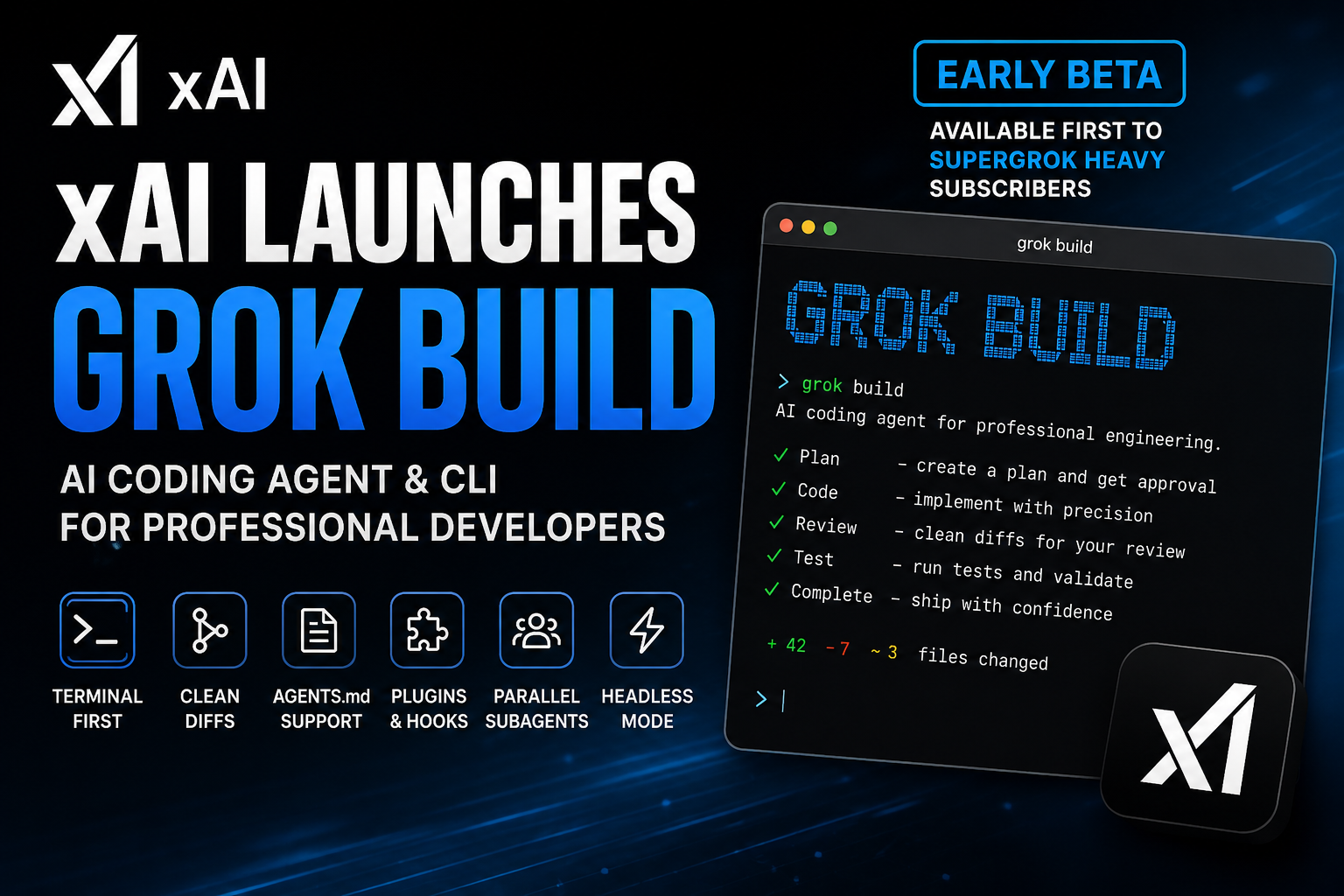
xAI has now launched Grok Build Early Beta, a new coding agent and command-line interface built for professional software engineering and complex coding work.
The important part is not only that xAI now has another AI coding product.
The important part is where it lives.
Grok Build runs from the terminal.
That tells us a lot about where AI-assisted development is going next.
AI coding is becoming more local, more agentic, and more workflow-aware
For the last few years, most AI coding tools were built around one simple idea:
A developer asks a question, and the AI gives an answer.
That was useful.
You could generate a function. Fix a bug. Explain code. Write a SQL query. Refactor a component. Create tests. Speed up repetitive work.
But the workflow was still mostly manual.
The developer had to ask the right question, copy the answer, paste the code, test it, fix the errors, and repeat the loop again.
Grok Build points to a different model.
Instead of only answering coding questions, the tool is designed to plan, execute, review, and operate closer to the actual repository.
That is the shift from AI assistant to AI agent.
An assistant helps you think.
An agent helps you move through a task.
The terminal matters
A terminal-based coding agent is not just a user interface choice.
For serious developers, the terminal is already where a lot of real work happens.
You run builds there. You run tests there. You manage Git there. You install packages there. You inspect logs there. You deploy from there. You automate scripts there.
So when an AI coding agent moves into the terminal, it gets much closer to the actual development environment.
That matters because real software work is not only writing code.
Real software work includes:
Understanding the repo structure.
Reading existing conventions.
Planning safe changes.
Checking diffs.
Running commands.
Testing assumptions.
Following project-specific instructions.
Respecting existing workflows.
Coordinating with tools the team already uses.
This is why AI coding tools are becoming less about “generate this snippet” and more about “understand this project and help me safely move it forward.”
Grok Build is designed around plan, review, and approval
One of the most interesting parts of Grok Build is the planning workflow.
For complex tasks, developers can start in plan mode. The agent creates a plan, and the developer can approve it, comment on steps, or rewrite it before execution begins.
That is important.
A lot of people imagine AI coding agents as fully autonomous systems that just change your code while you watch.
That is not always what professional developers want.
In real projects, control matters.
You do not want an AI agent blindly rewriting business logic, changing database assumptions, or modifying authentication flows without review.
The better workflow is not full surrender.
The better workflow is supervised autonomy.
Let the agent explore. Let it propose. Let it do the repetitive work. But keep the developer in the approval loop before meaningful changes happen.
That is where tools like Grok Build, Claude Code, Codex-style agents, Cursor agents, and other terminal or IDE-based agents are all heading.
The developer becomes less of a typist and more of a reviewer, architect, and workflow director.
Clean diffs are becoming the new trust layer
Another key detail is that Grok Build shows changes as clean diffs after a plan is approved.
That sounds small, but it is not.
Diffs are where trust happens in software engineering.
A developer does not trust an AI agent because the answer sounds confident.
A developer trusts it when the changes are visible, reviewable, testable, and reversible.
This is why the future of AI coding will not be won only by the model that writes the most code.
It will be won by the tool that helps developers understand what changed and why.
The best AI coding agents will not hide complexity behind a magic button.
They will expose the work clearly.
What did the agent inspect?
What did it change?
What files were touched?
What tests were run?
What assumptions did it make?
What should the developer review carefully?
That layer is critical for professional use.
Grok Build also supports existing developer conventions
xAI says Grok Build works with AGENTS.md, plugins, hooks, skills, and MCP servers.
That is another important signal.
AI coding tools are becoming configurable.
They are no longer just generic chatbots sitting next to your editor. They are starting to understand the rules of a specific project.
Every serious codebase has conventions.
How components are structured.
How APIs are called.
How styling works.
How commits are written.
How tests are organized.
How errors are handled.
How environment variables are used.
How deployment works.
The more an AI agent can read and follow these rules, the more useful it becomes.
This is especially important for agencies and freelancers.
When you work across Shopify, Squarespace, Webflow, WordPress, Angular, Firebase, Node.js, and custom web apps, every project has a different shape.
The agent must adapt to the project, not force every project into the same workflow.
Parallel subagents are where things get more interesting
Grok Build also supports subagents that can work in parallel.
This is one of the bigger trends in AI development right now.
Instead of one agent trying to do everything in a single long chain, the system can split work into smaller investigations.
One subagent can inspect the checkout flow.
Another can inspect infrastructure.
Another can check CI.
Another can review database queries.
Another can search for a performance regression.
This starts to look less like a chatbot and more like a small software team inside your terminal.
Of course, this does not mean the human developer disappears.
It means the human developer can delegate exploration faster.
That is a huge difference.
A senior developer often spends a lot of time reading, searching, comparing, and validating before writing the actual fix. If AI agents can reduce that exploration time, they can meaningfully improve software delivery.
Not because they replace engineering judgment.
Because they give engineers more context faster.
Headless mode points toward automated workflows
Another important detail is headless mode.
Grok Build supports running agents inside scripts and automations.
That is where coding agents start moving beyond interactive use.
Today, many developers use AI coding tools manually.
Open the tool. Ask a question. Wait. Review. Apply.
But headless mode suggests a future where agents can be part of automated workflows.
For example:
Run a repo review overnight.
Inspect failing tests.
Summarize a pull request.
Check migration risks.
Scan documentation gaps.
Prepare a refactor plan.
Generate a first-pass changelog.
Review performance-sensitive files.
Create a test coverage report.
This does not mean every automated agent should be allowed to push code to production.
That would be reckless in many environments.
But it does mean AI can become part of the software delivery pipeline.
The agent becomes another layer in the workflow, somewhere between code search, CI, documentation, testing, and human review.
What this means for software teams
For software teams, the lesson is simple:
AI coding is no longer just a productivity trick for individual developers.
It is becoming part of the engineering process.
Teams will need to decide how agents are allowed to work.
Can they edit files?
Can they run commands?
Can they access private repos?
Can they install dependencies?
Can they use MCP servers?
Can they read production logs?
Can they open pull requests?
Can they comment on issues?
Can they run in CI?
Can they work in parallel?
These are not only technical questions. They are operational questions.
Companies will need AI coding policies the same way they already have Git policies, deployment policies, security policies, and code review policies.
The teams that benefit most will not be the ones that randomly throw AI into the workflow.
They will be the ones that design a clear workflow around it.
What this means for agencies and freelancers
For agencies and freelancers, this is even more interesting.
A good agency does not only write code. It moves client projects forward.
That means reviewing old codebases, debugging strange problems, integrating third-party services, migrating platforms, improving performance, fixing design issues, and shipping under real deadlines.
AI coding agents can help with that kind of work.
They can speed up project discovery.
They can help inspect unfamiliar codebases.
They can generate implementation plans.
They can automate repetitive fixes.
They can create documentation.
They can test assumptions faster.
They can help a solo developer operate with more leverage.
But there is also a risk.
If every freelancer uses the same AI coding tools, the tool itself stops being the advantage.
The advantage becomes judgment.
Knowing what to ask.
Knowing what not to automate.
Knowing what to review.
Knowing where the AI is likely to be wrong.
Knowing how to protect the client’s project.
Knowing how to ship clean, maintainable work instead of fast but fragile code.
AI makes execution faster. It does not remove the need for professional responsibility.
The future is not one AI coding tool
Grok Build is entering a crowded and fast-moving space.
Developers already have GitHub Copilot, Cursor, Claude Code, OpenAI coding tools, Replit Agent, JetBrains AI features, Windsurf, and many other coding assistants.
But this market is not settled.
The reason is simple:
Coding is not one workflow.
Some developers want AI inside the IDE.
Some want it in the terminal.
Some want it in GitHub.
Some want it in CI.
Some want browser-based app generation.
Some want local-first workflows.
Some want enterprise controls.
Some want autonomous agents.
Some want very strict approval before anything changes.
That is why we will probably not end up with one winner.
We will end up with different AI coding environments for different types of work.
For fast prototypes, one tool may be best.
For enterprise codebases, another.
For local repo work, another.
For agents running in the background, another.
For agencies working across many client stacks, probably a mix.
The bigger picture
Grok Build is another sign that AI coding is moving from novelty to infrastructure.
The first wave was autocomplete.
The second wave was chat.
The third wave was agentic coding.
Now we are entering the workflow layer.
AI is not only helping developers write code. It is starting to participate in how software work is planned, reviewed, tested, automated, and shipped.
That is a much bigger shift.
The developer does not disappear.
The developer’s role changes.
Less time typing boilerplate.
More time reviewing plans.
Less time searching files manually.
More time deciding direction.
Less time fighting repetitive errors.
More time thinking about architecture, product, security, and user experience.
That is the real promise of AI coding agents.
Not replacing developers.
Making serious developers faster, more strategic, and more capable of handling larger amounts of complexity.
Final thought
Grok Build is still an early beta, and early beta tools should be treated carefully.
But the direction is clear.
AI coding is moving closer to the real developer environment.
Into the terminal.
Into repos.
Into workflows.
Into scripts.
Into parallel agents.
Into reviewable diffs.
Into the daily process of building software.
For developers, agencies, and software teams, the question is no longer whether AI will become part of coding.
It already has.
The better question is:
How much of your development workflow should AI be trusted to handle, and where should the human developer stay firmly in control?
https://x.ai/cli