
Codex Is Now on Your Phone. AI Coding Is Becoming Remote Work for Developers
AI coding is no longer limited to the laptop.
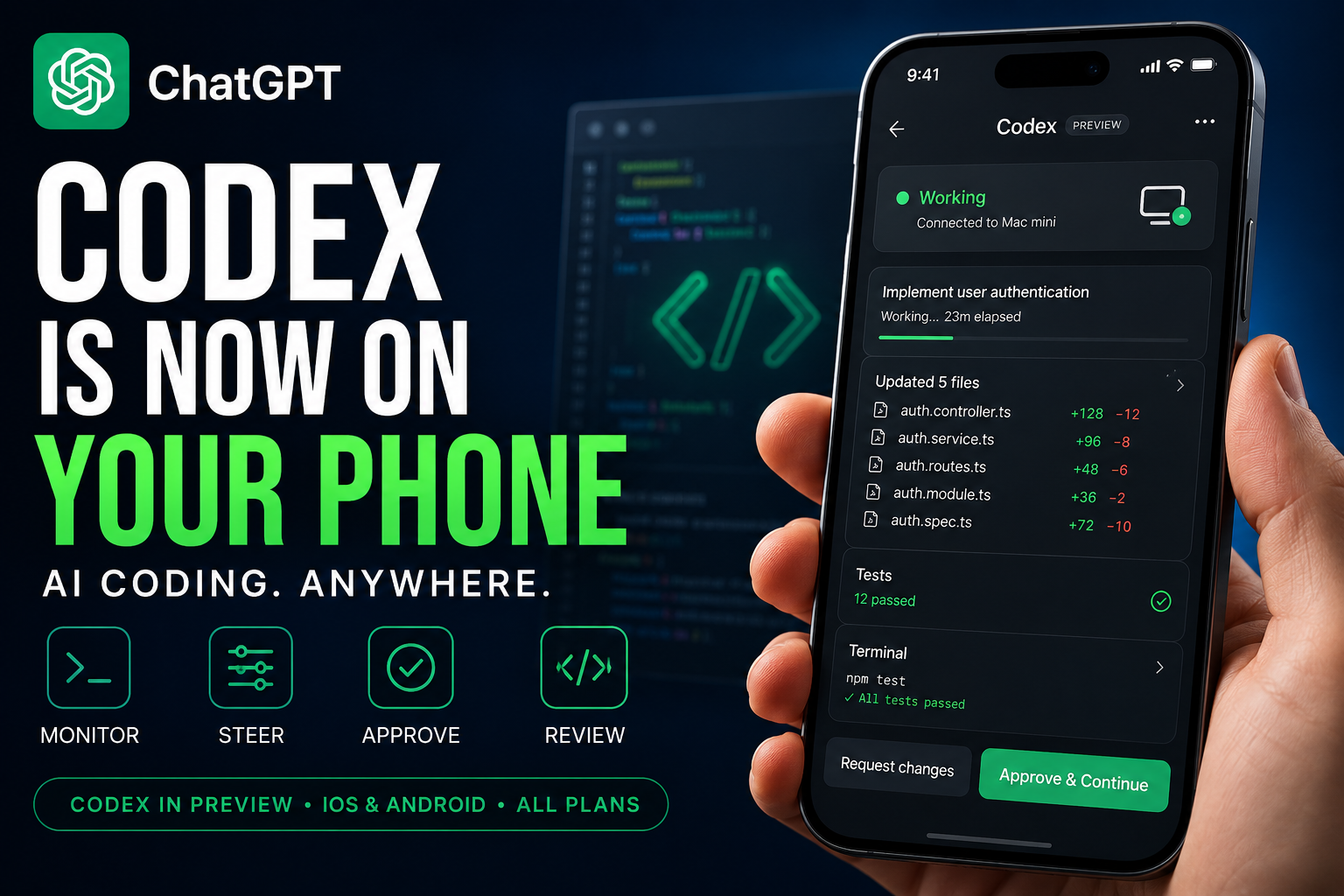
OpenAI has announced that Codex is now available in preview inside the ChatGPT mobile app. That means developers can stay connected to active coding work from their phone while Codex continues running on a connected host machine.
The announcement sounds small at first.
Codex on mobile.
But the direction is much bigger.
This is not about writing code on a tiny phone keyboard. Nobody wants to build a full application from a mobile screen. The real point is different: AI coding agents are becoming long-running workers, and developers need a way to supervise them from anywhere.
That is what this update points toward.
What changed
Until now, AI coding still had a very desktop-heavy workflow.
You opened your laptop. You started a task. You watched the agent work. You reviewed the output. You approved commands. You checked diffs. You redirected the model when it misunderstood something.
That workflow works, but it keeps the developer tied to the machine.
With Codex inside the ChatGPT mobile app, OpenAI is making that workflow more flexible. From mobile, developers can start or continue threads, answer questions, change direction, approve actions, review what Codex found, and move between connected hosts.
The mobile app can also show live context from the machine where Codex is operating, including project context, approvals, screenshots, terminal output, diffs, and test results.
That is the important part.
The phone is not replacing the development environment. The phone is becoming the remote control for the AI development environment.
This is the next phase after “AI autocomplete”
For years, AI coding was mostly autocomplete.
A developer wrote code, and the AI suggested the next line, function, or block. That was useful, but the human was still doing most of the coordination.
Then AI coding moved into chat.
Developers could ask questions about a bug, generate components, refactor files, or explain errors. This was more powerful, but still mostly request-response.
Now the workflow is changing again.
Tools like Codex are becoming agents that can run for longer periods, inspect a project, make changes, run tests, and come back with results. The developer is no longer just asking for snippets. The developer is assigning work.
That changes the role of the developer.
You are still responsible for quality, architecture, security, and final decisions. But you are not necessarily typing every line or watching every step.
You are supervising.
And supervision does not always require a laptop.
Why mobile access matters
The obvious use case is simple.
You start Codex on a task from your computer. Then you leave your desk. Maybe you go for a walk. Maybe you commute. Maybe you move to another room. Maybe you just do not want to keep your laptop open while the agent is still working.
With mobile access, you can still check what is happening.
Did Codex finish?
Did it get stuck?
Does it need approval?
Did the tests pass?
Did it misunderstand the goal?
Does it need a new instruction?
Before this kind of workflow, the answer was usually: go back to your machine.
Now the answer can be: open ChatGPT on your phone.
That is a meaningful shift.
For developers, freelancers, agencies, and technical founders, this makes AI coding feel less like a tool you use only while sitting at your desk and more like a background collaborator you can manage throughout the day.
The developer becomes the reviewer, not just the writer
This is where the bigger productivity change appears.
When AI coding agents become more capable, the bottleneck moves.
The bottleneck is no longer only writing the first version of the code. The bottleneck becomes giving the right task, reviewing the output, catching mistakes, protecting the architecture, and deciding what should actually ship.
That is why mobile control makes sense.
A lot of the work around AI agents is not deep typing work. It is decision work.
Approve this command.
Reject that direction.
Ask for a smaller change.
Review the diff.
Check the test result.
Tell the agent to continue.
Tell the agent to stop.
Those are small but important interventions.
And many of them can happen from a phone.
This is useful for agencies and freelancers too
For a software agency, this kind of workflow can become very practical.
Imagine a developer working on a client website, a Shopify customization, a WordPress migration, a Firebase bug, or an Angular feature. Codex can work on a contained task while the developer moves between meetings, client messages, QA checks, and other responsibilities.
The developer still needs to review the work carefully.
But the day becomes less blocked by one machine and one screen.
For freelancers, the benefit is similar. You can start a task, step away, and still keep control. You can check progress between calls. You can approve the next step without reopening the full development setup.
That does not mean every task should be delegated to an AI agent.
But it does mean the rhythm of development is changing.
Coding work is becoming more asynchronous.
This also creates new risks
There is a dangerous version of this future too.
If developers treat AI coding agents like magic, quality will suffer. More automation does not remove the need for engineering judgment. It increases the need for it.
Code still needs to be reviewed.
Architecture still needs to make sense.
Security still matters.
Tests still matter.
Performance still matters.
Client requirements still matter.
Mobile access makes it easier to keep work moving, but it also makes it easier to approve things too quickly.
That is the trap.
The best developers will not be the ones who blindly let agents run. The best developers will be the ones who learn how to manage agents properly.
Clear task.
Small scope.
Good context.
Careful review.
Test before shipping.
No blind approvals.
That is the workflow.
AI coding is turning into agent management
The important trend is not just “Codex is on mobile.”
The important trend is that software development is moving toward agent management.
A developer may soon have several coding agents running at the same time. One investigates a bug. One writes tests. One refactors a component. One updates documentation. One checks a migration path. One reviews a pull request.
The developer becomes the person coordinating all of that work.
That is a different skill set from traditional coding.
It still requires technical ability. Maybe even more than before. But the emphasis shifts toward breaking work into clear tasks, giving the right context, reviewing results, and knowing when the AI is wrong.
In other words, developers are not disappearing.
Their workflow is changing.
The phone is becoming the control layer
The reason this OpenAI update matters is because it shows where the interface is going.
The desktop remains the place where the real development environment lives. The codebase, terminal, tests, local tools, and project context still belong there.
But the phone becomes the control layer.
That makes sense.
Most people do not want to code on mobile. But they do want to stay connected to important work. They want to unblock agents. They want to check progress. They want to review outputs. They want to move a task forward without reopening the entire workspace.
That is exactly the kind of interaction mobile is good at.
Quick decisions.
Short replies.
Approvals.
Status checks.
Direction changes.
The laptop is where the work runs.
The phone is where the human stays in the loop.
What this means for businesses
For businesses, this is another sign that AI-assisted development is becoming more operational.
It is not just a productivity trick for individual developers anymore. It is becoming part of how software teams may plan, delegate, review, and ship work.
That matters for agencies, SaaS companies, internal software teams, and technical founders.
The teams that benefit most will not be the ones that simply “use AI.” Everyone is doing that already.
The teams that benefit most will be the ones that redesign their workflow around AI agents.
They will create smaller tasks.
They will document requirements better.
They will improve testing.
They will review AI-generated code carefully.
They will treat agents like junior contributors, not like senior architects.
They will keep humans responsible for the final product.
That is the realistic version of AI coding.
Not magic.
Leverage.
The bigger picture
Codex on mobile is a small product update with a big message.
AI coding is becoming more continuous, more agentic, and less tied to one desk.
The developer does not need to stare at the agent every second. The developer needs to guide it, unblock it, review it, and decide what ships.
That is why mobile access matters.
It turns AI coding from a single-screen interaction into a more flexible workflow.
Start the task on your computer.
Leave the laptop.
Check progress from your phone.
Approve or redirect.
Come back later and review the final result.
That is a very different way to build software.
And it is probably where development is heading.
https://chatgpt.com/codex/mobile/