
How Is Upwork Looking for Freelancers in 2026?
For many freelancers, Upwork used to feel simple.
Create a profile.
Send proposals.
Get clients.
Repeat.
That version of Upwork is mostly gone.
In 2026, Upwork is still one of the largest freelance platforms in the world. It still has massive demand. It still generates real income for thousands of freelancers.
But the structure of the platform has changed.
It is now more competitive, more selective, and more polarized than ever.
Some freelancers are earning more than they ever have.
Others are struggling to land even a single consistent client.
And the gap between those two groups is growing fast.
Upwork is still growing — but the game is tighter
At a high level, Upwork is not declining.
More companies are using freelancers than ever before.
More projects are being posted.
More money is flowing through the platform.
But growth is not evenly distributed.
And that is the key.
When a platform grows while competition grows even faster, the experience changes.
It becomes harder to win.
Harder to stand out.
Harder to convert.
That is exactly what is happening in 2026.
Upwork is no longer a place where effort alone gets results.
It is a marketplace where strategy, positioning, and leverage decide outcomes.
The supply side exploded
One of the biggest shifts is on the supply side.
There are more freelancers than ever.
Global access to remote work has expanded.
Developing markets are more active.
Career switching into freelancing is increasing.
And AI tools have lowered the barrier to entry for many types of work.
That creates a very specific dynamic:
more proposals per job
faster application cycles
higher noise for clients
Clients are now receiving dozens, sometimes hundreds of proposals within hours.
That changes behavior.
They skim faster.
They filter harder.
They respond to fewer people.
This is why many freelancers feel like “Upwork got worse.”
The platform did not get worse.
The competition got stronger.
Demand is real — but expectations are higher
The demand side is still strong.
Companies are hiring freelancers for:
flexibility
cost efficiency
speed
access to global talent
But what they expect from freelancers has evolved.
Clients in 2026 are not just looking for execution.
They are looking for:
problem-solving
decision-making
ownership
speed + quality combined
This is a major shift.
Before, many jobs were task-based.
Now, more jobs are outcome-based.
Instead of:
“Build this page”
Clients think:
“Help me improve conversions”
Instead of:
“Write 5 articles”
They think:
“Help me grow traffic”
This changes who wins.
Freelancers who understand business context win more.
Freelancers who only follow instructions struggle more.
AI didn’t kill freelancing — it compressed the market
AI is one of the biggest forces shaping Upwork in 2026.
But not in the way most people expected.
AI did not eliminate freelancing.
It reshaped it.
AI is replacing:
simple execution
repetitive tasks
low-skill production work
But it is increasing demand for:
AI-assisted professionals
people who can guide AI
people who can verify outputs
people who can integrate AI into workflows
This creates a compression effect.
Low-end work becomes cheaper and more competitive.
High-end work becomes more valuable.
The middle becomes unstable.
And that leads to one of the most important realities of Upwork today.
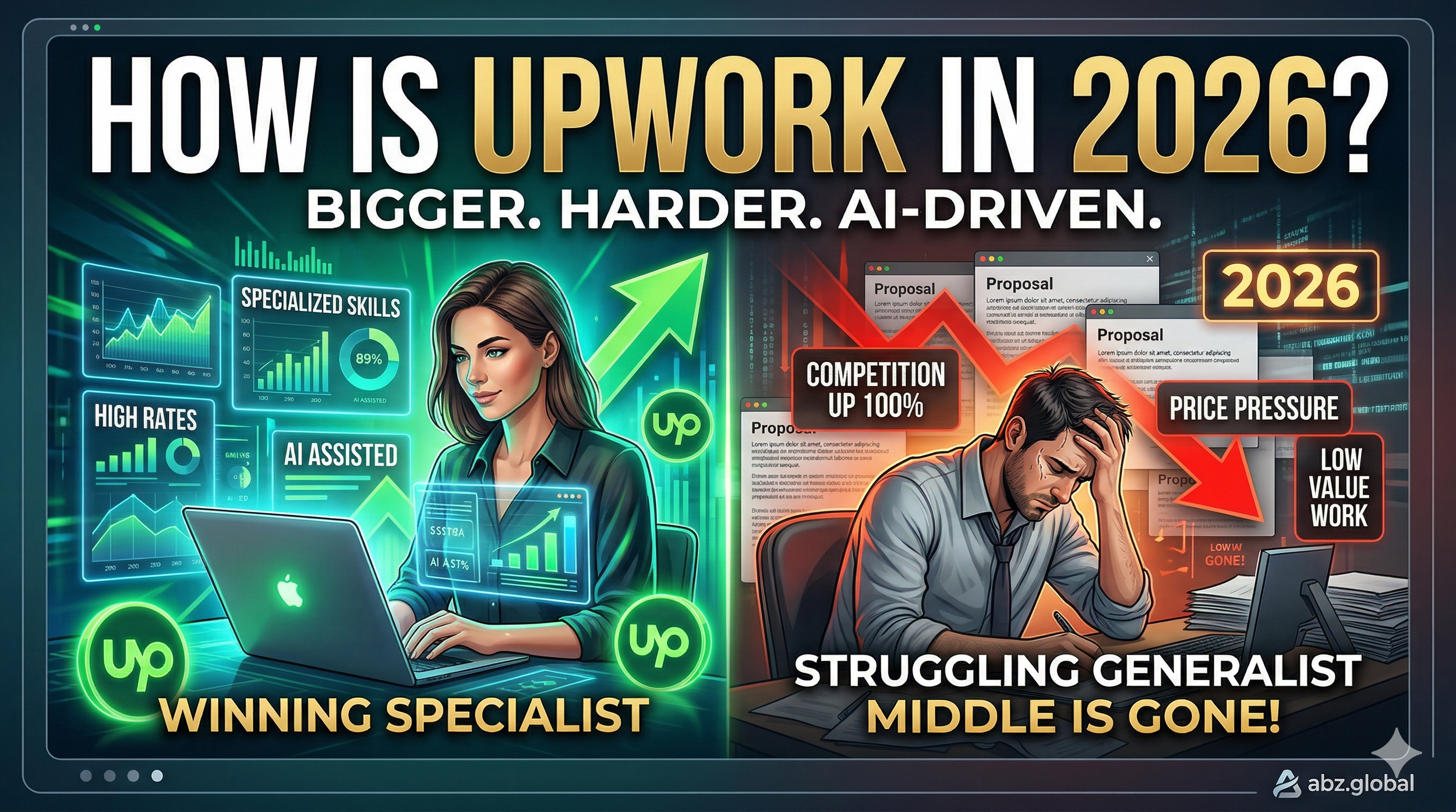
The middle freelancer is disappearing
In 2026, the hardest place to be is in the middle.
The freelancers who:
do general work
offer broad services
don’t specialize
don’t differentiate
They are getting squeezed from both sides.
From below:
AI and low-cost freelancers handle basic work.
From above:
Top freelancers dominate high-value work.
So the middle loses position.
This is why many freelancers feel stuck.
They are not beginners.
But they are not positioned as specialists either.
And that is the most dangerous place to be.
High-value work exists — but it is harder to access
There is more high-value work on Upwork than ever.
Larger contracts.
Longer engagements.
More serious clients.
But access to that work is not equal.
High-value clients are not browsing randomly.
They are:
searching specifically
inviting freelancers
filtering aggressively
choosing based on trust signals
That means:
Beginners rarely see these opportunities.
Mid-level freelancers struggle to break into them.
Top freelancers dominate them.
This creates a visibility gap.
The best opportunities exist.
But only a smaller group consistently reaches them.
Upwork is becoming a discovery platform, not just a bidding platform
This is a subtle but very important shift.
In earlier years, Upwork felt like a proposal platform.
You applied to jobs.
Clients chose from applicants.
Now, it increasingly behaves like a discovery platform.
Clients search.
Clients browse profiles.
Clients invite directly.
That changes the strategy.
Winning is no longer just about writing better proposals.
It is about:
profile optimization
niche clarity
positioning
visibility
In many cases:
The job is won before the proposal is even sent.
Rates are rising — but unevenly
There is a common narrative that freelance rates are going up.
That is true.
But only for a specific segment.
Top freelancers are:
charging more
increasing their minimums
working fewer hours for higher pay
At the same time:
Lower-tier freelancers are:
competing on price
lowering rates
struggling with consistency
This creates a split market.
Two freelancers in the same category can have completely different realities.
One making $20/hour.
Another making $120/hour.
Same platform.
Different positioning.
Specialization is no longer optional
This is probably the single most important shift.
General freelancers are struggling.
Specialists are winning.
Instead of:
“I build websites”
The winning positioning is:
“I build Shopify stores for fashion brands”
Or:
“I help SaaS companies increase conversion rates”
Or:
“I implement AI workflows for marketing teams”
Specificity matters.
Because clients don’t want general help anymore.
They want relevant expertise.
And Upwork’s algorithm also rewards clarity.
The more specific your positioning is, the easier it is to:
get found
get clicked
get trusted
Productization is replacing hourly thinking
Another shift is how freelancers package their work.
Selling time is becoming less effective.
Selling outcomes is becoming more effective.
Instead of:
“$50/hour for development”
Freelancers are moving toward:
fixed packages
clear deliverables
defined results
This aligns better with how clients think.
Clients don’t want hours.
They want results.
And freelancers who communicate that clearly have a major advantage.
AI is becoming a leverage tool, not a threat
The freelancers who are winning are not ignoring AI.
They are using it.
They use AI to:
move faster
handle repetitive tasks
increase output
improve quality
But they don’t rely on it blindly.
They combine:
AI speed
+
human judgment
That combination is extremely powerful.
And it is becoming the standard expectation.
The real opportunity is still massive
Despite all the challenges, the opportunity is still very real.
Companies are increasingly:
avoiding full-time hires
building flexible teams
outsourcing specialized work
Freelancers are becoming part of core operations, not just temporary support.
That is a structural shift in the global workforce.
Upwork is one of the main platforms capturing that shift.
But again:
The opportunity is not evenly distributed.
It rewards those who understand how the system works.
So how is Upwork looking in 2026?
The honest answer is:
Upwork is stronger than ever.
And harder than ever.
There is more money.
More demand.
More serious clients.
But also:
More competition.
Higher expectations.
Greater pressure to stand out.
It is no longer a platform where everyone can win equally.
It is a platform where:
a smaller percentage of freelancers capture a larger share of the value.
Final thought
Upwork in 2026 is no longer a beginner-friendly playground.
It is a competitive marketplace.
It rewards:
specialization
positioning
clarity
real skills
AI leverage
And it punishes:
generalists
unclear offers
low-value work
lack of differentiation
The opportunity did not disappear.
It evolved.
And the freelancers who adapt to that evolution are the ones who are still winning.