
Elon Musk’s Colossus 2 Post Signals xAI Is Still Betting Big on Scale
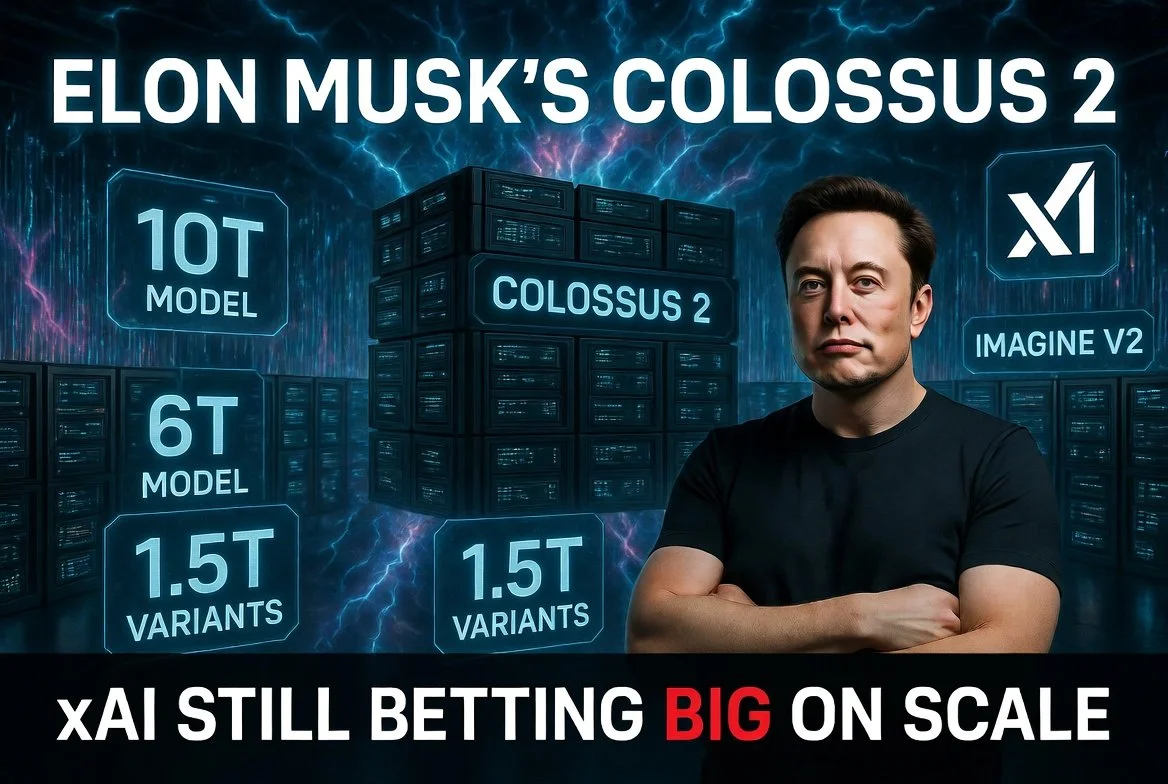
Elon Musk’s Colossus 2 post was short.
But strategically, it said a lot.
The headline detail was simple: Colossus 2 is training seven models at once, including Imagine V2, two 1T variants, two 1.5T variants, a 6T model, and a 10T model. Musk ended the post with a line that matters just as much as the model list: “Some catching up to do.” That wording makes the post more than a flex. It reads like an admission that xAI still sees itself as behind the very top tier and believes the answer is aggressive scale.
That is the real story.
This is not just about a company training bigger models.
It is about a company signaling that brute-force scale, parallel experimentation, and giant training infrastructure still sit at the center of its strategy.
Musk is effectively admitting xAI is still chasing
A lot of AI company messaging is built around momentum.
Everyone says they are leading.
Everyone says their roadmap is working.
Everyone says the next release will change the game.
Musk’s phrasing stands out because it is more revealing than the usual frontier-lab marketing language. “Some catching up to do” is not the sentence of a company claiming comfortable leadership. It is the sentence of a company that thinks the race is still open, but also thinks it needs a lot more model power and training throughput to close the gap.
That is important because it tells us how xAI sees the market.
It does not appear to think small refinements will be enough.
It does not appear to think one polished release will solve the problem.
It appears to think the right answer is to run multiple giant bets at once and let scale do the work faster.
The seven-model lineup is the real clue
The most interesting part of Musk’s post is not only that Colossus 2 is huge.
It is that xAI is using that infrastructure to run a portfolio of different model bets at the same time.
That matters.
A company training one giant model is making one primary frontier bet.
A company training seven models simultaneously is doing something else. It is exploring multiple scale points, multiple capability profiles, and probably multiple product directions in parallel. That is partly an inference, but it is a grounded one based on the diversity of the lineup Musk disclosed: image generation with Imagine V2, mid-range trillion-parameter variants, and then much larger 6T and 10T frontier runs.
That tells us xAI is not optimizing a finished system.
It is still searching.
And it is searching with a very expensive, very infrastructure-heavy approach.
Colossus 2 suggests xAI still believes scale can close the gap
There has been a lot of discussion over the past year about whether the AI race is moving beyond simple scaling.
That discussion is not wrong.
Data quality matters.
Post-training matters.
Inference efficiency matters.
Product integration matters.
But Musk’s post is a reminder that the biggest players still believe scale is far from dead.
xAI describes Colossus as its AI training supercomputer and frames it as the most powerful AI training system the company has built. It has been expanding infrastructure aggressively, investing heavily in data centers, and raising large amounts of capital to accelerate development.
Taken together, those moves point to the same thesis: xAI still believes capital, power, and compute density are core weapons in the race.
In other words, xAI is not behaving like a company that thinks clever optimization alone will get it there.
It is behaving like a company that thinks frontier AI is still a scale war.
The SpaceX tie-in makes the bet even bigger
This matters even more after the SpaceX combination.
The connection between xAI and SpaceX changes the meaning of Colossus 2. This is no longer just a startup trying to rent more GPUs and hope for a breakthrough. It is an AI company tied to one of Musk’s largest industrial systems, backed by larger capital ambitions and a more vertically integrated view of infrastructure.
That has several implications.
First, xAI can think bigger on compute than many independent labs.
Second, it can justify longer and more expensive training cycles if the payoff is considered strategic.
Third, it reinforces the idea that xAI is trying to compete not only as a chatbot maker, but as a frontier infrastructure player.
That is a more serious posture.
This is also a message to the market: xAI is not done being early-stage aggressive
A lot of companies become more conservative once they have a visible product.
They shift toward refinement.
They optimize the main line.
They narrow the roadmap.
Musk’s Colossus 2 post signals the opposite.
xAI still looks like a company in aggressive build mode.
It is pushing Grok across web, mobile, enterprise, and API layers, while also continuing to invest heavily in raw frontier training. The company is not acting like its current stack is good enough.
That combination is telling.
It means xAI is trying to do two hard things at once:
ship products now, and build much bigger capability later.
That is expensive.
It is risky.
But it is also exactly how a company behaves when it thinks it cannot afford to settle into second-tier status.
The parameter sizes are meant to signal ambition, not polish
The 6T and 10T figures in Musk’s post are especially revealing.
Even without over-interpreting parameter count as a direct measure of quality, numbers that large are not casual. They are there to communicate frontier intent. Musk is signaling that xAI is not making only incremental moves. It is training models at a scale designed to attract attention, change the narrative, and demonstrate that it still intends to compete at the highest level of compute ambition.
That matters because perception plays a role in the AI race.
Investors watch scale.
Talent watches scale.
Customers watch scale.
Competitors definitely watch scale.
A post like this is not only an engineering update.
It is a positioning statement.
xAI may be betting on parallelism because the frontier is uncertain
Another important implication is that xAI may not yet know which exact architecture or model size will best help it catch up.
That is normal.
The frontier is uncertain.
But the response here is expensive: train multiple major candidates in parallel.
That strategy makes sense if you have enough compute and enough capital. It reduces the cost of waiting for sequential experiments. Instead of betting everything on one path, you run several at once and learn faster. Musk’s disclosed lineup strongly suggests xAI is using Colossus 2 that way.
This is one of the clearest signs that xAI still sees the race as open-ended.
Not solved.
Not optimized.
Still brute-force competitive.
This says something bigger about the AI race itself
The post is also useful as a window into the broader state of frontier AI.
A lot of commentary lately has focused on product UX, agents, integrations, and enterprise deployment.
All of that matters.
But Musk’s post is a reminder that the core frontier competition still has a very physical layer underneath it:
power,
buildings,
chips,
cooling,
money,
and the ability to run many giant experiments at once.
That means the AI race is still, at least in part, an industrial race.
And Musk appears very committed to fighting it that way.
The risk in this strategy is obvious
Scale is powerful.
It is not free.
A company can spend enormous amounts on compute and still fail to produce the best end product.
It can run giant models and still trail in usability, reliability, post-training, or developer preference.
It can win headlines without winning habits.
That is the danger for xAI.
Because the more it leans into giant infrastructure and huge training runs, the more the market will expect unmistakable capability gains in return.
And that is a hard standard.
Musk’s own wording implies that xAI knows it is still in pursuit mode, not victory mode. So the Colossus 2 post should not be read as proof that xAI has already caught up. It should be read as proof that xAI is still willing to spend and scale like a company that thinks catching up is possible.
The post matters because it reveals the structure of the bet
That is what makes this more interesting than a tweet recap.
The post reveals the structure of xAI’s bet.
The bet is not subtle refinement.
The bet is not “our current product is good enough.”
The bet is not cautious pacing.
The bet is massive compute, giant parameter counts, parallel training, and the belief that enough scale can still move the frontier fast enough to close ground.
That is the message.
And it is a serious one.
Final thought
Elon Musk’s Colossus 2 post matters because it tells us how xAI thinks it wins.
It wins, in this view, by going bigger.
More models in training.
Larger models.
More compute.
More infrastructure.
More parallel bets.
And probably less patience for incrementalism.
That does not guarantee success.
But it does tell us that xAI still believes the frontier AI race is open to companies willing to spend aggressively and scale relentlessly.
So the most important part of Musk’s post is not the bravado.
It is the strategy underneath it.
xAI is still betting big on scale.