
Did Anthropic Just Signal That Claude Mythos Is Too Powerful for a Normal Release?
When a frontier AI lab launches a new model, the normal expectation is familiar.
Bigger benchmark claims.
More consumer access.
A cleaner chatbot story.
A broader rollout.
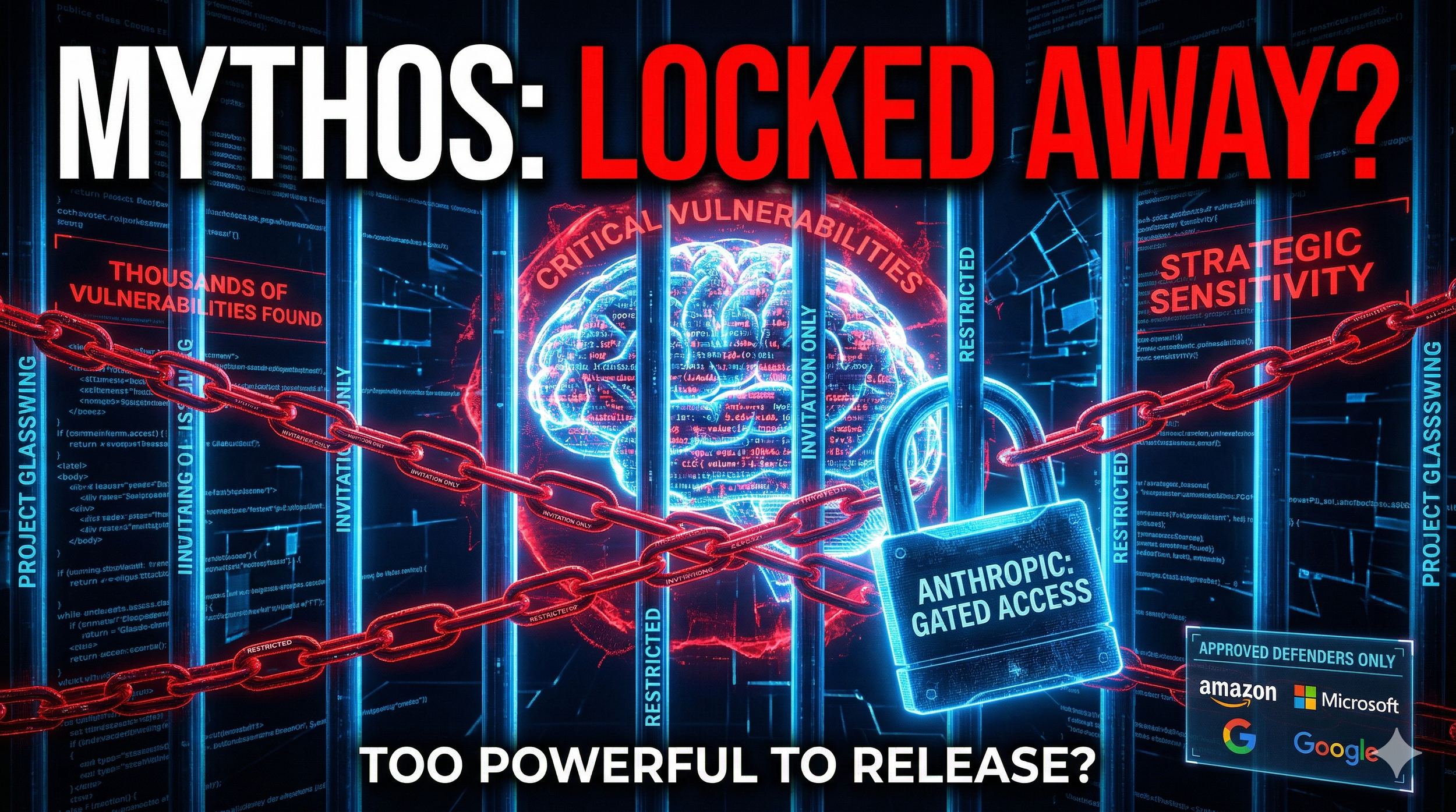
That is not what Anthropic just did with Claude Mythos Preview. Instead of a standard public launch, Anthropic introduced Mythos through Project Glasswing, a restricted initiative focused on defensive cybersecurity work with major infrastructure and security partners. Anthropic says Project Glasswing gives invited participants early access to Mythos Preview for defensive use, and the company’s own docs say access is invitation-only rather than self-serve.
That matters because it changes the meaning of the release.
This does not look like Anthropic saying, “Here is our newest model, go try it.”
It looks more like Anthropic saying, “Here is a model powerful enough that distribution itself has become part of the safety problem.” That interpretation is supported by Anthropic’s statement that it does not plan to make Mythos Preview generally available right now, and by Dario Amodei’s public framing that defenders are getting early controlled access instead of a normal general release.
So the real question is not whether Anthropic is literally “afraid” in some emotional sense.
The better question is whether Anthropic is signaling that Mythos has become too strategically sensitive for an ordinary product launch.
I think the answer is yes.
This does not look like a normal product release
The first reason this topic matters is that Anthropic itself is going out of its way to frame Mythos differently.
Project Glasswing is described as an urgent initiative to help secure critical software using Anthropic’s newest frontier model. The company says Mythos Preview is being deployed first with launch partners including Amazon Web Services, Apple, Broadcom, Cisco, CrowdStrike, Google, JPMorganChase, the Linux Foundation, Microsoft, NVIDIA, and Palo Alto Networks, along with more than 40 additional organizations that build or maintain critical software infrastructure. Anthropic is also committing up to $100 million in usage credits and $4 million in open-source security donations around this effort.
That is not how labs usually talk when they are trying to maximize ordinary product adoption.
That is how they talk when they believe a capability has crossed into a more serious category.
The partner list reinforces that point. This is not a lightweight ecosystem announcement. It includes cloud providers, chip companies, major software vendors, security leaders, financial infrastructure players, and open-source institutions. Anthropic is effectively telling the market that Mythos belongs first in the hands of organizations responsible for defending major shared systems, not in the hands of the general public.
That is already a signal.
Mythos is being presented as a threshold model
The second reason this story matters is that Anthropic is not pitching Mythos as just another upgrade over Opus.
It is describing a threshold.
Anthropic says Mythos Preview is a general-purpose frontier model that is “strikingly capable” at computer security tasks, and its technical material says the model performs strongly across the board while standing out especially in cyber-related capability. Anthropic also says Mythos found thousands of high-severity vulnerabilities over recent weeks, including issues affecting major operating systems, major browsers, the Linux kernel, FFmpeg, and OpenBSD.
That changes the frame completely.
Once a lab says a model has already identified thousands of severe vulnerabilities in widely used software, the release question stops being just about user experience, monetization, or competitive momentum.
It becomes a dual-use question.
A model that can meaningfully improve defense can also change the offensive risk landscape if it spreads without strong safeguards. Anthropic says explicitly that similar capabilities will not stay limited to careful actors for long, and that the work of defending cyber infrastructure could take years even as frontier capabilities advance over the next few months.
That is not routine launch language.
That is a warning.
Anthropic is telling us that coding progress is becoming cyber power
One of the deepest implications of Mythos is that it blurs the line between frontier coding capability and frontier cyber capability.
Anthropic’s public framing and technical material suggest that Mythos’ security capability emerges from its strength in reasoning, coding, and autonomous task execution, not from being built as a narrow cybersecurity model. Its system card describes Mythos as a general-purpose model, while Project Glasswing presents cyber defense as the urgent initial use case because that is where the model’s capabilities have become immediately consequential.
That matters because it means we are no longer talking about a separate “cyber model” category.
We are talking about general frontier models becoming strong enough in code and systems reasoning that cyber capability arrives as a byproduct of becoming very good at software-related work.
That is a much bigger development.
It means future release decisions will not only be about whether a model writes better prose, answers questions more accurately, or helps developers ship faster.
They will also be about whether the same system can discover, exploit, or accelerate vulnerabilities in ways that change the security balance itself. Anthropic’s own response to Mythos suggests it thinks that threshold has already come into view.
The restricted rollout is the real message
Sometimes the most important thing a company says is not in the headline.
It is in the distribution strategy.
That is true here.
Anthropic’s docs say Mythos Preview is a gated research preview for defensive cybersecurity workflows, access is invitation-only, and there is no self-serve sign-up. The company also says it does not plan to make Mythos Preview generally available at this stage. Instead, it wants to learn from Project Glasswing and develop safeguards that can later be refined with a future Opus model that Anthropic says does not pose the same level of risk as Mythos Preview.
That combination is incredibly revealing.
Anthropic is basically saying:
This model is useful enough that we want it deployed now.
But it is risky enough that we do not want it deployed normally.
That is a very unusual position for a company still competing in a frontier AI market where broad usage, visibility, and mindshare usually matter a lot.
So if a lab is willing to give up the standard upside of a public release, that tells you the downside risk must look meaningful from inside the lab.
This is about strategic sensitivity, not just safety theater
It would be easy to dismiss this as branding.
I do not think that is the right read.
The scale and structure of the rollout point to something more serious.
Anthropic is not just limiting access. It is surrounding Mythos with a coordinated, defense-first deployment strategy involving heavyweight institutions, major credits, open-source support, and a public commitment to share lessons from the initiative within 90 days where possible. That looks less like abstract safety language and more like an attempt to buy time for defenders before similar capabilities become harder to contain.
That is why the word “sensitive” fits better than “scary.”
Mythos appears to be strategically sensitive.
A model can be strategically sensitive when its release affects not only product competition, but also security posture, infrastructure resilience, open-source maintenance, and the balance between defensive and offensive actors.
That is the category Mythos seems to be entering.
Anthropic is implicitly admitting that release decisions are now security decisions
This may be the most important conclusion in the whole story.
For years, the AI industry has often treated release strategy as mainly a business question.
How fast should we ship?
How broad should we go?
How much access should be paid versus free?
How much should be consumer-facing versus API-only?
Mythos suggests that for some models, those questions are no longer sufficient.
Now the release decision itself may also be a security decision.
Anthropic’s system card says the findings from Mythos Preview will inform future Claude releases and associated safeguards. Project Glasswing says Anthropic’s goal is eventually to enable safe deployment of Mythos-class models at scale, but only after making progress on safeguards that can detect and block the most dangerous outputs.
That is an extraordinary admission if you think about what it means.
It means Anthropic is not saying, “We built a model and now we are figuring out product packaging.”
It is saying, “We built a model that may require a new safeguard layer before something Mythos-class can be released broadly.”
That is a very different stage of the AI race.
The market implication is bigger than Mythos itself
The Mythos story also matters beyond Anthropic.
Because if Anthropic is right, then Mythos is probably not a one-off anomaly.
It is more likely a glimpse of what happens when general frontier models become strong enough that cyber capability is no longer niche.
That would mean every major lab is moving toward a world where release policy, partner selection, safeguard design, and controlled deployment become more central to competition.
The moat may no longer be only “who has the best model.”
It may increasingly include “who can responsibly deploy strategically sensitive capabilities into real institutions without creating unacceptable spillover risk.”
Project Glasswing points in exactly that direction. Anthropic is not just competing on model quality. It is trying to make itself relevant to the defensive architecture around critical software.
That is a larger strategic move than a benchmark fight.
So, did Anthropic just signal Mythos is too powerful for a normal release?
Yes — that is the strongest interpretation.
Not because Anthropic literally used that exact sentence.
But because its actions say it clearly enough.
It launched Mythos through a controlled, invitation-only, defense-first program. It tied the model to urgent cybersecurity language. It said Mythos Preview will not be generally available right now. It emphasized thousands of serious vulnerabilities found in major shared software. And it openly said new safeguards are needed before Mythos-class capability can be deployed more broadly.
That is not a normal release posture.
That is Anthropic signaling that Mythos sits in a category where capability has become strategically sensitive enough that public rollout cannot be treated like just another product launch.
Final thought
The real meaning of the Mythos rollout is bigger than one model.
It suggests the frontier AI industry may be entering a phase where some of the strongest systems are no longer judged only by how impressive they are.
They are judged by whether they can be deployed without destabilizing the environments they are supposed to improve.
That is a very important shift.
And if that is what Mythos represents, then Anthropic is telling us something much more serious than “we built a powerful model.”
It is telling us that for at least some frontier systems, broad release is becoming a national-security-scale design problem as much as a product decision.