
Google Maps Just Got a Major AI Upgrade - Why Ask Maps and Immersive Navigation Matter
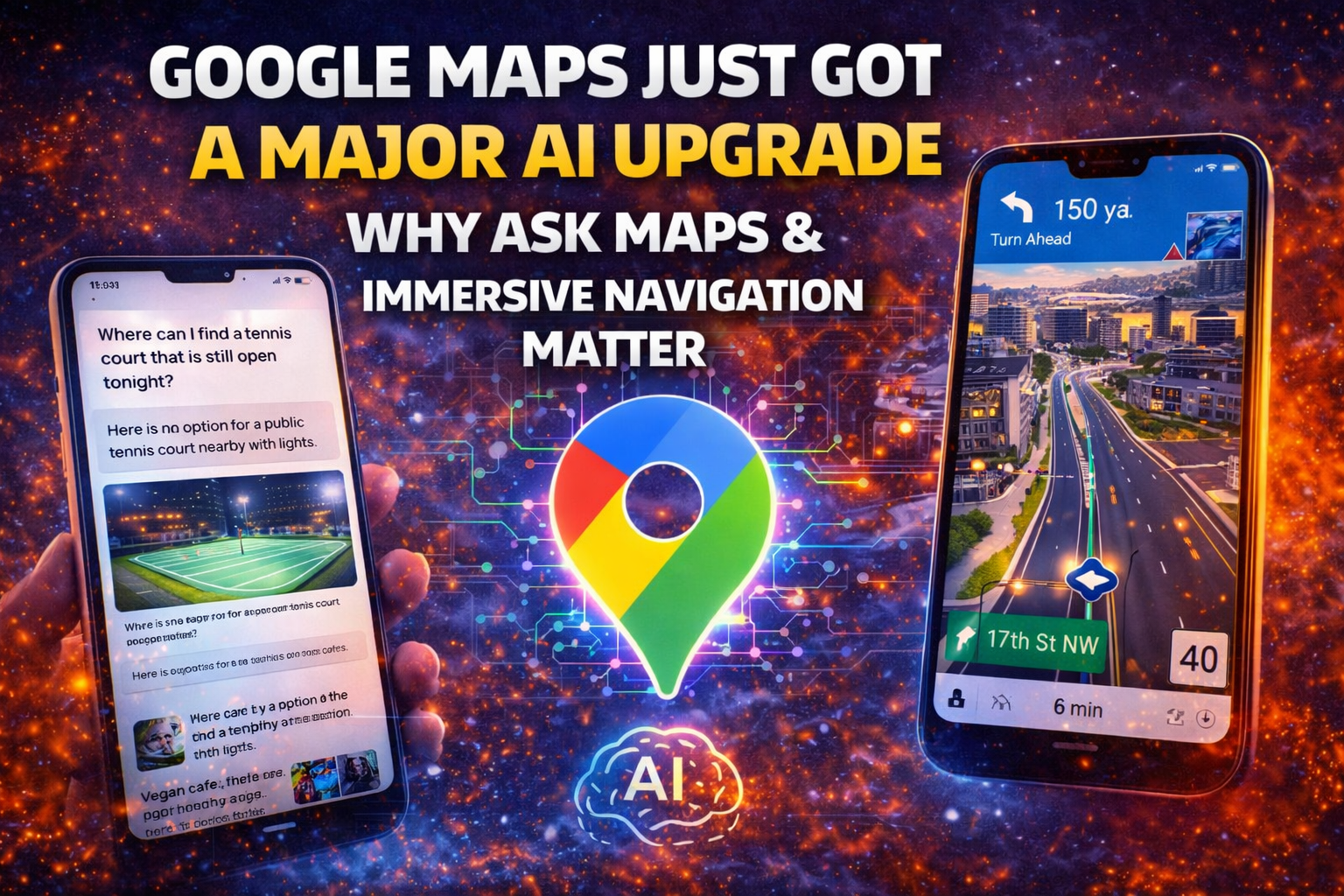
Google just announced one of its biggest Maps updates in years, built around two major ideas: making Maps more conversational with Ask Maps, and making driving easier with a major Immersive Navigation upgrade.
The bigger story here is that Google is no longer treating Maps as just a place to search for locations and get turn-by-turn directions. It is trying to turn Maps into something more intelligent, more helpful, and more natural to use in everyday life.
That is why this update matters. It is not just another AI feature added on top of an existing app. It is a broader attempt to rethink how people discover places, plan decisions, and move through the real world.
Ask Maps turns search into conversation
The most interesting part of the update is Ask Maps.
Google says this new experience allows users to ask more natural, real-world questions instead of relying on simple keyword searches. That means people can move beyond typing generic phrases like “restaurant” or “coffee shop” and instead ask for something much more specific.
For example, the product is designed for questions that reflect real situations, like finding a place to stop during a drive, looking for a specific kind of activity nearby, or asking for better recommendations based on what matters in that moment.
That changes the role of Maps quite a bit.
Instead of just showing a list of places and leaving the rest to the user, Maps is starting to behave more like a planning assistant. It can help narrow the options, surface more relevant places, and make the map itself feel more useful from the very first step.
Why Ask Maps is a bigger shift than it sounds
On the surface, this may sound like just another AI-powered search box.
But the deeper change is that Google is trying to reduce the distance between searching, deciding, and acting.
Normally, a user might search for a category, open several results, compare reviews, check distances, inspect the route, maybe send something to a friend, and only then decide what to do. That process works, but it can take too long and involve too many steps.
Ask Maps is clearly designed to compress that process.
Instead of manually piecing everything together, the user can ask a better question and get a more useful starting point immediately. That makes Maps feel less like a database of locations and more like a product that helps people make better real-world decisions faster.
Personalization is a major part of the update
Another important part of this launch is personalization.
Google says Ask Maps can use a person’s existing Maps context, such as previous searches, saved places, and preferences, to improve recommendations. That means the same question could produce different answers for different users depending on what Maps already knows about them.
This matters because location decisions are personal. The “best” place is rarely just the closest place. It often depends on taste, timing, convenience, past behavior, and the purpose of the trip.
That makes Maps one of the most natural places for AI to become genuinely useful. Unlike a general chatbot, Maps already understands location intent, real-world constraints, reviews, route logic, and saved context. Google is now trying to build a more natural conversational layer on top of all of that.
Immersive Navigation is the other big part of the story
The second major piece of the update is Immersive Navigation.
Google says this is its biggest navigation update in more than a decade, and the focus is clearly on making driving more intuitive, less confusing, and more visual.
The company is highlighting clearer guidance, stronger real-time context, better visual design, and more helpful route information. It is also putting more emphasis on things like route tradeoffs, previews, and practical details that can reduce stress while driving.
That is important because navigation is one of those product areas where good design has immediate value. When someone is already on the road, the product has to be fast, clear, and calm. Anything that reduces confusion in that moment makes a real difference.
So while Ask Maps may attract more attention because it sounds newer, the navigation upgrade may be just as important in real daily use.
Why this is more than a normal Maps improvement
A normal Maps update might improve search results, tweak the route engine, or change the visual interface a little.
This update feels broader than that.
Google is trying to improve both sides of the Maps experience at the same time:
how people decide where to go
how people get there once they decide
That is a much stronger product strategy than just adding one flashy AI feature.
On the discovery side, Ask Maps makes exploration more conversational. On the driving side, Immersive Navigation makes movement through the real world more intuitive. Together, those updates suggest Google wants Maps to feel less like a utility and more like a smart real-world assistant.
Google is leaning on the strength of Maps data
One reason Google sounds confident in this launch is that Maps already has enormous real-world coverage.
The product is built on a huge base of places, reviews, contributor updates, route data, and user behavior. That matters because conversational AI only becomes truly useful when the underlying information is strong enough.
In other words, Google is not starting from zero here.
It already has one of the richest location data systems in the world. What it is doing now is adding a more intelligent layer on top of that system so people can access it in a more natural and practical way.
That is one reason this update feels more substantial than many other AI product announcements.
Availability
Google says Ask Maps is rolling out in the U.S. and India on Android and iOS.
That means this is not just a concept or a future promise. Google is already beginning to put the experience in front of users.
That matters because it shows the company sees this as a real product direction, not just an experimental demo.
My view
This is one of the more meaningful Google product updates lately because it improves two things that people deal with all the time: deciding where to go and figuring out how to get there with less stress.
The strongest part of the launch is that it is built around a real, high-frequency use case. People already rely on Maps every day. So if Google can make it easier to ask better questions and easier to understand the route once you are moving, that is a very practical form of AI improvement.
The opportunity here is obvious. If Ask Maps works well, Google Maps could become one of the most useful consumer AI products because it sits right where digital intent turns into real-world action.
The challenge, of course, will be reliability. A map product has less room for error than a casual chatbot. Recommendations need to feel useful, routes need to stay clear, and the experience needs to be fast enough to matter in real life.
Final verdict
Google’s new Maps update matters because it is trying to improve both the thinking part of travel and the movement part of travel.
Ask Maps pushes Maps toward a conversational discovery tool that can answer more specific real-world questions. Immersive Navigation pushes the product toward a clearer and more intuitive driving experience.
Taken together, the update shows Google trying to make Maps feel less like a place you search and more like a place you can ask for help.
The simplest takeaway is this:
Google is trying to turn Maps from a map app into a smarter real-world assistant.
If that works well in practice, this could end up being one of the most useful AI upgrades Google has released to a mass-market product in a while.