
How Much Does the World Depend on the Middle East for Oil?
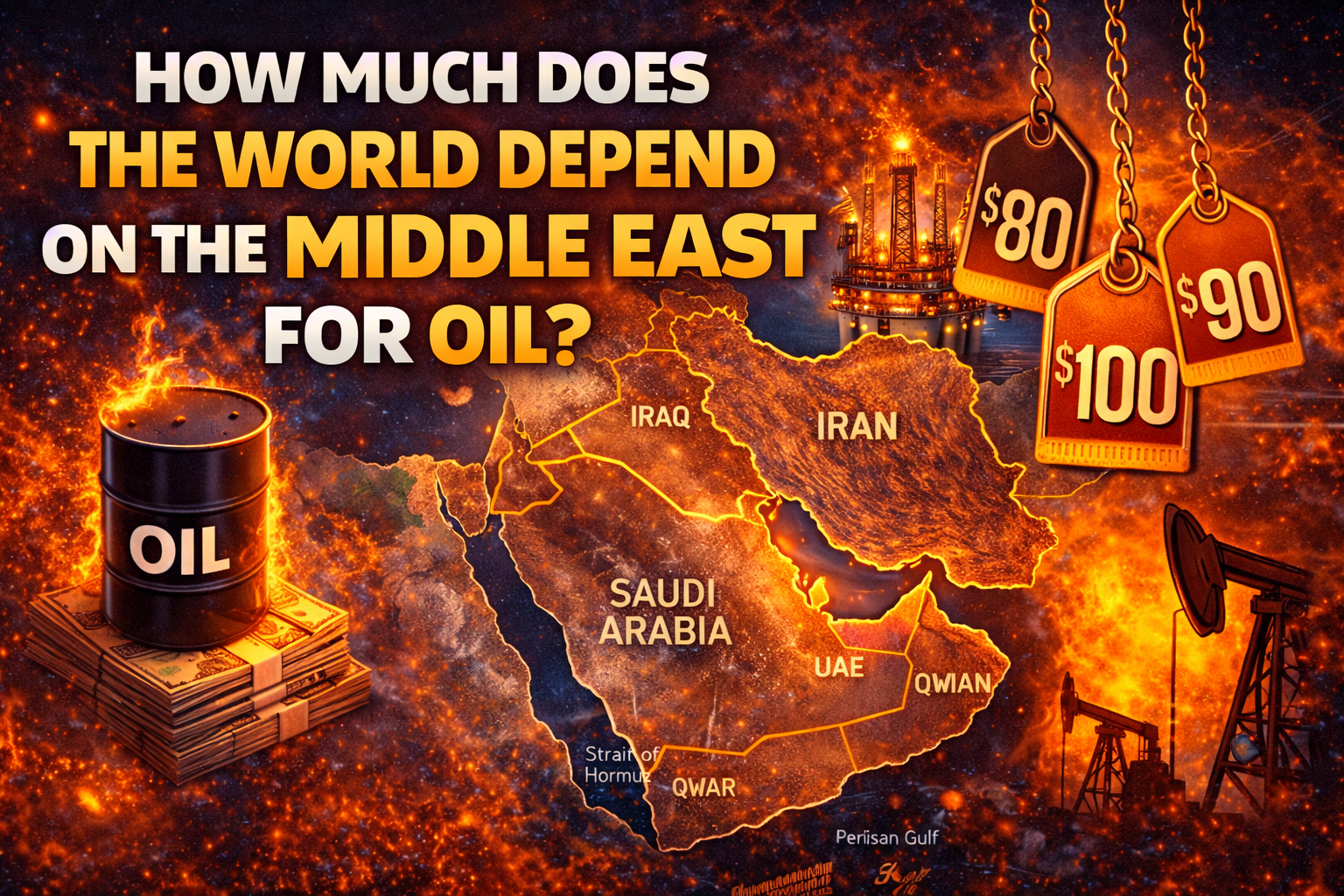
The world still depends heavily on the Middle East for oil, but the dependence is often misunderstood.
A lot of people hear that the United States produces huge amounts of oil, or that countries like Brazil, Canada, and Guyana are growing, and assume the Middle East is no longer that important. That is not true. The world may be less dependent on the Middle East than it was decades ago, but it is still highly dependent on the region in ways that matter enormously for global prices, trade flows, and energy security.
The simplest way to understand it is this:
The Middle East is not the only place that produces oil, but it is still one of the most important places in the world for oil production, oil exports, spare capacity, and shipping routes. And that means when something goes wrong there, the entire global market pays attention almost immediately.
The first thing to understand: production and dependence are not exactly the same thing
When people ask how much the world depends on the Middle East for oil, they often mean one of two different things.
The first question is: how much oil does the region actually produce?
The second question is: how much does the world depend on that oil staying available and moving smoothly through global markets?
Those are not exactly the same thing.
A country can produce a lot of oil and still not shape the global market as much as a region that exports massive volumes at low cost and sits on critical shipping routes. That is why the Middle East matters so much. It is not only a big producer. It is also a major exporter, and it sits at the heart of one of the most sensitive energy transport systems on Earth.
The Middle East still produces a huge share of the world’s oil
Even today, the Middle East remains one of the central pillars of global oil supply.
Countries such as Saudi Arabia, Iraq, the United Arab Emirates, Kuwait, Iran, and Qatar continue to play a major role in the energy system. Together, the region still accounts for a very large share of global oil production.
That matters on its own, but the importance becomes even bigger when you consider the quality of that supply. A lot of the oil in the Middle East is relatively low-cost to produce compared to many other parts of the world. That means the region is not just important because of how much oil it has, but because of how economically important that oil is to the global system.
In plain English, the Middle East is not just another supplier. It is one of the most strategically valuable suppliers in the entire market.
Exports are where the real dependence becomes easier to see
This is where the discussion becomes more serious.
The world does not only depend on oil being produced. It depends on oil being exported reliably to the countries that need it. And the Middle East is still one of the most important export regions in the world.
Many countries in Asia depend heavily on imported oil, and a large share of those imports comes from Gulf producers. That means even if some countries are less directly dependent than before, the wider global economy is still tied to Middle Eastern energy through trade.
This is especially important because oil is globally priced. Even countries that buy less directly from the region can still feel the impact when the Middle East is disrupted. If supply fears push global crude prices higher, fuel prices can rise almost everywhere.
So the world’s dependence is not only about direct imports. It is also about price exposure.
Why the Strait of Hormuz makes everything more dangerous
If you want to understand why the Middle East keeps dominating oil headlines, you have to understand the Strait of Hormuz.
This narrow waterway between Iran and Oman is one of the most important energy chokepoints in the world. Huge amounts of crude oil and oil products pass through it every day. So when tensions rise in the Gulf, the market is not only thinking about production. It is thinking about whether that oil can actually leave the region.
That is why the Strait of Hormuz matters so much.
Even if oil wells are still pumping, the market can panic if it believes exports may be slowed, attacked, delayed, or blocked. Tankers may avoid the route. Insurance costs can jump. Shipping becomes riskier. And once that happens, crude oil prices often rise quickly.
This is one of the biggest reasons the world still depends on the Middle East in a very practical way. A large share of globally traded oil still moves through a narrow and vulnerable bottleneck in that region.
The world is less dependent than before - but not independent
It is true that the energy map has changed.
The rise of U.S. shale changed the global oil story significantly. The United States became far more important as a producer. Other countries also expanded output. New offshore discoveries and new investment in places outside the Middle East helped diversify supply.
So yes, the world is not as dependent on the Middle East as it was in earlier decades.
But that does not mean the dependence is gone.
The reason is simple: diversification helps, but it does not replace the unique role of the Middle East. The region still combines four things that are hard to replace all at once:
large volumes, low-cost production, huge export capacity, and critical shipping routes.
That is why the Middle East still matters more than many people assume.
Not every part of the world depends on the region equally
This is another important point.
The world depends on the Middle East, but not every country depends on it in exactly the same way.
Asia is highly exposed
Many Asian economies are especially sensitive because they import large volumes of oil and a large share of that oil has traditionally come from the Gulf. For countries with strong industrial output, large populations, and heavy energy needs, Middle Eastern supply remains especially important.
Europe is exposed through prices and trade
Europe may not rely on the region in exactly the same direct way as some Asian importers, but it is still highly exposed to global oil-price shocks. If the Middle East becomes unstable, Europe feels it through fuel prices, inflation, transport costs, and business uncertainty.
The United States is less directly dependent, but not immune
The United States is much stronger in production than in the past, which gives it more resilience. But it still cannot isolate itself from global oil pricing. If the Middle East experiences a major disruption, American consumers and businesses can still feel the effect through higher crude prices and higher fuel costs.
So even where direct dependence has declined, price dependence remains.
Why the market reacts so fast to Middle East conflict
This is the part that most people notice first.
Fuel prices often rise very quickly when conflict breaks out in the Middle East, even before a full physical shortage appears. That is because oil markets react to risk, not only to confirmed lost barrels.
If traders think there is a real chance that exports could be interrupted, they start pricing in tighter supply immediately. That pushes crude oil up. Then petrol, gasoline, diesel, aviation fuel, and shipping costs often begin to rise as well.
This is why the Middle East shows up so often in headlines about inflation and fuel prices.
The market understands that the region is too important to ignore. Even a limited military escalation can trigger a strong reaction because the downside risk is so large.
Spare capacity makes the region even more important
Another reason the world depends on the Middle East is something many casual readers do not think about: spare capacity.
Not all oil producers can quickly raise production when the market tightens. Some producers are already operating close to their limits. But certain major Middle Eastern producers, especially Saudi Arabia and some Gulf states, are often viewed as among the few players with the ability to bring significant extra supply to the market when needed.
That makes the region even more strategically important.
It is not only a major source of oil in normal conditions. It is also a region the market watches during emergencies because it may be able to help stabilize supply.
That kind of role gives the Middle East influence far beyond its day-to-day production numbers.
The dependence is also psychological, not just physical
There is another layer to this story.
The world depends on the Middle East not only because of actual barrels, but because of market psychology. The region has such a strong historical and strategic role in oil that any sign of tension there immediately changes how traders, governments, and businesses think.
In other words, the Middle East does not only supply oil. It also shapes expectations.
If traders believe a Gulf crisis might grow worse, prices can jump on fear alone. If shipping looks unsafe, the market reacts. If there is talk of blocked routes or retaliation near major export infrastructure, the market starts building in a risk premium.
That means the region’s influence is partly physical and partly financial.
And both forms of influence are powerful.
Why this matters for ordinary people
This topic is not just for traders, economists, or governments.
It matters to ordinary people because oil still flows through almost everything in the economy. When oil prices rise, the effect does not stay limited to one sector.
It can show up in:
higher petrol and diesel prices
more expensive shipping and logistics
rising airline costs
pressure on farming and food transport
higher business costs
inflation across consumer goods and services
That is why Middle East headlines often end up affecting daily life far away from the region itself.
You may live thousands of kilometers away, but if global crude prices jump because of tensions in the Gulf, you can still end up paying more at the pump or seeing prices rise elsewhere in the economy.
So how much does the world depend on the Middle East for oil?
The best answer is this:
The world is not totally dependent on the Middle East for oil, and it is more diversified than it used to be.
But the world is still deeply dependent on the region in three major ways:
The Middle East still produces a very large share of global oil.
It remains one of the most important oil-exporting regions in the world.
It sits around critical chokepoints, especially the Strait of Hormuz, that can quickly affect global trade and prices.
That combination is what makes the region so important.
If the question is “could the world survive without Middle Eastern oil forever?” the answer is much more complex.
But if the question is “can the Middle East still move global oil and fuel prices very quickly?” the answer is clearly yes.
Final verdict
The world depends heavily on the Middle East for oil, even if that dependence is lower than it was in the past.
The region still matters because of its scale, its export strength, its low-cost production, its spare capacity, and its control over some of the most important oil shipping routes on Earth.
That is why the Middle East keeps appearing in every major energy story. It is not just one oil-producing region among many. It is still one of the central pressure points of the global oil system.
The simplest takeaway is this:
The world is less dependent on Middle Eastern oil than before, but still dependent enough that conflict there can push fuel prices higher almost everywhere.
That is why markets still watch the region so closely.