
Upwork’s Stock Is Down 52%. Here Is What Freelancers Should Learn.
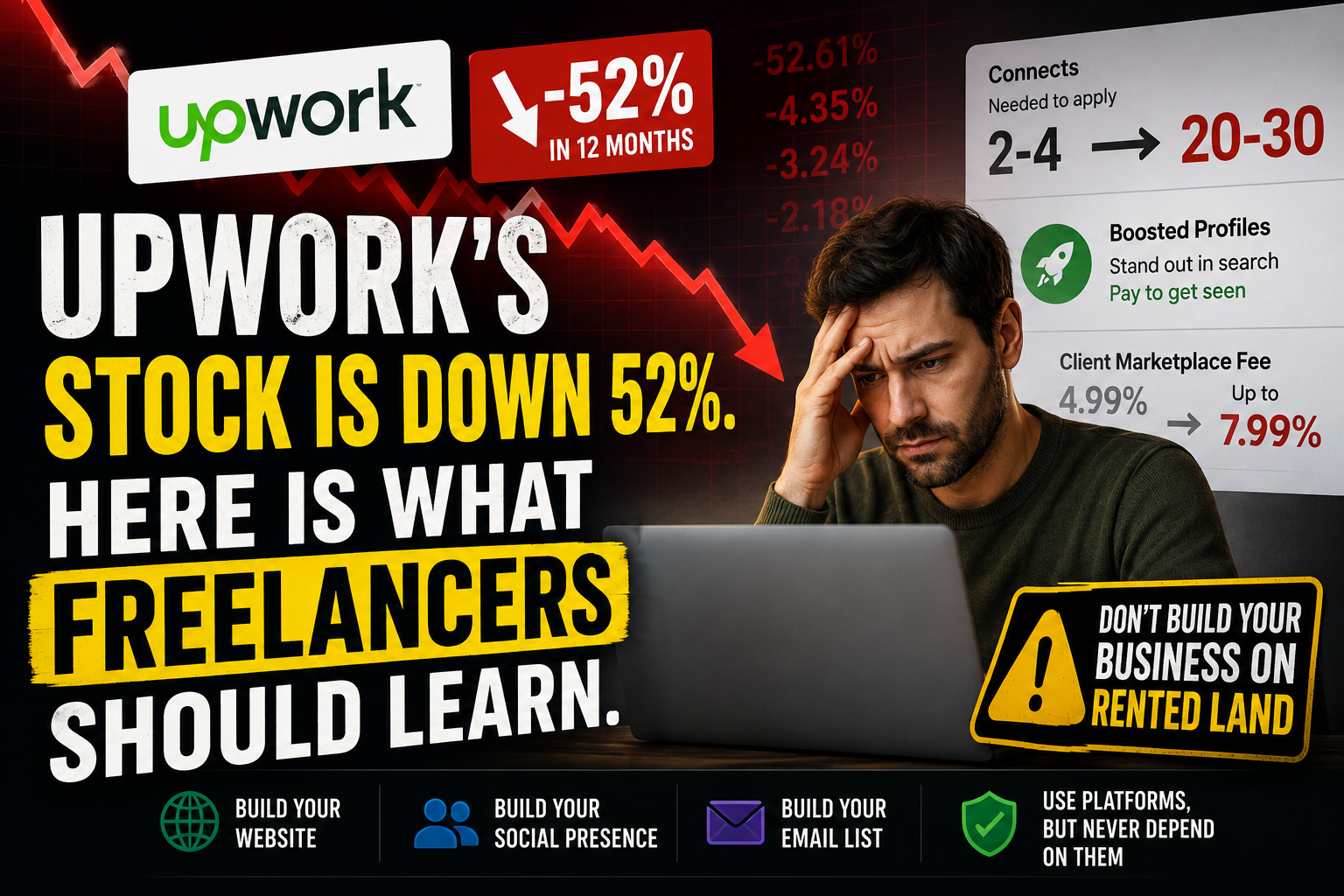
Upwork’s stock being down around 52% over the last 12 months is not just a stock market story.
It is a freelancing story.
It is a platform story.
And for independent professionals, agencies, consultants, developers, designers, writers, marketers, and anyone who depends on online platforms for work, it is a warning sign.
Upwork is still a large marketplace. It still has clients. It still has freelancers. It still has real value. But the decline in market confidence says something important: the economics of freelancing platforms are getting harder, and the people who depend on them are starting to feel the pressure.
The simple lesson is this:
Freelancers should use platforms, but they should not build their entire business on platforms.
Because when a platform changes its incentives, your business can change overnight.
The real issue is not only the stock price
A falling stock price does not automatically mean a company is dying.
Stocks move for many reasons: growth expectations, earnings, revenue guidance, investor sentiment, macro conditions, AI disruption, competition, profitability, and future outlook.
Upwork’s Q1 2026 results show a more complex picture. The company reported $195.5 million in revenue, up only 1.4% year over year, and also highlighted growth in its Business Plus offering. At the same time, outside reporting noted that active client count declined 3% year over year to 784,000.
So the issue is not that Upwork disappeared.
The issue is that the marketplace appears to be under pressure from both sides.
Freelancers are frustrated with the cost of competing.
Clients are being asked to pay more.
And the platform is trying to monetize more aggressively in an environment where trust, quality, and marketplace liquidity matter more than ever.
That is the dangerous part.
A marketplace does not work just because it has users. It works when both sides believe the deal is fair.
The freelancer side: paying before you even win the job
For freelancers, the biggest frustration is not only the service fee.
Upwork’s official freelancer service fee currently ranges from 0% to 15% per contract. That already means the platform takes a percentage from the work after the freelancer wins the client.
But the bigger psychological shift is that freelancers increasingly feel like they are paying before they even get a real chance.
That is where Connects come in.
Upwork says Connects are used to submit proposals to job posts, and the number required varies by job. The required amount can also change while a job is posted, based on factors like project size, scope, and demand.
In theory, this can reduce spam.
In theory, making applications more expensive should make freelancers more selective.
In theory, clients should receive fewer but better proposals.
But the practical experience for many freelancers is different.
When the cost to apply rises too much, the marketplace starts to feel less like a merit-based opportunity engine and more like a paid access system.
That creates a different kind of pressure.
A freelancer is no longer only asking:
“Am I good enough to win this project?”
They are also asking:
“Is this job even worth spending money to apply?”
That changes the psychology of the platform.
It turns business development into a pay-to-play auction before the client even replies.
When applying becomes a revenue stream, the incentives change
The problem with charging freelancers to apply is not that every fee is automatically bad.
Platforms cost money to run. Spam is a real problem. Low-quality proposals hurt clients. Some friction can improve the marketplace.
The issue is incentive alignment.
If a platform earns money when freelancers apply, whether or not they win, then unsuccessful applications become part of the platform’s business model.
That does not mean the company wants freelancers to fail.
But it does mean the platform can make money from freelancer hope.
That is a dangerous incentive.
A freelancer might spend money applying to jobs that never hire anyone.
They might spend money applying to vague job posts.
They might spend money applying to clients who are only testing the market.
They might spend money competing against dozens of other people, many of whom are also paying for visibility.
At that point, the marketplace is no longer just taking a cut of successful work.
It is monetizing the attempt to get work.
For freelancers, that distinction matters.
Paid visibility changes the quality signal
The second major issue is paid visibility.
Upwork officially describes Boosted Profiles as a way for freelancers to promote their profiles so they appear higher in search results when clients browse for freelancers. Upwork also says boosted profiles let freelancers pay with Connects to appear higher in search results or recommendations.
Again, this is not unusual in internet marketplaces.
Google has ads.
Amazon has sponsored products.
LinkedIn has promoted posts.
Facebook and Instagram have paid reach.
But freelancing is not the same as selling a commodity product.
When a client searches for a web developer, designer, copywriter, SEO consultant, automation expert, or software engineer, they are not just looking for visibility. They are looking for trust.
They need to know who is actually good.
They need to know who has relevant experience.
They need to know who can communicate, deliver, and solve the problem.
If too much of the search experience becomes paid placement, the platform risks weakening its own quality signal.
That hurts freelancers because strong work no longer guarantees strong visibility.
It hurts clients because search results become harder to interpret.
And it hurts the marketplace because the best person for the job may not be the person most willing to spend on promotion.
Clients are also paying more
This is not only a freelancer-side issue.
Clients also face higher costs.
Upwork’s support page says clients on the free Basic plan pay a Client Marketplace Fee of up to 7.99% on payments made to freelancers. Upwork’s pricing page also shows discounted lower rates for eligible U.S. clients using checking accounts, but the headline issue remains: clients can pay a meaningful fee on top of freelancer payments.
That matters because clients are not emotionally attached to a freelancing platform.
They want the job done.
If hiring through a platform becomes too expensive, too noisy, or too complicated, clients will look elsewhere.
They can hire through referrals.
They can search Google.
They can find agencies directly.
They can use LinkedIn.
They can use niche communities.
They can use AI tools for smaller tasks.
They can build internal teams.
They can go to specialized marketplaces.
Once clients start exploring alternatives, the platform loses one of its strongest advantages: habit.
For a marketplace, habit is everything.
If clients stop defaulting to Upwork, freelancers lose demand.
If freelancers lose demand, quality talent leaves.
If quality talent leaves, clients have even less reason to return.
That is how marketplace decline can become self-reinforcing.
The deeper lesson: rented land is dangerous
The most important lesson for freelancers is not “Upwork is bad.”
That is too simple.
Upwork helped many freelancers build real businesses. For some people, it still works. For new freelancers, it can still be a way to get experience, build a portfolio, test offers, and access global clients.
The real lesson is this:
Do not confuse access with ownership.
A freelancing platform gives you access to demand.
It does not give you ownership of that demand.
You do not own the algorithm.
You do not own the search results.
You do not own the client relationship before the contract begins.
You do not own the pricing model.
You do not own the rules.
You do not own the marketplace direction.
One decision from the platform can change your business.
More Connects required to apply.
Higher client fees.
More promoted profiles.
A new ranking algorithm.
A new category structure.
More AI-generated competition.
A different definition of what counts as “quality.”
A new policy around communication.
A new way of charging freelancers.
A new way of charging clients.
None of these changes require your approval.
That is the risk of building on rented land.
This applies beyond Upwork
This is not only about freelancers on Upwork.
The same pattern exists everywhere.
YouTube creators depend on YouTube’s algorithm.
Instagram creators depend on Instagram’s reach.
TikTok shops depend on TikTok’s distribution.
Amazon sellers depend on Amazon search.
App developers depend on app stores.
Newsletter writers depend on email deliverability.
Website owners depend on Google search.
SaaS companies depend on ad platforms.
The internet made distribution easier, but it also made dependency easier.
A platform gives you reach.
Then you build around that reach.
Then the platform changes.
Then your business model breaks.
That is why every freelancer, agency, consultant, and creator should think carefully about platform concentration.
A platform can be a channel.
It should not be the business.
What freelancers should do instead
The answer is not to leave every platform immediately.
That would be unrealistic and, for many freelancers, a bad business decision.
The better answer is to use platforms strategically while building assets outside the platform.
There are four basic moves.
First, build your own website.
A freelancer without a website is depending too much on other people’s pages to explain who they are.
Your website does not need to be complicated. It needs to clearly explain what you do, who you help, what problems you solve, and why someone should trust you.
It should include your services, examples of work, testimonials, case studies, and a simple way to contact you.
Second, build a social presence.
LinkedIn, X, YouTube, Reddit, Instagram, and niche communities can all work depending on your industry.
The point is not to become an influencer.
The point is to become discoverable.
A freelancer who shares useful ideas, explains their work, shows their process, and comments intelligently in their niche slowly builds trust outside any single marketplace.
Third, build an email list.
This is still one of the most underrated assets for independent professionals.
Social reach can disappear.
Marketplace rankings can disappear.
Search traffic can drop.
But an email list gives you a direct line to people who already know your work.
It can be simple: past clients, prospects, newsletter subscribers, people who downloaded a resource, or people who asked for future updates.
Fourth, use platforms, but never depend on one.
Upwork can be part of your lead generation.
Fiverr can be part of it.
LinkedIn can be part of it.
Google search can be part of it.
Referrals can be part of it.
Cold outreach can be part of it.
Content can be part of it.
The goal is not to find one magic channel.
The goal is to avoid one point of failure.
The future belongs to freelancers with distribution
The freelancers who will struggle most are the ones who only know how to wait for a platform to send them opportunities.
The freelancers who will survive are the ones who build distribution.
Distribution means people can find you.
Distribution means people remember you.
Distribution means your name shows up before the client even opens a marketplace.
Distribution means you have proof, authority, and visibility outside the platform.
That is the real advantage.
Because as platforms become more expensive, more competitive, and more algorithmic, the freelancer with an independent reputation becomes harder to replace.
They are not just another profile in a search result.
They are a business.
The real lesson from Upwork’s decline
Upwork’s stock decline is a signal, but not because every freelancer needs to analyze public market valuations.
The signal is simpler.
When a platform starts increasing monetization on both sides of the marketplace, the users feel it.
Freelancers feel it when applying gets more expensive.
Clients feel it when hiring gets more expensive.
Both sides feel it when visibility becomes more pay-driven.
And the marketplace becomes weaker if people stop believing the system is fair.
That is the lesson freelancers should take seriously.
Use platforms.
Learn from them.
Get clients from them.
Build experience through them.
But do not let them become your entire business.
Because the platform’s goal is to optimize the platform.
Your goal is to build a durable freelance business.
Those are not always the same thing.