How a private aviation company's founder traveled to Romania three times, why we spent roughly ten days working together in hotel restaurants, and how I turned his vision into a fully customized Squarespace website.
Two MacBooks, a hotel restaurant, and pictures of private jets
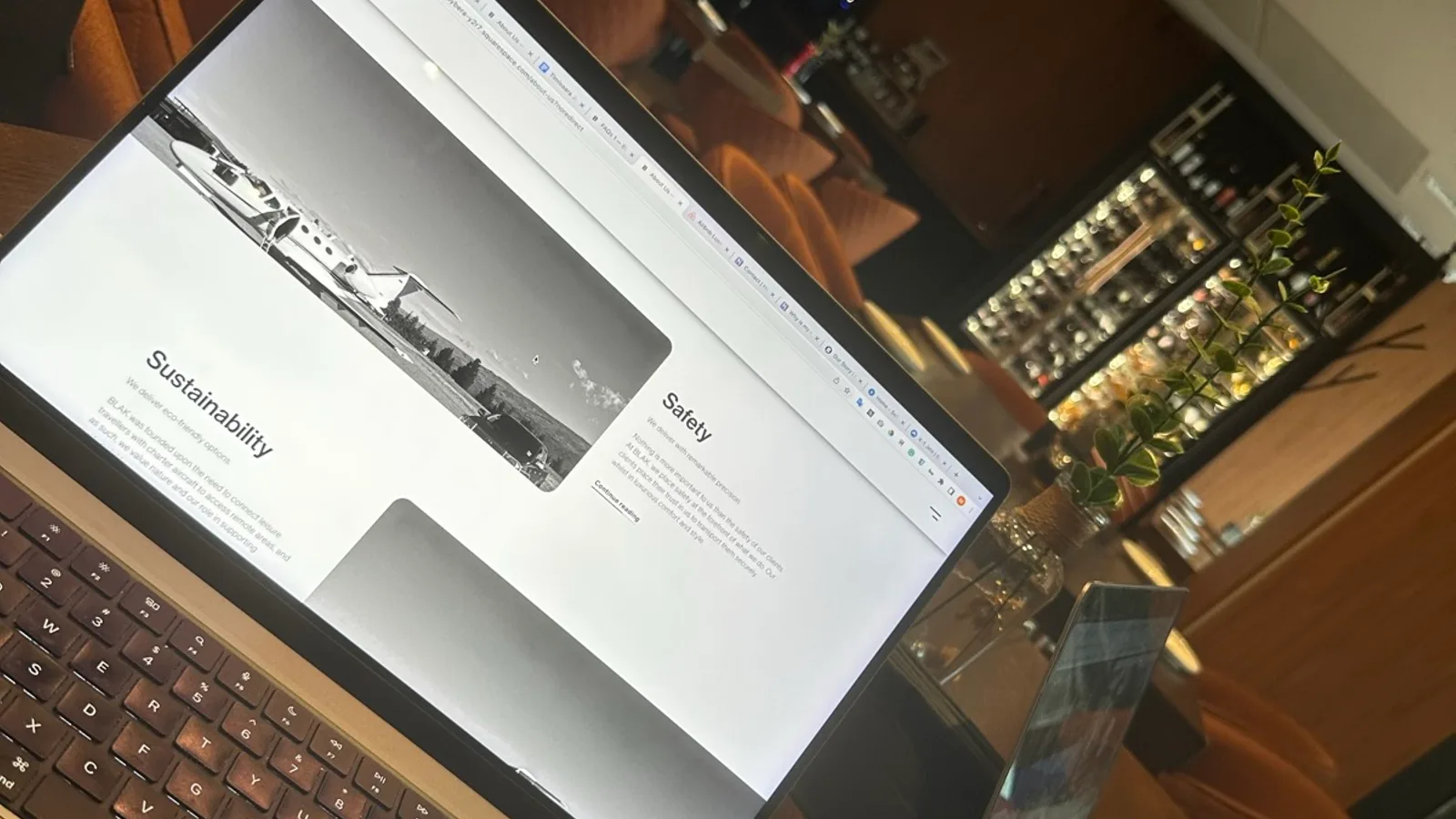
Imagine walking into a hotel restaurant in Romania and seeing two guys sitting at a table, both working on MacBooks displaying pictures of luxury private jets.
You might wonder what they were doing.
Were they buying private jets? Arranging flights? Running an aviation business?
Well, one of them was the founder of a private aviation company.
The other was me, building his website.
This is the story of how I worked with Sam, the founder of FLY JET BLAK, to develop a custom-coded website for his private aviation business.
It's also one of the more memorable client relationships I've had since I started working with international businesses in 2014.
Not because of the private jets, although those certainly made the project interesting.
But because of how closely we worked together, the technical challenges involved, and the opportunity to translate a business owner's vision directly into working software.
It started with smaller projects, not a complete website rebuild
Before taking on the full website project, Sam and I had already worked together on smaller assignments related to his business.
Those initial projects gave us an opportunity to establish a working relationship.
He became familiar with my technical capabilities and how I approached development, while I gained a better understanding of his business and expectations.
Eventually, Sam decided that FLY JET BLAK needed a completely new website.
The existing online presence wasn't what he envisioned for his company.
He wanted something more distinctive, more sophisticated, and better aligned with the expectations of clients who could afford private aviation.
But appearance was only one part of the project.
He also wanted the website to make running his business easier.
That distinction shaped many of the technical decisions I made during development.
A luxury website needs more than a luxury appearance
When someone visits a private aviation website, they're not shopping for an ordinary product.
They may be arranging a business trip, planning a luxury vacation, or exploring options for traveling between cities and countries.
The website needs to communicate professionalism, attention to detail, and trust.
But visitors also need an easy way to explain what they're looking for.
For FLY JET BLAK, Sam wanted prospective customers to provide useful information about their flight requirements, such as destinations, airports, and aircraft preferences.
The objective was to make submitting an inquiry simple for the customer while ensuring that the business received the information needed to respond.
This is an important principle that applies far beyond aviation.
A beautiful website may attract attention, but its functionality should help visitors take the next step toward becoming customers.
That was one of our priorities throughout the project.
Why we chose Squarespace for a website that was almost entirely custom-coded
Here's something that might surprise people familiar with Squarespace.
We built FLY JET BLAK on Squarespace, but it wasn't a conventional drag-and-drop website.
Almost everything visitors interacted with was custom-coded.
Squarespace provided the underlying platform, content structure, and native components that could be extended.
I used custom development to create the visual experience and functionality the business needed.
Why use Squarespace instead of building an entirely independent website?
Because Sam needed to manage the website himself.
I didn't want to deliver a technically impressive product that required him to hire a developer every time he wanted to update something.
That would have created an unnecessary dependency.
Instead, I wanted to combine two advantages:
The flexibility of custom web development with the convenience of an established content management platform.
This required a deep understanding of how Squarespace works internally.
The platform has limitations, particularly when you need functionality that goes beyond its standard editor.
Overcoming those limitations without sacrificing the underlying content management capabilities was one of the most interesting parts of the project.
I also used my own Squarespace Friendly Selectors plugin, which helped me extend native Squarespace components while retaining their usefulness for nontechnical users.
The resulting website offered a significantly more customized experience than a standard Squarespace implementation while remaining manageable by the business owner.
And that was intentional from the beginning.
Making private jet inquiries accessible throughout the website
One of the most important features was the flight inquiry interface.
Imagine browsing a particular aircraft or destination and deciding you want to request a flight.
On many websites, you'd need to navigate to a separate contact page, find a form, and start filling in your information.
We wanted to reduce those unnecessary steps.
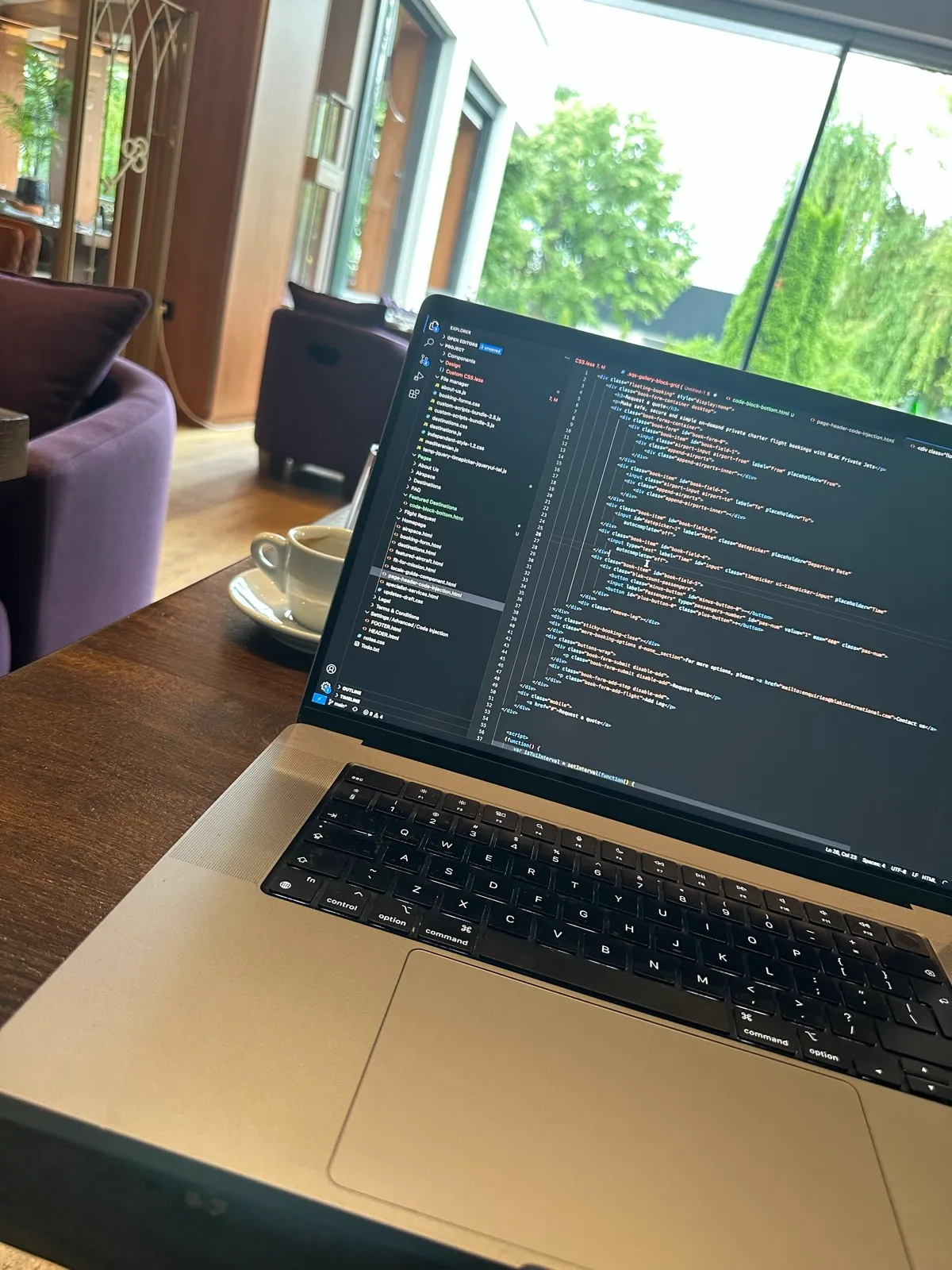
I developed a custom inquiry interface that could be opened directly from the website through a lightbox-style overlay.
Visitors could access the flight request functionality without leaving the page they were browsing.
This mattered because someone exploring a destination might decide to inquire at that exact moment.
There was no reason to interrupt their experience by making them navigate elsewhere.
The form was also designed around the information Sam needed to understand a customer's request.
That made the functionality useful on both sides.
For visitors, it simplified contacting the business.
For Sam, it provided a structured way to receive flight requirements.
We weren't adding functionality simply because it was technically possible.
We were addressing a specific business requirement.
That's how I believe custom development should work: identify a real need, then build the functionality around it.
The destination system that particularly impressed Sam
FLY JET BLAK serves different international destinations, including well-known luxury locations across Europe.
We created dedicated pages for destinations, giving visitors an opportunity to explore places the company serves.
But Sam wanted more than a collection of static pages.
He wanted visitors to discover additional destinations naturally as they explored the website.
One feature I developed displayed randomly selected destinations from the same geographical region.
For example, imagine someone visiting the page for Monaco.
At the bottom of that page, the visitor could discover other European destinations.
Instead of displaying exactly the same destinations in the same order every time, the system could vary which relevant locations appeared.
The homepage used a similar approach, but with one important difference.
Rather than displaying destinations from a specific region, it could randomly feature locations from all the regions represented on the website.
Sam was particularly excited when he saw this functionality working.
It's a small detail from the perspective of someone browsing the website.
But from an engineering perspective, it required custom logic that went beyond simply placing images and text into a website builder.
And from a business perspective, it gave visitors additional opportunities to explore the destinations available through FLY JET BLAK.
I enjoy these kinds of challenges.
They aren't necessarily the features people notice immediately.
But they're the details that help distinguish a carefully engineered website from a collection of standard templates.
Three visits to Romania and approximately ten days of working side by side
The technical development was only part of what made this project memorable.
Sam traveled to Romania three times during our collaboration.
Across those visits, we spent approximately ten days working together in person.
Much of that time was spent in hotel restaurants.
We would sit at a table with our MacBooks, discuss his ideas, review the website, and make changes.
What made these meetings particularly productive was that I could implement what he described while he was sitting next to me.
He didn't need to send a document explaining something, wait several days for a response, and then review the result.
We could discuss an idea and immediately work toward implementing it.
He could see his vision taking shape directly on the screen.
Sometimes that meant changing the appearance of a component.
Other times, it meant discussing functionality and figuring out how to make it work within the existing platform.
And, of course, there were those moments when other people in the restaurant would notice the private jets displayed on our laptops.
I can only imagine what they thought we were doing.
Two people sitting in a hotel restaurant in Romania, spending hours looking at private aircraft.
The reality was considerably less glamorous.
We were developing a website.
But those sessions illustrate something important about how I like to work with clients.
Good communication between a business owner and a developer can be just as important as the code itself.
When the developer understands the business owner's vision, there's less room for misunderstandings.
And when the business owner can see the technical possibilities, they can make better-informed decisions about their website.
Roughly a year of development, completed without AI
The main website project took roughly a year to develop, with the new website launching around mid-2023.
I handled the development myself.
This was also before AI coding assistants became part of my development workflow.
The custom components, interfaces, interactions, and technical solutions were written by hand.
That required extensive familiarity with web technologies and a detailed understanding of Squarespace's behavior.
By that point, I had already been developing for the web for more than a decade.
I started programming in 2010, and by the time I worked on FLY JET BLAK, I had accumulated years of experience solving complex web development problems.
That experience was valuable throughout the project.
When working with heavily customized platforms, you need to understand more than how to make something look correct in a browser.
You also need to consider how the components interact, what happens when content changes, how the platform behaves, and whether the solution will remain practical for the client.
The goal wasn't simply to make the website work on launch day.
It was to build something the business could continue using and managing afterward.
Today, AI tools have changed parts of the software development process considerably.
I use modern technologies in my work, including AI where appropriate.
But I still believe the most important part of engineering is knowing what needs to be built, why it matters, and how the different pieces should work together.
Tools evolve.
Those responsibilities remain.
What did the client think?
After the project, Sam left me a detailed testimonial.
He highlighted my technical expertise, attention to detail, reliability, and communication throughout our collaboration.
One part of his review was particularly meaningful to me.
He described the result as:
"a website exceeding our expectations."
— Sam, Founder and CEO of BLAK
His testimonial also discussed how I listened to his requirements, explained technical concepts, and approached problems throughout the development process.
You can read his full review and explore the project in our original FLY JET BLAK case study.
I don't have verified numbers showing how much the redesign affected bookings or inquiries, so I won't invent any.
What I can speak about is the work itself, the functionality we delivered, and the feedback Sam shared afterward.
For me, his review was particularly rewarding because it reflected something I've always tried to prioritize in client relationships.
Not just delivering code.
Delivering what I promised, paying attention to details, communicating clearly, and taking responsibility for the technical work.
What this project taught me about custom website development
I've been building websites and applications since 2010 and working with international businesses since 2014.
Over those years, I've worked on hundreds of projects across different industries, platforms, and technologies.
Some clients need relatively straightforward websites.
Others need complex ecommerce solutions, custom applications, integrations, or functionality that doesn't exist in standard website builders.
FLY JET BLAK was a particularly interesting example of the second category.
It reinforced several principles that continue to influence how I approach development today.
Understand the business before choosing the technology
The purpose of the project wasn't to demonstrate how much custom code I could write.
It was to help a private aviation company present its services professionally and make it easier for potential customers to get in touch.
The technology needed to support those objectives.
Don't underestimate the value of small details
A flight inquiry form that opens without leaving the current page might sound like a small feature.
So might displaying related destinations based on geographical regions.
But these decisions shape how visitors interact with a website.
Thoughtful functionality often comes from understanding what customers are trying to accomplish.
Custom development shouldn't eliminate the owner's independence
It's possible to create an impressive website that becomes difficult for the business owner to maintain.
I don't consider that an ideal outcome.
Whenever possible, I want clients to retain control over their content and routine website updates.
That was one of the reasons we chose to extend Squarespace rather than replace all of its underlying capabilities.
A strong working relationship improves the development process
Spending approximately ten days working directly with Sam gave us opportunities to discuss requirements, exchange feedback, and make decisions together.
That level of collaboration isn't necessary for every project.
But the underlying principle applies to all of them.
Understanding what a client needs requires listening, asking questions, and being willing to explain technical decisions in a way that makes sense to someone who doesn't write code.
More than a website
When I think about the FLY JET BLAK project today, I remember the technical challenges.
I remember the custom components, destination pages, and flight inquiry interface.
I remember writing the code and finding ways to extend Squarespace beyond its standard functionality.
But I also remember those days sitting in hotel restaurants in Romania.
Two MacBooks on the table.
A private aviation founder explaining what he wanted.
And me turning those ideas into a working website.
That's one of the things I enjoy most about software development.
Taking an idea that exists in someone's mind and turning it into something tangible that their business can use.
Developing for the web since 2010, I still find that process rewarding.
And it's the approach I continue to bring to my work at abZ Global.
Does your business need more than a standard website template?
Not every business needs a heavily customized website.
For some companies, a well-designed website built with standard components is entirely sufficient.
But when your business has requirements that existing templates and website builders can't accommodate, custom development can make a meaningful difference.
Whether you need unique customer-facing functionality, advanced forms, integrations, or a website designed around a particular business workflow, the right approach starts with understanding what you're trying to achieve.
At abZ Global, I work directly with business owners to design and develop websites and applications that fit their requirements.
I've been building software since 2010, with experience across Squarespace, Shopify, WordPress, Webflow, and custom web applications.
If you're planning a new website or have an existing one that's limiting what your business can do, I'd be interested in hearing about it.
Explore our custom website development services or get in touch to discuss your project.
You can also explore the FLY JET BLAK project and Sam's full testimonial.