
What People Expect the Direction of AI to Be in 2026
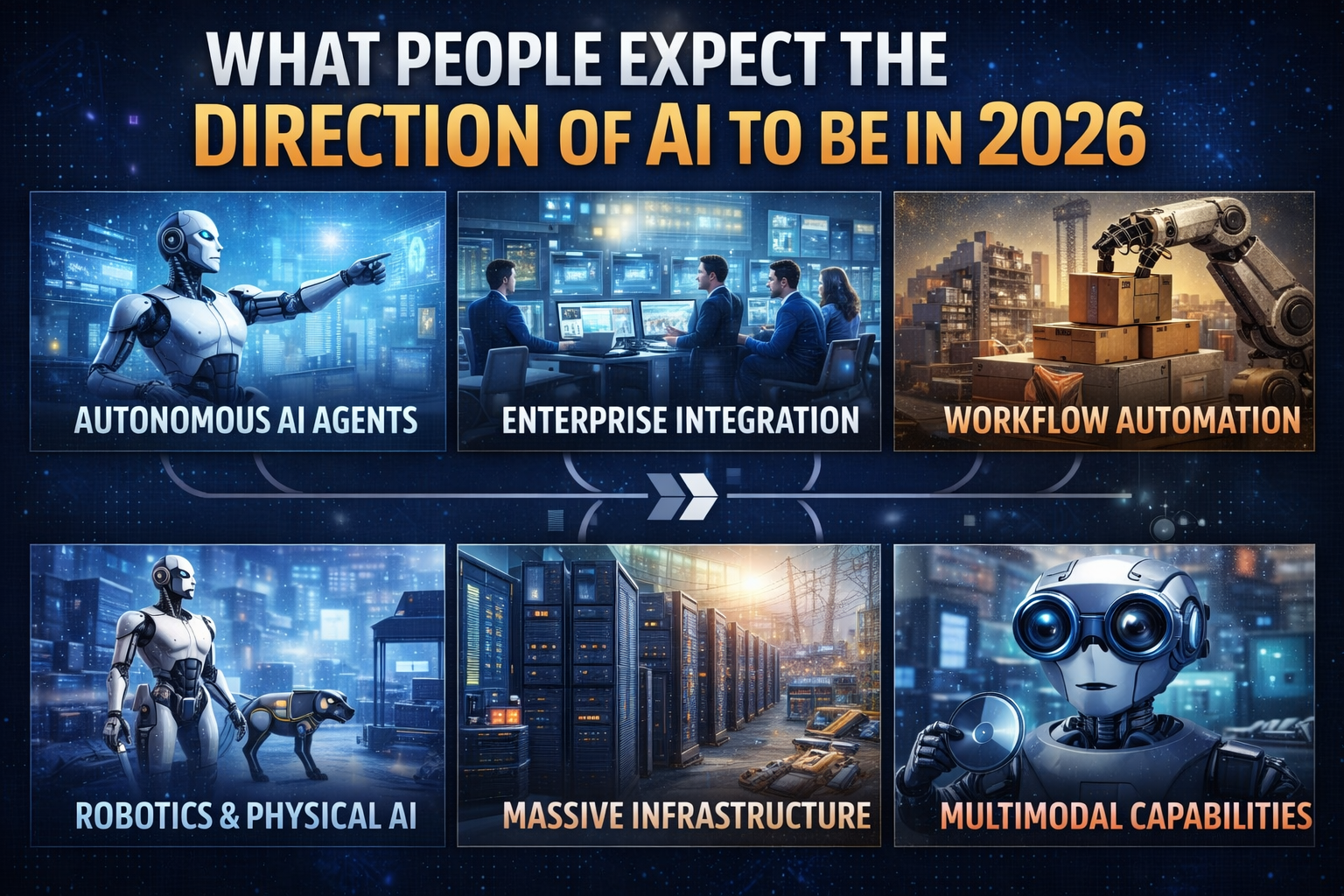
If you look at how people talk about AI now, the expectation in 2026 is no longer that the main story will be chatbots getting a little better every few months.
That was the earlier phase. It was important, but it was still the simpler phase. Back then, the focus was mostly on whether models could write better, reason better, answer faster, or sound more human. In 2026, the expectation is much broader and much more serious. People now expect AI to become more agentic, more deeply connected to real workflows, more multimodal, more embedded inside business software, and much more expensive at the infrastructure level.
That changes the whole conversation. The question is no longer just whether AI can produce impressive outputs. The question is whether AI can become part of the real operating layer of work, software, and decision-making. That is why the mood around AI in 2026 feels different from the earlier hype cycle. It feels less like fascination with a powerful new tool and more like a reorganization of how digital work may function.
So the cleanest way to understand the direction of AI in 2026 is this:
People expect AI to move from “help me think” toward “help me do.”
That is the major shift.
AI agents are expected to become the center of the story
The biggest expectation for 2026 is that AI will keep moving toward agents rather than staying limited to standard chat interfaces.
That does not simply mean better conversations or longer answers. It means systems that can take a goal, break it into steps, work across tools, and move a task forward with much less supervision. In other words, people increasingly expect AI to become something closer to a digital coworker than a digital search box.
This matters because it changes what AI is supposed to be. A chatbot gives you an answer. An agent is supposed to help finish the task. That is a much larger promise, and it is clearly where a lot of market expectations are now heading.
People increasingly assume that the next big step is not just smarter language. It is execution. They expect AI to schedule, organize, summarize, search, compare, coordinate, and sometimes even act across systems in a more structured way. That does not mean fully autonomous workers will suddenly become universal overnight, but it does mean the center of gravity is shifting. AI is expected to become less passive and more operational.
This is also why the word “agent” has become so important. It captures the idea that the model is no longer supposed to sit there waiting for a prompt and then disappear after one answer. It is supposed to stay involved, keep context, move between steps, and help drive the workflow forward.
Enterprise AI is expected to get much deeper
Another major expectation is that AI will become much more deeply embedded in business systems.
In the earlier phase, many companies treated AI like a useful extra layer on top of existing products. Maybe it wrote emails, summarized meetings, helped with search, or drafted content. That phase still matters, but the expectation in 2026 is stronger than that. Now people increasingly expect AI to sit inside email, documents, spreadsheets, customer systems, support operations, internal dashboards, legal workflows, finance processes, and everyday knowledge work.
That is why the AI conversation feels more serious now. It is less about “which chatbot is the smartest?” and more about “which company can integrate AI into real work in a trusted, scalable, and useful way?”
That is a much harder question to answer. A model can look very impressive in a demo and still fail inside an enterprise environment if it cannot handle permissions, workflows, governance, or reliability. So in 2026, people expect AI leaders to be judged less by raw wow-factor and more by whether they can survive inside actual organizations.
This is also why software companies are under pressure. Once customers begin expecting AI to be built into real workflows rather than bolted on as a novelty, the old product structure starts to look weaker. The companies that win in this phase are expected to be the ones that can combine model capabilities with workflow depth, enterprise trust, and practical integration.
Infrastructure is now expected to matter almost as much as the models
A lot of people now expect 2026 to be defined not only by model quality, but by compute, data centers, electricity, chips, financing, and physical scale.
This is a huge change from the more consumer-facing phase of the AI story. Earlier, the focus was on the visible layer: chat interfaces, product launches, new model releases, and benchmark comparisons. In 2026, people increasingly understand that AI is also an infrastructure race. Whoever wants to lead AI at scale has to secure power, land, compute, chips, networking, cooling, and long-term capital.
That makes AI feel much more industrial.
People no longer expect progress to come only from clever model updates. They increasingly expect it to be shaped by whoever can actually fund and build the physical backbone behind AI at scale. That means the race is no longer only between labs. It is also between ecosystems, balance sheets, supply chains, and energy access.
This expectation matters because it changes how the whole AI market is understood. AI is no longer seen only as a software revolution. It is increasingly seen as a capital-intensive industrial buildout. The future winners may not be determined only by who has the smartest researchers or the most viral product. They may also be determined by who can sustain the infrastructure burden over time.
That is one reason 2026 feels so different from the earlier excitement. The technology still looks magical from the outside, but underneath it is becoming very physical, very expensive, and very dependent on large-scale execution.
AI is expected to move beyond text into multimodal and real-world action
Another strong expectation for 2026 is that AI will keep expanding beyond text into voice, images, software control, workflow orchestration, and eventually robotics.
This does not mean text stops mattering. Text still matters a lot. But people increasingly expect text to become only one layer of the interface, not the whole experience. The more serious expectation now is that AI systems will combine multiple forms of input and output: they will read, listen, speak, interpret visual information, work inside apps, and eventually interact more naturally with the real world.
That is why many people now imagine AI less as a chatbot and more as a broader system. Not just something you type to, but something that can operate across screens, tools, devices, and environments.
This matters because it expands the scope of what AI is expected to do. Earlier, a good answer in text felt like the goal. In 2026, people increasingly expect AI to help with things like navigating software, controlling workflows, understanding images, handling voice interaction, and participating in environments where language alone is not enough.
That does not mean robotics suddenly becomes normal in daily life this year. But it does mean the market is mentally preparing for AI to move beyond pure text interaction. The expectation is not that the physical world will be fully transformed immediately. The expectation is that AI will continue moving closer to it.
And once that shift becomes normal, the whole product landscape changes.
Traditional software is expected to face much more pressure
People also increasingly expect AI to reshape software economics in 2026.
This is already one of the most important consequences of the current AI wave. The deeper expectation is that software pricing, product design, and even company moats will increasingly be judged by one key question:
Can the software actually help deliver work, or is it just organizing a workflow that AI may be able to handle more directly?
That is a very uncomfortable question for traditional software companies.
For years, software businesses were often valued around subscriptions, stickiness, seat count, and the difficulty of replacing embedded workflows. AI changes that conversation. If a system can increasingly act, summarize, search, compare, draft, respond, and move tasks forward directly, then the value of some old software layers starts to look weaker.
That means people expect 2026 to push software away from static subscriptions and closer to outcomes, automation, and agent-driven execution.
This is a major shift. And it helps explain why AI is now starting to feel like a restructuring force, not just a feature trend. Some software companies may get stronger if they have proprietary data, trusted workflows, and the right platform position. Others may look more exposed if AI can flatten too much of their category.
That is why the software world feels so tense. AI is not just creating new products. It is changing what software may be worth.
Human work is expected to be redesigned, not simply erased
One of the most important expectations for 2026 is that AI will change work more through reconfiguration than through instant total replacement.
That is a crucial distinction. A lot of the more serious thinking around AI no longer describes the future in the most dramatic terms possible. It is not mainly “all jobs disappear tomorrow.” It is more like this: tasks get reorganized, routine work gets absorbed, some roles shrink, some roles change, and human value becomes more concentrated in judgment, review, trust, relationship management, decision-making, and complex responsibility.
That is still a very big change.
People increasingly expect jobs to be broken into layers. Some layers are repetitive and structured enough that AI can take them over. Other layers still depend on human context, accountability, negotiation, or deeper strategic thinking. So the expectation in 2026 is not simple replacement. It is a rebalancing of who does which part of the work.
That means many people now expect organizations to change shape. They expect hiring patterns to shift. They expect role design to change. They expect fewer people doing some kinds of repetitive work and more people being asked to supervise, interpret, and guide AI-driven output.
This is one reason the labor conversation feels so important. Even if AI does not erase all jobs in one dramatic wave, it can still transform the labor market by changing the structure of work itself.
The deeper technical future is still expected to remain open
There is one more important expectation that often gets less attention, but it matters a lot.
Even though the market still focuses heavily on LLMs and agents, people increasingly expect 2026 to include more debate about whether current architectures are enough. In other words, the direction of the market may look fairly clear, but the final technical path still does not feel fully settled.
That matters because AI is still young enough that the dominant approach today may not be the final foundation tomorrow.
People clearly expect more agents. They clearly expect more enterprise integration. They clearly expect more infrastructure spending and more multimodal systems. But at the same time, many also expect a deeper technical debate to stay alive around questions like reasoning, planning, world models, physical understanding, and whether current model architectures can truly support the full ambitions now being projected onto them.
So 2026 is expected to be both an acceleration year and an uncertainty year.
The market knows where it wants to go.
But it is less certain about which exact technical road will get it there.
That is a very important part of the story, because it means the industry is becoming more mature. It is not just worshipping scale blindly. It is also starting to ask what kind of intelligence is actually being built and whether the current direction can carry all the weight people want to put on it.
Why 2026 feels more serious than earlier AI years
All of these expectations add up to something bigger.
2026 does not feel like another year of interesting demos and model upgrades. It feels like a year where people expect AI to become more deeply entangled with the actual structure of business, labor, software, and infrastructure.
That is why the tone has changed.
The earlier AI conversation was dominated by surprise: “Look what this model can do.”
The 2026 conversation is more demanding: “Can this system be trusted inside real work? Can it scale? Can it actually do the task? Can it justify the cost? Can it operate across systems? Can it hold up in production?”
That is a very different kind of question set.
It is what happens when a technology moves from fascinating to consequential.
Final verdict
The broad expectation for AI in 2026 is that it will move further away from being a chatbot layer and closer to being an execution layer across work, software, infrastructure, and eventually the physical world.
People expect more agents, deeper enterprise integration, more multimodal systems, more pressure on traditional software, much heavier spending on infrastructure, and a workforce that is increasingly reorganized around human-plus-AI collaboration rather than simple tool usage.
The clearest takeaway is this:
In 2026, people expect AI to become less about answering questions and more about taking action.
That is the direction most of the industry now seems to be pointing toward.