
How People in 2024 Thought AI Would Go - And How It Looks in 2026
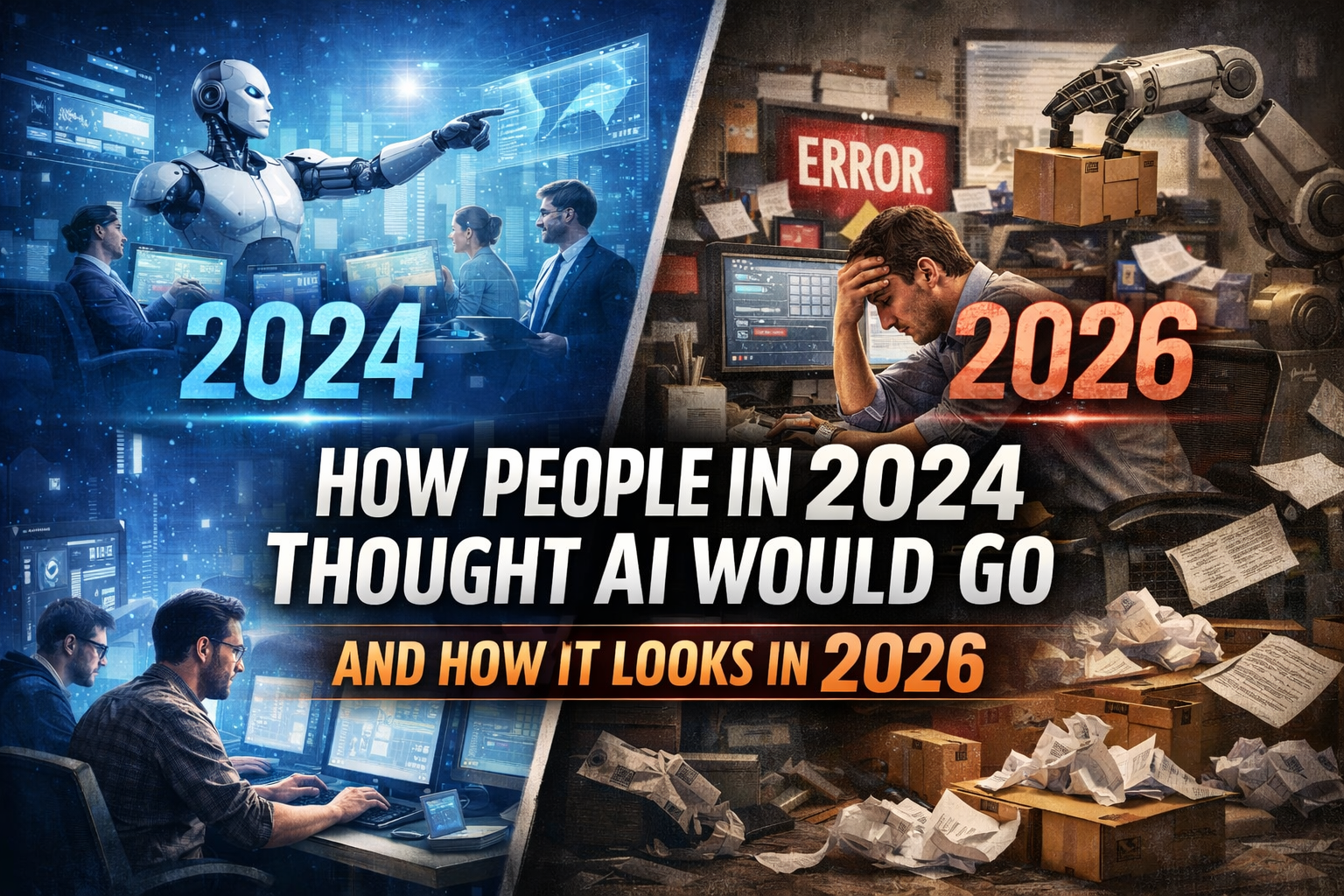
Back in 2024, the mood around AI was intense.
People already believed something very big had started. The debate was not really about whether AI mattered anymore. It was about how fast it would change everything. Economists were talking about a major productivity boom. Business leaders were rushing to deploy copilots. Analysts were warning that a large share of jobs could be affected. And a lot of the industry spoke as if the next two years would completely rewrite how software, work, and even intelligence itself would function.
Now, in 2026, enough time has passed to compare the expectations with the reality.
The short version is this:
A lot of the 2024 optimism was directionally right, but the actual path has been messier, less immediate, and more uneven than many people expected.
AI did get much better. It did spread deeper into work. It did change software markets, hiring plans, and enterprise strategy. But it did not instantly replace huge parts of white-collar work, it did not make most companies dramatically more productive overnight, and it still has not fully delivered the clean, reliable autonomous future that the most excited people were hinting at in 2024.
What people in 2024 expected
In 2024, there were roughly five big expectations repeated across the market.
The first was that AI would create a major productivity revolution. McKinsey described adoption as spiking in early 2024, while Goldman Sachs and others argued that generative AI could meaningfully raise GDP and labor productivity over time. Reuters also reported that AI-intensive sectors were already showing faster productivity growth, which reinforced the idea that a broad economic boost was coming.
The second expectation was that AI would affect a huge portion of the workforce very quickly. In early 2024, the IMF said AI would affect almost 40% of jobs globally, with even higher exposure in advanced economies. The dominant public conversation mixed optimism about augmentation with real fear about displacement.
The third expectation was that copilots would become normal everywhere. In 2024, many people assumed that once language models improved a bit more, every software suite would gain an AI layer, every employee would have some kind of assistant, and enterprise software would be restructured around conversational help. McKinsey’s research from that period already showed early measurable value, which helped fuel that belief.
The fourth expectation was that AI agents would be the next big phase, but in 2024 that idea still felt early and slightly theoretical. Gartner later framed the contrast clearly by saying that autonomous day-to-day decision making by agentic AI was basically at 0% in 2024, even as excitement around the concept was rising.
The fifth expectation was more emotional than analytical: many people believed AI would move in a straight line from impressive chat to something close to general-purpose digital workers very quickly. The industry mood in 2024 often treated each new model jump as evidence that a near-future breakthrough in autonomy, reasoning, and broad replacement of knowledge work was just around the corner. That expectation was real, even when it was not always expressed in careful language. It was one of the defining feelings of that year.
So what does 2026 actually look like?
In 2026, the most obvious truth is that AI really did get much stronger.
This is not a story where the hype simply collapsed. The models improved a lot. Enterprise AI became far more serious. OpenAI reportedly crossed $25 billion in annualized revenue by the end of February 2026, which shows that the commercial side of the industry has become enormous. Meanwhile, Microsoft is now testing more agentic systems like Copilot Cowork, which push AI beyond “answering questions” toward multi-step execution.
That alone tells you something important.
The 2024 expectation that AI would become a core business layer was mostly right. AI is no longer sitting at the edge of software strategy. It is now central to product planning, enterprise procurement, hiring decisions, and capital allocation. Even Thomson Reuters’ 2026 professional-services report describes AI adoption as having reached a tipping point, with most organizations integrating generative AI and planning around agentic systems.
So yes, AI did move forward in a very real way.
But it did not move forward in the perfectly smooth way many people imagined in 2024.
Expectation 1: “Productivity will explode quickly”
This one turned out to be partly right, but slower and patchier than expected.
In 2024, a lot of people spoke as if measurable productivity gains would arrive fast and broadly. The reality in 2026 is more uneven. AI is clearly helping many people work faster, especially in writing, coding, customer support, research, and internal knowledge tasks. But the broad enterprise story is not “everyone suddenly became twice as productive.”
Instead, what we are seeing is something more complicated.
Adoption is real, usage is spreading, and some sectors are seeing meaningful gains. But organizations are still struggling with measurement, governance, trust, and how to redesign workflows around AI instead of just adding it as a layer on top. Thomson Reuters reported in early 2026 that widespread adoption had arrived in professional services, but only 18% of professionals said their organizations tracked ROI, while another 40% did not know whether ROI was measured at all.
That is a very different picture from the simple “instant productivity boom” story.
AI is helping. But the economic value is not yet flowing through companies in a clean, evenly measured way.
Expectation 2: “AI will replace huge amounts of white-collar work fast”
This one also turned out to be directionally real, but less immediate than many feared.
The fear in 2024 was that large numbers of knowledge workers would be displaced very quickly. In 2026, the labor impact is clearly visible, but it is not yet a total white-collar wipeout. What has happened instead is a mix of role compression, restructuring, slower hiring in some areas, and changing skill requirements.
Atlassian is one of the clearest recent examples. It announced roughly 1,600 layoffs, or about 10% of its workforce, as part of a pivot toward AI. At the same time, the company explicitly said AI was changing the skill mix it needed, even if management did not frame the move as pure replacement. That pattern matters because it shows how AI is already changing labor demand from the inside, even before the most extreme job-loss scenarios have played out.
So the honest answer is this:
The 2024 warnings about labor disruption were not wrong. But the reality in 2026 looks more like uneven restructuring and selective displacement than a single dramatic collapse.
AI has changed hiring and org design faster than it has fully erased jobs at mass scale.
Expectation 3: “Every software product will become a copilot”
This one turned out to be very accurate.
If anything, this expectation was one of the biggest winners. By 2026, the enterprise software world is being rebuilt around AI layers, copilots, and agents. Microsoft is doing it. Anthropic is doing it. Google is doing it. Traditional software companies are being forced to respond because the market increasingly expects AI assistance to be built into the workflow, not bolted on as a novelty.
At the same time, this shift has not only created opportunities. It has also shaken the software sector badly. Reuters reported that the release of stronger AI agent tools helped trigger a selloff that wiped out nearly $1 trillion from software and services stocks in early 2026, because investors started worrying that AI agents might threaten entire categories of traditional software.
That is a huge development.
In 2024, people expected AI to be added to software.
In 2026, the real question has become whether AI will replace parts of software, compress software margins, or change what software is even worth.
That is a much more disruptive outcome than a simple feature upgrade.
Expectation 4: “Agents are the next phase”
This turned out to be true, but still early.
In 2024, agentic AI was mostly a prediction. People talked about autonomous digital workers, but most of that conversation still felt one step ahead of the actual product reality.
By 2026, that has changed. Agents are no longer just theory. Microsoft is testing Copilot Cowork. Anthropic launched Claude Cowork. Enterprise software companies are reorganizing around the idea that AI should not just answer questions, but actually perform multi-step work. Gartner’s later framing captures the scale of the shift well: it described day-to-day autonomous decisions by agentic AI as effectively 0% in 2024, but projected meaningful growth ahead. At the same time, Gartner also warned in 2025 that over 40% of agentic AI projects could be canceled by the end of 2027 because of cost, unclear value, or poor controls.
That is probably the best summary of where agents stand in 2026.
They are real.
They are moving from demo to deployment.
But they are still unreliable enough that the market is learning how hard the real enterprise version will be.
So the 2024 believers were right that agents were coming.
They were just early in assuming that the transition would be clean and universal.
Expectation 5: “Physical AI and robots will become real fast”
This one looks more delayed.
In 2024, a lot of the broader AI imagination started spilling into robotics and physical-world automation. The idea was that once models got better at reasoning and perception, the move into the real world would accelerate quickly.
In 2026, that transition is happening, but much more slowly than the online excitement often implied. Reuters reported in January 2026 that “physical AI” dominated CES, but humanity would still have to wait a while for humanoid servants, with the article emphasizing how much technical difficulty remains.
That is a useful reality check.
The robotics future is still advancing, but the 2024 assumption that physical AI would suddenly become normal in daily life by now looks too aggressive.
The software and knowledge-work layers moved faster than the embodied, real-world layers.
So who was more right in 2024 - the optimists or the skeptics?
The honest answer is: both were right about different parts.
The optimists were right that AI would improve very fast, spread into enterprise products, drive huge revenue growth, and become central to software strategy. That clearly happened. OpenAI’s scale, Microsoft’s agent push, software-market disruption, and rising enterprise adoption all prove that 2024 was not just hype detached from reality.
The skeptics were right that the rollout would be messier than people thought. Reliability is still a problem. ROI measurement is weak in many organizations. Agents are promising but not universally dependable. Physical AI is still early. And job disruption is showing up in restructuring and selective pain, not in a neat “AI takes all office jobs” moment.
So 2026 does not look like a collapse of the 2024 vision.
It looks like a more realistic version of it.
AI did not fail.
It also did not arrive in its final form.
The biggest difference between 2024 and 2026
If I had to summarize the whole comparison in one sentence, it would be this:
In 2024, people mostly imagined AI as a coming revolution. In 2026, it looks more like an uneven but very real industrial transition.
That is the biggest change.
In 2024, the story was still about potential.
In 2026, the story is about implementation.
That sounds subtle, but it changes everything.
Once the conversation moves from “what could happen” to “what actually works in products, companies, and labor markets,” the hype gets filtered through reality. And reality is always slower, messier, and more selective than early excitement suggests.
Final verdict
Back in 2024, people expected AI to bring a rapid productivity boom, major workforce disruption, copilots everywhere, the rise of agents, and a near-term leap toward much broader automation.
By 2026, the verdict looks like this:
Some of that happened.
Some of it is clearly underway.
And some of it is still earlier than people thought.
AI did become much more powerful. It did spread deeply into enterprise software. It did start changing labor markets and software valuations. But the transformation did not come as one clean wave. It came as a mix of real progress, messy deployment, uneven ROI, growing agentic ambition, and plenty of unresolved limits.
The clearest takeaway is this:
People in 2024 were right that AI would change everything. They were just too optimistic about how quickly that change would become smooth, reliable, and evenly distributed by 2026.