
What Are AI Agents and Agent Orchestration? How They Differ From AI Chat
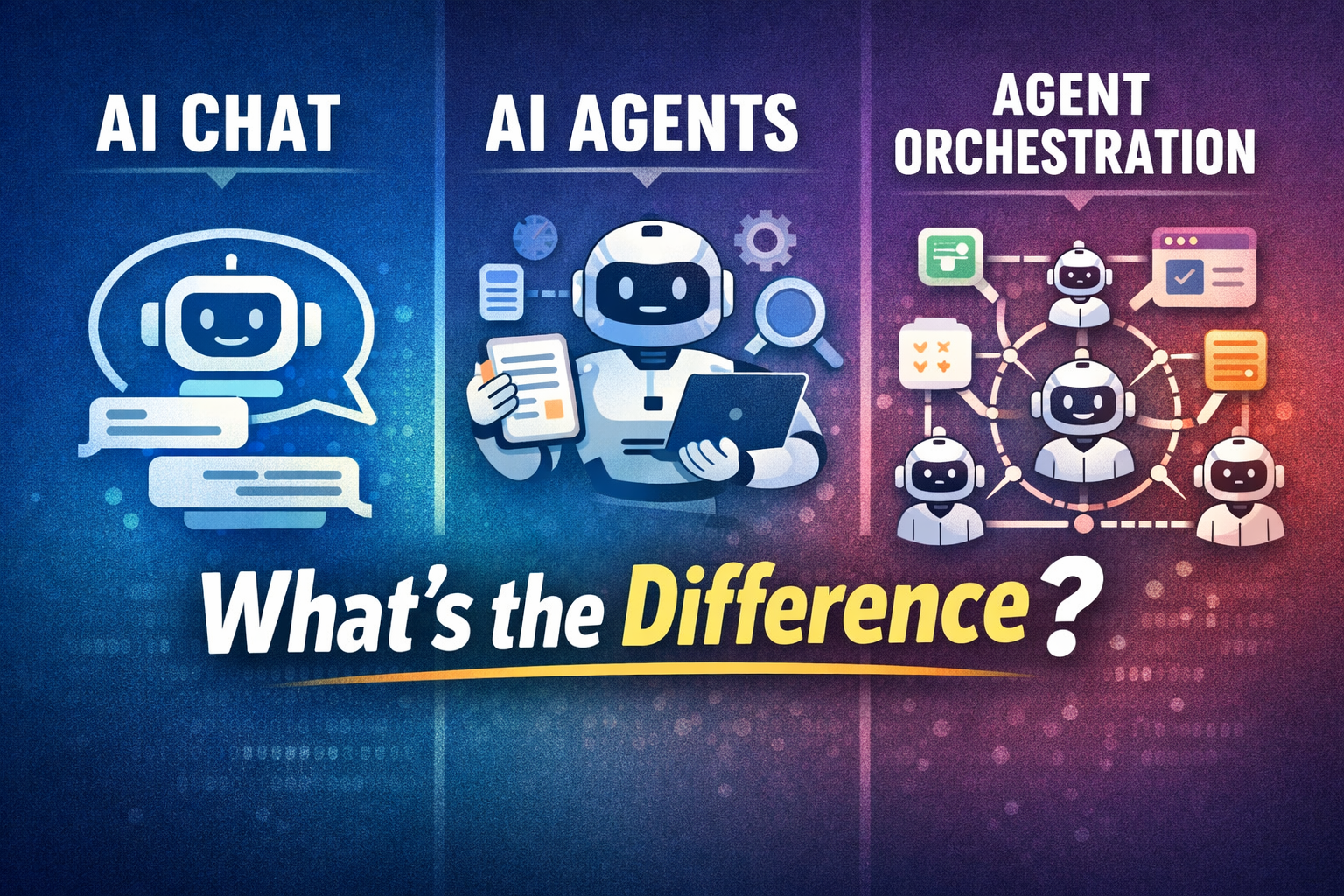
A lot of people still use the terms AI chat, AI assistant, and AI agent as if they mean the same thing.
They do not.
That confusion matters because businesses are starting to move from simple chat experiences toward systems that can actually do work. If you only think in terms of chatbots, you will miss what is changing in software right now.
AI chat is mainly about conversation.
AI agents are about action.
And agent orchestration is about coordinating multiple AI-driven steps, tools, or agents so the system can complete more complex tasks with less human micromanagement.
That is the short version.
The more useful version is this: AI chat gives you responses, while AI agents are designed to pursue outcomes.
What is AI chat?
AI chat is the interface most people already know.
You type a question, prompt, or request into a box. The model reads your input and generates a response. That response may be useful, smart, creative, and even impressive, but it is still mostly a response inside a conversation.
Examples of AI chat include:
answering questions
rewriting text
summarizing documents
brainstorming ideas
helping with coding
translating content
explaining concepts
This is powerful, but in many cases it stops at the point of advice or content generation.
An AI chat system may tell you how to do something.
It may even generate the code, outline, or email draft.
But often, you still have to take the next steps yourself.
What is an AI agent?
An AI agent is a system that uses AI to move beyond conversation and into execution.
Instead of only replying, it can be designed to:
choose from available tools
take actions in software
gather information from multiple sources
break a goal into steps
check progress
adapt based on results
continue until a task is completed or blocked
In simple terms, an AI agent is closer to a worker than a chatbot.
It does not just talk about the task.
It tries to do the task.
For example, an AI chat system might tell you how to research competitors.
An AI agent might:
search the web
collect company data
organize findings into categories
write a summary
highlight gaps
create a draft report for review
That is a very different kind of product experience.
The easiest way to understand the difference
A simple way to think about it is this:
AI chat = “Here is my answer.”
AI agent = “I will try to get this done.”
That does not mean every agent is fully autonomous or always reliable. It means the design goal is different.
Chat is centered on response quality.
Agents are centered on task completion.
What is agent orchestration?
Agent orchestration is the layer that coordinates how work gets done across steps, tools, models, or multiple agents.
This matters because real work is rarely one step.
A useful AI workflow often includes things like:
collecting input
planning a sequence
deciding which tool to use
executing a step
reading the result
deciding what to do next
handing off to another model, tool, or agent
producing a final output
That coordination is orchestration.
In some systems, one AI agent handles everything. In more advanced systems, several specialized agents may work together.
For example:
one agent gathers data
another analyzes it
another writes the summary
another checks quality or compliance
an orchestration layer decides order, retries, and handoffs
So when people talk about agent orchestration, they usually mean the logic that manages multi-step AI work instead of just single-prompt responses.
Why orchestration matters
Without orchestration, AI systems often feel impressive in a demo but weak in real operations.
That is because real business tasks usually involve:
multiple tools
multiple decisions
changing context
dependencies between steps
error handling
user permissions
verification before final action
A single chat response is not enough for that.
Orchestration is what turns AI from a smart text layer into something closer to an operational system.
That is where a lot of the real value is going to be.
AI chat vs AI agents vs agent orchestration
Here is the cleanest distinction.
AI chat
AI chat is primarily conversational.
Its main job is to understand your prompt and generate a useful response. It is reactive. You ask, it answers.
AI agent
An AI agent is task-oriented.
Its job is to use reasoning, context, and tools to move toward a goal. It may make decisions about what to do next rather than waiting for every single instruction.
Agent orchestration
Agent orchestration is the coordination layer.
Its job is to manage the sequence, roles, tools, and handoffs required to complete larger workflows reliably.
So chat is the interface many people see first, but agents and orchestration are what start to change how software actually operates behind the scenes.
A practical example
Imagine a company wants help with lead generation.
A normal AI chat experience might do this:
explain lead generation ideas
suggest outreach copy
recommend tools
answer questions about the process
An agent-based system might do this:
identify target companies
enrich the data
score the leads
generate personalized outreach drafts
schedule tasks for follow-up
update the CRM
report results back to the user
And an orchestrated agent system might go even further:
use one agent for market research
another for qualification
another for messaging
another for CRM updates
route approvals to a human where needed
retry failed steps
produce a dashboard summary
That is the real difference.
Why people confuse them
People confuse AI chat and AI agents for three big reasons.
1. Chat is the visible layer
Many agent systems still use a chat interface, so users assume the product is “just chat.” But the interface is not the whole architecture.
2. Marketing language is loose
A lot of companies call almost anything “agentic” now, even when the product is still mostly prompt-response software.
3. The market is still early
We are still in the phase where terminology is being stretched. Some products are genuine agent systems. Others are upgraded assistants with a few tool calls.
That is why it helps to ask a simple question:
Does this system mainly answer me, or does it actually carry work forward?
What makes an AI agent feel real?
Not every product labeled as an agent really deserves the term.
A more serious AI agent usually has some of these traits:
memory or state across steps
access to tools or APIs
the ability to plan tasks
the ability to decide between actions
some form of persistence toward a goal
feedback loops or self-checking
structured outputs for downstream actions
The more of these capabilities are present, the more the system starts to feel like an agent rather than just a chat layer with a nice prompt.
Where businesses should be careful
There is real excitement around AI agents, but also a lot of hype.
Businesses should be careful about assuming that “agent” automatically means reliable, safe, or ready to replace human workflows.
In practice, agent systems still need:
guardrails
permissions
monitoring
human review in critical steps
clear task boundaries
good fallback logic
The future is probably not fully autonomous AI doing everything alone.
The more realistic path is supervised autonomy.
That means AI systems handle more of the workflow, while humans remain in the loop for approvals, edge cases, and high-risk decisions.
Why this matters for software companies
For software companies, the shift from chat to agents changes the product opportunity.
The next generation of software will not just answer user questions. It will help users execute recurring workflows.
That means the most valuable AI products may be the ones that can:
sit close to real work
understand context over time
take action inside apps
coordinate steps across systems
help users move from intention to execution
This is one reason agent orchestration is becoming such an important concept.
It is not just about making AI smarter.
It is about making AI more operational.
Final takeaway
AI chat, AI agents, and agent orchestration are related, but they are not the same thing.
AI chat is mainly about conversation and response.
AI agents are about pursuing goals and taking actions.
Agent orchestration is about coordinating the full workflow across steps, tools, and sometimes multiple agents.
If AI chat was the first major user interface wave of generative AI, then agents and orchestration may become the layer that brings AI deeper into real software operations.
And that is where the biggest long-term shift may happen - not just AI that talks well, but AI systems that can actually move work forward.