
Trump Honors Elon Musk, Jensen Huang and Other Tech Leaders: What They Built and Why It Matters
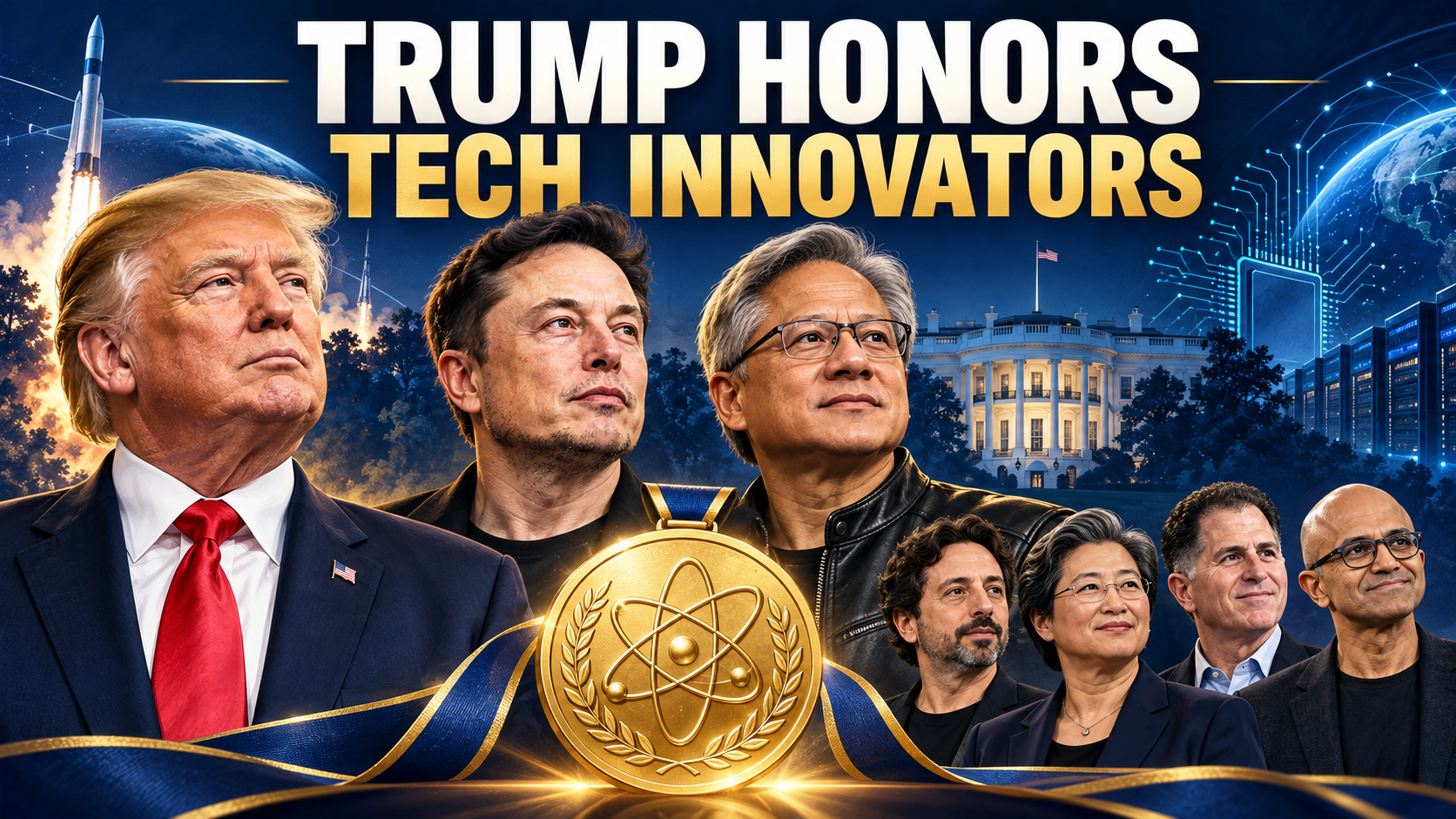
On October 8, 2026, President Donald Trump presented national science and technology medals to six technology leaders: Elon Musk, Jensen Huang, Sergey Brin, Lisa Su, Michael Dell, and Satya Nadella.
The ceremony took place at the White House’s Science: A New Golden Age Summit. The recipients represent several foundations of modern technology, including space exploration, information retrieval, semiconductor engineering, personal computing, and cloud infrastructure.
For business owners and software builders, the significance reaches beyond the ceremony. Much of what we build today depends on capabilities these leaders and their companies helped develop.
A website, a cloud application, or an AI assistant sits on top of decades of engineering. These awards offer an opportunity to look at that foundation and understand why it matters.
Who received which medal?
The six honorees received two different awards.
| Recipient | Award |
|---|---|
| Elon Musk | National Medal of Science |
| Jensen Huang | National Medal of Science |
| Sergey Brin | National Medal of Science |
| Lisa Su | National Medal of Science |
| Michael Dell | National Medal of Technology and Innovation |
| Satya Nadella | National Medal of Technology and Innovation |
The National Medal of Science recognizes outstanding contributions to scientific and engineering knowledge. Established by Congress in 1959, it is the United States’ highest recognition for scientists and engineers.
Its scope includes engineering and computer science alongside disciplines such as physics, chemistry, and biology.
The National Medal of Technology and Innovation recognizes lasting contributions through technological innovation, including benefits to the economy, quality of life, and the technical workforce. It was established in 1980 and first awarded in 1985.
The distinction helps explain why the ceremony recognized both advances in engineering and leadership in bringing technology into widespread use.
Elon Musk: making rocket reuse practical
One of the clearest examples of the engineering work associated with Musk’s leadership is SpaceX’s Falcon 9.
SpaceX designed Falcon 9 so that its first-stage booster can return, land, and fly again. Recovering expensive hardware and using it on another mission changes the economics of launching people and payloads into orbit.
The engineering challenge extends far beyond landing a rocket once. Hardware must survive flight, return safely, undergo inspection, and perform reliably again.
That is where an ambitious idea becomes an operating system of people, processes, and technology.
SpaceX’s engineers, technicians, and other teams made that work possible. Musk’s role illustrates the influence a founder can have in setting a difficult objective and organizing a company around achieving it.
For software builders, there is a useful parallel. A prototype that works once is a milestone. A product that works repeatedly, with manageable costs and maintenance, creates lasting value.
The complete operating cycle matters.
Jensen Huang: taking GPUs beyond graphics
Jensen Huang co-founded NVIDIA in 1993 with Chris Malachowsky and Curtis Priem. The company began with a focus on 3D graphics, then expanded the role of graphics processors in computing.
NVIDIA’s introduction of CUDA in 2006 was a major step in making GPUs useful for workloads beyond rendering images.
A GPU can perform many calculations in parallel. CUDA gave developers a programming platform for applying that capability to broader computational problems.
Those capabilities became useful for scientific simulations, analytics, and the algorithms underlying modern generative AI.
The achievement involves both hardware and software. A powerful processor becomes more useful when developers have the tools, libraries, and documentation to build on it.
That relationship is particularly relevant to software businesses. When a company adds an AI feature through an external service, it benefits from this computing ecosystem even if its developers never program a GPU directly.
The interface might be a simple chat box. Behind it is a substantial investment in processor design, programming tools, and computing infrastructure.
Sergey Brin: helping people find useful information
Sergey Brin’s contribution reaches back to a central problem of the early web: finding relevant information among a growing number of pages.
At Stanford, Brin and Larry Page developed a search engine that used links to assess the importance of web pages. Their early project, Backrub, became Google.
That work helped make the web more navigable. Publishing information and helping people discover it are separate problems, and search addressed the second at enormous scale.
For businesses, this distinction remains useful.
A company can publish excellent service pages, product information, or documentation and still struggle if people cannot find and understand it.
For software builders, the question is equally practical: does your product simply store information, or does it help users retrieve what they need at the right moment?
Search, organization, and retrieval deserve attention early in product design. Their quality can determine whether a growing collection of information remains useful.
Lisa Su: advancing high-performance computing
Lisa Su’s recognition brings attention to semiconductor engineering and the systems that support demanding computation.
A concrete example is Frontier at Oak Ridge National Laboratory. AMD worked with the Department of Energy, Oak Ridge, and HPE Cray on the system, which used AMD EPYC processors and Instinct accelerators.
Frontier became the first supercomputer to officially cross the exascale threshold, achieving 1.1 exaflops.
Exascale means computation on the order of a billion billion floating-point operations per second. Systems at this scale support scientific workloads that require enormous amounts of calculation.
The business relevance extends beyond a performance record. Every application operates within physical constraints:
Processing capacity.
Available memory.
Energy consumption.
The cost of moving and storing data.
For application developers, those constraints appear as response times, infrastructure bills, and limits on what a feature can do economically.
Advances in computing hardware expand the range of feasible software. They also remind builders that efficient engineering still matters, even as machines become more powerful.
Michael Dell: bringing computing to customers at scale
Michael Dell founded the company that became Dell in 1984.
Its early approach centered on selling computer systems directly to customers, understanding their needs, and supplying configurations that served those needs. Over time, the business expanded into enterprise computing, including servers and storage.
This contribution highlights an aspect of technology that product discussions sometimes overlook: adoption.
A technical capability needs a dependable way to reach customers. Purchasing, configuration, delivery, support, and maintenance all affect whether organizations can use it successfully.
For an agency or SaaS founder, this is familiar territory.
The quality of implementation matters, but so do onboarding, documentation, support, and continuity. Customers need confidence that the system will keep working after the initial sale.
Dell’s story offers a useful reminder that understanding customers and delivering technology effectively can be as consequential as developing a new technical capability.
Satya Nadella: developing cloud infrastructure and services
Satya Nadella became Microsoft’s CEO in February 2014. Before that appointment, he led its Cloud and Enterprise group and helped develop the company’s cloud infrastructure.
Cloud platforms give developers access to infrastructure through services, reducing the need to build and operate every component themselves.
For a small software business, this changes what is practical.
Hosted computing, databases, and other services can support a product without the founder owning a data center. Developers can spend more of their effort on the application and the customer experience.
There are still engineering decisions to make. Reliability, permissions, operating costs, and dependence on providers remain part of the job.
Access to infrastructure reduces some barriers while creating new responsibilities. Choosing a cloud platform is also a decision about how a business will operate, maintain, and scale its software.
Nadella’s recognition highlights the importance of leadership in developing and delivering that infrastructure.
What the ceremony says about technology’s direction
The summit placed these awards within a broader push for scientific discovery.
In a separate announcement, the administration described more than $6 billion in investments across government, industry, academia, and philanthropy, including computing resources and AI-related research initiatives.
These are announced programs and commitments. Their results will need to be assessed over time.
Our reading of the recipient list is that it highlights how connected modern technology has become.
Space systems need computing. AI needs processors, software, and infrastructure. Digital services need ways to organize information and deliver it to users.
Progress in one field creates opportunities in another. Better computing can support better scientific tools. Better infrastructure can allow smaller businesses to build more capable products.
The practical opportunity for founders is to understand which of these capabilities can solve a real problem for their customers.
What business owners and builders can take from this
Three lessons are particularly useful when planning a website, application, or AI integration.
1. Look beneath the interface
An attractive interface is only one part of a functioning product.
When evaluating a tool or commissioning development, ask about the systems behind it:
How is customer data handled?
Who can access information and perform actions?
What happens when a service fails?
What will the system cost to operate?
Who will maintain it?
These decisions shape the everyday experience customers receive.
2. Build for repeated use
A convincing demonstration needs to become a dependable experience.
Plan for errors, maintenance, support, and the ordinary conditions in which people will use the product. A workflow that succeeds during a carefully prepared demonstration may encounter incomplete data, unexpected requests, or interrupted connections in practice.
Reliability develops through attention to those details.
3. Connect technical work to a useful outcome
Faster computing or a new integration matters when it enables something valuable.
That might be a shorter process, a better service, clearer information, or a task customers previously could not complete.
For a business owner, the question is concrete: what will this technology help someone do, and how will we know it works?
At abZ Global, that is the perspective we bring to websites, applications, and AI integrations: understand the business need, choose the appropriate technology, and make the result work in everyday use.
Frequently asked questions
When did Trump present the medals?
President Donald Trump presented the awards on October 8, 2026, at the Science: A New Golden Age Summit.
Did Elon Musk and Jensen Huang receive the same award?
Yes. Both received the National Medal of Science. Sergey Brin and Lisa Su also received that medal.
Which awards did Michael Dell and Satya Nadella receive?
Both received the National Medal of Technology and Innovation.
Are these Nobel Prizes?
No. They are United States national honors presented by the president. The National Medal of Science and National Medal of Technology and Innovation have their own purposes and selection processes.
Why does this matter to small businesses?
The honorees’ work helped develop capabilities businesses can build on, including computing hardware, search, and cloud infrastructure. Small businesses can use those capabilities to improve services, build applications, and solve operational problems.