
Top 10 U.S. Companies That Produce Military Equipment for the Army
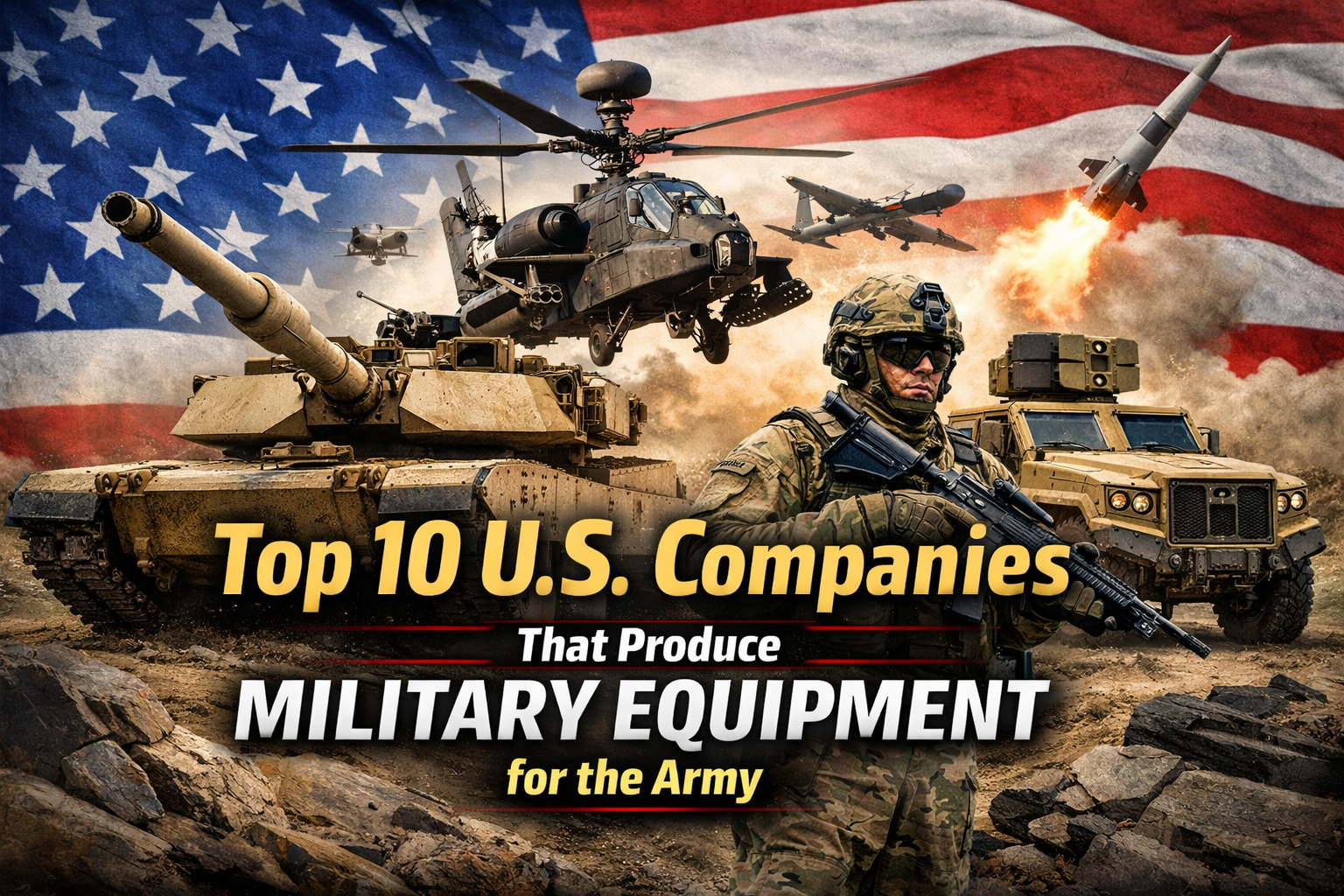
When people think about military equipment for the U.S. Army, they often think only about tanks and rifles.
In reality, the Army depends on a much wider industrial base. It needs armored vehicles, helicopters, missiles, air-defense systems, drones, radios, night-vision gear, artillery support systems, logistics trucks, and many other categories of equipment. Recent Army and DoD budget and contract documents show that modernization still spans ground vehicles, aviation, missiles, integrated air and missile defense, and tactical mobility.
This list is not an official Pentagon ranking. It is a practical top 10 based on company scale, recurring importance to Army programs, and how central their products are to the Army’s real-world equipment mix in 2025 and 2026.
1. Lockheed Martin
Lockheed Martin remains one of the biggest names in U.S. defense and is deeply tied to Army-relevant systems. Its businesses include missile defense, radar, command-and-control, rotary and mission systems, and a wide range of classified and tactical programs. In recent filings, Lockheed Martin describes major lines including land-based missile defense systems, radar systems, laser systems, simulation and training, and mission solutions - all highly relevant to Army operations.
For the Army, Lockheed Martin matters because modern ground war is no longer just about armor. It is also about sensing, intercepting, coordinating, and defending. That keeps companies like Lockheed at the center of air defense, missile defense, battlefield networking, and precision systems.
2. RTX
RTX, through Raytheon and its broader defense businesses, is one of the most important U.S. suppliers of missiles, interceptors, radars, and air-defense technology. Its 2025 annual report highlights key programs such as Patriot and LTAMDS, both closely tied to modern air and missile defense.
That matters for the Army because air defense has become a much bigger priority than it was a decade ago. A company that can provide radar, interceptors, and integrated defense systems is not just a contractor - it becomes part of the Army’s core battlefield architecture.
3. General Dynamics
If the article is about Army equipment in the most direct sense, General Dynamics has to be near the top. Its Land Systems business says it is the sole-source producer of two foundational Army platforms: the Abrams main battle tank and the Stryker wheeled combat vehicle.
That alone secures its place on the list. Tanks and armored combat vehicles remain central to Army force structure, and General Dynamics continues to sit directly on top of some of the Army’s best-known ground combat programs.
4. Boeing
Boeing is still a major Army equipment producer because of military rotorcraft. Its 2024 annual report states that the company continued delivering new-build and remanufactured AH-64E Apache helicopters for the U.S. Army, including aircraft under the Army’s Multi-Year II contract.
That is important because the Apache is one of the Army’s signature combat aircraft. Even in a world full of drones and precision munitions, attack helicopters remain a major part of Army aviation doctrine.
5. Northrop Grumman
Northrop Grumman is more diversified than many people realize, but it remains highly important to U.S. military procurement. In its 2025 filing, the company said 84% of sales came from the U.S. government, showing just how defense-centered the business remains.
For the Army, Northrop is especially relevant in integrated battle management, sensors, munitions, electronics, and air and missile defense support. It may not be the first brand civilians think of when they think “Army equipment,” but it sits inside many of the systems that make modern formations work.
6. Textron
Textron deserves a spot because it combines Bell and Textron Systems, giving it exposure to both Army aviation and tactical military systems. Textron’s 2024 and 2025 reporting notes progress on the Army’s Future Long Range Assault Aircraft program, while Bell’s military revenues were also boosted by the Army’s MV-75 program.
That makes Textron one of the most important companies to watch for future Army aviation. The Army is not only replacing or upgrading old platforms - it is also trying to define what the next generation of vertical lift looks like.
7. L3Harris Technologies
L3Harris is one of the clearest examples of a company that produces essential military equipment even when it is not always the most visible name to the general public. Its filings describe products including communication systems used across the U.S. military, as well as integrated night-vision goggles, weapon sights, aiming lasers, and related soldier systems.
For the Army, that is a big deal. Radios, optics, vision systems, targeting tools, and battlefield communications are not side equipment - they are central equipment. Modern troops are only as effective as their awareness and connectivity.
8. Oshkosh Defense
Oshkosh Defense remains one of the most important U.S. producers of Army tactical vehicles. In February 2025, the DoD announced an Army contract worth over $133 million for Oshkosh Defense to provide M1093 Low Velocity Air Drop vehicles and M1081 vehicles. Earlier company reporting also tied Oshkosh closely to the JLTV family and related Army vehicle work.
This is the kind of company that matters because armies run on mobility. Heavy trucks, tactical vehicles, protected wheeled platforms, and transport support systems are less glamorous than missiles, but they are fundamental to readiness.
9. AeroVironment
AeroVironment is smaller than the giants above, but it absolutely belongs on this list because drones and loitering munitions have become a much more important part of modern warfare. In 2024, the DoD announced an Army contract modification worth over $32 million for the Switchblade Weapon System. AeroVironment’s own filings also show a meaningful relationship with Army revenue.
This is one of the clearest examples of how the Army’s supplier base is changing. The future is not only tanks and helicopters. It is also increasingly unmanned, portable, precise, and software-enhanced.
10. AM General
AM General still matters because the HUMVEE remains part of the Army ecosystem, and recent contract activity proves the company is still active in Army vehicle production. In July 2025, DoD contract reporting showed AM General receiving a $126.5 million Army contract modification for M1165A1B3 HMMWV vehicles, bringing the cumulative contract value above $3 billion. The company also said in 2025 that it manufactures both the HUMVEE and JLTV platforms under multi-year contracts.
That makes AM General relevant even if it is not as broad as some of the larger primes. Tactical wheeled vehicles are still one of the most visible and practical categories of Army equipment.
Final thoughts
If you zoom out, this list shows something important.
The companies producing military equipment for the Army are not all doing the same thing. Some dominate tanks and armored vehicles. Some dominate missiles and air defense. Others are strong in helicopters, radios, night vision, logistics trucks, or drones. The Army’s industrial base is not one lane - it is an ecosystem.
That is also why the definition of “military equipment” has widened. A modern Army needs physical strength, but it also needs sensors, electronics, software integration, mobility, and fast-response precision systems. The companies above are some of the biggest U.S. names helping supply that mix.