
Elon Musk Announces Terafab - Why the Tesla, SpaceX, and xAI Partnership Matters
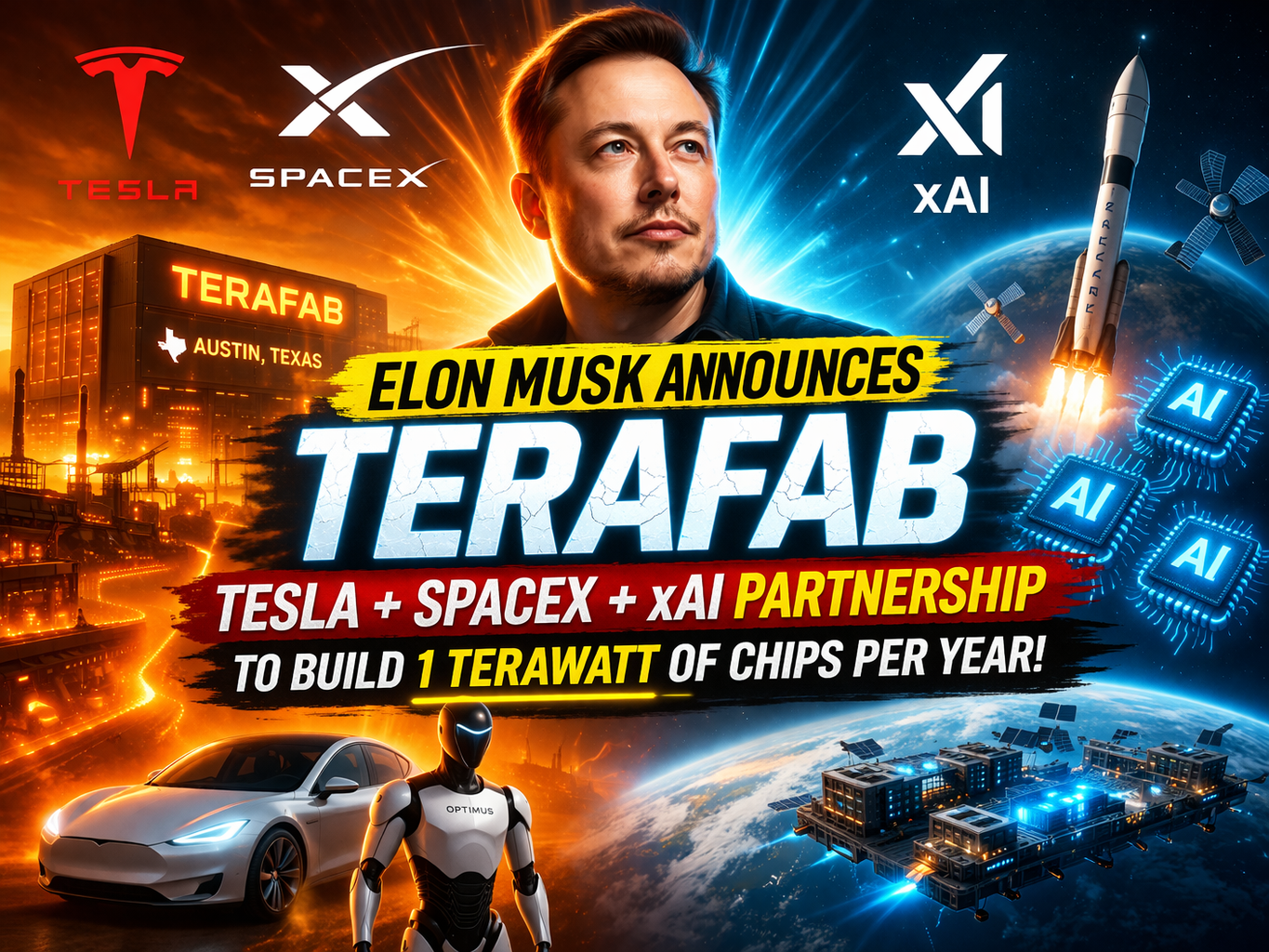
Elon Musk has announced Terafab, a new chip manufacturing initiative connected to Tesla, SpaceX, and xAI. Recent reporting says the project is centered in Austin and is being presented as a major step toward building more of Musk’s computing infrastructure inside his own ecosystem.
On the surface, this may look like another factory announcement.
In reality, it looks much bigger than that.
Terafab appears to be part of a broader push to give Musk’s companies more direct control over one of the most important bottlenecks in modern technology: compute hardware.
What Terafab is supposed to do
According to recent reporting, Musk said SpaceX and Tesla plan to build two advanced chip factories in Austin. Each would focus on a different chip design. One would be for Tesla vehicles and Optimus robots, while the other would be for AI data centers in space.
That alone makes the project unusual.
This is not just about cars.
It is not just about AI software either.
It is about trying to build the physical hardware foundation for several very different but connected businesses at the same time.
Musk also described a very ambitious long-term goal for Terafab: producing one terawatt of computing capacity per year.
That is the kind of number that immediately tells you this is not being framed as a small side project.
Why Tesla, SpaceX, and xAI being together matters
The most important part of the story is not just the fab itself.
It is the combination of companies around it.
Tesla needs more compute for self-driving systems, robotics, factory automation, and future AI workloads. xAI needs enormous computing power for model training and deployment. SpaceX adds the space infrastructure angle, which makes the Terafab idea much more ambitious than a normal semiconductor expansion.
That combination changes how the announcement should be interpreted.
If Tesla was doing this alone, it would already be a significant story.
If xAI was involved too, it would become a more serious AI infrastructure story.
But once SpaceX is also part of the picture, the project starts to look like a broader attempt to connect AI, robotics, chips, satellites, and launch capability into one industrial system.
And that is exactly why Terafab stands out.
It feels less like a factory announcement and more like a signal that Musk wants tighter alignment between his biggest companies.
Why this is really about vertical integration
Terafab makes sense if you assume Musk believes future AI demand will be far larger than current chip supply can handle.
Recent reporting says Musk acknowledged existing suppliers such as Samsung, TSMC, and Micron, but argued that future demand from his companies could eventually outgrow what outside suppliers can provide.
That point is critical.
Terafab does not seem to be about replacing current chip partners overnight.
It seems to be about reducing long-term dependence on external supply.
That is a classic vertical integration move.
Instead of relying entirely on third parties for critical hardware, Musk appears to want his companies closer to the production layer itself. In a world where AI, robotics, and compute capacity are becoming more central, that kind of control could become a major competitive advantage.
The companies that win in the next phase of AI may not just be the ones with the best models.
They may be the ones with the strongest infrastructure.
Terafab fits that logic very well.
Why Austin is a logical location
Austin is not a random choice for this project.
Tesla already has a major footprint there, including its headquarters and Gigafactory. Austin has also become an increasingly important base for Musk’s wider operations in Texas.
That gives Terafab a more natural starting point.
Chip manufacturing needs land, power, logistics, engineering talent, and long-term industrial planning.
A project like this benefits from being close to existing operations that already have some of that foundation in place.
There is also a symbolic side to Austin.
It increasingly looks like one of the main places where Musk’s manufacturing, AI, and infrastructure ambitions are converging.
So Terafab launching there fits both strategically and operationally.
The biggest part of the story: space-based AI infrastructure
One of the most striking details in the reporting is that part of Terafab is meant for AI infrastructure in space.
One of the planned chip designs is intended for AI data centers in space and for operation in harsh environments.
This is where the story becomes much bigger than Tesla.
And much bigger than xAI alone.
Most companies talk about AI in terms of models, products, or software tools.
Terafab introduces a different scale of thinking.
It suggests Musk is looking at a future where compute is so important that it must be treated like core infrastructure across Earth and possibly beyond it.
Whether that future arrives soon is another question.
But the ambition is very clear.
Why people will take it seriously
There are good reasons this announcement is getting serious attention.
Musk has a history of making very bold industrial bets that many people initially doubted. Tesla and SpaceX both grew into far more significant businesses than many critics expected in their earlier years. That history makes new announcements like Terafab harder to ignore.
There is also a real market need behind the idea.
AI demand is putting pressure on chips, power, cooling, and data center capacity.
So even if Terafab sounds huge, it is not disconnected from reality.
It is rooted in an actual problem: the future may require far more compute than the current supply chain can comfortably provide.
That makes the strategic logic understandable even if the execution remains uncertain.
Why people will still be skeptical
At the same time, skepticism is completely reasonable.
Musk did not provide a timeline for the project.
And timelines matter a lot in semiconductor manufacturing.
Building advanced chip production capacity is one of the hardest things in the industrial world.
It takes enormous capital, specialized equipment, deep engineering expertise, and years of execution.
So even if the vision is compelling, the difficulty level is extreme.
That means two things can be true at once.
Terafab can be a smart strategic direction.
And it can still be extremely difficult to execute.
Those two ideas do not contradict each other.
What Terafab really signals
The biggest takeaway is not simply that Musk wants to build chips.
It is that he seems to believe the next era of competition will be shaped by who controls more of the underlying infrastructure.
Not just the apps.
Not just the models.
The infrastructure.
Tesla gives him deployment through vehicles and robotics.
xAI gives him demand for large-scale intelligence systems.
SpaceX gives him launch, satellites, and a path toward more futuristic computing infrastructure.
Terafab looks like an attempt to pull those layers closer together.
If that strategy works, even partially, Terafab could become one of the most important bets in the Musk ecosystem.
Because in the end, this is not just about factories.
It is about building the hardware base for a much larger vision.
Final thoughts
Terafab matters because it shows how Musk may be thinking about the future of technology at a systems level.
Cars, robots, AI models, chip production, satellites, and future compute infrastructure may no longer be separate stories in his world.
They may be part of the same machine.
That does not guarantee success.
The scale is massive.
The challenge is real.
And there is still no detailed roadmap.
But as a strategic signal, the message is strong: Musk is trying to bring Tesla, SpaceX, and xAI closer together around the infrastructure that could power the next stage of AI, robotics, and industrial technology.