
Top 10 European AI-Native Software Companies by Revenue in Q2 2026
Europe does not have an OpenAI.
At least not yet.
But that does not mean Europe has no serious AI software companies.
By Q2 2026, Europe has produced several AI-native software companies generating real revenue, not just funding headlines. Some are building foundation models. Some are building voice agents. Some are building AI coding tools. Some are building enterprise AI platforms. Some are quietly making hundreds of millions in annual recurring revenue by solving specific business problems better than general-purpose AI tools.
This matters because the AI market is often discussed as if it is only an American story.
OpenAI.
Anthropic.
Google Gemini.
Microsoft Copilot.
xAI.
Meta.
Nvidia.
That is the dominant narrative.
But Europe has a different AI market. It is less concentrated around consumer chatbots and more concentrated around enterprise workflows, language, video, voice, AI sovereignty, automation, and vertical software.
This article ranks the top European AI-native software companies by revenue as of Q2 2026.
One important disclaimer:
This is not a perfect accounting table.
Most private AI companies do not publish clean audited revenue. Some disclose annual recurring revenue. Some disclose annualized revenue run-rate. Some are covered through investor reports or press interviews. Some have large valuations but very little public revenue data.
So this ranking is based on the best available public revenue signals: company announcements, credible media reporting, investor disclosures, and ARR estimates.
Also, “European” here means companies that are European-founded, European-headquartered, or strongly rooted in Europe. That includes the UK, even though it is no longer part of the EU.
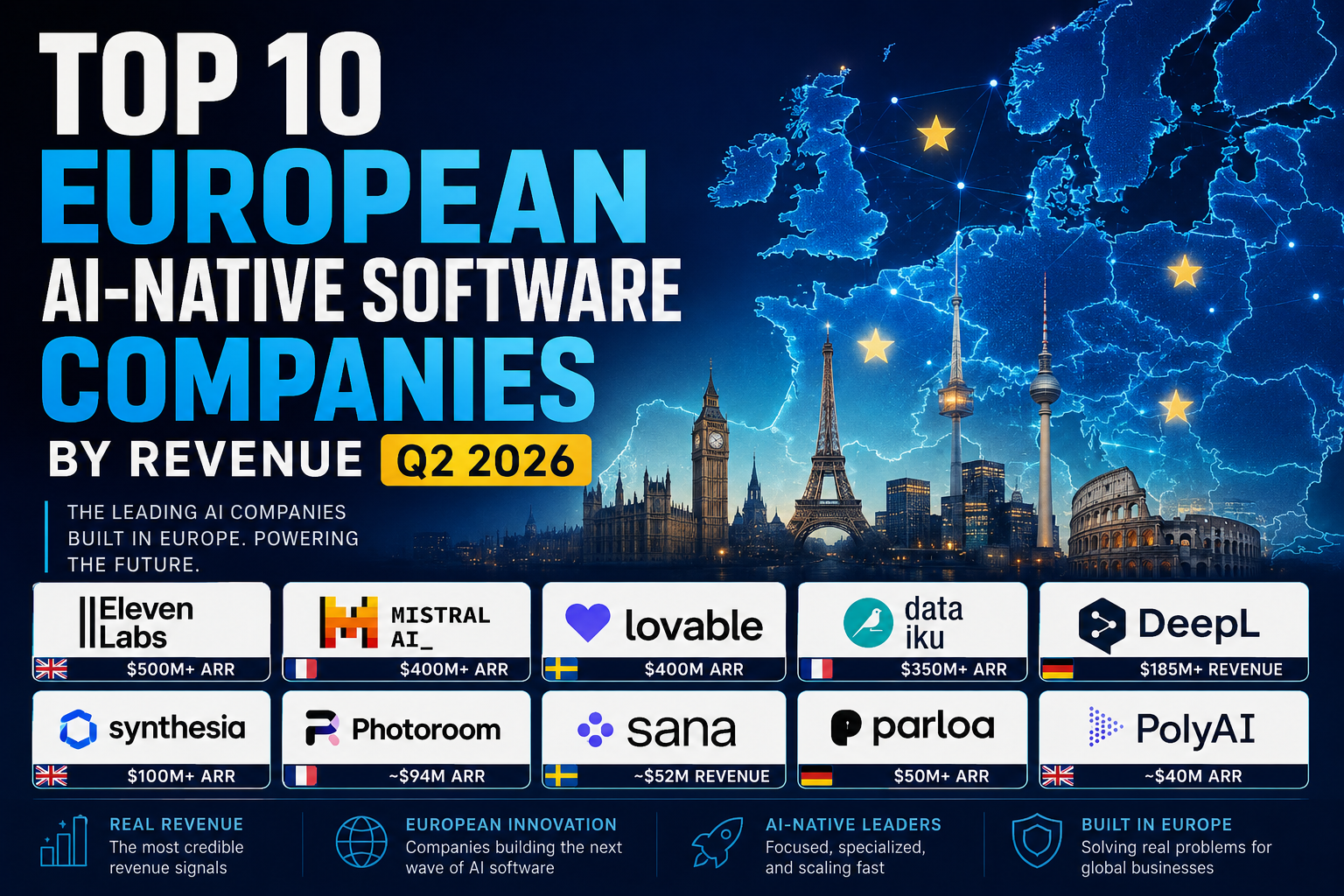
Estimated top 10 European AI-native software companies by revenue in Q2 2026
| Rank | Company | Country / European Base | Main Category | Revenue Signal |
|---|---|---|---|---|
| 1 | ElevenLabs | UK / Europe-founded | AI voice and audio | $500M+ ARR |
| 2 | Mistral AI | France | Foundation models / enterprise AI | $400M+ annualized run-rate |
| 3 | Lovable | Sweden | AI app building / vibe coding | $400M ARR |
| 4 | Dataiku | France-founded / global | Enterprise AI platform | $350M+ ARR |
| 5 | DeepL | Germany | Language AI / translation | $185M+ reported revenue |
| 6 | Synthesia | UK | AI video / avatars | $100M+ ARR / ~$200M target |
| 7 | Photoroom | France | AI image editing for commerce | Around $94M ARR estimate |
| 8 | Sana | Sweden | AI learning / knowledge platform | Around $52M revenue estimate |
| 9 | Parloa | Germany | AI customer service agents | $50M+ ARR |
| 10 | PolyAI | UK | Enterprise voice AI agents | Around $40M expected ARR |
The order is not perfect because not all companies report revenue in the same way. But the direction is clear: Europe already has multiple AI-native software companies in the $50M to $500M+ revenue range.
That is not small.
That is an actual software market.
1. ElevenLabs
ElevenLabs is currently one of Europe’s strongest AI-native software companies by revenue.
The company started with AI voice generation, but it is no longer only a text-to-speech tool. It now sits inside a much larger category: conversational AI, dubbing, voice cloning, voice agents, audio generation, accessibility, localization, and enterprise voice workflows.
In May 2026, ElevenLabs said it had ended 2025 with $350 million in ARR and had already surpassed $500 million ARR in the first four months of 2026. The company said the growth was driven by enterprises deploying voice agents across customer support, sales, hiring, and marketing operations.
That puts ElevenLabs at the top of this European AI revenue ranking.
The important thing about ElevenLabs is that it owns a specific output format: voice.
OpenAI, Anthropic, Google, and xAI are competing heavily in general AI assistants. ElevenLabs is competing in something more vertical and more monetizable: making machines speak, listen, translate, dub, and interact in human-like ways.
That makes the business easier to understand.
Companies already spend money on customer support, call centers, training, marketing, localization, sales outreach, and media production. If voice AI reduces cost or increases output in those workflows, businesses can justify paying for it.
This is one of the reasons ElevenLabs has scaled so quickly.
It is not selling AI as a novelty.
It is selling AI as infrastructure for communication.
2. Mistral AI
Mistral AI is Europe’s most important foundation model company.
It is the closest thing Europe has to a direct answer to OpenAI, Anthropic, and Google DeepMind.
The company is based in Paris and has become a symbol of European AI sovereignty. That matters because many European companies and governments do not want to depend entirely on U.S. model providers for critical AI infrastructure.
According to Financial Times reporting, Mistral’s annualized revenue run-rate exceeded $400 million, up dramatically from around $20 million the previous year. The same reporting said Mistral had more than 100 enterprise clients and was aiming to pass $1 billion in ARR by the end of 2026.
That makes Mistral one of the fastest-growing AI software companies in Europe.
Mistral is interesting because its business is not only about model quality.
It is about independence.
For European banks, governments, defense organizations, manufacturers, and regulated industries, AI is not just a productivity tool. It is strategic infrastructure.
They care about where the model runs.
They care about data control.
They care about deployment options.
They care about compliance.
They care about dependency risk.
That is why Mistral has a different market position from many smaller AI startups. It is not just trying to build a better chatbot. It is trying to become Europe’s AI infrastructure layer.
That is a much bigger ambition.
3. Lovable
Lovable is one of the clearest examples of how fast the AI coding market is moving.
Based in Stockholm, Lovable helps users build apps by describing what they want in plain English. It is part of the “vibe coding” wave, where software creation becomes more conversational, visual, and accessible to non-traditional developers.
In March 2026, TechCrunch reported that Lovable had crossed $400 million in annual recurring revenue.
That is an extraordinary number for a company in this category.
Lovable is important because it shows that AI coding is not only for professional engineers.
Cursor and Claude Code are powerful tools for developers. Lovable is closer to the opposite side of the market: founders, operators, marketers, designers, and small business owners who want to create software without starting from a blank code editor.
This does not mean developers disappear.
It means more people start software projects.
That has major implications for agencies and software companies.
Basic prototypes, internal tools, landing pages, dashboards, and MVPs will become easier to generate. But many of those projects will still need professional help later: architecture, security, scalability, design systems, payments, integrations, compliance, performance, and maintenance.
Lovable is not destroying software development.
It is expanding the number of people who can begin building software.
That may create even more demand for serious developers, not less.
4. Dataiku
Dataiku is a slightly different case.
It is not a new generative AI chatbot company. It is an older enterprise AI and machine learning platform founded in France, now operating globally. But it belongs in this ranking because its core business is AI software, and its revenue is large.
In October 2025, Dataiku announced that it had surpassed $350 million in annual recurring revenue. The company said its platform was used by more than 750 organizations worldwide, including one in four of the Forbes Global 2000.
That makes Dataiku one of the largest European-founded AI software companies by revenue.
Dataiku’s positioning is not flashy. It is not a consumer AI product. It does not have the same mainstream brand recognition as ChatGPT, Gemini, Claude, or Grok.
But enterprise AI is not only about flashy products.
Large companies need governance.
They need model control.
They need auditability.
They need human approval workflows.
They need explainability.
They need to connect AI to existing data, internal teams, and compliance processes.
That is where Dataiku fits.
In many ways, Dataiku represents the boring but profitable side of AI: helping large organizations actually operationalize it.
And in enterprise software, boring can be very valuable.
5. DeepL
DeepL is one of Europe’s most successful AI software companies, but it is also facing one of the most interesting strategic challenges.
The company built its reputation in AI translation. For years, it was considered one of the best machine translation products in the world, especially for professional and business use.
DeepL is based in Cologne, Germany, and has become a major player in language AI. Latka’s company profile lists DeepL at $185.2 million in 2024 revenue, up from $141.3 million in 2023.
Reuters also reported in 2024 that DeepL was valued at $2 billion after a $300 million investment round, with business customers including Nikkei, Coursera, and Deutsche Bahn.
DeepL’s challenge is that general-purpose LLMs have made translation feel more common.
A few years ago, high-quality translation was a specialized AI category.
Now ChatGPT, Gemini, Claude, and other large language models can translate, rewrite, summarize, adapt tone, and explain cultural context. That puts pressure on standalone translation tools.
But DeepL still has a strong enterprise argument.
Professional translation is not only about “good enough” output.
It is about accuracy.
Security.
Terminology.
Consistency.
Workflow integration.
Business communication.
Legal and technical language.
Data protection.
This is where DeepL can still win.
The company’s future may depend on whether it can evolve from “the best translator” into a broader language AI platform for businesses.
6. Synthesia
Synthesia is one of the UK’s strongest AI-native software companies.
Its core product is AI video generation for business: training videos, internal communication, onboarding, compliance, sales enablement, and marketing content.
In April 2025, Synthesia announced that it had reached more than $100 million in annual recurring revenue and received a strategic investment from Adobe Ventures.
The company also raised $200 million at a $4 billion valuation in early 2026, and reporting said it expected to earn about $200 million in 2026.
Synthesia’s strength is that it sells into a clear enterprise use case.
Companies need training content.
They need internal communication.
They need product explainers.
They need compliance videos.
They need multilingual content.
Traditional video production is expensive, slow, and hard to update.
AI video changes that.
Instead of hiring a studio, filming a presenter, editing, translating, and re-recording, companies can generate and update videos much faster.
That is why Synthesia has become a real business.
It is not just an AI demo.
It replaces a painful workflow.
7. Photoroom
Photoroom is a French AI image editing company focused heavily on commerce, product photography, sellers, creators, and small businesses.
It is not as famous as Midjourney or Adobe Firefly, but it solves a very practical problem: helping people create better product images quickly.
Sacra estimates that Photoroom reached about $94 million in ARR as of 2024, up 89% year over year. The same source notes that Photoroom had reached $50 million ARR by December 2023.
That makes Photoroom one of Europe’s strongest vertical AI software companies.
The lesson from Photoroom is simple:
AI does not need to be general to be valuable.
Sometimes the best AI businesses are narrow.
Remove backgrounds.
Create product images.
Improve ecommerce listings.
Generate marketing visuals.
Help sellers make their products look professional.
That is not as glamorous as building a frontier model, but it is monetizable.
Small merchants, marketplace sellers, ecommerce brands, and social media sellers all need better images. They do not want to learn Photoshop. They want the result.
Photoroom gives them the result.
8. Sana
Sana is a Swedish AI company focused on learning, knowledge, and enterprise AI workflows.
It started around personalized learning and has expanded toward knowledge tools and AI agents for organizations.
Latka lists Sana Labs at $52.1 million in 2024 revenue, up from $25 million in 2023.
Sana is interesting because the enterprise knowledge market is huge.
Companies have documents, training materials, onboarding processes, internal knowledge bases, customer information, product details, and team workflows spread across many tools.
AI can help organize, retrieve, teach, summarize, and automate parts of that knowledge layer.
This is one of the most important enterprise AI categories.
Every company has internal knowledge chaos.
Every company has onboarding problems.
Every company has employees asking the same questions.
Every company loses time searching for information.
Sana’s opportunity is to become part of the AI knowledge layer inside companies.
That is a quieter market than AI chatbots, but potentially very durable.
9. Parloa
Parloa is a German AI customer service company focused on enterprise automation.
In January 2026, Reuters reported that Parloa had raised $350 million at a $3 billion valuation. The same report said Parloa’s annual recurring revenue had surpassed $50 million and that its customers include Microsoft, Accenture, KPMG, and Booking.com.
Customer service is one of the clearest AI software markets because the ROI is easy to understand.
Companies spend heavily on support teams.
They receive repetitive questions.
They need 24/7 coverage.
They want faster response times.
They want lower costs.
They want consistent customer experiences.
AI agents can help with many of those problems, especially for common support tasks like order tracking, returns, booking changes, account questions, troubleshooting, and basic customer requests.
That is why companies like Parloa, PolyAI, Sierra, Decagon, and others are attracting so much attention.
The customer support market is not theoretical.
The budgets already exist.
AI is trying to capture part of them.
10. PolyAI
PolyAI is a UK-based enterprise voice AI company focused on customer service and call center automation.
It was spun out of the University of Cambridge and builds AI voice assistants for real customer conversations.
SiliconANGLE reported that PolyAI was on track to more than $40 million in annualized recurring revenue, while UK filings showed revenue growing from $8.9 million to just over $15 million in the 12-month period ending January 2025.
Dealroom similarly lists PolyAI with reported revenue of $15 million for the fiscal year ending January 2025 and expected ARR of $40 million.
PolyAI belongs in this ranking because it shows how competitive voice AI has become.
This category is not only about generating nice voices.
It is about handling real conversations.
Latency matters.
Accuracy matters.
Interruptions matter.
Context matters.
Fallbacks matter.
Enterprise integrations matter.
A customer calling a bank, hotel, airline, utility company, or telecom provider does not care that the company is using AI.
They care whether the problem gets solved.
That is the challenge and opportunity for PolyAI.
What about Helsing, Stability AI, Aleph Alpha, Black Forest Labs, and Recraft?
Several European AI companies are extremely important but harder to rank by revenue.
Helsing is one of Europe’s most valuable defense AI companies, but it is difficult to compare with pure software companies because its business includes defense contracts, autonomous systems, drones, and hardware-adjacent products. Reuters reported in 2025 that Helsing raised €600 million and was expanding from AI software into drones, aircraft, and submarines.
Stability AI is important historically because of Stable Diffusion, but its revenue has been less clear and its business has gone through major changes.
Aleph Alpha was once seen as Germany’s answer to OpenAI, but Reuters reported in 2026 that Canada’s Cohere acquired Aleph Alpha as part of a broader push into European sovereign AI.
Black Forest Labs is strategically important in AI image generation. Financial Times reporting described it as a German startup challenging AI giants with its Flux image generation models, strong funding, and partnerships with companies like Meta, Adobe, and Canva.
Recraft is also worth watching in AI design, but public revenue estimates are still much smaller than the companies in the top 10.
These companies may be important, but this article is focused on revenue, not valuation, funding, or technical influence.
That distinction matters.
The biggest pattern: Europe is winning in vertical AI
The most important thing about this ranking is not the exact order.
It is the pattern.
Europe is not winning AI in the same way the United States is.
The U.S. has the dominant general AI platforms: OpenAI, Anthropic, Google, Microsoft, Meta, xAI.
Europe is stronger in vertical AI software:
Voice.
Translation.
Video.
AI coding.
Enterprise AI governance.
Customer service.
Product images.
Learning and knowledge.
Sovereign AI.
This is a very different kind of market.
It may not produce one giant consumer chatbot that dominates the world.
But it can produce many serious AI software companies that generate real revenue from specific workflows.
That may actually be healthier.
Vertical AI companies can be more focused, more practical, and closer to business budgets.
They do not need everyone on earth to use their chatbot.
They need specific customers to pay because the product solves a real problem.
What this means for software agencies and developers
For agencies, freelancers, and software companies, this ranking is useful because it shows where AI demand is becoming real.
The money is not only in chatbots.
The money is in workflows.
Voice agents.
AI-powered customer service.
AI-generated training content.
AI-assisted software development.
AI image tools for ecommerce.
AI language tools for global teams.
AI platforms for enterprise governance.
AI knowledge systems for internal operations.
That is where businesses are spending.
For a software agency, this creates a clear opportunity.
Clients will not only ask for websites anymore.
They will ask:
Can we add AI to our customer support?
Can we create AI-generated internal training?
Can we automate product image creation?
Can we build an AI assistant for our internal knowledge base?
Can we integrate AI into our ecommerce workflow?
Can we use AI to summarize sales calls, tickets, documents, tasks, or reports?
Can we build an AI tool specific to our business?
This is where agencies that understand both software development and AI implementation can win.
Most businesses do not need another generic AI pitch.
They need practical AI integrated into their existing systems.
Final thought
Europe may not have an OpenAI-sized consumer AI company yet.
But Europe does have real AI software businesses.
ElevenLabs is above $500 million ARR.
Mistral is above $400 million annualized revenue run-rate.
Lovable is around $400 million ARR.
Dataiku is above $350 million ARR.
DeepL, Synthesia, Photoroom, Sana, Parloa, and PolyAI are all building serious revenue around specific AI workflows.
That is the real story.
European AI is not dead.
It is just different.
Less consumer hype.
More enterprise workflows.
Less “one chatbot to rule them all.”
More vertical AI companies solving specific business problems.
And by Q2 2026, that strategy is already producing hundreds of millions in revenue.