
Top 10 AI Business Models in 2026: Where the Real Money Is Going
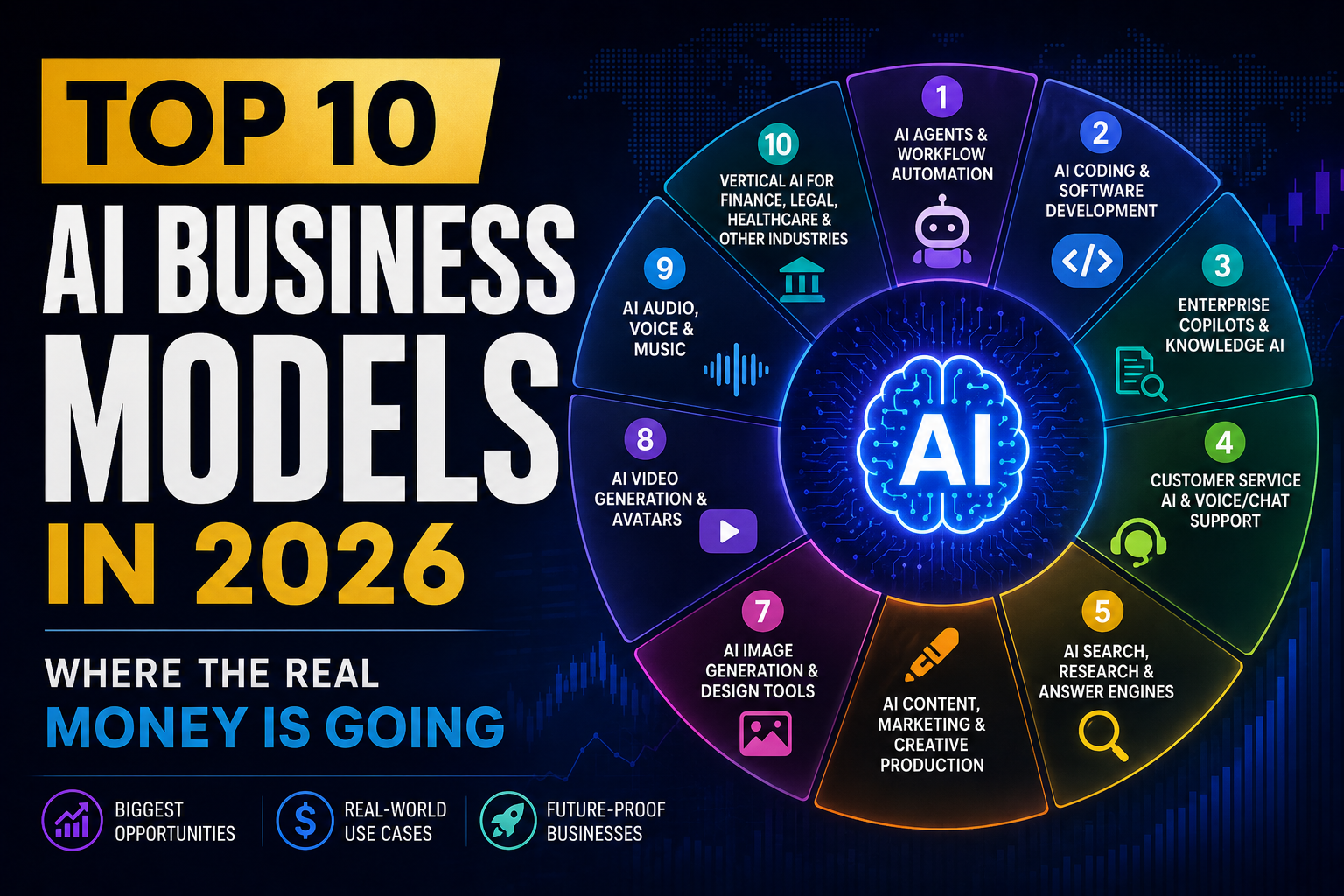
1. AI agents and workflow automation
This should probably be number one.
Not “chatbots” in the old sense, but agents that do work across tools: sales, support, finance, HR, marketing, operations, internal admin, documents, email, CRM, and reporting.
This is where AI moves from “answering questions” to “doing tasks.”
Anthropic launching Claude for Small Business with workflows across tools like QuickBooks, PayPal, HubSpot, Canva, DocuSign, Google Workspace, and Microsoft 365 is a very good current signal for this direction.
2. AI coding and software development
This is one of the cleanest AI business models because developers and companies can directly measure productivity.
Cursor, Claude Code, GitHub Copilot, Replit, Lovable, Bolt-style tools, and AI coding agents all belong here.
This category deserves to be very high because software development is expensive, technical, and already budgeted. If AI saves developers time, businesses pay.
Also, recent enterprise AI adoption data showed Anthropic gaining heavily because of Claude Code and broader business use across software development, legal, finance, and research.
3. Enterprise copilots and internal knowledge AI
This is slightly different from agents.
This category is about AI connected to company knowledge: documents, policies, manuals, tickets, CRM data, product docs, analytics, contracts, internal notes, and databases.
The business model is usually B2B SaaS, seat-based subscriptions, enterprise licensing, or usage-based pricing.
This is very relevant for agencies because many companies will want custom AI assistants connected to their own data, not generic ChatGPT.
4. Customer service AI and voice/chat support
This is probably one of the most practical AI business models.
Companies already spend a lot on support teams, call centers, live chat, help desks, and customer success. AI can reduce repetitive work and provide 24/7 coverage.
This includes chatbots, voice agents, call center automation, support ticket automation, ecommerce support, booking support, and post-purchase support.
I would separate this from general “chatbots” because support AI has a much clearer ROI.
5. AI search, research, and answer engines
This includes Perplexity-style products, enterprise research agents, legal research, financial research, market research, academic research, and internal search.
This category is important because search intent is valuable.
The old model was: search → links → manual reading.
The new model is: ask → synthesized answer → sources → action.
This is a huge shift for SEO, content, agencies, and software companies.
6. AI content, marketing, and creative production
This includes AI copywriting, ad generation, social media content, SEO articles, product descriptions, email campaigns, and campaign variations.
But I would be careful here.
This market is crowded and easier to commoditize. The winning businesses will not be “generate a blog post.” The winners will be platforms that connect AI content to real workflows: ecommerce, ads, brand assets, analytics, publishing, localization, and testing.
7. AI image generation and design tools
This includes Midjourney, Adobe Firefly, Canva AI, Freepik, Photoroom, Recraft, Ideogram, Krea, and ecommerce image tools.
This is a strong category because the output is visual and immediate.
But the business model is different depending on the customer:
Creators pay for subscriptions.
Agencies use it for speed.
Ecommerce companies use it for product images.
Enterprises use it for branded creative workflows.
a16z’s 2026 consumer AI app report also shows creative tools continuing to gain attention as AI apps expand beyond simple chatbot usage.
8. AI video generation and avatars
This includes Runway, Synthesia, HeyGen, Kling-style tools, Sora-style tools, and enterprise video automation.
Video is very powerful, but it is also expensive to generate and harder to perfect.
The strongest business cases are probably:
Training videos.
Product explainers.
Internal communication.
Ads.
Social content.
Localization.
AI avatars for enterprise.
I would rank video below coding/agents/support for now because the revenue potential is huge, but the cost and quality challenges are still higher.
9. AI audio, voice, and music
This includes ElevenLabs, Suno, Udio-style music tools, dubbing, voice cloning, narration, podcasts, audiobooks, and voice agents.
Voice is a strong category because it fits both creator and enterprise markets.
The best angle is that audio AI is not only “fun music generation.” It is also localization, customer service, accessibility, training, education, sales, support, and media production.
10. Vertical AI for finance, legal, healthcare, real estate, and industry-specific work
This is where I would place “finance.”
Finance AI is important, but I would not make it a standalone top-level category unless the article is about industries. I would group it under vertical AI.
The reason: finance, legal, healthcare, insurance, real estate, logistics, and manufacturing all have similar AI business logic.
They need specialized AI.
They have expensive workflows.
They have compliance requirements.
They have industry-specific data.
They are willing to pay if the AI saves time or reduces risk.
This category may produce many successful companies, but usually as specialized B2B SaaS, not mass-market consumer apps.
My suggested article angle
The article should say:
AI business models are moving from “generate content” to “complete workflows.”
That is the central point.
In 2023, people were impressed that AI could write text or create images.
In 2026, the serious money is moving toward AI that saves companies time, replaces repetitive work, helps teams make decisions, writes code, supports customers, searches knowledge, creates media at scale, and automates business operations.
McKinsey’s 2026 AI trust research also shows why this is becoming more serious: as companies move into agentic AI, governance, controls, risk management, and trust become bigger adoption issues. That means the winning AI businesses will not only be powerful; they will need to be reliable and controllable.
The ranking I would use
AI agents and workflow automation
AI coding and software development
Enterprise copilots and internal knowledge AI
Customer service AI and voice/chat support
AI search, research, and answer engines
AI content, marketing, and creative production
AI image generation and design tools
AI video generation and avatars
AI audio, voice, and music
Vertical AI for finance, legal, healthcare, real estate, and other industries