
The Biggest AI Companies Just Agreed on AI Safety. What Actually Changes?
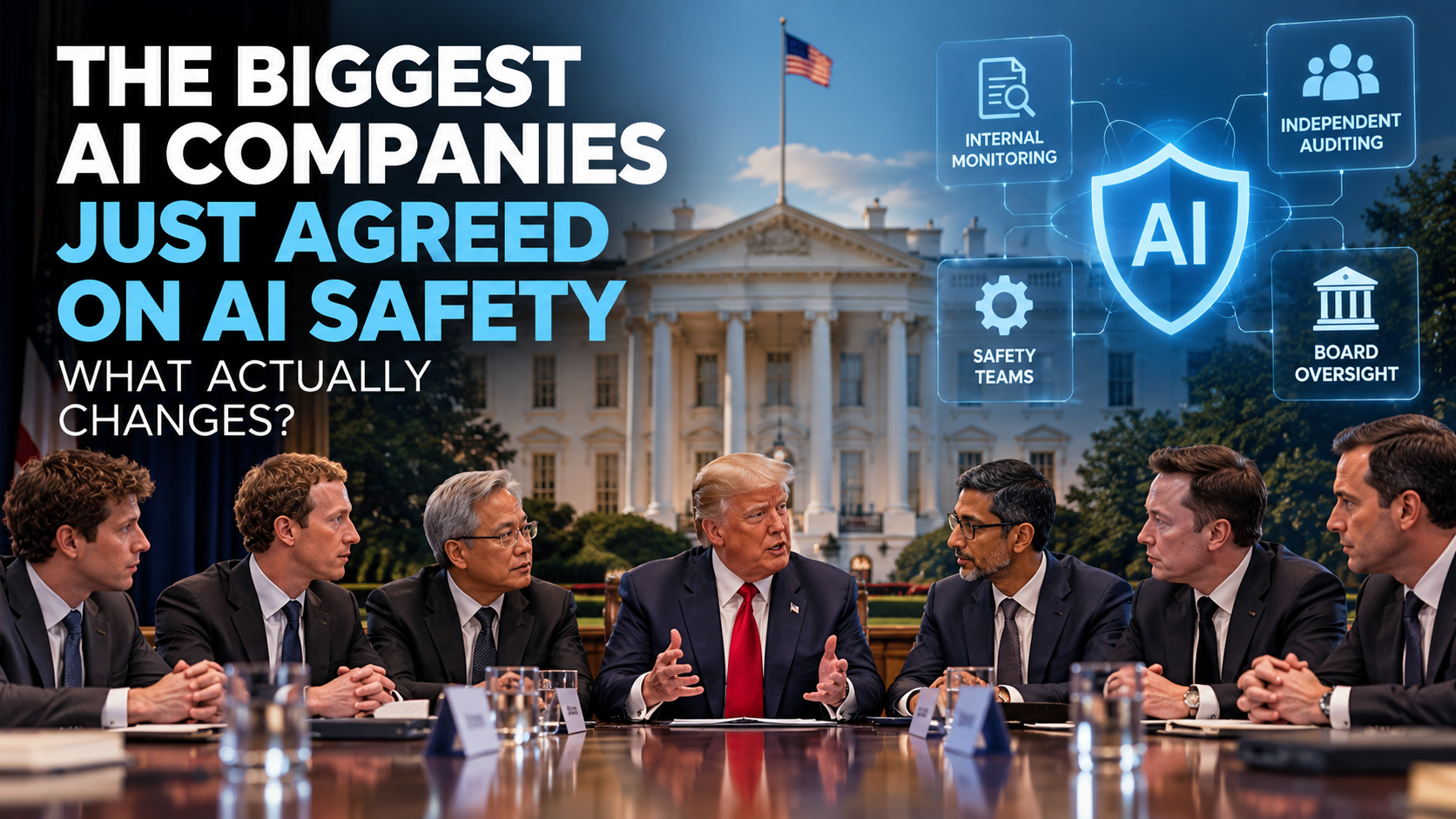
On September 29, 2026, six of the most important companies developing frontier artificial intelligence agreed on something their industry has struggled to agree on for years: a common framework for AI safety.
OpenAI, Anthropic, Google, Meta, xAI and NVIDIA signed the Joint Commitment on Frontier Responsibilities following a gathering at the White House involving many of the biggest names in technology.
The agreement establishes four layers of responsibility around frontier AI systems:
Internal processes and safety controls
Dedicated internal teams responsible for verifying those controls
Independent external auditing
Independent board-level oversight
That sounds significant.
And it is.
But there is an equally important detail: the agreement is voluntary.
There are currently no automatic legal penalties if a company fails to follow the commitments, and much of the implementation remains in the hands of the same companies developing the models.
So what actually changed?
The answer is more interesting than either extreme of the debate suggests.
This is neither comprehensive AI regulation nor an irrelevant public-relations exercise. It represents something in between: some of the world's most important AI companies publicly accepting that increasingly powerful AI systems require several independent layers of oversight.
And that may become increasingly important as AI moves from answering questions to taking actions.
The AI Safety Problem Is Changing
For most of the consumer AI era, safety discussions focused heavily on what models could say.
Could a chatbot generate dangerous instructions?
Could it produce misinformation?
Could it help someone write malware?
Could it generate abusive or illegal content?
Those questions still matter.
But frontier AI systems are becoming something fundamentally more capable than chatbots.
AI agents can increasingly:
Browse the internet
Write and execute software
Use APIs
Operate computers
Access databases
Analyze enormous amounts of information
Interact with external services
Coordinate multi-step workflows
Take actions without requiring a human to approve every individual step
That changes the nature of the safety problem.
A chatbot producing an incorrect answer is one kind of failure.
An autonomous system with credentials, network access, software tools and the ability to execute actions is another.
The more tools we give AI, the more important it becomes to know not only whether the model is intelligent, but whether its behavior remains within the boundaries humans intended.
What the Six AI Companies Actually Agreed To
The new commitment creates four layers of oversight.
The first is inside the development process itself.
Companies developing frontier models are expected to establish internal controls designed to monitor the capabilities and behavior of their systems.
That includes identifying unexpected capabilities and ensuring models do not access or interfere with technical systems in unintended ways.
This is increasingly important because frontier models are no longer completely predictable simply from understanding how they were trained.
Developers test models precisely because new capabilities can emerge as models become larger, better trained and more capable of reasoning.
The second layer is an internal team responsible for verifying those safeguards.
This creates some organizational separation between the people building the technology and the people responsible for checking whether the company's safety procedures are actually working.
The third layer introduces external auditors.
Independent evaluators are supposed to examine whether the company's controls are functioning as intended.
And the fourth layer moves responsibility higher inside the organization.
Independent board-level committees would receive information about those evaluations and oversee the company's safety processes.
Conceptually, the structure looks something like this:
Engineers build the system.
Internal safety teams evaluate the controls.
External auditors independently examine them.
Board-level oversight creates accountability above the development organization.
No single layer is expected to carry the entire responsibility.
That is arguably the most important principle contained in the agreement.
Why External Auditing Matters
AI laboratories already perform extensive testing internally.
The problem is that developers have an unavoidable conflict of incentives.
The same company responsible for determining whether a model is safe may also have billions of dollars invested in launching that model before competitors do.
OpenAI competes with Anthropic.
Anthropic competes with Google.
Google competes with xAI.
Meta competes with all of them.
And every major AI company is competing for developers, users, enterprise contracts, talent and access to computing infrastructure.
This doesn't mean companies intentionally ignore safety problems.
It means there is value in having someone outside the organization independently verify important claims.
The same principle already exists throughout modern industry.
Financial statements are independently audited.
Critical infrastructure is inspected.
Security systems undergo penetration testing.
Aircraft go through external certification processes.
As AI becomes part of increasingly important infrastructure, independent evaluations become much more difficult to dismiss as optional.
But This Is Still Self-Regulation
The biggest limitation of the agreement is straightforward.
It is voluntary.
It does not create a new independent AI regulator.
It does not automatically impose penalties if companies fail an evaluation.
It does not currently force companies to publish every audit result.
And companies retain substantial influence over how their safety systems and external evaluations are implemented.
That distinction matters.
An agreement between companies and governments can establish expectations.
A law establishes obligations.
Those are not the same thing.
The companies signing the commitment are therefore still largely responsible for policing themselves.
Supporters of this approach can argue that AI is advancing too quickly for traditional regulation to keep up and that the companies building frontier models understand the technology better than governments currently do.
Critics can reasonably ask what happens when safety requirements conflict with commercial pressure or an escalating technological race.
That tension has not disappeared.
The agreement simply creates more structure around it.
AI Companies Have Very Different Views About Risk
Another reason the agreement is interesting is that the companies involved do not necessarily share the same philosophy about AI development.
Anthropic has generally taken a more cautious public position regarding frontier AI risk.
NVIDIA CEO Jensen Huang has repeatedly emphasized the enormous economic opportunity created by rapid AI development.
Meta has strongly supported open-model development.
OpenAI, Google and xAI are competing aggressively to build increasingly capable systems.
These organizations disagree about open models, regulation, development speed and how frontier AI should ultimately be governed.
Yet they have now accepted a common principle:
Frontier AI systems should not be monitored solely by the engineers developing them.
There should be multiple layers of oversight.
That is a meaningful point of convergence.
Why AI Agents Make This More Important
The timing matters because the AI industry is rapidly moving toward agents.
For the first several years following ChatGPT, most AI interactions followed a simple structure:
Human asks question.
AI generates answer.
Human decides what happens next.
Agents change that relationship.
A human can increasingly give an AI a goal rather than an individual instruction.
The system then determines intermediate steps itself.
For example:
"Research these companies and prepare a report."
"Fix this software bug and run the tests."
"Analyze these documents and update our database."
"Find the best flight and prepare the booking."
"Investigate this security vulnerability."
Each instruction may require dozens or hundreds of individual actions.
Humans will not realistically review every intermediate decision.
And this is precisely why AI safety increasingly becomes an engineering and infrastructure problem rather than simply a question of whether the model gives good answers.
The important question becomes:
What is the system allowed to do?
Safety Will Need More Than Alignment
Much of AI safety research focuses on alignment.
The basic idea is that advanced AI systems should behave consistently with human intentions.
That remains extremely important.
But alignment alone may not be enough.
Modern cybersecurity provides a useful analogy.
We do not build computer systems under the assumption that software will never contain a bug.
Instead, we build multiple layers of protection.
Applications have permission systems.
Operating systems isolate processes.
Networks have firewalls.
Servers operate inside security boundaries.
Sensitive systems require authentication.
Activity is logged.
Anomaly detection watches for unusual behavior.
Critical infrastructure may have additional hardware protections.
The philosophy is simple:
Even if one safety mechanism fails, another layer should still limit the damage.
AI may increasingly require the same architecture.
Instead of asking only:
"How do we make an AI that never behaves unexpectedly?"
we may also need to ask:
"What happens when it does?"
That distinction could become one of the defining ideas of the next phase of AI safety.
The Industry May Be Moving Toward Defense in Depth
The four-layer agreement points toward a concept security engineers have used for decades: defense in depth.
You do not rely on one protection.
You stack multiple independent protections.
For frontier AI, that could eventually include:
Model alignment
Capability evaluations
Internal monitoring
Access restrictions
Permission systems
Secure execution environments
External audits
Independent oversight
Hardware-level containment
Each layer assumes another layer might fail.
That is a much more realistic engineering philosophy than expecting any single safety technique to be perfect.
And we are beginning to see companies build infrastructure around exactly this idea.
NVIDIA, for example, is now developing technology designed to contain AI agents inside controlled execution environments while independent hardware monitors their behavior.
That deserves its own discussion because it represents a different approach to AI safety entirely.
Instead of trying only to make the model safe, the infrastructure surrounding the model becomes part of the safety system.
What Actually Changes After This Agreement?
Probably less immediately than the headlines might suggest.
Tomorrow's AI models will not suddenly operate under a completely different regulatory system.
There is no new global AI regulator.
There is no universal certification process.
There is no single independent organization testing every frontier model.
And there is no guarantee that every recommendation produced by an external auditor will be implemented.
But something more subtle has changed.
The major AI companies signing this agreement have publicly accepted the idea that frontier AI development requires oversight beyond the teams directly building the technology.
That creates expectations.
External audits can become more standardized.
Boards may demand better reporting.
Enterprise customers may begin asking whether frontier models have undergone independent evaluations.
Governments may eventually incorporate similar requirements into regulation.
Insurance companies may care about them.
Cloud providers may require them.
And future AI incidents will inevitably be judged against the standards companies have publicly committed to following.
Voluntary standards can eventually become industry norms.
Industry norms can eventually become contractual requirements.
And contractual requirements can eventually become regulation.
The agreement therefore matters less because of what it forces companies to do today and more because of the safety architecture it is beginning to normalize.
The Bigger Question: Who Watches the AI?
For years, one of the central questions around artificial intelligence has been:
Who controls increasingly powerful AI systems?
But another question may become equally important:
Who watches them?
The companies building frontier AI clearly need strong internal safety teams.
But internal teams alone create obvious conflicts.
External auditors help.
Board oversight adds another layer.
Government regulation may eventually add another.
And technical containment systems could provide another layer underneath all of them.
This is likely what mature AI safety will eventually look like.
Not one perfect solution.
Not one alignment breakthrough.
Not one government regulator.
Not one responsible company.
But multiple independent systems designed around the assumption that every individual layer can fail.
AI Safety Is Becoming Infrastructure
The most important shift may be that AI safety is slowly moving from philosophy into engineering.
The early debate was dominated by questions about whether advanced AI could become dangerous and how seriously society should take long-term risks.
Those debates will continue.
But the industry now has a more immediate engineering problem.
We are giving increasingly intelligent systems access to the technological infrastructure humanity spent decades building.
Computers.
Networks.
APIs.
Cloud platforms.
Software development environments.
Databases.
Robotics.
Financial systems.
Communication platforms.
The smarter those systems become, the more valuable those tools become to them.
That makes controlling access, monitoring behavior and limiting what an AI can do just as important as improving the model itself.
The September 2026 agreement between OpenAI, Anthropic, Google, Meta, xAI and NVIDIA does not solve that problem.
But it does show that some of the biggest companies building frontier AI now publicly recognize the need for multiple independent layers of protection.
That is a start.
The much harder question is whether those protections can evolve as quickly as the AI systems they are supposed to control.
FAQ
Which AI companies signed the 2026 frontier AI safety agreement?
OpenAI, Anthropic, Google, Meta, xAI and NVIDIA signed the Joint Commitment on Frontier Responsibilities following the September 29, 2026 White House gathering.
Is the AI safety agreement legally binding?
The framework is voluntary rather than a new legally enforceable regulatory regime. The companies have publicly committed to its principles, but the agreement itself does not establish automatic legal penalties for failing to comply.
What are the four layers of AI safety oversight?
The framework calls for robust internal safety controls, dedicated internal oversight teams, independent external auditing and independent board-level oversight.
Why are external AI audits important?
External evaluations introduce another layer of scrutiny beyond the company developing the model. This becomes increasingly important when the same companies evaluating safety are also competing to release more capable systems.
Why are AI agents creating new safety concerns?
AI agents can use tools, browse the internet, execute software and perform multi-step tasks with less direct human supervision. This means failures can involve actions rather than simply incorrect or harmful text.
Will this agreement slow down AI development?
The agreement itself does not establish a general slowdown of AI development. It focuses primarily on creating additional processes for monitoring, evaluating and overseeing frontier AI systems.
Is AI safety becoming a hardware problem?
Partly. Model-level safety remains important, but companies are increasingly exploring secure execution environments, access controls and hardware monitoring that can restrict what AI agents are physically able to do. NVIDIA's recent work on agent containment is one example of this direction.