
DeepSeek V4 Shows Why the AI Race Is Now About Cost, Context, and Open Models
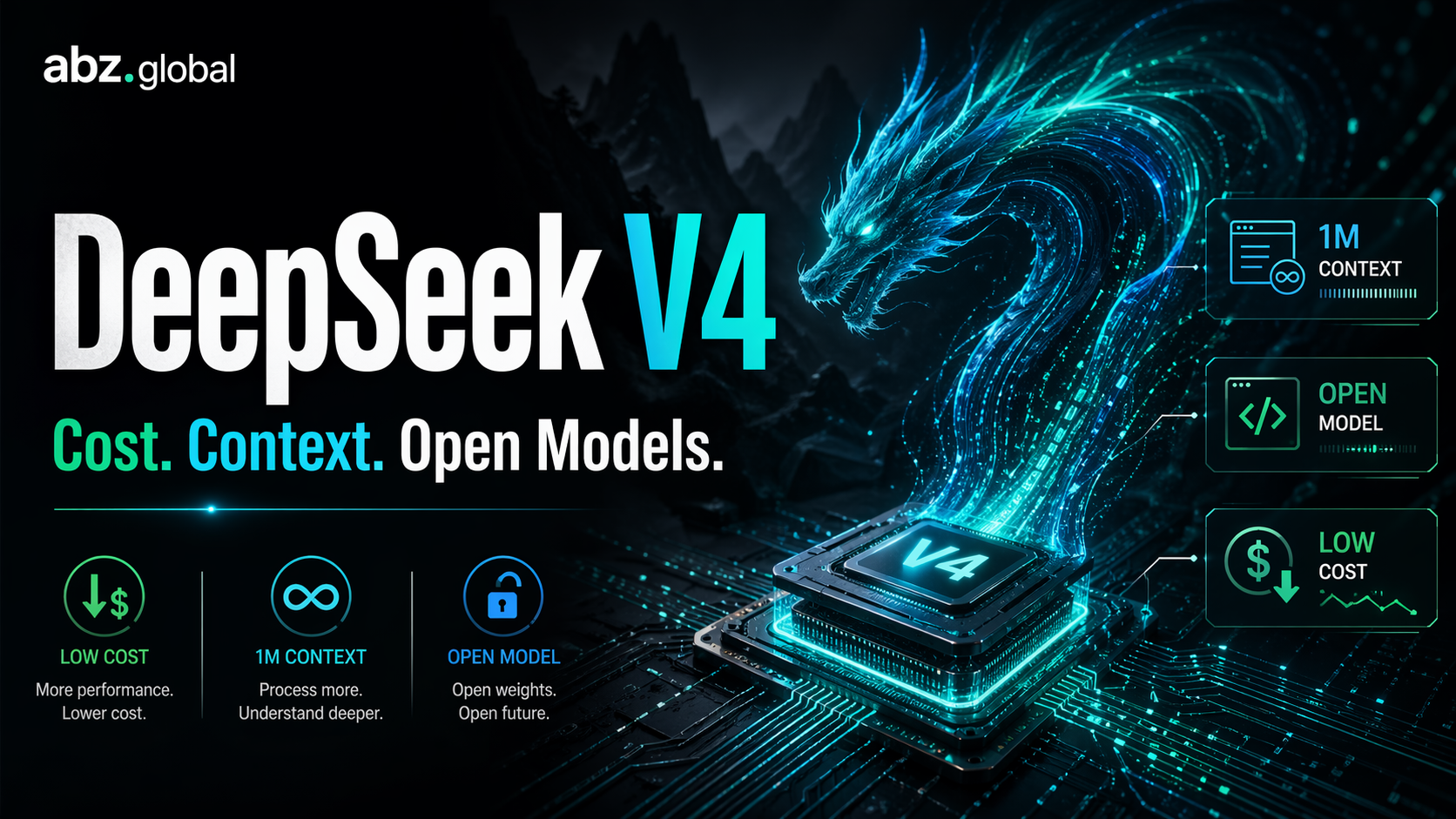
DeepSeek just released DeepSeek V4 Preview, and the announcement feels important for a reason that goes beyond another model name entering the market.
According to DeepSeek, V4 is now live, open-sourced, available through the web app, mobile app, and API, and built around a 1M token context window. The launch includes two main models: DeepSeek-V4-Pro with 1.6T total parameters and 49B active parameters, and DeepSeek-V4-Flash with 284B total parameters and 13B active parameters. DeepSeek is positioning Pro as the stronger model and Flash as the faster, cheaper, more efficient option.
That alone would be interesting.
But the bigger story is the direction of the market.
For the last few years, the AI race has mostly been framed around who has the smartest model. OpenAI, Anthropic, Google, xAI, Meta, Mistral, DeepSeek, Qwen, Kimi, and others are all competing on reasoning, coding, agentic workflows, long context, tool use, and multimodal capabilities.
But DeepSeek V4 is a reminder that intelligence is only one part of the product.
Cost matters. Availability matters. Context length matters. Open weights matter. API compatibility matters. And for developers building real products, those things can matter just as much as whether one model beats another model by a few percentage points on a benchmark.
The 484 day gap matters
One of the posts around the launch highlighted the timeline: DeepSeek-V3 was released on December 26, 2024, and DeepSeek-V4 arrived on April 24, 2026. That is 484 days between major releases.
That is a long time in AI.
During that period, the market changed completely. Frontier models became stronger, coding agents became mainstream, context windows got larger, developers started using AI inside IDEs every day, and the idea of AI-assisted software development became normal.
So DeepSeek V4 does not arrive in the same world DeepSeek V3 entered.
It arrives in a market where users are no longer impressed only by chat quality. They want models that can work inside real systems. They want models that can read larger codebases. They want models that can run through tools. They want lower costs. They want API compatibility. They want options.
That is why this launch is interesting.
DeepSeek is pushing hard on long context
DeepSeek says both V4-Pro and V4-Flash support a 1M token context length. In practical terms, that means the model can accept very large inputs compared with traditional chatbot context windows. For developers, that matters because long context can reduce the need to constantly summarize, chunk, or manually feed parts of a project into the model.
Long context is especially relevant for software work.
A coding assistant is much more useful when it can see more of the project. Not just one file. Not just the function you pasted. Not just a small error message. The more context it can hold, the closer it gets to understanding the real shape of the application.
That does not mean 1M context automatically solves everything.
Large context windows can still be expensive, slow, and imperfect. Models can still miss details. They can still misunderstand architecture. They can still produce confident mistakes. But the direction is clear: AI tools are moving from short prompt helpers toward systems that can understand larger work environments.
For agencies and SaaS builders, that is where the value starts becoming serious.
The pricing is the real pressure point
DeepSeek’s API pricing page lists V4-Flash at $0.14 per 1M input tokens for cache miss and $0.28 per 1M output tokens. V4-Pro is listed at $1.74 per 1M input tokens for cache miss and $3.48 per 1M output tokens. Cache-hit input pricing is even lower.
This is where the market pressure comes from.
If models get close enough in capability while being much cheaper to run, a lot of product decisions change.
A SaaS company may not need the absolute best model for every task. A support chatbot may need reliability and low cost. An internal summarization tool may need cheap long context. A productivity app may need AI features that can run often without destroying margins. A coding tool may route simple tasks to a cheaper model and reserve expensive models for harder reasoning.
This is probably where the AI market is going.
Not one model for everything.
Instead, products will use many models depending on the task: fast models for routine work, stronger models for complex reasoning, open models for self-hosting, closed models for premium performance, and specialized models for specific workflows.
Open weights are still a big deal
DeepSeek V4 is also available as an open-weight release on Hugging Face. The DeepSeek V4 collection currently includes Flash, Flash Base, Pro, and Pro Base variants, with the Pro model listed under an MIT license.
For developers, this matters because open weights create leverage.
Not everyone will run a 1.6T parameter model locally. In fact, most people will not. The hardware requirements are too serious for typical individuals and small teams.
But open weights still change the ecosystem.
They allow researchers to inspect, benchmark, fine-tune, optimize, quantize, integrate, and build around the model in ways that are impossible with closed APIs. They also create pressure on closed labs. If open models keep getting close enough, then closed models have to justify their pricing through better performance, better tools, better reliability, better enterprise controls, or better product experience.
That is healthy pressure.
It does not mean open models automatically win.
It means the gap between open and closed AI keeps getting more interesting.
DeepSeek is also targeting agents
DeepSeek says V4-Pro has stronger agentic capabilities, strong coding benchmark performance, and integrations with coding agent workflows. The API docs also show support for both OpenAI-compatible and Anthropic-compatible formats, with model names deepseek-v4-pro and deepseek-v4-flash.
That is smart positioning.
The next serious wave of AI software is not just chat. It is agents working inside workflows.
For developers, that means AI tools that can inspect files, modify code, run commands, reason through errors, create pull requests, and interact with external tools. For businesses, it means AI systems that can help with support, operations, research, reporting, QA, content, data analysis, and internal automation.
But agents are expensive if every step uses a premium frontier model.
That is why cheaper capable models matter.
If an agent needs to make 50 tool calls, read thousands of lines of code, produce multiple drafts, check its own work, and run several passes, the price per token becomes a real product constraint.
This is where models like DeepSeek V4-Flash may become important. Not because they are always the smartest model, but because they might be good enough for many steps inside a larger workflow.
The Huawei angle is also important
Reuters reported that DeepSeek V4 is adapted for Huawei chip technology, which is significant because most leading AI models have depended heavily on Nvidia hardware. The report frames the launch as part of China’s push toward more AI self-sufficiency under U.S. export controls.
This is not just a technical story.
It is also a geopolitical and supply chain story.
AI is now infrastructure. Chips, data centers, model architectures, open-source ecosystems, cloud providers, and developer tooling are all becoming strategic assets. DeepSeek’s progress matters partly because it shows that AI capability is not only concentrated in one country, one company, or one hardware stack.
That does not mean every claim should be accepted at face value.
Benchmarks need independent testing. Real production performance matters more than launch slides. Privacy, compliance, data governance, and reliability still matter. For Western companies and agencies working with client data, those questions are not optional.
But strategically, the direction is clear: powerful AI is becoming more distributed.
What this means for developers and agencies
For a web development agency, SaaS founder, or software team, the lesson is simple: do not build your AI strategy around one provider only.
The model market is moving too fast.
A year ago, a specific model might have looked unbeatable. A few months later, another model becomes better at coding. Then another one becomes cheaper. Then another one gets a larger context window. Then an open model becomes good enough for internal workflows.
The winning approach is flexibility.
Use abstractions. Keep your AI layer modular. Store prompts and model configuration in a way that can change. Test multiple providers. Measure output quality on your own use cases. Track cost per successful task, not just cost per token.
That last part matters.
The cheapest model is not always the cheapest system. If a cheap model fails three times and an expensive model succeeds once, the expensive model may be cheaper in practice. But if a cheaper model succeeds reliably on 80 percent of routine tasks, it can dramatically reduce product costs.
This is the kind of thinking developers now need.
Not “which model is best?”
But “which model is best for this exact task, at this exact cost, with this exact reliability requirement?”
The AI race is becoming more practical
DeepSeek V4 is not just another launch.
It is part of a broader shift from AI as a demo to AI as infrastructure.
The important questions are changing.
Can the model help build software? Can it work with long context? Can it run inside agent workflows? Can the API be swapped in without rewriting everything? Can the pricing support real usage at scale? Can teams trust it with sensitive data? Can open models keep pressure on closed labs?
That is where the industry is going.
The most exciting part is not that one company released one model.
The most exciting part is that the baseline keeps rising.
What was expensive and rare two years ago is becoming cheaper and more available. What required a frontier closed model last year may soon be possible with a cheaper open model. What used to be a chatbot feature is becoming a software architecture decision.
For builders, this is good news.
It means more choice. More competition. More leverage. Lower costs. Better tools.
And it means the companies that win will not simply be the ones that use AI.
They will be the ones that understand how to use the right AI model, in the right workflow, at the right cost.