
The Web Was Too Big for One Company to Control. AI Search Finally Broke the Monopoly.
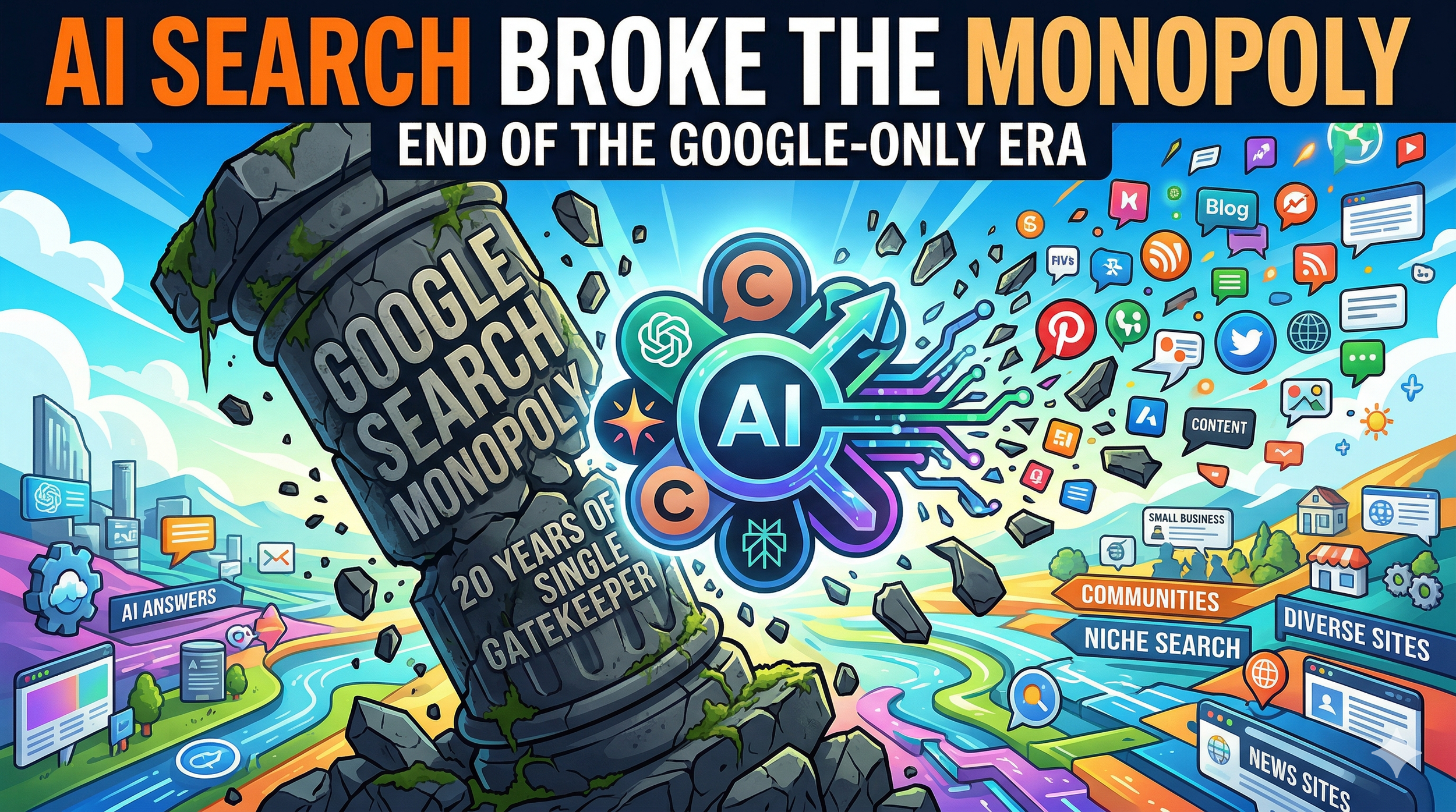
For about twenty years, the open web had a single gatekeeper.
If you ran a business, a blog, a SaaS, or a side project, your survival depended on one question: where did you rank on Google?
If the answer was "page two," you might as well not have existed. If the answer was "page one but below the fold," you were fighting for scraps. And if Google decided to update its algorithm on a Tuesday morning, your traffic could be cut in half by lunchtime, with no warning, no appeal, and no human to talk to.
That arrangement was always strange when you stopped to think about it.
The web is the largest information system humanity has ever built. The idea that a single company should decide which slice of it ten billion people see every day was never going to age well. It just took a long time for an alternative to show up.
It's here now. And it's worth saying out loud how much healthier the situation already feels.
What the Old Game Actually Looked Like
If you have never run a website that depended on search traffic, it is hard to convey how punishing the Google-only era really was.
You wrote content not for humans but for a ranking system whose rules were never published.
You hired SEO consultants who half-guessed and half-reverse-engineered what Google wanted that quarter.
You watched competitors with worse products outrank you because they had older domains, more backlinks, or a better-funded link-building agency.
You refreshed Search Console every morning hoping a core update had not wiped out a year of work.
And the worst part was the silence.
There was no appeal. There was no human at Google you could ask. There was a help forum full of other desperate site owners and the occasional cryptic blog post from the search team that explained nothing. If you got hit, you got hit, and the only path forward was to keep guessing.
This was not a free market. It was a single-choke-point market dressed up as one.
What Changed
The shift started quietly and then accelerated faster than most people expected.
ChatGPT made it normal to ask a question and get an answer instead of a list of links. Claude built a serious user base for long-form research and analysis. Perplexity made AI-native search a real product category. Microsoft pushed Copilot into Bing and into Windows itself. Grok carved out its own audience inside X.
Google itself responded with AI Overviews, which is its own admission that the ten-blue-links era is over.
The result is that for the first time in two decades, the question "how do people find things on the internet" has more than one serious answer.
A user researching a product today might ask Claude for a comparison, follow up with ChatGPT for a second opinion, check Perplexity for sources, glance at Google for a sanity check, and never click into the traditional search results at all.
Different tools surface different sites. Different models cite different sources. The traffic that used to flow through a single funnel is now spreading across half a dozen of them.
For users, this is a better experience. For site owners, it is something even more important: it is optionality.
Why This Matters for Builders and Site Owners
The most underrated consequence of AI search is that it has broken the single-point-of-failure problem.
Under the old regime, one algorithm change could end a business.
Under the new one, an unfavorable shift inside one model is annoying but not fatal, because there are five other discovery surfaces still sending people your way.
That is a structurally healthier setup. It is closer to how distribution worked before search engines existed at all, when traffic came from a mix of links, directories, word of mouth, communities, and curiosity.
There is also a quieter shift in what gets rewarded.
Google's ranking system, by its nature, rewarded signals that could be gamed: backlinks, anchor text, keyword density, domain age, technical SEO trickery.
AI models are not immune to gaming, but the things they tend to surface are different. They surface clear writing. They surface sources that explain something well enough to be quotable. They surface specific, factual, well-structured content over keyword-stuffed filler.
A site that is genuinely useful has a better shot at being cited by an AI than it ever had at ranking for a competitive Google query against an SEO agency.
That is not a small shift. For the first time in a long time, writing the best version of a thing is a viable distribution strategy on its own.
The Honest Caveats
It would be dishonest to pretend this transition is pain-free or that the new world is a utopia.
AI tools sometimes summarize content without sending traffic back to the source, which is its own kind of gatekeeping problem. Citations are inconsistent. Some models are better than others at attribution.
Publishers are right to worry about a future where their work feeds an answer engine that never sends them a visitor. These are real issues, and they are not solved.
There is also a reasonable concern that the AI search market could re-concentrate.
If two or three models end up with overwhelming usage share, we could end up back where we started, just with different gatekeepers. That is possible.
But it is also possible that the market stays distributed, because the cost of running a competitive model keeps falling and because users seem genuinely willing to switch between tools depending on the task.
Either way, the situation today is better than the situation five years ago. That much is clear.
What to Actually Do About It
If you run a site, a product, or a content operation, the practical takeaways are straightforward.
Stop optimizing only for Google.
The old SEO playbook still has some value, but it is no longer the whole game. Write content that an AI model would find genuinely useful to cite, which usually means being specific, being correct, and being clear. Make your factual claims easy to extract. Structure your pages so a model parsing them can tell what the answer is.
Diversify the surfaces you show up on.
Get cited in places AI models read. Build a presence in communities, on forums, on platforms where real conversations happen. The signals AI tools weight are not the same as the signals Google weights, and many of them come from outside the traditional SEO universe.
And stop treating any single algorithm as your landlord.
The whole point of the new landscape is that you do not have one anymore.
Takeaways
For two decades, Google's ranking decisions effectively rationed traffic on the open web, and there was no appeal.
AI search tools from Claude, ChatGPT, Perplexity, Copilot, Grok, and others have broken that single-funnel model.
The shift rewards clear, specific, useful content more than it rewards traditional SEO trickery.
There are real concerns about attribution and about future re-concentration, but the situation today is structurally healthier than the Google-only era.
The right strategy is to diversify discovery surfaces and stop treating any one algorithm as your landlord.