
Yann LeCun’s Startup Just Raised Over $1 Billion - Why That Matters
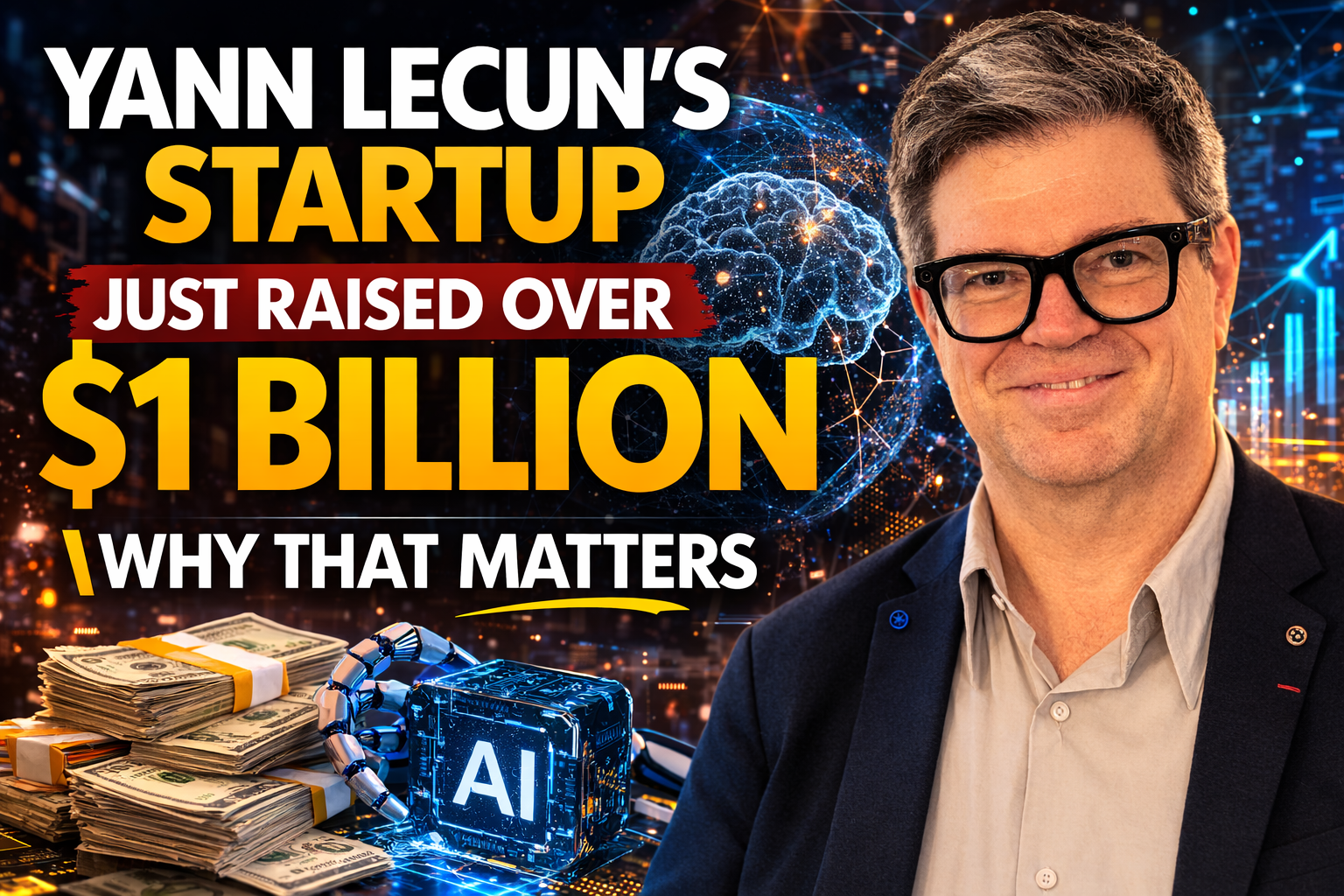
Yann LeCun’s new startup has just made one of the strongest statements in AI this year: it raised more than $1 billion.
That matters immediately because this is not a normal early-stage startup funding round. When a company raises that much money so early, investors are not treating it like a side experiment. They are treating it like a serious attempt to shape the future direction of the AI industry.
But the funding itself is only part of the story.
What makes this much more interesting is why investors are willing to back it at this scale. This is not just money going into another chatbot company or another standard large language model play. It is a bet on the idea that the current AI path may not be enough, and that a different approach may be needed to build something much more capable.
That is why this raise matters so much.
First, why this startup gets more attention than usual
If this were an unknown founder raising money around a vague AI idea, the story would be very different.
But this is Yann LeCun.
He is one of the most influential people in modern AI. He is widely known as one of the pioneers of deep learning and one of the most respected researchers in the field. He also spent years as Meta’s chief AI scientist and has long been one of the most visible voices arguing that today’s AI systems still have major limitations.
So when someone like LeCun starts a new company and raises over a billion dollars, the market pays attention for a reason.
This is not only about funding a founder.
It is about funding an alternative technical vision from someone with enough credibility to make investors believe the current mainstream approach may not be the final answer.
This is not just another LLM story
That is the most important part of this whole topic.
The dominant AI story of the last few years has been centered on large language models. Bigger models, more data, more compute, better fine-tuning, stronger reasoning layers, multimodal inputs, and more powerful chat interfaces have defined most of the market conversation.
That path has produced very impressive results.
But LeCun has long argued that this path may not be enough to reach deeper forms of machine intelligence. His new startup is being funded around the idea that AI systems need to do more than predict the next word, the next token, or even the next image. They need to build a better understanding of how the world works.
That is where the idea of world models becomes central.
What “world models” really means in simple terms
The phrase can sound abstract, but the core idea is actually fairly understandable.
A world model is about building AI systems that do not just imitate patterns in language, but develop richer internal representations of reality. That includes things like:
understanding cause and effect
predicting what happens next in a real environment
planning actions over time
modeling physical and logical relationships
reasoning beyond surface-level pattern matching
In simpler terms, the goal is to move from “AI that sounds smart” to “AI that understands the structure of situations more deeply.”
That is a very different ambition from simply making a chatbot more fluent or making a language model better at completing prompts.
It is also why this funding round feels bigger than a normal startup raise.
Investors are not just betting on another model. They are betting on a different theory of intelligence.
Why some people think this matters so much
One of the biggest criticisms of today’s AI systems is that they are often very good at producing convincing output, but still weak in deeper understanding.
They can be impressive, fast, helpful, and highly useful. But they can also be brittle, inconsistent, and limited when it comes to real-world planning, long-horizon reasoning, or deeper causal understanding.
That is exactly the gap LeCun’s broader philosophy has been focused on for years.
So when his startup raises this kind of money, the message is clear:
there are major investors who believe the next leap in AI may not come only from scaling current LLM systems further. It may come from building architectures that understand the world more structurally.
That is a very big statement.
Because if that belief is right, then the next important wave in AI may look very different from the current one.
Why the funding size matters so much
A billion-dollar raise does more than generate headlines.
It changes the seriousness of the company overnight.
At that scale, the startup is no longer operating like a small research experiment that may or may not become relevant. It suddenly has the ability to recruit elite talent, build major research teams, invest in long-term technical work, access significant compute, and position itself as one of the most closely watched alternative AI efforts in the market.
That matters because ambitious technical bets need time, money, and patience.
A startup trying to challenge the basic assumptions of the current AI industry cannot survive on small rounds and short-term pressure alone. It needs enough capital to explore difficult ideas without immediately collapsing under commercial expectations.
That is one reason this raise is so meaningful.
It gives LeCun’s startup the room to pursue a harder path.
Why investors would back a harder path
At first, this might seem surprising.
Why would investors put over a billion dollars behind an approach that sounds less mainstream and possibly more difficult than simply building on today’s language model momentum?
The answer is probably a mix of belief, opportunity, and dissatisfaction.
First, investors clearly believe LeCun has the reputation and technical depth to make a non-trivial alternative worth taking seriously.
Second, the opportunity is huge. If current LLM-centered AI eventually hits structural limits, then the company that offers a better architecture could become incredibly valuable.
Third, there is growing awareness that current AI systems, for all their strengths, still have very visible weaknesses. They can impress in language while struggling in deeper reasoning, real-world grounding, long-term planning, or robust physical understanding.
That creates space for a different story.
LeCun’s startup appears to be funded as a bet on that space.
This is also a challenge to the current AI consensus
That is why this story matters beyond the startup itself.
It is really about a larger debate inside AI.
The dominant consensus of the last few years has been that scaling large models plus enough compute plus better training methods can keep pushing the field forward. And to be fair, that approach has worked extremely well so far.
But LeCun’s direction suggests something more skeptical.
It suggests that scaling language prediction may not be enough on its own. It suggests that more powerful AI may require a deeper shift in architecture and learning methods.
That is a direct challenge to today’s mainstream momentum.
And when over a billion dollars flows into that challenge, the industry has to take it seriously.
Even if LeCun’s startup does not win, the existence of a heavily funded alternative changes the conversation.
It reminds people that the future of AI is still not settled.
Why this could matter outside research labs
One easy mistake is to think this is only an academic or theoretical story.
It is not.
If AI systems become better at understanding the world, modeling complex environments, and reasoning about real situations, the commercial applications could be enormous.
That could affect:
robotics
autonomous systems
industrial automation
aerospace
medical systems
scientific research
smart devices
wearables
logistics
consumer assistants that interact with the real world
This is why the idea is commercially interesting.
The value is not only in beating current chat models on a benchmark. The value is in building systems that can operate more effectively in messy, real-world settings where language alone is not the whole game.
That makes the upside much broader than “another assistant app.”
The Meta angle makes this even more interesting
There is also a strong symbolic layer here.
LeCun spent years inside Meta, helping shape one of the biggest AI organizations in the world. But now he is outside that company, building a new startup around a technical direction that feels more distinct and independent.
That makes this feel like more than just a founder launch.
It feels like a fork in the road.
One path continues leaning heavily into the current large-model ecosystem. The other path asks whether the field needs something more grounded, more structural, and closer to genuine world understanding.
That is a very big split in vision.
And because LeCun is such a respected figure, his startup instantly becomes one of the most important symbols of that alternative path.
Why this does not guarantee success
Of course, raising over a billion dollars does not prove the thesis is right.
That is important to say clearly.
There is a big difference between “this idea deserves serious funding” and “this idea will definitely win.” AI history is full of technically impressive ideas that turned out to be harder to commercialize than expected. A startup can have a world-class founder, a huge round, and a compelling theory, and still struggle to turn that into a breakthrough product.
That risk is real here too.
In fact, the more ambitious the technical thesis, the more uncertainty usually comes with it. If the company is trying to go beyond the current dominant approach, then it is probably taking a harder road by definition.
But that is also what makes it interesting.
This is not a safe incremental bet. It is a large bet on a different future.
Why this story matters right now
Timing matters here.
The AI market is at a point where many people are starting to ask harder questions about what current systems can and cannot really do. There is excitement, but there is also growing awareness that intelligence is not the same as fluency.
That creates a moment where LeCun’s argument can land more strongly than before.
A few years ago, a startup built around “something beyond today’s LLM logic” might have sounded too early or too abstract. Today, it sounds like a serious strategic question.
If current systems keep improving, this startup may still matter as a parallel frontier.
If current systems begin to show deeper limits, then this startup could matter even more.
That is why the funding round feels important now, not just in theory.
The simplest way to understand the whole story
If you strip away all the AI terminology, the story becomes easier to understand.
A very influential AI pioneer has raised over a billion dollars because investors believe he may be right that today’s mainstream AI path is powerful but incomplete.
They are betting that the next major leap may require systems that understand the world more deeply, not just systems that generate better language.
That is the essence of this story.
It is not just about startup funding.
It is about whether the AI industry may eventually need a different foundation than the one dominating headlines today.
Final verdict
Yann LeCun’s startup raising over $1 billion matters because it is one of the clearest signals yet that investors are willing to fund a major alternative to the current LLM-heavy AI direction.
This is not just a vote of confidence in one founder. It is a vote of confidence in a bigger idea: that the next real leap in AI may require systems that reason, plan, and model the world more deeply than today’s mainstream systems do.
That does not mean the startup will automatically win.
But it does mean the industry has to take the question seriously.
The clearest takeaway is this:
This is not just a big funding round. It is a billion-dollar bet that the future of AI may require something deeper than today’s dominant language-model approach.
That is why this story matters.