
Why the Strait of Hormuz Is Still Not Truly Open Even If the U.S. Dominates Air and Sea Power
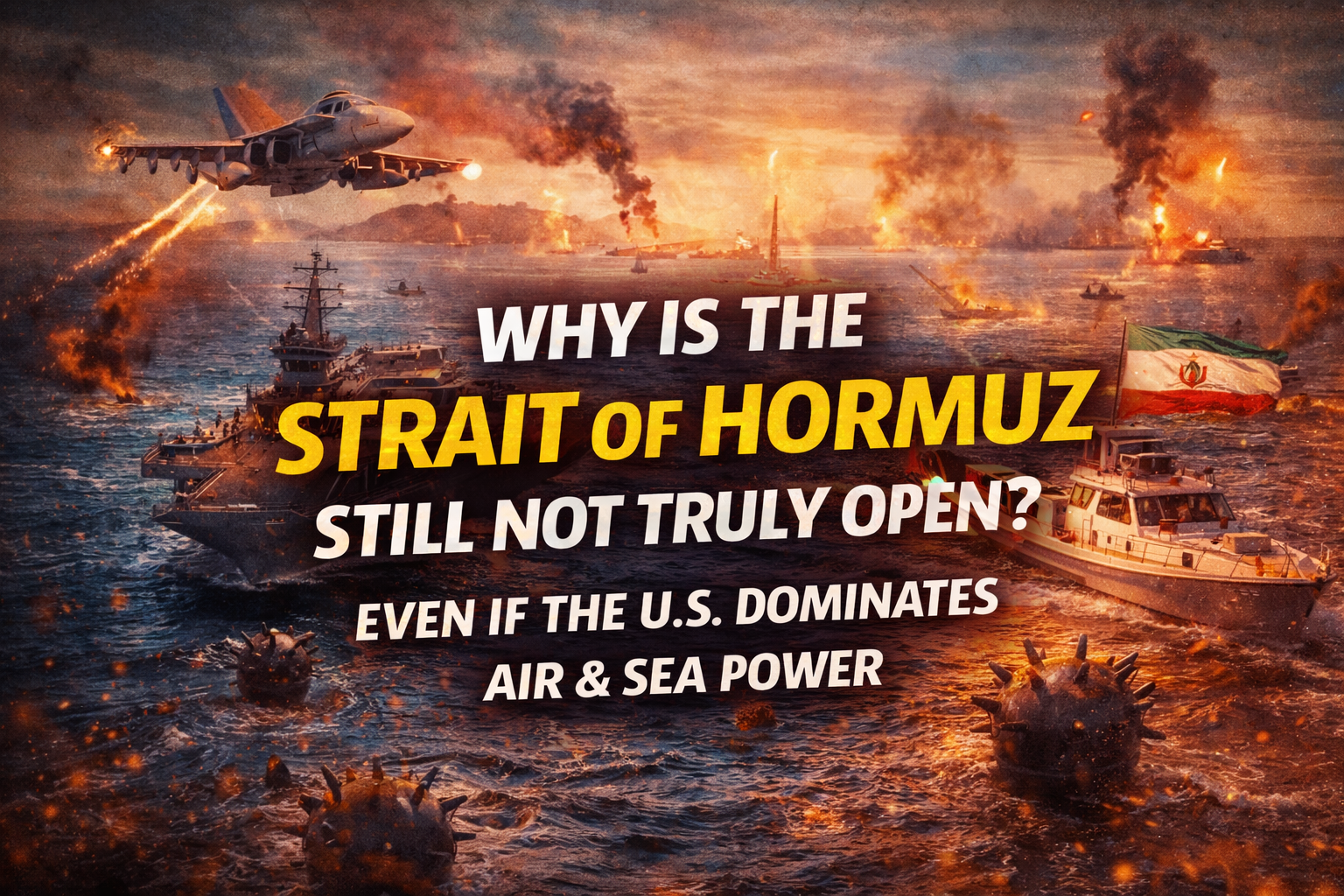
A lot of people look at the map, look at American military strength, and ask a simple question:
If the United States dominates the air and dominates the sea, why is the Strait of Hormuz still not fully open?
The answer is that military dominance does not automatically produce commercial normality.
That is the key point.
At the time of writing, the Strait is not functioning like a normal open shipping corridor. Reuters has reported a near closure, partial exemptions for some non-hostile vessels, and continued diplomatic and military standoffs over reopening it.
So this is not really a story about whether the U.S. military is powerful enough.
It is a story about what kind of problem the Strait of Hormuz actually is.
1. Because controlling the sky is not the same as making shipping safe
The first mistake people make is assuming that air superiority solves everything.
It does not.
A shipping lane is not “open” in the real business sense unless commercial tankers, insurers, crews, port operators, and charterers believe transit is safe enough to resume at scale. Reuters reported that war-risk insurance premiums have surged by as much as 1,000%, and India is now considering sovereign guarantees to keep insurers functioning amid the disruption.
That tells you everything.
Even if the U.S. can destroy targets from the air, that does not instantly convince shipowners to send billion-dollar cargoes through a corridor where one mine, one missile, one drone strike, or one boarding incident can create a catastrophe.
Military superiority and commercial confidence are not the same thing.
2. Because Iran does not need to defeat the U.S. Navy to disrupt the strait
This is the deeper strategic point.
Iran does not need to win a full naval war to create a shipping crisis.
It only needs to make passage dangerous, uncertain, expensive, and politically complicated. Reuters has reported that U.S. intelligence believes Iran still sees its ability to manipulate the strait as a major source of leverage and is unlikely to give it up soon. That same reporting mentions attacks on vessels, the use of sea mines, and demands tied to passage.
That is how asymmetric power works.
The weaker side does not have to control everything.
It only has to make normal operations unreliable.
3. Because the Strait of Hormuz is a chokepoint, not an open ocean
Geography matters a lot here.
According to the U.S. Energy Information Administration, the Strait is only 21 miles wide at its narrowest point, and the shipping lane in each direction is just two miles wide, separated by a two-mile buffer.
That is a huge advantage for disruption.
In a narrow chokepoint, threats from shore, fast boats, drones, mines, and anti-ship systems become much harder to neutralize perfectly. You do not need total sea control to create risk inside a corridor that tight. CSIS noted in March 2026 that Iran could still threaten commercial shipping in the Strait of Hormuz even if it would struggle to counter U.S. convoys over time.
So the geography itself favors harassment.
4. Because reopening it fully could require a larger war, not a cleaner shipping lane
This is where the military question becomes political.
Yes, the U.S. can hit targets.
But a truly forced reopening could require sustained strikes on coastal launch systems, surveillance assets, naval units, logistics nodes, and mine-laying capabilities, plus convoy protection and probably broader escalation. Reuters reported that a U.N. effort to protect commercial shipping had to be watered down after opposition from China and others to language authorizing force.
That matters because reopening the strait is not just a tactical problem.
It is also a decision about how much larger the war should become.
A superpower may be able to do something militarily and still decide that the full cost, escalation path, legal complexity, and diplomatic fallout are not worth doing at maximum intensity.
5. Because partial passage is not the same as normal trade flow
Another reason people get confused is that the Strait is not always either fully closed or fully open.
Right now it appears to be selectively passable in some cases. Reuters has reported passage for some Omani, French, Japanese, Indian, Malaysian-linked, Iraqi-linked, and Russian-linked vessels, often under conditions shaped by Iran’s political preferences or bilateral understandings.
That means the real situation is closer to this:
The strait is not functioning as a neutral, reliable, high-volume global artery.
It is functioning as a politically filtered corridor under coercive conditions.
That is very different from “open.”
6. Because insurance, law, and commercial behavior move slower than missiles
Even if military escort operations expand, the private market still has to follow.
Tankers do not move just because a navy says the route is technically possible.
They move when insurers price the risk, crews accept the voyage, owners accept the liability, refiners trust deliveries, and counterparties believe cargo will arrive without being trapped, damaged, or politically entangled. Reuters has reported continuing insurance stress, supply disruption, and major concern from countries heavily dependent on Gulf energy flows.
That is why “open by force” can still look half-closed in economic reality.
7. Because Iran is using the strait as leverage, not just as a battlefield
This may be the most important reason of all.
Iran appears to be treating Hormuz as leverage over energy markets, diplomacy, and war termination. Reuters has reported that Iran has rejected simple ceasefire framing, demanded broader terms, and resisted reopening the strait without concessions, while the U.S. has issued ultimatums tied to reopening.
So the Strait is not only a military zone.
It is a bargaining chip.
And bargaining chips are not neutralized just because the other side has better aircraft carriers and jets.
8. Because dominance is not the same as omnipotence
This is the cleanest summary.
The U.S. may dominate air and sea power in the region.
But dominance does not mean instant control over every outcome that matters.
It does not mean zero missiles.
It does not mean zero mines.
It does not mean zero insurance panic.
It does not mean zero political escalation.
It does not mean zero economic damage.
In a narrow chokepoint used for roughly a fifth of global oil and gas transit, even limited disruption has outsized consequences. Reuters and the IMF’s Kristalina Georgieva have both highlighted the global economic impact of the Hormuz disruption, including higher inflation risk and slower growth.
That is the real answer.
My take
If I had to put it in one blunt sentence, it would be this:
The Strait of Hormuz is still not truly open because the U.S. can dominate the battlespace without yet fully restoring commercial trust, political settlement, and risk-free passage.
That is a very different challenge from simply winning in the air or at sea.
This is what modern power politics looks like in a chokepoint.
One side does not need to defeat the stronger military.
It only needs to keep the corridor dangerous enough that normal business cannot fully return.
Final thought
So why is the Strait of Hormuz still not fully open if the U.S. dominates air and water?
Because the real obstacle is not just enemy ships.
It is a mix of chokepoint geography, asymmetric disruption, escalation risk, market fear, insurance costs, diplomacy, and Iran’s willingness to use energy flows as leverage.
That is why this story is bigger than naval power.
It is about the difference between military superiority and actually restoring normal global commerce.