
Where We Are in the AI Foundational Models Race at the End of Q1 2026
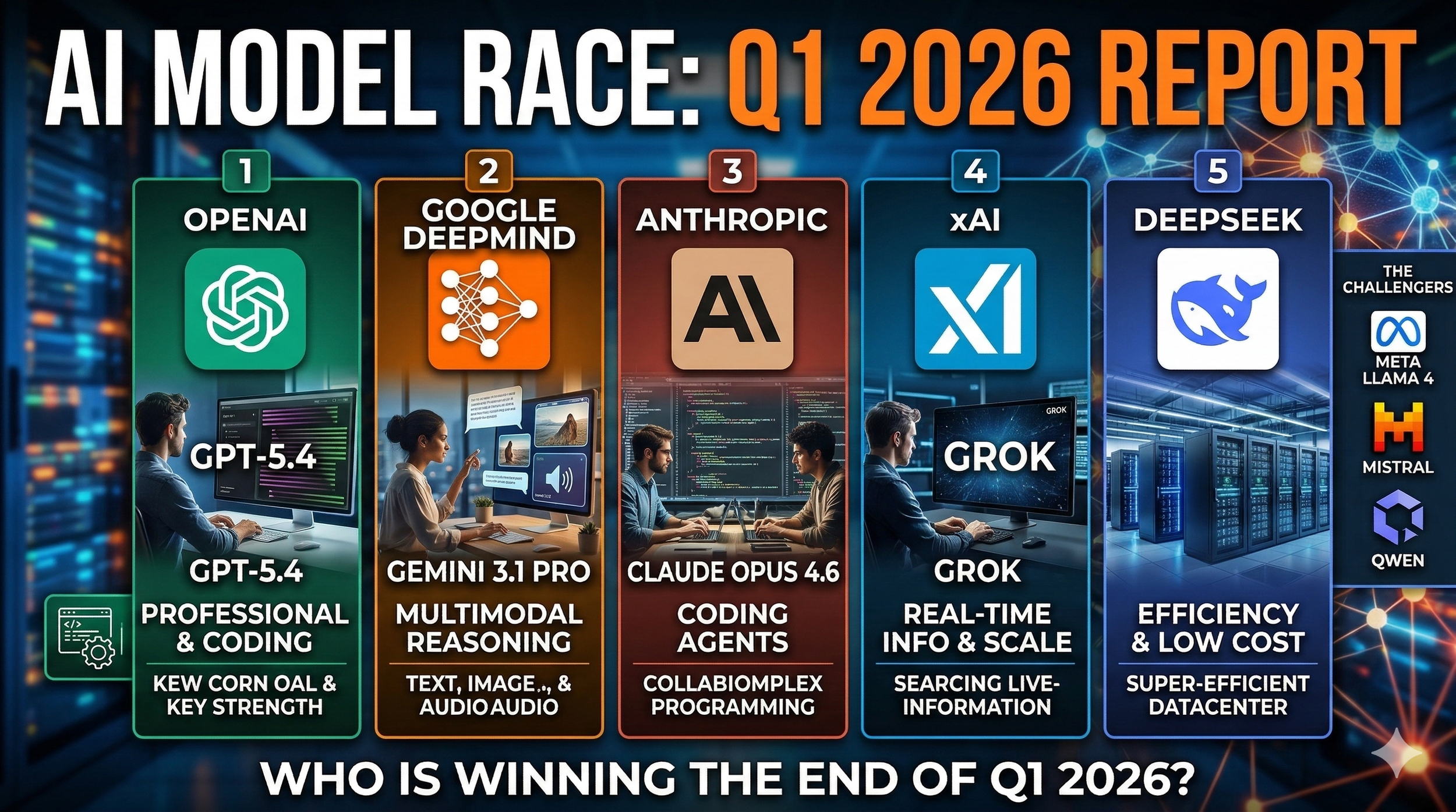
By the end of Q1 2026, the AI foundation model race looks less like a simple leaderboard and more like a multi-front competition. The frontier is no longer just about who has the smartest chatbot in a vacuum. It is now about reasoning, coding, agentic tool use, multimodality, context length, distribution, and the ability to fund the massive infrastructure required to keep improving. Reuters noted in January that the race is increasingly about land, electricity, labor, and financing for long-term infrastructure, while major U.S. tech companies are collectively projected to spend more than $630 billion this year largely on AI-related capex.
That matters because “best model” and “best-positioned company” are no longer exactly the same thing. One company may lead on coding, another on long-context reasoning, another on distribution, another on open-weight influence, and another on cost efficiency. So the smartest way to read the race at the end of Q1 2026 is this: there are a few clear leaders, but they are leading in different ways.
The big picture at the end of Q1 2026
The first thing to say clearly is that the race has tightened, not simplified. OpenAI is still one of the central leaders. Google DeepMind has clearly strengthened its position. Anthropic remains extremely strong at the frontier, especially in coding and long-horizon agentic work. xAI is still in the top group because of product momentum, real-time search integration, and capital intensity. Meanwhile, the Chinese side of the race is no longer something people can dismiss casually: DeepSeek and Alibaba’s Qwen have made the competition much more serious, especially on cost and increasingly on agentic capabilities.
Another major shift is that the frontier is no longer defined only by one closed benchmark. Companies are now positioning around different strengths: OpenAI around professional work and tool use, Anthropic around coding and agents, Google around reasoning plus multimodal breadth, xAI around real-time information and distribution through Grok/X, and Chinese labs around aggressive efficiency and fast iteration. That makes the race more interesting, but also harder to summarize with one winner-take-all sentence.
My view of the top 5 winners at the end of Q1 2026
This ranking is not “who has the single best answer on every benchmark.” It is a practical ranking based on frontier capability + product momentum + ecosystem position + strategic importance right now.
1) OpenAI
If you force a single #1 at the end of Q1 2026, OpenAI still has the strongest overall claim. The clearest reason is the March 5, 2026 launch of GPT-5.4, which OpenAI describes as its “most capable and efficient frontier model for professional work,” rolling out across ChatGPT, the API, and Codex. OpenAI also frames GPT-5.4 as its first mainline reasoning model to incorporate the frontier coding capabilities of GPT-5.3-Codex, which matters because it suggests the company has merged stronger reasoning with stronger practical software performance into its flagship line.
OpenAI’s position is also stronger than a benchmark table alone would suggest because of distribution. GPT-5.4 is not sitting in a lab. It is already deployed across ChatGPT, the API, and Codex, and OpenAI has also been expanding business-facing integrations like ChatGPT for Excel. That combination of top-end capability, product reach, developer access, and enterprise workflow integration is why OpenAI still deserves the top slot in a practical ranking.
That does not mean OpenAI has a monopoly on the frontier. It means that at the end of Q1 2026, it still looks like the company with the best blend of model quality, tooling, distribution, and commercial momentum.
2) Google DeepMind
Google DeepMind has probably done more than anyone else to close the perceived gap with OpenAI over the last year. By March 2026, the company is presenting Gemini 3.1 Pro as its most intelligent model and has rolled it across consumer and developer products. Its February 2026 model card shows strong results against other top models on hard evaluations, including Humanity’s Last Exam and ARC-AGI-2, with Gemini 3.1 Pro significantly outperforming Gemini 3 Pro.
Google’s strength is not just raw capability. It is the breadth of its platform. Gemini is connected to Search, the Gemini app, AI Studio, Vertex AI, and broader Google product surfaces. That kind of distribution matters because a model race is increasingly also a deployment race. A powerful model that is immediately wired into massive user and developer channels has an advantage that goes beyond benchmark scores.
At the end of Q1 2026, Google looks like the strongest alternative to OpenAI for the top overall spot. In some areas it may already be leading, especially where multimodality, ecosystem reach, and integrated deployment matter most.
3) Anthropic
Anthropic remains one of the clearest frontier winners, especially if your lens is coding, agentic work, and long-context reasoning. In February 2026, Anthropic launched Claude Opus 4.6, describing it as an upgrade in coding skill, careful planning, long-running agentic tasks, code review, and debugging, with a 1 million token context window in beta. Later that month it also launched Claude Sonnet 4.6, which Anthropic described as a full upgrade across coding, computer use, long reasoning, agent planning, knowledge work, and design.
That matters because Anthropic has become the company many serious users associate with dependable high-end work, especially for programming and structured reasoning. Even when another company edges ahead on a particular benchmark, Anthropic still has one of the strongest reputations in the market for real-world technical usefulness. Its public materials continue to emphasize sustained agentic tasks and reliability in larger codebases, which is exactly the kind of capability that matters as the market shifts from “chatbot wow factor” to “can this thing actually help me do difficult work?”
So while I would place Anthropic third overall in this quarter-end snapshot, the gap between Anthropic and the top two is not dramatic. In some workflows, especially coding-heavy ones, many users would reasonably place it even higher.
4) xAI
xAI is more polarizing than the first three, but it still belongs in the top five. The reason is not that it has released the clearest new frontier leap in Q1 2026. The reason is that it has built a serious model ecosystem around Grok, real-time search, X integration, enterprise positioning, and huge funding. xAI’s API positions Grok as a frontier model family with reasoning, voice, image generation, and real-time web/X search, while xAI announced a $20 billion Series E in January 2026 and then a merger with SpaceX in February 2026.
That combination of product distribution, capital access, and infrastructure ambition is strategically important. Even if xAI is not the consensus #1 on pure model quality, it is one of the few players with enough money, data access, user reach, and compute ambition to remain a genuine frontier contender. Grok’s positioning around “most real-time search capabilities” also gives it a distinctive identity relative to rivals.
In other words, xAI is still in the winners’ circle because this race is partly about raw intelligence, but it is also partly about who can stay in the race at hyperscale. xAI clearly can.
5) DeepSeek
DeepSeek gets the fifth slot because it has changed how the whole industry thinks about the frontier. Reuters reported in February 2026 that Chinese models are increasingly challenging the assumption that only companies spending extreme amounts on infrastructure can compete at the top, and it noted that Chinese models operate at roughly one-sixth to one-fourth the cost of comparable U.S. systems according to RAND. Reuters also reported that DeepSeek’s latest model was being withheld from U.S. chipmakers and that a next-generation V4 model with strong coding capabilities was expected.
DeepSeek’s importance is not only about whether one public benchmark says it is #3 or #6 this week. Its importance is strategic. It represents the strongest evidence so far that the frontier can be attacked with more aggressive efficiency and lower-cost economics than many Western investors assumed. That makes it one of the biggest winners in the race even before counting whatever comes next.
At the end of Q1 2026, I would not place DeepSeek above OpenAI, Google, or Anthropic overall. But I would absolutely place it in the top five because it has changed the shape of the competition itself.
Who just missed the top 5?
The biggest omission from the top five is Meta. That is not because Meta is weak. It is because Meta currently looks more dominant in open-weight influence and platform-scale distribution than in owning the very top closed-model slot. Meta’s April 2025 launch of Llama 4 Scout and Maverick gave it its first open-weight natively multimodal models, and by March 2025 Meta said Llama downloads had crossed 1 billion. Reuters also reported in January 2026 that Meta boosted capex sharply for its AI and “superintelligence” push.
Meta is still one of the most important players in the race. It just sits slightly differently in it. If the question were “who matters most in open models, distribution, and long-term compute ambition,” Meta would rank much higher. If the question is “who are the top five winners at the end of Q1 2026 in the live frontier model race,” I would keep it just outside for now.
So where exactly are we in the race?
The most accurate answer is that we are in a three-layer race.
The first layer is the top closed-model frontier, where OpenAI, Google DeepMind, and Anthropic are still the clearest leaders. The second layer is the hyperscale challengers with serious distribution and compute ambition, where xAI and Meta matter enormously. The third layer is the cost-disruptive and open challengers, where DeepSeek, Qwen, and Mistral are forcing the rest of the field to prove that giant capex translates into a real edge.
That means the race is no longer about one lab running away with everything. It is about whether any lab can maintain a lead across quality, price, deployment, and distribution at the same time. Right now, nobody has an undisputed lock on all four.
The most promising ones coming next
Meta’s next serious Llama move
Meta is one major release away from re-entering the top-five conversation more aggressively. Llama 4 already gave it an important position in open multimodal models, and its capex surge shows the company is still investing with enormous seriousness. If Meta ships a clearly stronger flagship that closes the quality gap while keeping its open-weight and platform advantages, it could move up fast.
Mistral
Mistral remains one of the most credible non-U.S. challengers. It launched Mistral 3, including Mistral Large 3 under Apache 2.0, and Reuters reported in February 2026 that the company was investing heavily in compute infrastructure in Sweden to support next-generation models. That makes Mistral one of the most serious “not top five yet, but very relevant” names at the end of Q1 2026.
Qwen / Alibaba
Alibaba’s Qwen 3.5 is one of the clearest rising threats. Reuters reported in February 2026 that Qwen 3.5 was positioned for the “agentic AI era,” with visual agentic capabilities across desktop and mobile applications, and that Alibaba was restructuring internally to accelerate foundation model work. Qwen looks especially important because it combines a fast-moving product line with the strategic weight of one of China’s largest tech companies.
Safe Superintelligence Inc. (SSI)
SSI is promising in a different way: not because it has a public flagship model in market today, but because it is one of the few companies with enough talent magnetism and investor confidence to plausibly matter later at the true frontier. Reuters reported in 2025 that SSI was in talks for a valuation of $20 billion, and the company’s own positioning is explicit: one goal, one product, safe superintelligence. That is not enough to rank it among today’s winners, but it is enough to keep it on the serious-watch list.
DeepSeek’s next release
DeepSeek is both a current winner and a coming story. Reuters reported that its next-generation model and coding-focused improvements were expected around February 2026, and other reporting indicated the latest model was important enough to trigger U.S. export-control concerns. That means DeepSeek is not only already in the race - it may still be underpriced by many Western observers.
Final verdict
At the end of Q1 2026, the AI foundation model race does not have one simple universal champion. But it does have a current top group.
My practical top five winners are:
OpenAI
Google DeepMind
Anthropic
xAI
DeepSeek
OpenAI still has the strongest overall claim because of GPT-5.4 and its product reach. Google looks like the fastest-closing rival with Gemini 3.1 Pro. Anthropic remains elite, especially in coding and agents. xAI is still strategically in the top pack because of scale, money, and product distribution. DeepSeek is the most important cost-and-efficiency disruptor in the race.
The most promising next wave includes Meta, Mistral, Qwen, SSI, and whatever DeepSeek ships next. That is why the real takeaway from Q1 2026 is not “the race is over.” It is the opposite: the race is now broader, more expensive, more geopolitical, and more competitive than it looked a year ago.