
What Is an AI Harness? A Simple Explanation for Non-Technical People
Artificial intelligence models get most of the attention.
We talk about GPT, Claude, Gemini and whatever new model reaches the frontier next. We compare reasoning, coding, writing, multimodal capabilities and benchmark scores.
But as AI moves from answering questions to actually performing work, the model is only part of the story.
Another layer is becoming increasingly important: the AI harness.
The simplest explanation is this:
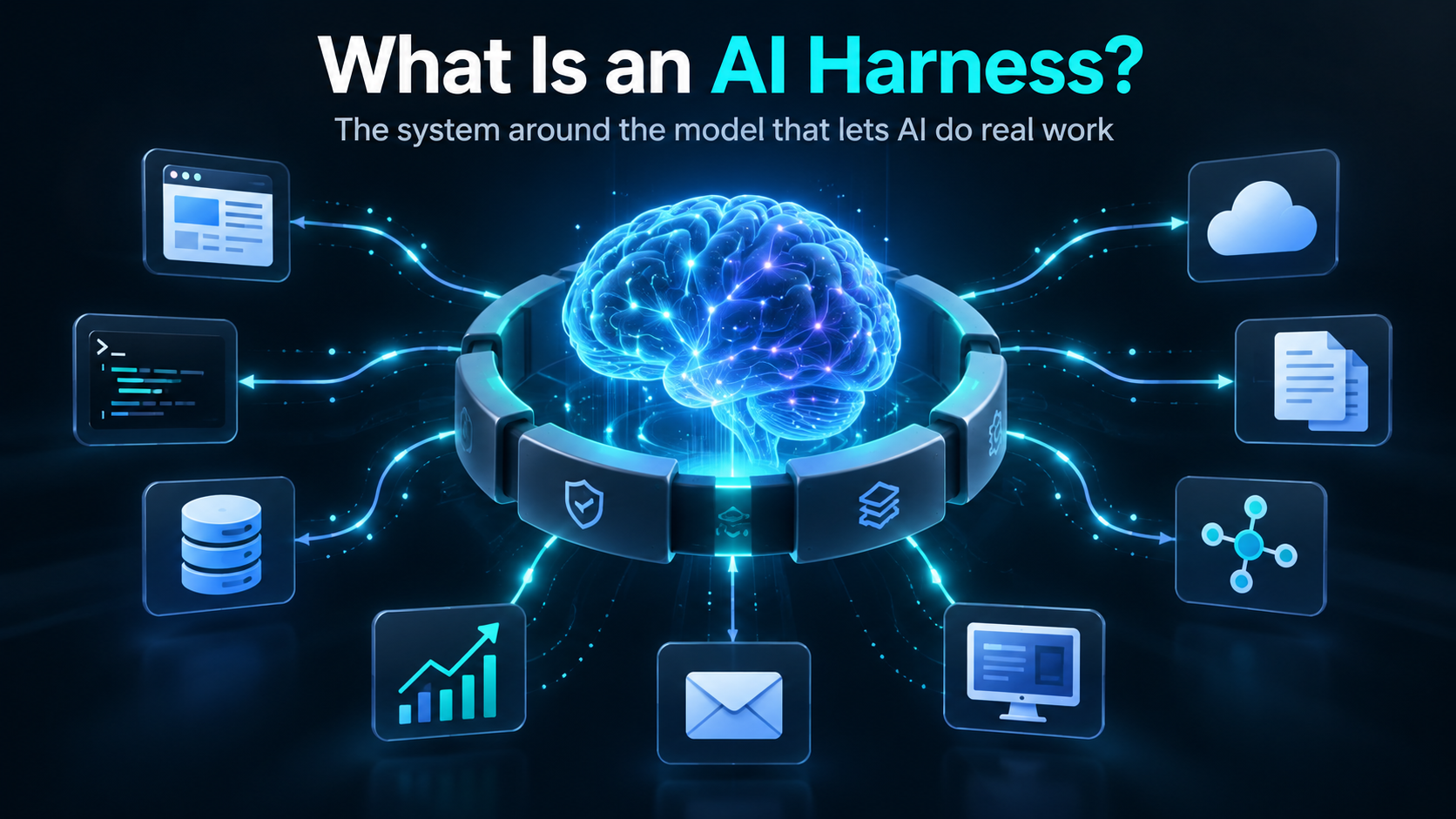
The AI model is the brain. The harness is the system around the brain that allows it to work.
A model can reason about how to solve a problem. A harness can give that model files to inspect, software to operate, a browser to search with, memory from previous steps, tools to call, permissions to follow, and ways to check whether its work succeeded.
This distinction matters because the next stage of AI is not only about making models more intelligent.
It is about connecting that intelligence to the enormous collection of tools humanity has already built.
We spent decades building computers, browsers, operating systems, programming languages, APIs, databases, cloud infrastructure, communication systems, business software and the internet.
Now we are increasingly giving AI the ability to use them.
The harness is one of the layers making that possible.
What Is an AI Harness?
An AI harness is the software infrastructure around an AI model that helps the model interact with information, tools, memory, computers and other systems while working toward a goal.
There is no single universally fixed definition of "AI harness." Different companies and developers may use the term slightly differently.
But the central idea is consistent.
A raw language model can receive input and generate output.
A harness turns that model into part of a larger working system.
Microsoft's current Agent Framework, for example, describes a harness as the scaffolding an agent needs for longer multi-step tasks, including planning, task tracking, context management, file memory, file access and tool approvals. OpenAI similarly separates the underlying models from the agent runtime that manages tools, state, context, sandboxes and multi-step execution.
The difference becomes much easier to understand with an example.
Imagine asking an AI:
"Find the bug in this application and fix it."
A language model by itself might explain common causes of the bug or suggest code you could try.
An AI inside a capable harness could potentially:
Open the project.
Search through the files.
Identify relevant code.
Inspect error logs.
Edit the code.
Run the application.
Execute the test suite.
Notice that one test still fails.
Read the error.
Modify the code again.
Run the tests again.
Confirm that they pass.
Then summarize what changed.
The intelligence used to understand the problem came primarily from the model.
But the ability to access the project, manipulate files, run software, observe results and continue working came from the surrounding system.
That surrounding system is the harness.
Think of the Model as a Brain
One useful analogy is to imagine an extremely intelligent person sitting alone in an empty room.
That person might understand mathematics, programming, business, law, history and science.
But the room contains nothing.
No computer.
No internet.
No telephone.
No documents.
No calculator.
No access to your business.
No way to change anything outside the room.
Their intelligence might be extraordinary, but their ability to act is limited.
Now start adding things to the room.
Give them a computer.
Give them internet access.
Give them your documents.
Give them a browser.
Give them a terminal.
Give them access to selected business systems.
Give them a notebook containing important information from yesterday.
Give them rules about what they can and cannot change.
Give them a checklist they need to complete before saying the job is finished.
Give them a way to call another specialist when they need help.
The person's intelligence has not necessarily changed.
But their practical capabilities have changed enormously.
This is roughly what is happening with AI.
The model is the brain.
The harness creates the working environment around that brain.
Why AI Harnesses Matter More Now
When modern generative AI first became widely popular, the dominant interaction was straightforward:
Human asks a question → AI generates an answer.
That model works extremely well for many tasks.
You can ask for an explanation, summarize text, generate an email, brainstorm ideas or write code.
But most real-world work does not consist of producing one response.
Real work usually involves sequences.
You inspect something.
You make a decision.
You use a tool.
You observe what happened.
You adjust.
You use another tool.
You verify the result.
You continue until the goal is complete.
That requires something more than a chatbot.
It requires a loop.
A simplified agent loop looks like this:
Goal → model thinks → chooses an action → harness executes the action → result returns to the model → model evaluates the result → chooses another action → continues until finished
That loop is one of the fundamental differences between a simple chatbot experience and a more agentic AI system.
OpenAI's current agent tooling describes agents as systems that can use tools, maintain context across steps and work with other agents, while Microsoft's harness implementation explicitly includes planning and state for multi-step work.
The model no longer needs to answer everything immediately.
It can act, observe and try again.
Humanity Already Built the Tools AI Needs
This is where the AI harness becomes part of a much larger technological story.
Humanity spent decades digitizing work.
We built web browsers so people could navigate information.
We built search engines so people could find it.
We built spreadsheets so people could manipulate numbers.
We built databases so companies could store information.
We built programming languages so humans could instruct computers.
We built APIs so software systems could communicate with one another.
We built cloud infrastructure so computing resources could be accessed from almost anywhere.
We built CRMs, accounting systems, analytics tools, design applications, project-management software, communication platforms, ecommerce systems and millions of other applications.
These systems were designed primarily for humans or conventional software.
The interesting development now is that AI can increasingly operate them too.
A sufficiently capable AI agent does not necessarily need a special "AI version" of every tool humanity uses.
It can sometimes use the existing tool.
It can search the web.
It can read and write files.
It can call APIs.
It can operate a computer.
It can execute code.
It can query databases.
It can interact with software.
It can communicate with other services.
And increasingly, protocols such as MCP are making it easier to expose external tools and data to AI applications through standardized interfaces. MCP itself is not an AI harness. It is an open standard for connecting AI applications to external data, tools and workflows, which a harness can then make available to an agent.
This distinction is important.
We are not only building smarter artificial brains. We are connecting those brains to the digital infrastructure humanity already created.
That may prove to be one of the biggest changes of the agent era.
What Is Actually Inside an AI Harness?
Different harnesses have different architectures, but most serious agent systems eventually need to solve many of the same problems.
1. Instructions
Before an agent starts working, it needs to understand its role.
What is it trying to accomplish?
What rules should it follow?
What should it never do?
When should it ask the user for help?
How should it respond when it is uncertain?
These instructions might be invisible to the end user, but they strongly influence how the AI behaves.
A customer support agent, coding agent and research agent might all use the same underlying model while receiving completely different instructions.
The model provides general intelligence.
The harness helps turn that intelligence toward a specific job.
2. Context
An AI cannot effectively work on a problem if it does not have the right information.
This is why context engineering has become so important.
Imagine asking an AI to modify a large software application containing 50,000 files.
Giving the entire project to the model every time would be inefficient and often impossible.
Instead, the system must decide:
Which files matter?
Which previous messages matter?
Which instructions matter?
Which tool results should remain available?
Which information can be summarized?
Which information can be discarded?
The harness helps manage this information flow.
This is one reason the quality of an AI system cannot be judged purely by its underlying model.
An extremely intelligent model given bad context can produce bad work.
A well-designed harness tries to give the model the right information at the right moment.
3. Tools
Tools allow an AI to do something beyond generating text.
A tool could be almost anything.
A web search.
A calculator.
A database query.
A file reader.
A code interpreter.
An image generator.
A browser.
An API.
A terminal.
A CRM connection.
A calendar.
An email system.
A company-specific internal service.
From the model's perspective, many of these tools can be presented as capabilities it is allowed to invoke.
Instead of pretending to know what happened on a website, the AI can search it.
Instead of estimating a calculation, it can use a calculator.
Instead of telling you how to change a file, it can modify the file.
This changes AI from something that merely describes actions into something that can increasingly perform them.
4. State and Memory
A chatbot conversation might last ten minutes.
An agent task might last much longer.
Some work could involve dozens, hundreds or potentially thousands of individual actions.
The system therefore needs to remember what happened.
What has already been completed?
What decisions were made?
What failed?
Which files changed?
What did the user approve?
What remains unfinished?
State allows the system to keep track of the current job.
Longer-term memory can also allow AI systems to retain relevant information between separate tasks or conversations.
Without some form of memory, every interaction risks becoming a fresh start.
5. Planning
Complex goals usually need to be broken into smaller tasks.
Consider a request such as:
"Research five competitors, compare their pricing and features, analyze their positioning, and prepare a report for management."
That is not one action.
The AI may need to identify the competitors, find their websites, collect information, check sources, structure the data, compare the results, identify patterns and finally write the report.
A harness can help maintain a plan or task list so the agent knows what it has completed and what remains.
Microsoft's current harness implementation, for example, includes planning modes and todo tracking specifically for multi-step tasks.
This sounds simple, but it solves an important problem.
Without a plan, an agent can wander.
It can repeat work.
It can forget part of the request.
It can prematurely conclude that it has finished.
A plan gives the intelligence structure.
6. The Execution Loop
The loop is where agentic behavior really begins.
Instead of generating one answer, the system repeatedly cycles through reasoning and action.
The model looks at the current situation.
It decides what should happen next.
The harness executes the appropriate tool.
The tool returns a result.
The model sees the result.
Then it decides again.
This process might happen three times.
Or thirty times.
Or hundreds of times.
For a software task, the loop might look like:
Inspect code → edit code → run test → observe failure → inspect failure → edit code → rerun test → verify success
For research:
Search → read source → extract information → identify missing information → search again → compare sources → write conclusion
For business operations:
Read request → query CRM → check account → update record → generate message → request approval → send message → log result
The model provides intelligence inside the loop.
The harness keeps the loop functioning.
7. Permissions
Giving an AI tools creates a new problem.
Should it be allowed to use all of them freely?
Reading a document is different from deleting one.
Searching a database is different from modifying it.
Drafting an email is different from sending it.
Preparing a payment is different from executing it.
A well-designed harness can distinguish between actions with different levels of risk.
Some actions may happen automatically.
Some might require user approval.
Some may be completely prohibited.
This is especially important as agents become capable of operating computers and external systems.
8. Sandboxing and Containment
Another approach is to limit the environment itself.
Instead of asking for permission before every action, an AI can operate inside a controlled sandbox.
Perhaps it can freely modify files inside one project directory but cannot access the rest of the computer.
Perhaps it can connect only to approved internet domains.
Perhaps it can execute code but cannot access sensitive credentials.
Anthropic has used this approach with Claude Code, combining filesystem and network restrictions so the agent can operate more independently inside defined boundaries while limiting what it can reach outside them.
This illustrates an important principle of AI harness design:
Autonomy does not have to mean unlimited access.
A good harness can increase both capability and control.
9. Verification
One of the biggest weaknesses of generative AI is that a confident answer is not necessarily a correct answer.
Harnesses can help by giving AI a way to verify its own work.
Coding is an excellent example.
Instead of asking the model:
"Are you sure this code works?"
the system can actually run the tests.
That external feedback is far more useful than asking the model to judge itself purely from its own generated text.
The same principle can work elsewhere.
A research agent can compare multiple sources.
A data agent can rerun calculations.
A browser agent can check whether a form submission succeeded.
An ecommerce agent can verify that an order status actually changed.
A deployment agent can check whether the service is healthy after releasing new software.
The important idea is that the harness creates feedback from reality.
The AI does something.
The environment responds.
The AI can then adjust.
10. Observability
If an AI agent performs 80 actions to finish a task, developers and businesses need some way to understand what happened.
Which tools did it use?
What information did it receive?
Where did it make a bad decision?
How much did the process cost?
Why did it stop?
Which actions required approval?
This is where tracing and observability become important.
Modern agent frameworks increasingly provide records of model calls, tool calls, handoffs, guardrails and other events so developers can inspect how an agent reached its result. OpenAI's current Agents SDK, for example, includes tracing designed to expose these parts of an agent run.
For simple chatbots, this infrastructure may seem excessive.
For agents running important business processes, it becomes much more important.
Model vs Harness vs Agent vs AI Application
These terms are increasingly used together, which can make the subject confusing.
A simple way to think about them is:
The model is the intelligence.
It understands language, reasons and generates output.
The harness is the working infrastructure around the model.
It manages things such as tools, context, memory, state, permissions and execution loops.
The agent is the working system pursuing a goal.
It uses the model through the harness to make decisions and take actions.
The AI application is the complete product the user interacts with.
It might contain one agent, many agents or no real agent at all.
This is why two AI applications using the same underlying model can behave very differently.
The model is only one component.
Where Does MCP Fit?
MCP, or Model Context Protocol, is another term frequently discussed alongside AI agents and harnesses.
They are not the same thing.
MCP is a standardized way for AI applications to connect to external systems such as databases, files, applications and tools. Its official documentation compares the concept to a USB-C connection for AI applications: one standardized interface that can connect many different systems.
A harness can support MCP connections.
The MCP server might expose a tool.
The harness decides when the agent should use it, what context to provide, how to process the result and what should happen next.
So the relationship can be simplified as:
MCP helps connect the tool.
The harness helps the AI use the tool as part of a larger task.
Why the Same Model Can Feel Much Smarter in One Product
This distinction explains something many AI users already experience.
Suppose two products use the exact same model.
Product A sends your prompt to the model and displays the response.
Product B surrounds that model with:
Relevant company knowledge.
Search.
Files.
Memory.
Code execution.
Computer access.
Specialized instructions.
Verification.
Long-running tasks.
Permission management.
Several specialist subagents.
Product B can appear dramatically more intelligent.
But the underlying model may be identical.
The difference is what the system allows that model to do.
This is why simply asking "Which model does this product use?" is becoming less useful as a complete way of judging AI software.
A better question is increasingly:
What has been built around the model?
Why Coding Agents Became an Early Showcase for Harnesses
Software development became one of the first areas where agentic AI demonstrated obvious value.
There is a good reason.
Programming provides an unusually useful environment for agents.
There are files to inspect.
There are structured programming languages.
There are terminals to execute commands.
There are compilers that return errors.
There are test suites that return pass-or-fail results.
There are version-control systems that track changes.
There are logs that explain failures.
There are linters that identify problems.
In other words, coding gives an AI agent something extremely valuable:
Fast external feedback.
The agent does not have to guess whether its change worked.
It can run the software.
This makes programming almost an ideal laboratory for AI harnesses.
Tools such as Claude Code and similar coding agents therefore demonstrate more than AI's ability to write code.
They demonstrate the power of connecting an intelligent model to a rich environment with tools and feedback loops.
AI Harnesses Are Not Just for Coding
The same pattern can apply almost anywhere software exists.
Consider a research agent.
The model provides reasoning.
The harness gives it search, browsing, document access, note-taking, source tracking and perhaps a way to verify claims.
Now consider a customer support agent.
The model understands the customer's request.
The harness provides access to account information, order systems, company policies, refund tools and communication channels.
Or a marketing agent.
The model understands the campaign goal.
The harness connects analytics, ad platforms, content systems, spreadsheets, research tools and approval workflows.
Or an operations agent.
The model understands a business process.
The harness connects inventory systems, supplier databases, internal documents, communication software and workflow tools.
The pattern remains the same.
Intelligence + environment + tools + feedback.
The more digital our work becomes, the more areas there are where AI can potentially operate through software rather than merely advise the human operating it.
Long-Running Agents Make the Harness Even More Important
Chatbots were designed around conversations.
Agents are increasingly being designed around tasks.
That distinction becomes important when the task takes longer than a few seconds.
Imagine an AI working for an hour.
It needs to maintain its objective.
It needs to remember what it already tried.
It needs to avoid repeating itself.
It may need to summarize old context so the working memory does not become unmanageable.
It needs to recover when a tool fails.
It needs to pause if human approval is required.
It may need to save progress and resume later.
It may need to delegate parts of the task.
It needs to know when the task is actually complete.
These are not primarily questions about model intelligence.
They are runtime and harness questions.
The longer an agent operates, the more important the surrounding infrastructure becomes.
What About Multiple AI Agents?
A harness does not necessarily need to manage only one agent.
More complex systems can involve multiple specialized agents.
One agent might perform research.
Another could analyze the information.
Another could write software.
Another could review the software.
Another could test it.
One agent might act as the coordinator deciding which specialist should handle each part.
Whether multi-agent systems are always better is a separate question. More agents also introduce more complexity, cost and coordination problems.
But the concept demonstrates how far the architecture has moved from the original chatbot model.
Instead of one model generating one response, the system can become an environment in which multiple AI workers exchange information and use tools toward a shared objective.
The harness becomes the infrastructure coordinating that environment.
Why Harnesses Make AI Safety More Important
There is a fundamental difference between an AI producing a wrong answer and an AI performing a wrong action.
Imagine a chatbot incorrectly telling you that a file should be deleted.
You can ignore the advice.
Now imagine an agent that has permission to delete the file itself.
The intelligence might be the same.
The consequence is different.
As we give AI access to more tools, credentials and real-world systems, the security of the surrounding harness becomes increasingly important.
What can the AI access?
What can it modify?
Which actions require approval?
Can it send information outside the company?
Can a malicious website manipulate its instructions?
What happens if the agent misunderstands the user's goal?
Can the damage be contained?
Anthropic's work on sandboxing Claude Code illustrates this concern directly: as agents gain more access to files, commands and networks, boundaries around that access become part of the security architecture rather than an optional feature.
The same infrastructure that gives agents their power therefore also needs to limit that power.
Better AI Does Not Always Mean a Better Model
For several years, improvements in generative AI were largely discussed as a race between models.
Which model has the best reasoning?
Which one writes the best code?
Which one understands images?
Which one has the highest benchmark score?
Those questions still matter.
A better model gives the entire system a stronger foundation.
But agentic AI adds another dimension.
Suppose Model A is 10% better at reasoning than Model B.
But the product using Model B has dramatically better context management, tools, memory, verification and task execution.
Which product will accomplish the real-world task more successfully?
The answer is not automatically Model A.
This is why harness engineering may become one of the most important competitive layers in AI.
Model intelligence determines what the system is theoretically capable of understanding.
Harness quality helps determine how effectively that intelligence can interact with the world.
The Model Race and the Harness Race
The AI industry may increasingly contain two overlapping competitions.
The first is already familiar:
Who can build the most capable model?
Better reasoning.
Better multimodal understanding.
Better coding.
Better reliability.
Better long-context performance.
Better efficiency.
But another race is developing above the model:
Who can build the best environment for that intelligence?
Who manages context best?
Who gives the AI the most useful tools?
Who enables reliable computer use?
Who can preserve state over long tasks?
Who can safely grant more autonomy?
Who builds the strongest verification loops?
Who coordinates multiple agents effectively?
Who can recover gracefully when an agent makes a mistake?
Who can connect AI to the largest ecosystem of existing software?
As frontier models become capable across increasingly overlapping areas, those harness differences may become more visible to users.
Two products could use similarly intelligent models yet deliver very different real-world performance.
What This Means for Businesses
For businesses evaluating AI, this means the model name should not be the only question.
Knowing that a product uses GPT, Claude, Gemini or another frontier model tells you something about the intelligence underneath the system.
But it does not tell you everything about what the product can actually accomplish.
Businesses should increasingly look at the surrounding system.
What information can the AI access?
Which business tools can it use?
What can it remember?
What actions can it take?
How is sensitive access controlled?
Does it verify important actions?
Can humans review high-risk decisions?
Can the agent maintain context during long tasks?
Can administrators inspect what happened afterward?
How well does the system recover from failure?
Those questions are really questions about the harness.
For many real-world business applications, their answers may matter as much as which model sits underneath.
From AI That Talks to AI That Acts
The first era of modern generative AI was defined largely by generation.
Generate text.
Generate code.
Generate images.
Generate answers.
The emerging agent era adds another capability:
Action.
Search.
Open.
Read.
Write.
Execute.
Test.
Send.
Update.
Compare.
Verify.
Repeat.
The shift is not simply that AI became smarter.
The environment around AI changed too.
We began giving models access to the tools required to turn reasoning into action.
The Bigger Picture: We Are Giving AI Access to Human Civilization's Digital Toolset
This may be the most important way to think about AI harnesses.
For decades, humanity constructed an enormous layer of digital machinery around ourselves.
Computers became extensions of human work.
Then the internet connected those computers.
Software encoded millions of business processes.
APIs allowed those systems to communicate.
Cloud computing made infrastructure available everywhere.
Smartphones made software constantly accessible.
We digitized enormous parts of human economic activity.
And now another transition is beginning.
Increasingly capable artificial intelligence is being connected to that infrastructure.
AI does not need to reinvent the spreadsheet.
It can use one.
It does not need to recreate the web.
It can browse it.
It does not need to invent another database.
It can query the databases we already built.
It does not need to replace every business application.
It can potentially operate those applications.
It does not need a completely separate technological civilization designed for machines.
We already built the tools.
The harness helps AI use them.
That is why agentic AI can advance so quickly once models become sufficiently capable.
The intelligence arrives into a world that is already full of machines, software, information and digital interfaces waiting to be operated.
The Future of AI Will Not Be Determined by Models Alone
Models will continue improving.
They will reason better.
They will become faster.
They will understand more modalities.
They will make fewer mistakes.
They will work with increasingly large amounts of information.
But intelligence alone is not the entire product.
What matters is what that intelligence can do.
A model without useful context is limited.
A model without tools cannot affect external systems.
A model without memory loses continuity.
A model without verification can confidently repeat mistakes.
A model without permissions can be dangerous.
A model without an execution loop remains largely reactive.
A model inside a sophisticated harness can become something very different.
It becomes part of an agent.
And as the AI industry shifts from assistants that answer questions toward agents that perform work, harnesses are likely to become one of the most important layers of the entire AI stack.
The model is the brain.
The harness gives that brain a working environment.
And increasingly, that environment includes the tools humanity spent decades building.
That is what makes the transition from AI that knows to AI that does so significant.
Frequently Asked Questions
What is an AI harness in simple terms?
An AI harness is the software infrastructure surrounding an AI model that helps it use tools, access information, maintain memory, follow permissions and perform multi-step tasks.
A simple analogy is that the AI model is the brain while the harness provides the working environment around that brain.
Is an AI harness the same as an AI model?
No.
The AI model provides the underlying intelligence. It understands information, reasons and generates outputs.
The harness manages how that intelligence interacts with tools, files, memory, software, computers and other external systems.
Is an AI harness the same as an AI agent?
Not exactly.
The harness is part of the infrastructure that enables an AI agent to operate.
An agent typically combines a model, instructions, tools, context, memory and an execution loop that allows the system to work toward a goal over multiple steps.
Is MCP an AI harness?
No.
MCP is a protocol that allows AI applications to connect to external tools and data sources.
A harness can use MCP to make those tools available to an agent, but MCP itself does not manage the entire agent loop, planning, memory, permissions and task execution.
Why can two products using the same AI model perform differently?
Because the model is only one component of the complete system.
One product might simply send prompts to the model.
Another might provide better context, tools, memory, planning, verification, computer access and specialized instructions.
The underlying model can therefore be identical while the final products behave very differently.
Why are coding agents so good at demonstrating AI harnesses?
Software development provides AI with unusually strong feedback.
An agent can edit code, execute it, run tests, inspect errors and try again.
This creates a clear feedback loop between the AI's decisions and actual results.
Why are AI harnesses becoming important now?
AI models have become capable enough to use tools and perform more complex multi-step work.
As models move beyond generating answers toward operating software and completing tasks, the quality of the infrastructure surrounding those models becomes increasingly important.
Can AI harnesses make AI safer?
They can help.
Harnesses can control which tools an AI is allowed to access, require human approval for sensitive actions, isolate execution inside sandboxes, record what the agent did and limit access to files or networks.
The harness therefore affects both an AI system's capabilities and the boundaries placed around those capabilities.
Will AI harnesses become more important than AI models?
Models will remain fundamental because they provide the underlying intelligence.
But as leading models become capable across more overlapping tasks, differences in tools, memory, context management, verification, computer access and orchestration may become increasingly important in determining which AI products perform best in real-world situations.
The future of AI is therefore unlikely to be a model race alone.
It is also becoming a race to build the best systems around those models.